
The High-Performance Polymer That Survives Where Others Fail and the Reason Solvay Has Made It a Billion-Dollar Priority
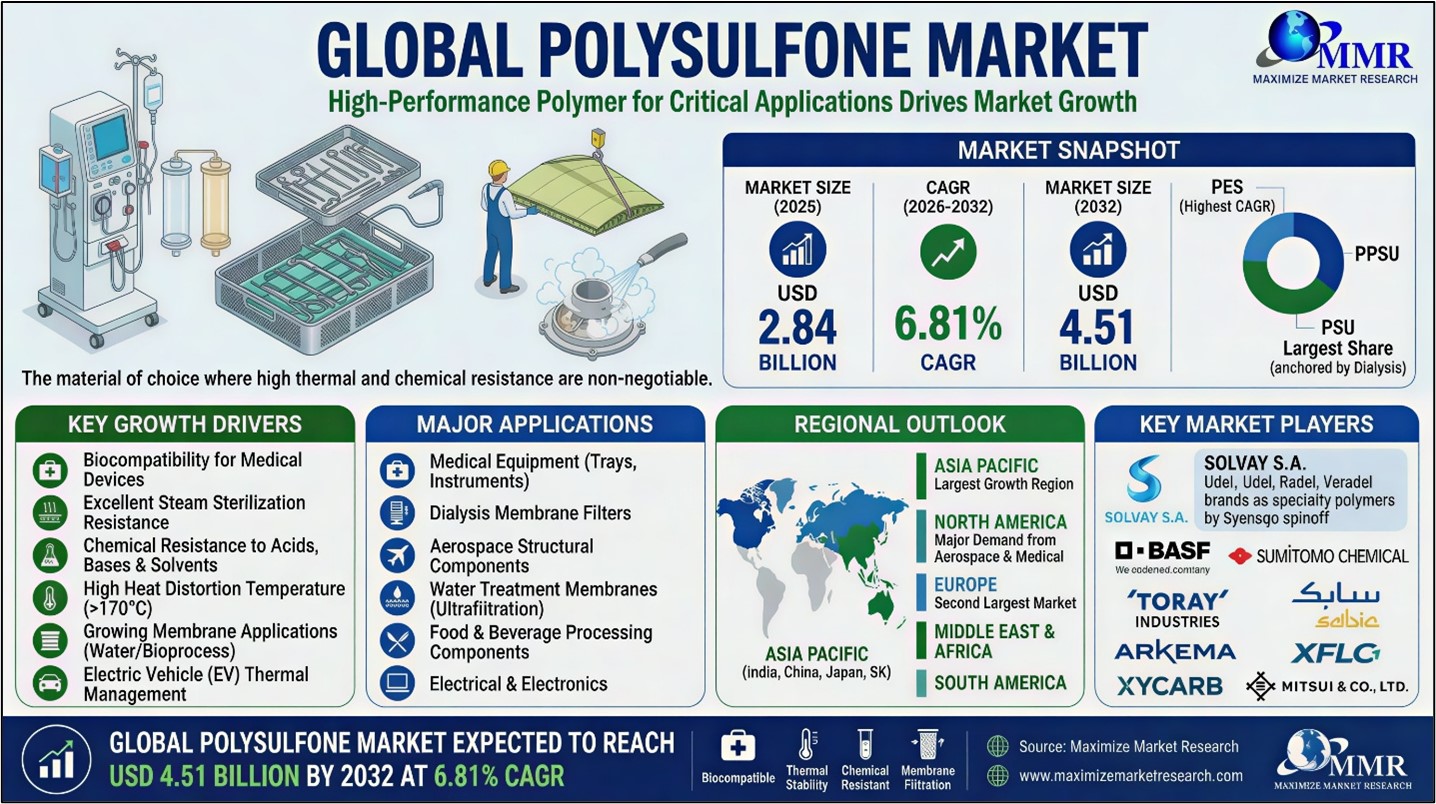
The global Polysulfone Market was valued at USD 2.84 Billion in 2025 and is projected to reach USD 4.51 Billion by 2032, growing at a CAGR of 6.81%, per Maximize Market Research. Solvay S.A., one of the world’s leading producers of high-performance polymers, is expanding its polysulfone and polyethersulfone production capacity to serve an accelerating pipeline of demand from medical devices, aerospace, water filtration, and food processing applications where thermal stability and chemical resistance are non-negotiable.
Most polymers fail above 150 degrees Celsius. Most polymers degrade when exposed to steam sterilization, hydraulic fluids, or concentrated industrial chemicals. Most polymers are opaque, limiting their use in applications where visual monitoring is required.
Polysulfone is not most polymers. And the Global Polysulfone Market, valued at USD 2.84 Billion in 2025 and projected to reach USD 4.51 Billion by 2032 at a CAGR of 6.81%, per Maximize Market Research, is expanding precisely because more industries are discovering what medical device manufacturers have known for decades: when performance requirements are extreme, polysulfone is frequently the only viable answer.
Why Polysulfone Is Irreplaceable in High-Stakes Applications
Polysulfone polymers, including Polysulfone (PSU), Polyethersulfone (PES), and Polyphenylsulfone (PPSU), are thermoplastic materials that combine properties that are rarely found together: heat distortion temperatures above 170 degrees Celsius, transparency, extraordinary chemical resistance across acids, bases, aqueous solutions, and steam, and biocompatibility that meets FDA and ISO 10993 requirements for medical device applications. These properties make polysulfone the material of choice for medical device sterilization trays and surgical instrument housings, kidney dialysis membrane filters, aerospace structural components, water treatment ultrafiltration membranes, and food contact components requiring repeated steam cleaning cycles.
Solvay’s Capacity and Portfolio Strategy
Solvay produces polysulfone-family polymers under its Udel (PSU), Radel (PPSU), and Veradel (PES) brand names, which collectively represent the most comprehensive high-performance sulfone polymer portfolio in the industry. In 2024, Solvay completed the restructuring of its specialty polymers business as part of its broader split into two independent companies, with Syensqo emerging as the dedicated specialty materials entity inheriting the high-performance polymer portfolio including polysulfone grades.
Syensqo’s strategy for polysulfone centers on three growth vectors: expansion into healthcare single-use bioprocessing components where chemical resistance and sterilizability command premium pricing, penetration of the electric vehicle thermal management market where polysulfone’s performance at high operating temperatures is increasingly specified, and scale-up of ultrafiltration membrane grades for water treatment infrastructure investment globally.
MMR Insight: The Polysulfone Market is dominated by Asia Pacific, with India, China, Japan, and South Korea as the major contributing nations, driven by rapid expansion in electrical and electronics, medical, and food processing industries. The medical applications segment holds the largest share, anchored by dialysis membranes, surgical instruments, and sterilization equipment. The Polyethersulfone (PES) segment is projected to witness the highest CAGR through 2032, reflecting its growing adoption in membrane filtration. Europe represents the second-largest regional market, underpinned by stringent food safety and medical device regulatory frameworks that consistently specify high-performance polymers. Key market participants alongside Solvay include BASF SE, Sumitomo Chemical, and Toray Industries.
Final Take
A 6.81% CAGR carrying the Polysulfone Market from USD 2.84 Billion in 2025 to USD 4.51 Billion by 2032 reflects the broadening of high-performance polymer demand beyond traditional aerospace and medical device niches into water treatment, EV thermal systems, and food processing. Solvay, through its Syensqo spinoff, has structured its polysulfone business as a growth platform rather than a legacy materials portfolio. The companies that specified polysulfone because it was the best option are now being joined by entirely new industries discovering it for the first time. That is how specialty material markets accelerate.
Related Reports
Explore related market intelligence reports from Maximize Market Research: