Tiles Are Just the Beginning: How Kajaria’s Integration Play Is Rewriting the Ceramic Industry’s Competitive Rules
Key Highlights
- Kajaria Ceramics consolidates Kajaria Adhesives and Kajaria Surfaces subsidiaries into a unified building materials platform
- Global ceramic leaders shifting from product manufacturing to integrated surface solutions ecosystems
- Premiumization, digital design, and sustainability emerging as the three defining growth levers across the Ceramic Tiles Market
Kajaria no longer just makes tiles. That is precisely the point.
In a move that signals far more than an internal restructuring, Kajaria Ceramics Limited has consolidated its subsidiaries — including Kajaria Adhesives and Kajaria Surfaces — into a unified building materials platform. On the surface, it looks like an operational decision. Look closer, and it reveals a fundamental shift in how India’s largest tile manufacturer sees its own future.
Kajaria is not competing on tiles anymore. It is competing on ecosystems.
From Manufacturer to Solutions Provider
The consolidation of Kajaria Adhesives and Kajaria Surfaces under a single strategic umbrella is a deliberate repositioning. By controlling surfaces, adhesives, and complementary construction materials under one roof, Kajaria is eliminating the fragmentation that has historically defined the building materials supply chain.
For a construction professional or interior designer, this matters enormously. Instead of sourcing tiles from one supplier, adhesives from another, and surface treatments from a third, Kajaria is offering a single, integrated, accountable partner. That shift — from product to platform — is where durable pricing power lives.
It is also where the margin expansion story gets interesting. Kajaria’s Q3 FY26 results told a revealing tale: revenue was flat year-on-year at ₹1,168 crores, yet profit before tax surged 49% to ₹165 crores, with EBITDA margins expanding from 12.78% to 17.20%. This is not a top-line growth story — it is a value capture story. Integration is already working.
A Global Pattern, An Indian Leader
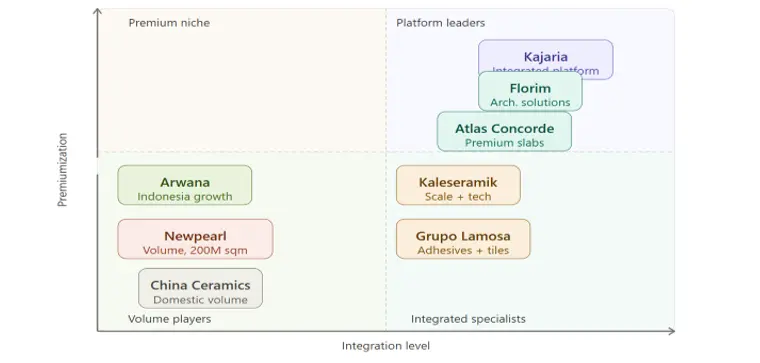
Kajaria’s move mirrors a structural shift visible across the global Ceramic Tiles Market. The world’s leading ceramic manufacturers are no longer competing primarily on production capacity or price. They are competing on design leadership, technological differentiation, and the breadth of their product ecosystems.
Atlas Concorde doubled its porcelain stoneware slab capacity while simultaneously launching an immersive 3,000 sqm exhibition space — investing in experience as much as output. Florim Ceramiche used KBIS 2026 in Las Vegas to position large-format ceramic slabs as architectural materials, not commodity inputs. Kaleseramik is doubling its Sinterflex ultra-thin slab line while aggressively targeting the North American market at Coverings 2026.
The pattern is consistent across geograpThies: the manufacturers gaining ground are those that have moved furthest up the value chain — from tiles to surfaces, from surfaces to solutions, from solutions to ecosystems.
What MMR’s Research Reveals
According to Maximize Market Research, the global Ceramic Tiles Market is entering its most strategically consequential phase since the digital printing revolution of the 2000s. MMR’s analysis identifies three forces converging to reshape competitive dynamics:
First, premiumization — consumer preference for large-format, design-led, and textured surfaces is accelerating across both residential and commercial segments, rewarding manufacturers with strong design capabilities and penalizing commodity producers.
Second, sustainability — green construction standards and energy-efficient manufacturing are rapidly transitioning from differentiators to baseline requirements. MMR’s research highlights that manufacturers investing in low-carbon kilns, recycled material integration, and eco-certified product lines are commanding both regulatory advantages and premium pricing power in key export markets.
Third, integration — MMR’s market intelligence consistently identifies end-to-end product ecosystems as the single most durable source of competitive advantage in the sector. Companies controlling a broader share of the building materials value chain — from raw surface to finished installation — are better positioned to scale profitably and build lasting brand loyalty.
Kajaria’s consolidation strategy aligns directly with all three imperatives.
The Takeaway
The ceramic tiles industry is not simply growing — it is structurally upgrading. The players that will define the next decade are not the ones with the largest kilns. They are the ones building the most integrated, design-forward, and sustainability-aligned platforms.
Kajaria has read that shift clearly. Its subsidiary consolidation is not a back-office exercise — it is a strategic declaration. The race to own the building materials ecosystem in India’s booming construction market has begun. And Kajaria has moved first.
Strategic Market Intelligence
For deeper industry insights, explore MMR’s detailed market research reports: