Your Dog Has Cancer. Mars Wants to Diagnose It. So Does IDEXX. That Fight Is Worth $45 Billion
Inside the most consequential battle in veterinary medicine — and what it means for the Veterinary Reference Laboratory Market
Key Highlights
- IDEXX raises full-year 2026 revenue guidance to $4.63–4.72 billion; placed 1,900+ inVue Dx instruments in Q4 2025 alone
- Mars/Antech launches AI-powered AIS RapidRead imaging and Nu.Q® cancer screening — results in minutes, not days
- IDEXX expands Cancer Dx Panel to cover mast cell tumors — addressing over one-third of all canine cancer cases
- Mars has assembled Heska, Antech, SYNLAB Vet, and Cerba Vet into a single diagnostics empire within 36 months
- Global Veterinary Reference Laboratory Market valued at $5.42B today — MMR projects $8.55B by 2032
Pet owners do not think about market share. They think about their dog. They think about a lump under the fur they noticed last Tuesday, and whether it matters, and how long they have to wait to find out.
That anxiety — multiplied across 470 million pet dogs worldwide — is the market that IDEXX and Mars are fighting over. And in the last sixty days, both companies moved.
What IDEXX Just Did
In February 2026, IDEXX reported Q4 2025 results that beat expectations and raised full-year 2026 guidance to $4.63 to $4.72 billion in revenue. For context, that is a diagnostics company — not a pharma giant, not a device manufacturer — generating nearly five billion dollars annually from blood panels, urine tests, and reference lab work for animals.
The number matters less than what is behind it. IDEXX placed more than 1,900 inVue Dx instruments in Q4 alone — a quarterly record for instrument placements and a 12% year-over-year expansion of its global premium instrument installed base.
The inVue Dx is not a routine analyzer. It features a slide-free design that now includes FNA cytology for mast cell tumor detection — allowing veterinarians to evaluate skin masses, identify and quantify cells, and get results while the pet owner is still in the room. No sending a sample to a lab. No waiting three days. Answer in minutes, owner still sitting in the chair.
By mid-year 2026, IDEXX’s Cancer Dx Panel will cover mast cell tumor and lymphoma detection simultaneously — addressing over one-third of all canine cancer cases in a single test.
That is not a product update. That is a platform shift.
What Mars Just Did
Antech — Mars’s diagnostics arm — has launched two new tools in North America: AIS RapidRead, an AI-powered imaging system that returns results in minutes instead of hours, and the Nu.Q® Canine Cancer Test, a rapid cancer screening tool showing over 75% detection rates for lymphoma and hemangiosarcoma in high-risk breeds.
Read those two moves together. IDEXX is pushing diagnostics into the clinic — into the room where the vet and owner sit. Mars is pushing AI into the image — cutting the radiologist out of the loop for routine reads.
They are attacking the same problem from opposite ends. And the pet sitting on the examination table is in the middle.
Mars has built this position through disciplined acquisition — Heska for in-clinic instrumentation, Antech for reference laboratory scale, SYNLAB Vet and Cerba Vet for European laboratory coverage. Three years. Four acquisitions. One integrated diagnostics empire spanning reference labs, point-of-care testing, imaging, and AI — in more than 130 countries.
Why This Matters Beyond Pet Health
Boards and CFOs evaluating animal health sector exposure should understand what is actually being built here.
IDEXX has turned veterinary diagnostics into a subscription-heavy, data-rich platform business — functioning less like a diagnostics supplier and more like the operating system of modern veterinary practice. Every analyzer placed is a recurring consumable revenue stream. Every software integration is a switching cost. Every new test added to the panel increases revenue per visit without increasing the clinic’s patient volume.
Mars is attempting to replicate that model through acquisition rather than organic development. The question is whether buying four companies and integrating them produces the same platform coherence that IDEXX built over four decades. The answer is not yet clear. The competition, however, is.
According to Maximize Market Research, the global Veterinary Reference Laboratory Market is valued at $5.42 billion in 2025 and projected to reach $8.55 billion by 2032. MMR’s analysis identifies AI-assisted diagnostics, cancer screening expansion, and point-of-care test integration as the three structural forces reshaping competitive dynamics in the sector. Both IDEXX and Mars are executing precisely against those three vectors — simultaneously, aggressively, and with significant capital behind each move.
The Number Nobody Is Talking About
IDEXX’s estimated total addressable market in veterinary diagnostics is $45 billion. Current revenue is under five billion. That gap — $40 billion of addressable market not yet captured — is the real story. And it explains why Mars spent years and billions building a diagnostics platform to compete for it.
The pet sitting on the examination table does not know any of this. The vet reading the inVue Dx result does not think about market share. But the executives at IDEXX headquarters in Maine and the Science & Diagnostics team inside Mars absolutely do.
That $40 billion gap is what this fight is about.
Two companies. One $45B prize.
The gap tells the whole story.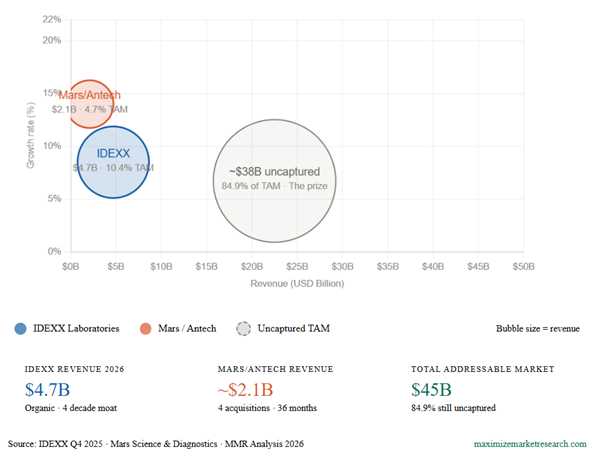
Strategic Market Intelligence
For investment-grade analysis of market size, competitive positioning, and growth forecasts: