
SABIC Is Building a New Ethylene Oxide Plant in Saudi Arabia Using Technology Designed to Decarbonise
SABIC is constructing a new ethylene oxide and ethylene glycol plant in Al-Jubail, Saudi Arabia, using EO and EG technology licensed from Scientific Design Company. In December 2023, SABIC, Linde Engineering, and Scientific Design signed an agreement to investigate decarbonising the EG production process using SABIC’s CO2 recovery technology. In a USD 86 billion market, the company integrating capacity expansion with carbon reduction simultaneously is playing a longer game than anyone else.
There is a chemical plant being built in Al-Jubail, Saudi Arabia, that most of the global chemical industry has not yet fully appreciated.
Saudi Basic Industries Corporation – the world’s largest petrochemical company by market value and a wholly owned subsidiary of Saudi Aramco – is constructing a new integrated ethylene oxide and ethylene glycol facility at its Al-Jubail industrial hub on the Arabian Gulf. The plant uses EO and EG process technology licensed from Scientific Design Company (SD), a Linde subsidiary, representing one of the most commercially proven and widely deployed ethylene glycol production processes in the global chemical industry.
The Global Ethylene Oxide Market was valued at USD 60.19 billion in 2024 and is projected to reach USD 86.19 billion by 2032 at a CAGR of 4.59%, per Maximize Market Research. Asia-Pacific, where EG demand from polyester and PET manufacturing is growing fastest, currently commands over 50% of global ethylene oxide consumption. SABIC’s Al-Jubail expansion positions the company to serve that demand from one of the world’s most cost-advantaged petrochemical feedstock locations.
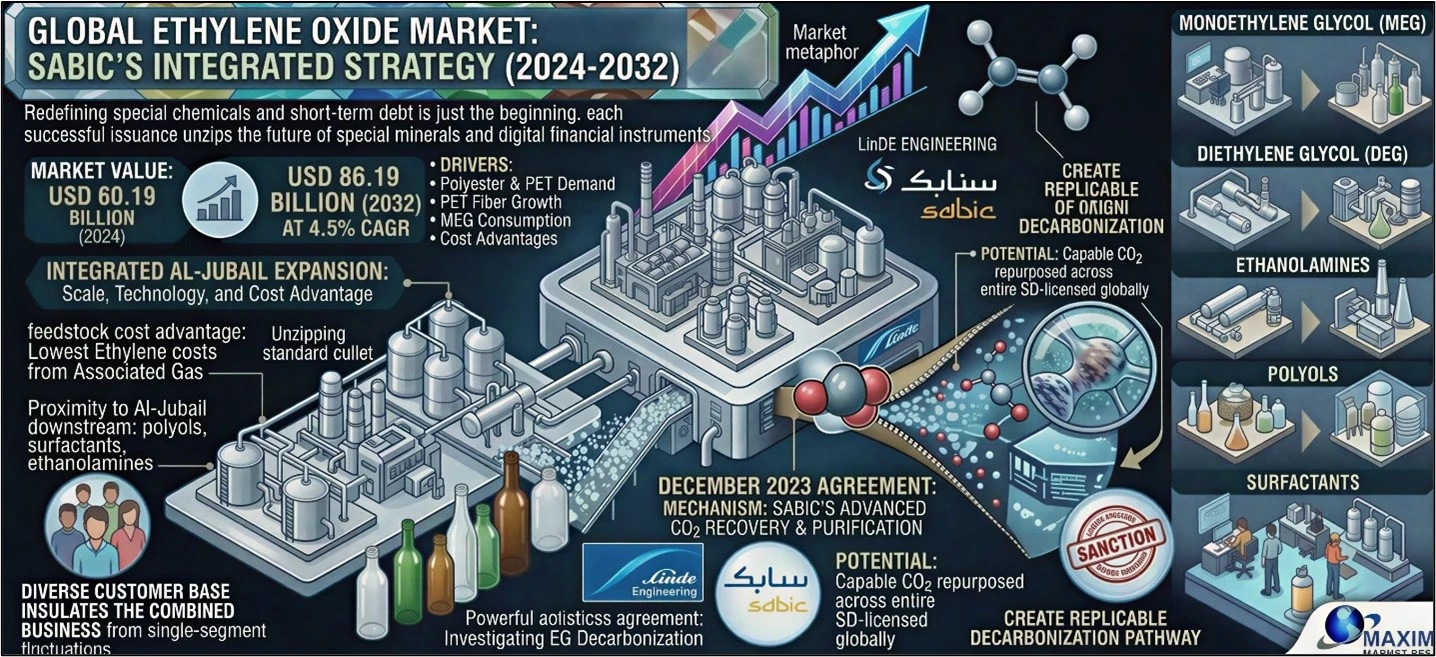
The Al-Jubail Expansion: Scale, Technology, and Cost Advantage
SABIC’s choice of Scientific Design’s licensed EO/EG technology for the Al-Jubail plant reflects a deliberate emphasis on production efficiency and selectivity performance. Scientific Design’s process uses advanced silver catalysts that deliver high selectivity – the proportion of ethylene converted to ethylene oxide rather than CO2 and water – reducing both raw material consumption and direct emissions per tonne of EO produced.
The strategic advantages of the Al-Jubail location compound the technology benefits:
- Feedstock cost advantage: Saudi Arabia benefits from among the lowest ethylene feedstock costs in the world, derived from associated gas and cracker economics that underpin SABIC’s structural competitive position across all its olefins-based products
- Proximity to Al-Jubail Industrial City: co-location with SABIC’s extensive downstream chemicals network enables direct integration of EO into adjacent production chains for ethylene glycol, polyols, ethanolamines, and surfactants
- Export logistics: Al-Jubail’s deep-water port infrastructure provides direct access to Asia-Pacific EG import markets, where PET and polyester fiber demand is expanding most rapidly
Asia-Pacific ethylene glycol demand for monoethylene glycol use in polyester fiber manufacturing reached 17.6 million metric tonnes in 2024, with China and India accounting for the majority of regional consumption growth. SABIC’s expanded Al-Jubail capacity targets these high-volume, price-sensitive markets where production cost position determines commercial outcomes.
MMR Insight: The SABIC Al-Jubail plant is not simply a capacity expansion. It is a strategic positioning of Saudi feedstock cost advantage directly against the fastest-growing EO derivatives consumption geography on earth, using best-available process technology licensed from the same company that has licensed EG plants in China for three decades.
The Decarbonisation Play That Changes the Long-Term Story
In December 2023, SABIC, Linde Engineering, and Scientific Design formalized an agreement to investigate decarbonising SD’s ethylene glycol production process. The specific mechanism under investigation is the integration of SABIC’s advanced CO2 recovery and purification technology into SD’s licensed glycol plants – potentially enabling captured CO2 from the EG production process to be recovered and repurposed rather than emitted.
The commercial significance of this collaboration extends across the entire SD-licensed EG plant network globally:
- SD technology is deployed at EG plants across China, the Middle East, and Southeast Asia, collectively representing a substantial share of global EG capacity
- CO2 recovery from EG production would reduce the carbon intensity of EG output across the entire licensed plant base, not only SABIC’s own facilities
- A successful demonstration at SABIC scale could create a replicable decarbonisation pathway for the world’s most widely deployed EG production process
Final Take
SABIC is simultaneously executing on two timelines in the ethylene oxide market. In the near term, it is adding Al-Jubail EO/EG capacity using proven licensed technology to capture growing Asia-Pacific EG demand from a structurally advantaged cost position.
In the medium term, it is investigating whether that same process can be decarbonised at scale using SABIC’s own CO2 recovery technology – a move that could make Saudi-produced EG not just the cheapest in the market, but the lowest-carbon as well.
In a market heading toward USD 86.19 billion by 2032, the producer that combines volume, cost, and carbon credentials simultaneously will be extraordinarily difficult to compete against.
Related Reports
Explore related market intelligence reports from Maximize Market Research: