Wires and cables Market - Industry Structure Evaluation, Demand Drivers Analysis, Regional Growth Analysis and Identification, Competitive Positioning / Landscape Review & Global Market Size Forecast to 2034

5.4%
CAGR (2026-2034)
222.37 USD Bn.
Forecast Market Size
309
Report Pages
152
Market Tables

Overview

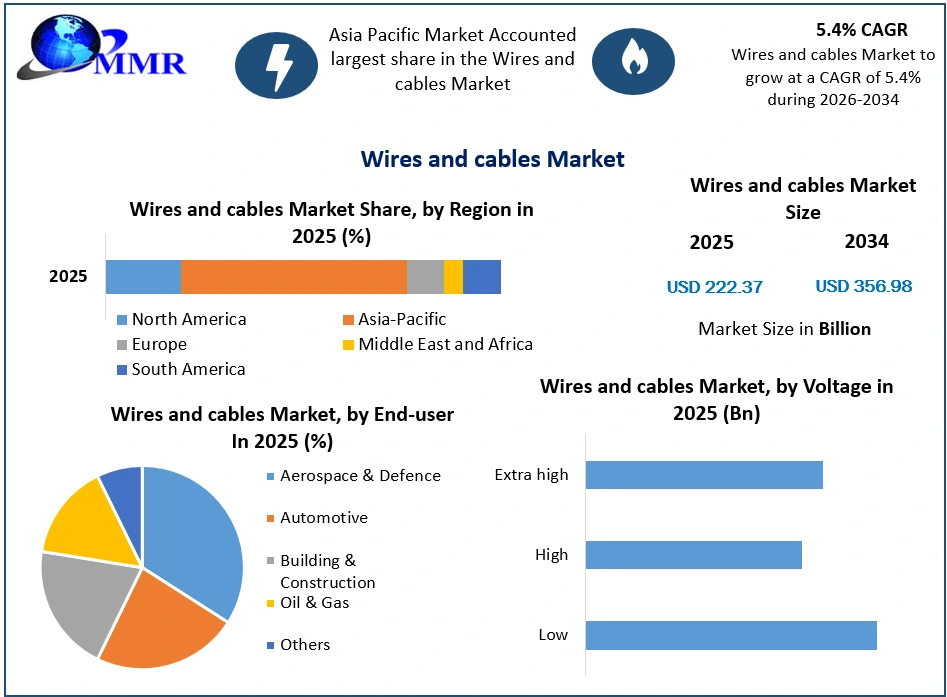
Wires and cables Market size was valued at USD 222.37 Bn. in 2025 and the total Global Wires and cables Market revenue is expected to grow at a CAGR of 5.4% from 2026 to 2034, reaching nearly USD 356.98 Bn. by 2034.

Wires and Cables Market Overview

Wires and cables market holds a broad range of products used for power transmission, distribution, and communication across various sectors. These include insulated wires, power cables, telecom cables, and specialty cables, which use in energy, construction, automotive, electronics, and telecommunications industries.

Wires and cables market growth has been driven by urbanization, increasing energy demand, electrification of transportation, and the spread of data centres and broadband infrastructure. Investments in renewable energy projects, smart grid development, and industrial automation growth are fuelling demand for heat-resistant, and environment-proof cable solutions. Asia Pacific dominates wires and cables market, fuelled by significant infrastructure development, growing power sector, and increasing industrial activity in countries like China, India, and South Korea. North America also holds a significant share due to grid modernization, 5G deployment, and electric vehicle (EV) infrastructure development. Top key players such as Prysmian Group, Nexans, Sumitomo Electric, and LS Cable & System dominate the competitive landscape, with innovation in material technology, fire-resistant designs, and smart cable solutions. These top key players are focus on sustainable manufacturing, product durability, and digital monitoring capabilities to gain an edge in the growing market.

Report covers the wires and cables market dynamics, structure by analyzing the market segments and projecting wires and cables market size. Clear representation of competitive analysis of key players by product, price, financial position, product portfolio, growth strategies and regional presence in wires and cables market.

Wires and cables Market Growth and Share Analysis
Wires and cables Market Growth

To know about the Research Methodology :- Request Free Sample Report

To know about the Research Methodology

Global wires and cables are segmented into by voltage, by installation, by an end user, and by region. Based on the voltage wires and cables market is divided into low, high and extra high. Installation is split into the overhead, underground. End users are classified as aerospace & defense, automotive, building & construction, oil & gas, energy & power, IT & telecommunication. Region wise the market is divided into North America, Europe, Asia Pacific, Middle East & Africa, and Latin America.

Wires and Cables Market Dynamics

Smart Grid Expansion to fuel wires and cables market growth

Growing reserves in smart grid technology, increasing renewable energy production, and government initiatives for upgrading the transmission and distribution systems are expected to drive this market. Adoption of smart grid technology has fulfilled the increasing need for grid interconnections, resulting in growing investments in the new submarine and underground cables.

Additionally, the market growth is attributed to the rising offshore wind farms and high voltage direct current links. Other drivers of the market are, Need for good aesthetics, safety and, functional flexibility. Request From data centers and IT facilities. Rapid growth into construction sector. Opportunities of the market is growing demand from renewable power generation sector.

Wires and Cables Market Segment Analysis

Based on the voltage, the wires and cables market are segmented into low, high, and extra high voltage. Low-voltage segment dominated the wires and cables market in 2025. Low voltage cables have high tensile strength and superior conductivity. So, used in industrial and domestic home appliances wiring, internal wiring for lighting circuits, power supply, automotive applications, telecommunication lines, and power generation cables.

Based on end user, the wires and cables market is segmented into Energy and power, IT and telecommunication, oil & gas and others. Energy and power segment hold the largest share of the overall market. With increasing awareness, the manufacturers are actively seeking chances to invest in renewable energy generation, such as solar and wind power.

Wires and Cables Market Regional Analysis

Asia Pacific dominated the wires and cable market in 2025. The dominance of the region in the market is attributed to its large population base, rising industrialization and urbanization, development in transmission and distribution networks, growing renewable energy production, large automobile production, and supportive governmental initiatives for expansion or upgrade of existing infrastructure.

Wires and Cables Market Competitive Landscape

Top key players such as Prysmian Group, Nexans S.A., Sumitomo Electric Industries, Ltd., and LS Cable & System Ltd. are driving innovation through advanced material science, high-voltage engineering, and smart cable solutions integrated with energy and communication networks. These key players are investing in advanced cable technologies designed for high efficiency, thermal strength, and intelligent monitoring to demanding applications across renewable energy, utilities, construction, automotive, and data transmission sectors. Prysmian Group is known for its inclusive submarine, underground, and specialty cables portfolio are supporting critical infrastructure in power grids, offshore wind farms, and high-speed broadband networks. The company is a leader in developing sustainable and recyclable cable systems, with decarbonization goals and green energy mandates. Nexans is known for its leadership in electrification solutions and digital infrastructure and offering fire-resistant, high-voltage, and data cables to smart grid deployment, railways, and large-scale construction projects. The company leverages digital twins, condition monitoring systems, and lifecycle management to ensure grid resilience and energy efficiency. These companies are transforming the market dynamics by continuous R&D, digital innovation, and strategic collaborations with renewable energy firms, utilities, and telecom providers.

Wires and Cables Market Trends

• Surge in HVDC & Smart Grid Cables
High-voltage DC cables are increasingly adopted for long-distance power transfer especially in offshore wind and cross-border grid interconnections—thanks to higher transmission capacity and lower losses.

• Infrastructure, Urbanization & EV Charging
Global urbanization and smart-city projects are fueling demand for fire-resistant, safe, and intelligent cables. EV deployment is increasing the need for specialized charging cables and robust grid infrastructure.

• Advanced Materials & Automation in Installation
Deployment of corrosion-resistant polymers, high-performance insulations, and superconductors is enabling higher capacity capabilities. Automated laying technologies- underwater drones, trenching robots, and smart monitoring are reducing installation time and cost.

Wires and Cables Market recent development

• On 3 June 2025, Prysmian group shipped the industry’s first 245 kV HVAC dynamic cable system for floating offshore wind, following a three-year R&D effort. Manufactured in Finland and Italy, this breakthrough extends its 72.5 kV inter-array range to 245 kV export tails, bolstering floating wind farm deployment in the Mediterranean and Northern Europe.

• On 2 June 2025, Nexans completed its acquisition of Cables RCT (Spain), a low-voltage, fire-safe cable specialist. The move strengthens its Iberian presence, adds production capacity (plus 25%), and aligns with its electrification strategy.

• On 10 February 2025, Sumitomo Electric Industries, Ltd. signed a subcontract with Germany’s ea Ramonat for 525 kV DC XLPE cable installation over 300 km as part of the Korridor B project 49, contributing to German/EU decarbonization goals.

• On 22 January 2025, Sumitomo Electric Industries, Ltd. Partnering with Van Oord and SSEN Transmission, Sumitomo was named preferred bidder to manufacture subsea HVDC cables in Scotland (Shetland 2 link) and will build a £350 million cable plant in Nigg, creating 150 jobs locally.

Wires and cables Market Recent Development

Date Company Development Impact
3 June 2025 Prysmian Group Prysmian shipped the industry's first 245 kV HVAC dynamic cable system for floating offshore wind after a three-year R&D effort. This breakthrough extends inter-array range from 72.5 kV to 245 kV export tails, bolstering floating wind farm deployment in Northern Europe and the Mediterranean.
2 June 2025 Nexans S.A. Nexans successfully completed its acquisition of Cables RCT, a Spanish specialist in low-voltage, fire-safe cables. The acquisition strengthens Nexans' Iberian market presence and instantly expands its regional production capacity by 25%, aligning directly with its core electrification strategy.
10 February 2025 Sumitomo Electric Industries Sumitomo Electric signed a key subcontract with Germany's ea Ramonat for a 525 kV DC XLPE cable installation spanning over 300 km. Executed as part of the Korridor B project, this high-capacity initiative directly contributes to long-term German and EU decarbonization goals.
22 January 2025 Sumitomo Electric Industries Partnering with Van Oord and SSEN Transmission, Sumitomo was named preferred bidder for subsea HVDC cables on the Shetland 2 link. As part of the project, Sumitomo is building a £350 million cable manufacturing plant in Nigg, locally creating 150 jobs.

Wires and Cables Market Scope: Inquire before buying

Wires and Cables Market
Report Coverage Details
Base Year: 2025 Forecast Period: 2026-2034
Historical Data: 2020 to 2025 Market Size in 2025: USD 222.37 Bn.
Forecast Period 2026 to 2034 CAGR: 5.4% Market Size in 2034: USD 356.98 Bn.
Segments Covered: by Product Type Power Cables
Hybrid Cables
Communication Cables
Others
by Material Metal
Polymer
PVC
  PE
  LSF0H/HFFR
  Others
by End-user Aerospace & Defence
Commercial
Residential
IT & Telecommunication
Power Transmission & Distribution
Oil & Gas
Consumer Electronics
Manufacturing
Automotive
Others
by Voltage Low Voltage
Medium Voltage
High Voltage
Extra-High Voltage
by Connection Overhead
Underground
Submarine

Wires and Cables Market, by Region

North America (United States, Canada and Mexico)
Europe (UK, France, Germany, Italy, Spain, Sweden, Austria and Rest of Europe)
Asia Pacific (China, South Korea, Japan, India, Australia, Indonesia, Malaysia, Vietnam, Taiwan, Bangladesh, Pakistan and Rest of APAC)
Middle East and Africa (South Africa, GCC, Egypt, Nigeria and Rest of ME&A)
South America (Brazil, Argentina Rest of South America)

Wires and Cables Market Key Players

North America

1. Southwire Company, LLC
2. Belden Inc.
3. Amphenol Corporation
4. Encore Wire Corporation (Prysmian Group)
5. General Cable Corporation (Prysmian Group)
6. Hubbell Incorporated
7. International Wire Group, Inc.
Others

Europe
8. Prysmian S.p.A. (Prysmian Group)
9. Nexans SA
10. NKT A/S
11. LEONI AG
12. HELUKABEL GmbH
13. Tratos Group
14. Studer Cables AG
15. Brugg Kabel AG (Brugg Group)
16. Habia Cable AB
17. Naficon
18. ABB Ltd
19. Siemens AG
20. Kabelwerk Eupen AG
Others

Asia Pacific

21. Sumitomo Electric Industries, Ltd.
22. Furukawa Electric Co., Ltd.
23. Fujikura Ltd.
24. LS Cable & System Ltd. (LS Corporation)
25. KEI Industries Limited
26. Polycab India Limited
27. Finolex Cables Ltd.
28. RR Kabel Ltd. (RR Global)
29. Havells India Limited
30. Cords Cable Industries Ltd.
31. Jiangsu Zhongtian Technology Co., Ltd. (ZTT Group)
32. Taihan Electric Wire Co., Ltd.
Others

Middle East & Africa

33. alfanar Group
34. Bahra Cables Company
35. Elsewedy Electric Company S.A.E.
36. Jeddah Cables Company
37. Midal Cables Limited
38. Riyadh Cables Group Company
40. Saudi Cable Company
Others

South America

41. Ficap S.A.
42. Indelqui S.A.
Others

FAQs:

1. Which region has the largest share in the Wires and cables market?
Ans: The Asia Pacific region held the highest share in 2025 in the Wires and cables market.

2. What are the key factors driving the growth of the Wires and cables market?
Ans: Smart Grid Expansion to fuel wires and cables market growth.

3. Who are the key competitors in the Wires and cables market?
Ans: Prysmian Group, Nexans S.A., Sumitomo Electric Industries, Ltd., and LS Cable & System Ltd. are the key competitors in the Wires and cables market.

4. What are the opportunities for the Wires and cables market?
Ans: Surge in Electric Vehicle (EV) Infrastructure creates opportunities in the Wires and cables market.

5. Which voltage type segment dominates the Wires and cables market?
Ans: The low-voltage type segment dominated the Wires and cables market.

Table of Contents

1. SECTION A – GLOBAL WIRES AND CABLES MARKET INTRODUCTION 1.1 Executive Market Landscape and Industry Overview 1.1.1 Global Wires and Cables Market Size (Value USD Mn), 2025–2034 1.1.2 Historical Market Size Trends and Growth Momentum Analysis Across Wires and Cables Industry 1.1.3 Forecast Revenue Projections with Underlying Market Growth Driving Factors 1.1.4 Demand-Supply Balance and Its Influence on Market Expansion Potential 1.1.5 Impact of Macroeconomic Indicators on Wires and Cables Market Growth Trajectory 1.1.6 Infrastructure Investment Trends Influencing Market Development 1.1.7 Long-Term Market Outlook Highlighting Structural Growth Opportunities Through 2034 1.1.8 CAGR Analysis of Global Wires and Cables Market (2025–2034) 1.2 Wires and Cables Market Dynamics 1.2.1 Wires and Cables Market Trends 1.2.2 Wires and Cables Market Dynamics 1.2.3 Drivers 1.2.4 Restraints 1.2.5 Opportunities 1.2.6 Challenges 1.2.7 PORTER’s Five Forces Analysis 1.2.8 PESTLE Analysis 1.3 Pricing Structure and Value Chain Profitability Assessment 1.3.1 Comprehensive Breakdown of Wires and Cables Cost Structure Across Value Chain 1.3.2 Copper and Aluminum Cost Contribution Across Different Cable Products 1.3.3 Insulation, Sheathing, and Other Raw Material Cost Contribution Analysis 1.3.4 Manufacturing, Labor, Energy, and Logistics Cost Components 1.3.5 Margin Distribution Analysis Among Manufacturers, Distributors, and Contractors 1.3.6 Impact of Copper and Aluminum Price Fluctuations on Cable Pricing Strategies 1.3.7 Pricing Differences Across Low, Medium, High, and Extra-High Voltage Cables 1.3.8 Project-Based Pricing and Tendering Strategies Across Major End-Use Industries 1.3.9 Profitability Trends and Revenue Optimization Strategies Across Industry Participants 1.4 Copper, Aluminum, Polymer and Raw Material Supply Dynamics 1.4.1 Global Copper and Aluminum Sourcing Models and Supplier Dependency Risk Assessment 1.4.2 Copper and Aluminum Production Capacity and Availability Trends 1.4.3 Impact of Commodity Price Volatility on Cable Manufacturing Costs 1.4.4 PVC, XLPE, PE, LSZH, Rubber, and Other Insulation Material Supply Dynamics 1.4.5 Specialty Material Availability for High-Performance and High-Voltage Cables 1.4.6 Recycled Copper and Aluminum Utilization Across Wire and Cable Manufacturing 1.4.7 Raw Material Quality Influence on Electrical Performance and Product Reliability 1.4.8 Supplier Concentration and Raw Material Supply Chain Risk Assessment 1.5 End-User Procurement Evolution and Infrastructure Investment Trends 1.5.1 Increasing Infrastructure Investments Driving Wires and Cables Demand 1.5.2 Utility Procurement Trends Across Power Transmission and Distribution Projects 1.5.3 Construction Industry Demand for Building Wires and Cables 1.5.4 Industrial Procurement Trends Across Manufacturing and Process Industries 1.5.5 Renewable Energy Project Requirements for Specialized Cable Solutions 1.5.6 Data Center and Telecommunications Infrastructure Procurement Trends 1.5.7 EV Charging Infrastructure and Automotive Electrification Cable Demand 1.5.8 Project-Based Procurement and Long-Term Supply Agreement Trends 1.6 Product Innovation and Cable Technology Development 1.6.1 Development of High-Voltage and Extra-High-Voltage Cable Technologies 1.6.2 Advancements in HVDC Cable Systems for Long-Distance Power Transmission 1.6.3 Innovation in Fire-Resistant, Flame-Retardant, and Low-Smoke Cable Products 1.6.4 Development of Low-Smoke Zero-Halogen Cable Solutions 1.6.5 Advanced Insulation Technologies Enhancing Cable Performance and Reliability 1.6.6 Lightweight and High-Conductivity Cable Design Innovations 1.6.7 Smart Cable Technologies Enabling Real-Time Monitoring and Diagnostics 1.6.8 Specialty Cable Development for Renewable Energy, EV, Aerospace, and Industrial Applications 1.7 Manufacturing Technology, Automation and Quality Development 1.7.1 Adoption of Automation in Wire and Cable Manufacturing Processes 1.7.2 Advanced Wire Drawing and Stranding Technologies Enhancing Production Efficiency 1.7.3 Continuous Vulcanization and Advanced Insulation Processing Technologies 1.7.4 High-Speed Extrusion Technologies for Improved Manufacturing Productivity 1.7.5 Automated Testing and Quality Inspection Systems 1.7.6 Digital Monitoring Systems Ensuring Product Quality and Compliance 1.7.7 Industry 4.0 Implementation in Modern Cable Manufacturing Facilities 1.7.8 Artificial Intelligence and Predictive Analytics in Manufacturing Optimization 1.7.9 Energy-Efficient Manufacturing Technologies Reducing Production Costs 1.8 Distribution Evolution and Project Supply Chain Dynamics 1.8.1 Evolution of Distributor and Electrical Wholesale Networks 1.8.2 Direct-to-Project Sales Models Among Major Cable Manufacturers 1.8.3 Role of Electrical Distributors in Expanding Market Accessibility 1.8.4 Growth of Digital B2B Platforms for Wires and Cables Procurement 1.8.5 Expansion of Regional Distribution Centers and Warehousing Infrastructure 1.8.6 Long-Term Supply Agreements with Utilities and Infrastructure Developers 1.8.7 Logistics Optimization for Large-Volume and Project-Based Cable Deliveries 1.8.8 Supply Chain Integration Across Manufacturers, Distributors, Contractors, and EPC Companies 1.9 Digitalization, Smart Grid and Cable Monitoring Transformation 1.9.1 Digitalization of Power Transmission and Distribution Networks 1.9.2 Smart Grid Development Driving Advanced Cable Requirements 1.9.3 Online Cable Monitoring and Condition Assessment Technologies 1.9.4 Distributed Temperature Sensing for High-Voltage Cable Systems 1.9.5 Predictive Maintenance Solutions for Power Cable Networks 1.9.6 Digital Twins and Data Analytics in Cable Asset Management 1.9.7 IoT Integration in Cable Monitoring and Infrastructure Management 1.9.8 Remote Diagnostics Enhancing Cable Reliability and Lifecycle Management 1.10 Sustainability, Circular Economy and Environmental Analysis 1.10.1 Rising Demand for Environmentally Sustainable Cable Products 1.10.2 Carbon Footprint Reduction Across Wire and Cable Manufacturing 1.10.3 Recycled Copper and Aluminum Integration in Cable Production 1.10.4 Circular Economy Practices Across Cable Manufacturing and End-of-Life Management 1.10.5 PVC and Halogen-Free Material Adoption Trends 1.10.6 Sustainable Insulation and Sheathing Material Development 1.10.7 Energy-Efficient Manufacturing and Renewable Energy Integration 1.10.8 Cable Recycling and Material Recovery Market Development 1.10.9 ESG Initiatives Influencing Procurement Decisions of Major Customers 1.11 Electrification, Renewable Energy and Emerging Infrastructure 1.11.1 Global Electrification Trends Supporting Long-Term Wires and Cables Demand 1.11.2 Grid Modernization and Transmission Network Expansion 1.11.3 Renewable Energy Integration Driving Cable Infrastructure Requirements 1.11.4 Solar and Wind Power Project Cable Demand 1.11.5 Offshore Wind Development and Submarine Cable Requirements 1.11.6 Electric Vehicle Adoption and Charging Infrastructure Cable Demand 1.11.7 Battery Energy Storage System Infrastructure and Cable Requirements 1.11.8 Data Center Expansion and High-Capacity Power Cable Demand 1.11.9 5G and Fiber Infrastructure Expansion Supporting Communication Cable Demand 1.12 Import-Export Trade Analysis (2020–2025) 1.12.1 Global Trade Flow Trends Impacting Wires and Cables Market Development 1.12.2 Import-Export Patterns Influencing Product Pricing and Availability 1.12.3 Copper and Aluminum Trade Flows Affecting Cable Production Economics 1.12.4 Supply Chain Disruptions Affecting Manufacturing and Distribution Efficiency 1.12.5 Geopolitical Factors Impacting Cable Manufacturing and Trade Routes 1.12.6 Tariff and Regulatory Barriers Affecting Cross-Border Cable Trade 1.12.7 Anti-Dumping Measures and Trade Protection Policies Across Major Markets 1.12.8 Post-Pandemic Supply Chain Resilience and Adaptation Strategies 1.13 Strategic Infrastructure and Application Expansion Analysis 1.13.1 Transmission and Distribution Grid Expansion Supporting Market Growth 1.13.2 Urbanization and Construction Infrastructure Driving Building Wire Demand 1.13.3 Industrial Automation and Manufacturing Expansion Supporting Cable Consumption 1.13.4 Oil and Gas Infrastructure Creating Demand for Specialty Cables 1.13.5 Mining Infrastructure and Heavy-Duty Cable Requirements 1.13.6 Railway and Transportation Infrastructure Cable Demand 1.13.7 Marine, Offshore, and Submarine Cable Market Expansion 1.13.8 Aerospace and Defense Applications for Specialty Wire and Cable Products 1.14 Project-Based Demand and Large Infrastructure Opportunity Analysis 1.14.1 Demand for Wires and Cables Across Large-Scale Infrastructure Projects 1.14.2 Utility Grid Expansion and Transmission Project Opportunities 1.14.3 Renewable Energy Project Pipeline and Cable Requirements 1.14.4 Data Center Construction Project Opportunities 1.14.5 EV Charging Infrastructure Deployment Opportunities 1.14.6 Railway and Metro Infrastructure Project Demand 1.14.7 Offshore Wind and Submarine Cable Project Opportunities 1.14.8 Major EPC and Engineering Procurement Trends 1.14.9 Long-Term Project Backlog and Revenue Visibility Analysis 1.15 Capacity Expansion and Manufacturing Footprint Analysis 1.15.1 Global Manufacturing Capacity Expansion Trends 1.15.2 Regional Production Footprint of Major Cable Manufacturers 1.15.3 New Manufacturing Facility Investments and Capacity Additions 1.15.4 High-Voltage and Submarine Cable Production Capacity Development 1.15.5 Localization of Cable Manufacturing Across Emerging Markets 1.15.6 Vertical Integration Strategies for Copper, Aluminum, and Cable Components 1.15.7 Capacity Utilization Trends Across Major Manufacturing Regions 1.15.8 Impact of Capacity Expansion on Competitive Pricing and Supply Availability 1.16 Regulatory Framework, Standards and Compliance Analysis 1.16.1 Global Electrical Safety Regulations Governing Wires and Cables 1.16.2 International Standards for Cable Manufacturing and Performance 1.16.3 IEC Standards and Certification Requirements Across Major Cable Categories 1.16.4 UL, BS, EN, ASTM, and Regional Standard Compliance Requirements 1.16.5 Fire Safety and Flame-Retardancy Regulations 1.16.6 Low-Smoke Zero-Halogen and Environmental Compliance Requirements 1.16.7 Building Codes and Electrical Installation Regulations 1.16.8 Import-Export Compliance Requirements Across International Markets 1.16.9 Regional Regulatory Comparison Across North America, Europe, Asia Pacific, Middle East & Africa, and South America 1.17 Infrastructure Procurement, Tendering and Contractor Ecosystem Analysis 1.17.1 Utility Tendering Practices and Cable Supplier Selection Criteria 1.17.2 EPC Contractor Influence on Cable Product Selection 1.17.3 Infrastructure Developer Procurement Strategies 1.17.4 Price Versus Quality Trade-Offs in Cable Procurement 1.17.5 Technical Qualification and Vendor Approval Requirements 1.17.6 Long-Term Contracting and Framework Agreement Trends 1.17.7 Distributor and Contractor Relationship Management 1.17.8 After-Sales Service and Technical Support Requirements 1.17.9 Product Warranty and Lifecycle Service Considerations 1.18 Emerging End-User Segments and Demand Patterns 1.18.1 Data Centers and Hyperscale Infrastructure Driving High-Capacity Cable Demand 1.18.2 Electric Vehicle and Automotive Electrification Applications 1.18.3 Renewable Energy and Energy Storage Infrastructure 1.18.4 Offshore Wind and Submarine Power Transmission Applications 1.18.5 Smart Cities and Intelligent Infrastructure Development 1.18.6 Industrial Automation and Robotics Cable Requirements 1.18.7 Railway Electrification and Transportation Infrastructure 1.18.8 Aerospace, Defense, and Specialty Industrial Applications 1.18.9 Mining and Heavy Industrial Cable Applications 1.19 Wires and Cables Market: Market Size and Forecast by Segmentation (by Value USD Million) (2025–2034) 1.19.1 Wires and Cables Market Size and Forecast, By Product Type 1.19.1.1 Power Cables 1.19.1.2 Hybrid Cables 1.19.1.3 Communication Cables 1.19.1.4 Others 1.19.2 Wires and Cables Market Size and Forecast, By Material 1.19.2.1 Metal 1.19.2.2 Polymer 1.19.2.2.1 PVC 1.19.2.2.2 PE 1.19.2.2.3 LSF0H/HFFR 1.19.2.2.4 Others 1.19.3 Wires and Cables Market Size and Forecast, By Connection 1.19.3.1 Overhead 1.19.3.2 Underground 1.19.3.3 Submarine 1.19.4 Wires and Cables Market Size and Forecast, By Voltage 1.19.4.1 Low Voltage 1.19.4.2 Medium Voltage 1.19.4.3 High Voltage 1.19.4.4 Extra-High Voltage 1.19.5 Wires and Cables Market Size and Forecast, By End-Use 1.19.5.1 Aerospace & Defence 1.19.5.2 Commercial 1.19.5.3 Residential 1.19.5.4 IT & Telecommunication 1.19.5.5 Power Transmission & Distribution 1.19.5.6 Oil & Gas 1.19.5.7 Consumer Electronics 1.19.5.8 Manufacturing 1.19.5.9 Automotive 1.19.5.10 Others 1.19.6 Wires and Cables Market Size and Forecast, By Region 1.19.6.1 North America 1.19.6.1.1 United States 1.19.6.1.2 Canada 1.19.6.1.3 Mexico 1.19.6.2 Europe 1.19.6.2.1 United Kingdom 1.19.6.2.2 France 1.19.6.2.3 Germany 1.19.6.2.4 Italy 1.19.6.2.5 Switzerland 1.19.6.2.6 Spain 1.19.6.2.7 Sweden 1.19.6.2.8 Russia 1.19.6.2.9 Rest of Europe 1.19.6.3 Asia Pacific 1.19.6.3.1 China 1.19.6.3.2 South Korea 1.19.6.3.3 Japan 1.19.6.3.4 India 1.19.6.3.5 Australia 1.19.6.3.6 Indonesia 1.19.6.3.7 Philippines 1.19.6.3.8 Malaysia 1.19.6.3.9 Vietnam 1.19.6.3.10 Thailand 1.19.6.3.11 Rest of Asia Pacific 1.19.6.4 Middle East And Africa 1.19.6.4.1 South Africa 1.19.6.4.2 Turkey 1.19.6.4.3 Saudi Arabia 1.19.6.4.4 UAE 1.19.6.4.5 Qatar 1.19.6.4.6 Egypt 1.19.6.4.7 Nigeria 1.19.6.4.8 Rest of ME&A 1.19.6.5 South America 1.19.6.5.1 Brazil 1.19.6.5.2 Argentina 1.19.6.5.3 Chile 1.19.6.5.4 Colombia 1.19.6.5.5 Rest Of South America 2. SECTION B – COMPETITIVE INTELLIGENCE & INDUSTRIAL ECOSYSTEM 2.1 Competitive Landscape 2.1.1 MMR Competition Matrix 2.1.2 Competitive Positioning of Leading Key Players [Revenue and Market Share (%)] 2.1.3 Key Players Benchmarking 2.1.3.1 Company Name 2.1.3.2 Headquarter 2.1.3.3 Product Portfolio 2.1.3.4 Specialty & High-Performance Cables 2.1.3.5 HV / EHV / HVDC Cable Capability 2.1.3.6 Submarine Cable Products 2.1.3.7 Product Quality & Reliability 2.1.3.8 Manufacturing Capacity 2.1.3.9 Supply Chain Resilience 2.1.3.10 Distribution Network 2.1.3.11 Customer Base 2.1.3.12 Revenue (2025) 2.1.3.13 R&D Investment 2.1.3.14 Profit Margin (%) 2.1.3.15 Growth Rate (Y-o-Y %) 2.1.3.16 Geographic Presence 2.1.4 Market Structure 2.1.4.1 Market Leaders 2.1.4.2 Market Followers 2.1.4.3 Emerging Players 2.1.5 Growth Rate/Y-o-Y (%) of Companies 2.1.6 Profit Margin (%) of Companies 2.1.7 R&D Investments (%) of Companies 2.1.8 Mergers and Acquisitions Details 2.1.9 Recent Key Developments 2.2 Competitive Landscape and Industry Structure Analysis 2.2.1 Market Concentration Levels and Competitive Intensity Across Wires and Cables Industry 2.2.2 Competitive Positioning Strategies Among Leading Global Manufacturers 2.2.3 Entry Barriers and Challenges for New Participants 2.2.4 Capital Investment Requirements for Advanced Cable Manufacturing 2.2.5 Manufacturing Capacity as a Competitive Differentiation Factor 2.2.6 Market Share Distribution Patterns Among Established and Emerging Players 2.2.7 Competitive Benchmarking Based on Product Quality, Pricing, Technology, and Reliability 2.2.8 Importance of Certifications and Technical Qualification in Competitive Positioning 2.3 Company Market Share and Positioning Analysis (2024–2025) 2.3.1 Revenue-Based Market Share Comparison Across Leading Wires and Cables Companies 2.3.2 Market Share Comparison by Major Product Categories 2.3.3 Competitive Positioning Across Low, Medium, High, and Extra-High Voltage Segments 2.3.4 Growth Performance Analysis of Emerging Market Players 2.3.5 Competitive Pricing Benchmarking Across Major Industry Participants 2.3.6 Impact of Manufacturing Capacity on Market Share Expansion 2.3.7 Product Differentiation as Key Factor in Competitive Positioning 2.3.8 Regional Market Presence and Expansion Comparison 2.4 Strategic Initiatives and Expansion Strategy Analysis 2.4.1 Mergers and Acquisitions Shaping Competitive Landscape 2.4.2 Capacity Expansion Strategies Supporting Production and Market Penetration Growth 2.4.3 Global Market Entry and Expansion Strategies Among Leading Companies 2.4.4 Strategic Partnerships Strengthening Supply Chain and Distribution Networks 2.4.5 Investment in High-Voltage and Submarine Cable Manufacturing 2.4.6 Investments in Renewable Energy and Grid Infrastructure Opportunities 2.4.7 Localization Strategies Across Emerging Markets 2.4.8 Investment in Innovation and Product Development Enhancing Competitive Advantage 2.4.9 Diversification Strategies Across Wire and Cable Product Portfolios 2.5 Product Portfolio, Technology and Innovation Benchmarking Analysis 2.5.1 Comparative Analysis of Product Portfolios Across Leading Manufacturers 2.5.2 Innovation Pipeline Evaluation in Wire and Cable Product Development 2.5.3 High-Voltage and Extra-High-Voltage Cable Technology Benchmarking 2.5.4 HVDC Cable Technology and Product Capability Comparison 2.5.5 Submarine Cable Product Portfolio Benchmarking 2.5.6 Renewable Energy and EV Cable Product Benchmarking 2.5.7 Smart Cable and Monitoring Technology Comparison 2.5.8 Product Quality and Reliability Benchmarking Across Leading Manufacturers 2.5.9 Certification and Standards Compliance Benchmarking 2.6 Financial Performance and Profitability Benchmarking 2.6.1 Revenue Growth Trends Across Leading Market Participants 2.6.2 Profit Margin Analysis and Cost Structure Comparison Across Companies 2.6.3 Investment Trends in Research and Development Activities 2.6.4 Manufacturing Capacity Investment and Capital Expenditure Analysis 2.6.5 Financial Resilience Analysis During Commodity Price and Economic Disruptions 2.6.6 Impact of Raw Material Prices on Revenue and Profitability 2.6.7 Operational Efficiency Strategies Supporting Cost Optimization and Profitability 2.6.8 Revenue Diversification Across Product and Geographic Markets 2.7 Manufacturing Capacity, Technology and Operational Excellence Benchmarking 2.7.1 Manufacturing Capacity Comparison Across Leading Companies 2.7.2 Production Facility Footprint and Geographic Distribution 2.7.3 High-Voltage and Submarine Cable Manufacturing Capability 2.7.4 Automation and Industry 4.0 Adoption Across Manufacturing Facilities 2.7.5 Production Technology and Process Efficiency Benchmarking 2.7.6 Quality Control and Testing Capability Comparison 2.7.7 Capacity Utilization and Expansion Trends 2.7.8 Vertical Integration Across Raw Materials and Components 2.7.9 Supply Chain Resilience and Operational Continuity Benchmarking 2.8 Supply Chain and Raw Material Sourcing Strategy Benchmarking 2.8.1 Copper and Aluminum Sourcing Strategies Across Leading Manufacturers 2.8.2 Polymer and Insulation Material Procurement Strategies 2.8.3 Supplier Diversification and Supply Chain Risk Management 2.8.4 Long-Term Raw Material Contracting Strategies 2.8.5 Commodity Price Hedging and Cost Management Practices 2.8.6 Supplier Relationship Management Strategies Supporting Material Availability 2.8.7 Logistics and Distribution Optimization Across Global Supply Chains 2.8.8 Regional Manufacturing and Sourcing Localization Strategies 2.8.9 Recycling and Secondary Raw Material Procurement Practices 2.9 Private Label, Local Manufacturers and Regional Competitive Expansion 2.9.1 Growth of Regional and Local Wire and Cable Manufacturers 2.9.2 Competitive Positioning of Local Manufacturers Against Global Players 2.9.3 Private Label and Distributor-Branded Cable Product Development 2.9.4 Competitive Pricing Strategies of Regional Manufacturers 2.9.5 Quality Perception and Certification Challenges for Local Brands 2.9.6 Government Localization Policies Supporting Domestic Manufacturing 2.9.7 Import Substitution Strategies Across Emerging Markets 2.9.8 Consumer and Contractor Acceptance of Local Cable Brands 2.10 Innovation Leadership and R&D Investment Analysis 2.10.1 Research and Development Investment Trends Across Leading Companies 2.10.2 Innovation Leadership in Cable Product Development and Process Improvement 2.10.3 New Product Development Strategies Driving Competitive Advantage 2.10.4 Technological Advancements Supporting High-Voltage Cable Manufacturing 2.10.5 HVDC and Submarine Cable Technology Development 2.10.6 Smart Cable Monitoring and Diagnostic Technology Innovation 2.10.7 Collaboration with Research Institutions and Infrastructure Developers 2.10.8 Innovation Pipeline Strength and Future Product Launch Capabilities 2.11 Company Profile: 40+ Key Players 2.11.1 Detailed Profile Considering the Parameters 2.11.1.1 Overview 2.11.1.2 Business Portfolio 2.11.1.3 Financial Overview 2.11.1.4 SWOT Analysis 2.11.1.5 Strategic Analysis 2.11.1.6 Recent Developments 2.11.2 North America 2.11.2.1 Southwire Company, LLC 2.11.2.2 Belden Inc. 2.11.2.3 Amphenol Corporation 2.11.2.4 Encore Wire Corporation (Prysmian Group) 2.11.2.5 General Cable Corporation (Prysmian Group) 2.11.2.6 Hubbell Incorporated 2.11.2.7 International Wire Group, Inc. 2.11.2.8 Others 2.11.3 Europe 2.11.3.1 Prysmian S.p.A. (Prysmian Group) 2.11.3.2 Nexans SA 2.11.3.3 NKT A/S 2.11.3.4 LEONI AG 2.11.3.5 HELUKABEL GmbH 2.11.3.6 Tratos Group 2.11.3.7 Studer Cables AG 2.11.3.8 Brugg Kabel AG (Brugg Group) 2.11.3.9 Habia Cable AB 2.11.3.10 Naficon 2.11.3.11 ABB Ltd 2.11.3.12 Siemens AG 2.11.3.13 Kabelwerk Eupen AG 2.11.3.14 Others 2.11.4 Asia Pacific 2.11.4.1 Sumitomo Electric Industries, Ltd. 2.11.4.2 Furukawa Electric Co., Ltd. 2.11.4.3 Fujikura Ltd. 2.11.4.4 LS Cable & System Ltd. (LS Corporation) 2.11.4.5 KEI Industries Limited 2.11.4.6 Polycab India Limited 2.11.4.7 Finolex Cables Ltd. 2.11.4.8 RR Kabel Ltd. (RR Global) 2.11.4.9 Havells India Limited 2.11.4.10 Cords Cable Industries Ltd. 2.11.4.11 Jiangsu Zhongtian Technology Co., Ltd. (ZTT Group) 2.11.4.12 Taihan Electric Wire Co., Ltd. 2.11.4.13 Others 2.11.5 Middle East & Africa 2.11.5.1 alfanar Group 2.11.5.2 Bahra Cables Company 2.11.5.3 Elsewedy Electric Company S.A.E. 2.11.5.4 Jeddah Cables Company 2.11.5.5 Midal Cables Limited 2.11.5.6 Riyadh Cables Group Company 2.11.5.7 Saudi Cable Company 2.11.5.8 Others 2.11.6 South America 2.11.6.1 Ficap S.A. 2.11.6.2 Indelqui S.A. 2.11.6.3 Others 3. SECTION C – KEY INSIGHTS, STRATEGIC OUTLOOK & METHODOLOGICAL FRAMEWORK 3.1 Key Findings 3.2 Strategic Moves & Industry Outlook 3.3 Research Methodology

Custom Market Research Services

We Will Customise The Research For You, In Case The Report Listed Above Does Not Meet With Your Requirements