
Wax Market - Industry Structure Evaluation, Demand Drivers Analysis, Regional Growth Analysis and Identification, Competitive Positioning Review & Global Market Size Forecast to 2034
Overview
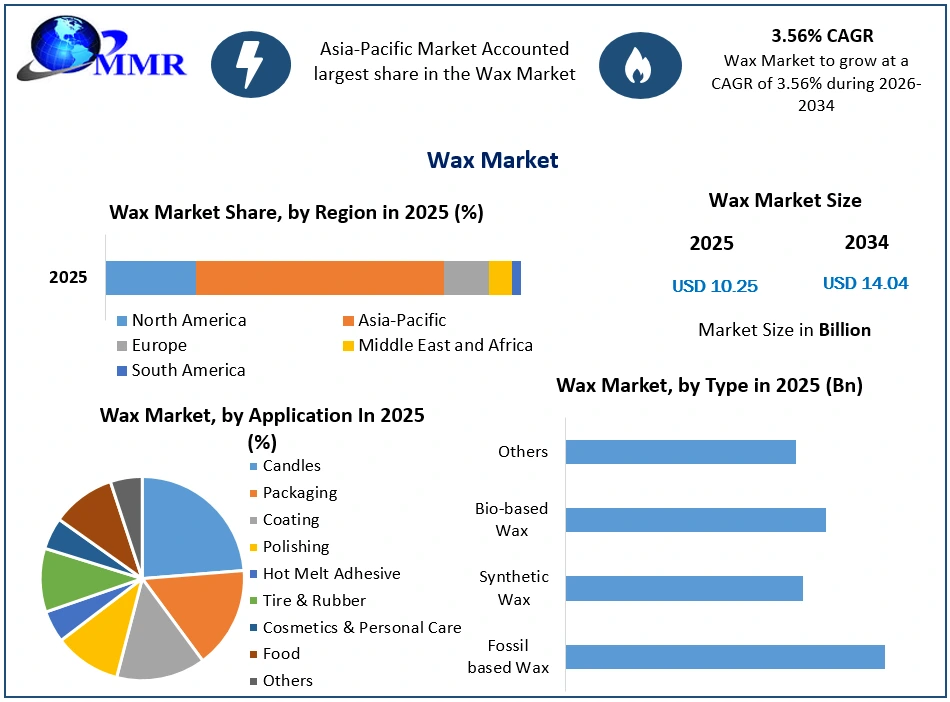
The Wax Market size was valued at USD 10.25 Billion in 2026 and the total Wax revenue is expected to grow at a CAGR of 3.56% from 2026 to 2034, reaching nearly USD 14.04 Billion.
Wax Market Overview:
As hydrophobic and pliable solids at room temperature, waxes belong to the class of organic chemicals.
The report analyzes key market trends, including growing usage patterns in various industries such as cosmetics, pharmaceuticals, and automotive, growing demand for specialty waxes, and technological advancements in the wax manufacturing process. Factors such as industrialization, urbanization, and consumer preferences for environmentally friendly products are also highlighted.
The global wax market is segmented by application (candles, packaging, adhesives, etc.) and wax type (paraffin wax, microcrystalline wax, synthetic wax, etc.) by region. With the help of regional analysis, regional dynamics, growth rates, and new perspectives can be understood. The wax market report includes an in-depth analysis of the product portfolios, financial performance, strategic efforts (partnerships, mergers & acquisitions), and competitive strategies of the leading companies operating in the market. In the competitive landscape, there are often comparative assessments and SWOT analyses of the major players in the global wax market.
Wax Market Growth Outlook
 To know about the Research Methodology :- Request Free Sample Report
Wax Market Dynamics:
The rising popularity and demand for personal care and cosmetics are boosting the Global wax market.
Global demand for wax is driven by increased demand for personal care products such as lip balms, skin creams, and hair care products. Because of its versatility and versatility, wax is a key part of many products that meet the demands and interests of different consumers. Some waxes are used in personal care products for their moisturizing properties, including synthetic, carnauba wax, and beeswax. Humectants, also known as emollients, are substances that soften and moisturize the skin by creating a barrier that prevents water from evaporating and keeps the skin moist.
The rise of the personal care and cosmetics sector is creating a high demand for waxes, responding to their functional versatility, improved product performance, and consumer demands for natural and sustainable ingredients. This demand is the main factor behind the growth of the wax market.
Environmental regulations are becoming increasingly concerned about waxes derived from petroleum or coal.
Increased regulatory scrutiny and environmental concerns about petroleum-based waxes, particularly paraffin wax, have been a major restraint in the global wax market in recent years. Global environmental awareness and government initiatives to reduce carbon emissions and promote sustainability are increasing regulatory pressure.
| Wax Type | CO2 Emission (Tonnes/Year) | Annual Growth Rate | Water Usage
(Litres/Year) |
Land Use
(Hectares/Year) |
Waste Generation
(Tonnes/Year) |
| Paraffin Wax | 2,000,000 | 4% | Low | N/A | 500,000 |
| Soy | 500,000 | 11.7% | High | 1,000,000 | 100,000 |
| Beeswax | 100,000 | 3.81% | Moderate | 500,000 | 50,000 |
These waxes contribute to air pollution and climate change because they emit carbon dioxide during recycling, processing, and burning. In addition, the mining methods used in their production are disruptive and damage habitats.
Wax Market Segment Analysis:
Based on the Type, according to MMR analysis, fossil-based wax dominated the global wax market in terms of revenue in 2025, due to several factors such as versatility and wide application, cost-effectiveness, established market presence and infrastructure, technological advancement and formulation flexibility. Paraffin wax, a type of fossil-based wax is a versatile substance obtained from petroleum refining. It has properties such as low viscosity, strong electrical insulation, and excellent water resistance. It is commonly used in various fields including adhesives, packaging, candles, and cosmetics. Paraffin is the most general candle wax because it keeps its color while burning evenly and smells good. It is used as a packaging material as a coating to improve the printability and moisture resistance of paper and cardboard. Paraffin wax is also used in the cosmetic industry in creams, emulsions, and lip balms due to its softening properties. Due to all these factors, paraffin dominated the global wax market in 2025.
Synthetic wax will grow at the fastest rate in the global wax market during the forecast period. Synthetic waxes often outperform natural waxes in terms of heat resistance, water resistance, and longevity. This makes them attractive in industries that require certain performance standards.
Based on the Application, according to MMR analysis, Candles held the largest market share in the global wax market in 2026 and is expected to continue to dominate the market during the forecast period. The growth is due to people's rapidly growing desire for aromatherapy and lighting scented candles. In addition, candles are widely used in aesthetics, meditation, and other similar purposes. They are also easily available in the market in various shapes, essences, sizes, shapes and types. As a result, the candle wax market is growing rapidly, which directly affects the need for wax. This leads to a dominant position in the global wax market.
• According to the American National Candle Association, about 35% of candle sales occur around Christmas/Halloween. Non-seasonal activity accounts for approximately 65% of candle sales.
Therefore, many key players are expanding their manufacturing and distribution network in response to the growing demand for candles in various regions, which is expected to positively impact the global wax market. Along with e-commerce platforms, many companies are increasing their visibility as mass retailers and decorative stores, which is contributing to the growing demand for candles.
Wax Market Regional Analysis:
According to MMR analysis, Asia Pacific accounts for the largest share of the global wax market in 2026 and is expected to continue at the same level during the forecast period. The demand for wax is mainly due to the ever-increasing living conditions of people and the desire to buy scented candles for meditation and aesthetic purposes. Additionally, the growing number of industries such as packaging, food and beverage, cosmetics, plastic, rubber, and adhesives will directly impact the region's wax market as governments focus on industrialization. and infrastructure development.
• The global wax market is dominated by China and India, with China leading regional market growth. Supported by cheap labor, readily available raw materials and low operating costs, wax production and distribution is growing across the country, helping the Asia-Pacific market to flourish. The aforementioned factor also creates growth opportunities for existing companies, which enable them to use their knowledge and respond to growing demands across the region.
European wax market is the fastest-growing global wax market during the forecast period. This is mainly due to the explosive demand for fluxes in the adhesive industry, which has boosted the wax market. In addition, several major global wax manufacturers and distributors support the growth of the European wax market. In addition, the extensive cosmetic sector of many countries in the region is another factor supporting the growth of the global wax market and indicates a high demand for wax.
Competitive Landscape:
In 2025, the global wax market was dynamic and competitive, with key players trying to maintain or grow their market share while managing regulatory changes, technological improvements, and customer tastes. Sinopec, Sasol Wax, Exxon Mobil Corporation, Royal Dutch Shell, Petroleo Brasileiro (Petrobras), Lukoil, Total S.A., CNPC (China National Petroleum Corporation) are some of the major players. Companies focus on differentiating their products to gain a competitive advantage. This includes creating custom waxes for use in adhesives, coatings, candles and packaging, among others. Special waxes - both synthetic and natural - are becoming increasingly popular due to their special properties.
The market is growing due to technological and process innovations in wax production. Manufacturers spend money on R&D to increase productivity, lower production costs and improve product performance. The competition environment is also shaped by the acceleration of sustainability programs and breeding methods.
Wax Market Recent Development
| Date | Company | Development | Impact |
|---|---|---|---|
| 15 January 2025 | Clariant | Clariant launched a new line of 100% bio-based micronized Licocare RBW plant-derived waxes engineered specifically for coatings and plastics applications. | The expansion enhances the company's sustainable additives portfolio while offering industrial manufacturers low-carbon alternatives to traditional paraffin waxes. |
| 28 April 2025 | BASF SE | BASF completed a capacity expansion for its high-performance polyethylene wax production facility in Ludwigshafen, Germany. | The upgraded site boosts total yield by 20% to serve growing European demand across masterbatches, lubricants, and hot-melt adhesives. |
| 12 September 2025 | Evonik Industries | Evonik acquired a majority stake in a specialized European manufacturer of synthetic and specialized microcrystalline waxes. | The strategic acquisition strengthens Evonik’s market footprint in high-margin sectors like cosmetics, personal care, and pharmaceutical packaging. |
| 18 November 2025 | ExxonMobil Chemical | ExxonMobil commercialized its next-generation fully refined hydrotreated paraffin wax grade designed for food-contact packaging applications. | The novel formulation significantly improves moisture barrier performance and thermal stability, supporting global food safety compliance standards. |
| 10 February 2026 | Sasol Limited | Sasol partnered with a leading bio-refinery provider to commercialize a novel second-generation Fischer-Tropsch synthetic wax. | This collaborative milestone scales production of ultra-pure, low-carbon synthetic waxes suited for advanced industrial and electronics manufacturing. |
Wax Market Scope: Inquiry Before Buying
| Wax Market | |||
|---|---|---|---|
| Report Coverage | Details | ||
| Base Year: | 2025 | Forecast Period: | 2026-2034 |
| Historical Data: | 2020 to 2025 | Market Size in 2025: | USD 10.25 Bn. |
| Forecast Period 2026 to 2034 CAGR: | 3.56% | Market Size in 2034: | USD 14.04 Bn. |
| Segments Covered: | by Type | Fossil based Wax Synthetic Wax Bio-based Wax Others |
|
| by Application | Candles Packaging Coating Polishing Hot Melt Adhesive Tire & Rubber Cosmetics & Personal Care Food Others |
||
Wax Market, by Region
North America (United States, Canada, and Mexico)
Europe (UK, France, Germany, Italy, Spain, Sweden, Austria and Rest of Europe)
Asia Pacific (China, South Korea, Japan, India, Australia, Indonesia, Malaysia, Vietnam, Taiwan, Bangladesh, Pakistan and Rest of APAC)
Middle East and Africa (South Africa, GCC, Egypt, Nigeria and Rest of ME&A)
South America (Brazil, Argentina Rest of South America)
Key Players of the Global Wax Market
1. Sinopec – China, India
2. Sasol Wax - South Africa
3. Exxon Mobil Corporation - USA
4. Royal Dutch Shell - Netherlands
5. Petroleo Brasileiro S.A. (Petrobras) - Brazil
6. Lukoil - Russia
7. Total S.A. - France
8. CNPC (China National Petroleum Corporation) - China
9. The International Group, Inc. (IGI) - USA
10. Hexion - USA
11. BASF SE - Germany
12. Honeywell International Inc. - USA
13. Clariant - Switzerland
14. Baker Hughes - USA
15. Borealis AG - Austria
16. The Darent Wax Company Ltd - UK
17. Koster Keunen - USA
18. Calwax - USA
19. Blended Waxes, Inc. – USA
20. Cargill, Inc.,(India)
Frequently Asked Questions.
1. What is the forecast period considered for the Wax market report?
Ans. The forecast period for the wax market is 2026-2034.
2. What was the Global Wax Market size in 2025?
Ans: The Global Wax Market size was USD 10.25 Billion in 2025.
3. Which key factors are hindering the growth of the Wax market?
Ans. Fluctuations in crude oil prices are a major constraint in the global wax market.
4. What is the compound annual growth rate (CAGR) of the Wax market for the next 6 years?
Ans. The Wax market is expected to grow at a CAGR of 3.56% during the forecast period (2026-2034).
5. What are the key factors driving the growth of the Wax market?
Ans. The rising popularity and demand for personal care and cosmetics are the key factors expected to drive the growth of the global wax market during the forecast period.