
Waterborne Coatings Market by Resin Type, Application and Region – Global Market Size Estimation, Industry-Wide Analysis, Competitive Landscape Assessment & Long-Term Forecast to 2032
Overview
The Waterborne Coatings Market size was valued at USD 94.21 Billion in 2025 and the total Waterborne Coatings revenue is expected to grow at a CAGR of 3.8% from 2026 to 2032, reaching nearly USD 122.31 Billion.
Waterborne Coatings Market Overview:
The Waterborne resin innovations are transforming the coatings industry. As the main constituent, coatings comprise one or more solvents. Solvents dissolve the paint components, resulting in a sprayable liquid combination. The solvent evaporates after being applied to a component, leaving behind the paint coating. Water is a common solvent in aqueous coatings. Because this coating comprises water-soluble resin, it dissolves fully in water and other solvents.
Organic co-solvents are present in aqueous coatings due to poly-condensation or polymerization processes. Waterborne coatings, contrary to their name, frequently incorporate additional solvents that can account for up to 30% of the product. Waterborne coatings have been existing in some form or another for decades, but their performance qualities have considerably improved in recent years.
China is the primary driver for waterborne resin technologies that influence regulations and encourage sustainable coatings. Waterborne coatings are also recognized to be environmentally beneficial, as US and European standards mandate a VOC concentration of fewer than 3.5 pounds per gallon of water.
The rise in environmental regulations driving the need for VOC-free coatings, and increased development in end-use industries is expected to drive the growth of the waterborne coatings market. On the other side, inconsistent enforcement, accessibility of alternatives, and humidity sensitivity are all expected to restrict the growth of the market throughout the forecast period.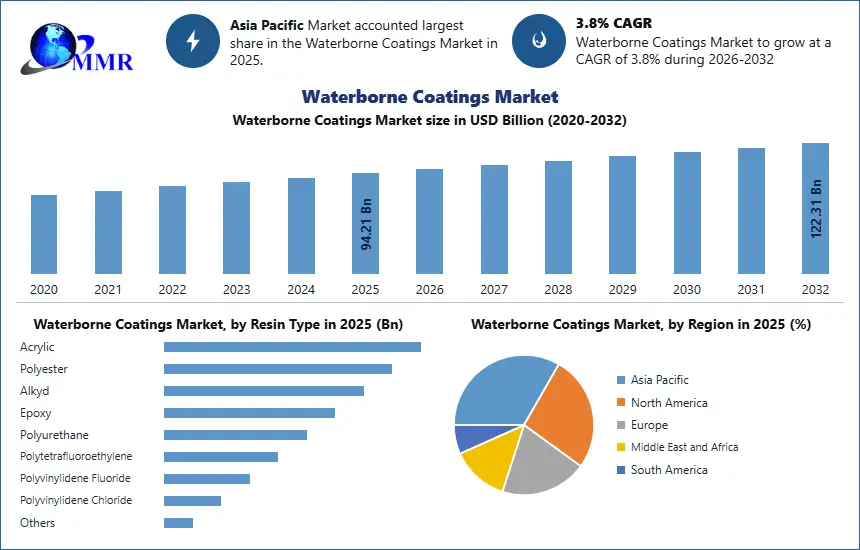
To know about the Research Methodology :- Request Free Sample Report
Waterborne Coatings Market Dynamics:
Rising Awareness for VOC-free coatings and stringent environmental regulations
One of the most significant trends observed in the coatings industry over the last few years has been the increasing demand for environmentally friendly properties, which has been heavily influenced by stringent EU regulations governing the reduction of volatile organic compound (VOC) emissions from coating materials. The European Commission and other federal government organizations are implementing new laws and regulations, such as the Eco-product Certification Scheme (ECS). These standards promote a green and sustainable environment by limiting or eliminating dangerous VOC emissions. Additionally, government laws in the United States and Western Europe, particularly about air pollution, are expected to drive the utilization of innovative, low-polluting coating technologies.
As people become more aware of the adverse effects of VOC emissions, there has been a steady change in demand away from solvent-borne coatings and toward more environmentally friendly solutions such as waterborne coatings, which contain fewer solvents that evaporate during the curing process. The Asia Pacific region is expected to be the largest and fastest-growing market for waterborne coatings. This can be attributable to the region's fast-increasing automobile and construction sectors. Regulations that are less severe in the region are also driving the market growth.
Rising usage of waterborne coating in automotive industries
Rising automotive production and sales globally due to improved economic growth are expected to drive demand for waterborne coatings during the forecast period. Automobile coatings have become one of the most significant markets in recent years, and they play an essential role in the automotive sector. Polyurethane coating is frequently utilized in automotive applications as a high-performance topcoat binder. Due to their strong adhesion and corrosion resistance capabilities, epoxy coatings are also utilized as a primer on the layer underneath the topcoat.
Waterborne Coatings required prolonged time to dry
The Waterborne coatings require a prolonged time to dry and cure than solvent-borne coatings. Waterborne coatings have good flow characteristics that fluctuate with humidity, influencing coating application. Water does not easily evaporate in high humidity circumstances, resulting in poor cure and decreased effectiveness. Waterborne coatings are likewise susceptible to freezing temperatures, and many are rendered ineffective after freezing.
Expensive Waterborne coatings restrain the market growth
The raising prices of waterborne coatings and the poor and ineffective performance of solvent coatings are major elements expected to restrict the global market growth during the forecast period. This is related to price fluctuations in raw ingredients required to make aqueous coatings. Additionally, another issue restraining growth is the creation of foam during the manufacturing process of waterborne technology, which may be damaging to the environment.
Lucrative Opportunities in emerging economies
Emerging economies are making significant investments in infrastructure and other long-term initiatives. Those in these economies are growing rapidly in comparison to markets in North America and Western Europe, as major corporations spend heavily to capitalize on prospects in these economies. The Asia Pacific market, particularly in China and India, is providing considerable potential for resin and waterborne coating businesses.
The rising disposable income and purchasing power of the populations in the Asia Pacific and other growing regions is driving up investment in the construction, automobile, electronics and electronics, consumer goods, and appliances industries. Waterborne coating resin manufacturers may benefit from the economic growth of rising economies such as China, India, Russia, and Brazil, which are investing heavily in the architecture, automobile, electricity, and other industrial sectors.
Enforcement of stringent regulatory policies
As a result of the growing number of environmental legislation adopted by various governments, coatings manufacturers must continually develop their processes to comply with the new policies. Products that do not fulfill legal standards are not allowed to be used in nations with rigorous environmental rules, particularly in Western Europe and North America. The concentration method also overlooks the lower air emissions caused by low-VOC coatings.
Waterborne Coatings Market Segment Analysis:
By Resin Type, the Acrylic segment dominated the Waterborne Coatings market with the highest market share in 2025 and is expected to maintain its dominance at the end of the forecast period. Acrylic-based resins are thermoplastic resins that are created by polymerizing acrylate or methacrylate monomers. To lower costs, some acrylic resins can additionally incorporate vinyl monomers such as styrene or vinyl acetate. These resins offer hydrolysis resistance, exceptional weather resistance, great gloss, and color retention, making them ideal for external applications. They also offer additional features including transparency, UV resistance, and good color ability for coating solutions.
Acrylic resins are used in solvent-borne paints. Solution polymerization products can also be used to create water-borne acrylic dispersions and powder coatings for architectural purposes. These resins are used to minimize VOC emissions in water-borne systems. The use of these acrylic resins might result in high surface hardness. Acrylic coatings are utilized in a variety of applications, including walls, roofs, and decks, to produce elastomeric surfaces that increase the surface's UV resistance. Acrylic coatings are mostly used in the construction sector for high-finishing on roads, bridges, floors, and decks, among other things.
Acrylic-based paints and coatings are also used on marine ships and buildings, electrical items, equipment, and other metal products. Water-based coatings are expected to dominate the acrylic resin market due to fewer environmental issues, such as VOC emissions, which impair air quality. All of the aforementioned reasons are expected to increase market demand throughout the forecast period.
As a crucial component of coating, the resin has received a lot of attention. Traditional solvent-based resins utilize similar organic volatile solvents to decrease the viscosity of resins. However, as awareness of environmental issues has grown, governments throughout the world have enacted stringent environmental regulations and policies that prohibit the emission of volatile organic compounds (VOCs), restricting the development of conventional solvent-based coatings.
Replace conventional solvent resins with waterborne resins, which primarily employ water as a solvent or dispersion and can dramatically reduce VOC emissions. Meanwhile, in the manufacturing and transportation processes, the waterborne resin has the advantages of being nonflammable and pollution-free, and it is gaining popularity. Waterborne resins come in a variety of forms, with waterborne acrylic resin being one of the most common. It is used in a variety of applications, including locomotives, ships, containers, bridges, and the military industry.
Acrylic resin is made from acrylate or methacrylate as the primary monomers and has high light, heat, and chemical stability. As a result, the acrylic resin coating has outstanding low cost, weather resistance, pollution resistance, and acid and alkali resistance. For the waterborne acrylic resin to disperse properly, hydrophilic groups must be incorporated into the synthesis process, resulting in the production of water and air that may easily penetrate the resin molecules. Thus, aqueous acrylic resin has several drawbacks, such as low solid content, poor water resistance, poor corrosion resistance, compactness, and so on. These limitations hinder its applicability and restrict the segment's growth.
Waterborne Coatings Market Regional Insights:
The Asia-Pacific region held the largest revenue share of about 40% in 2025 and is expected to dominate the market at the end of the forecast period. The Asia Pacific area has a diversified variety of economies with varying levels of economic development and a wide range of sectors. The strong growth rate and considerable investments across businesses in automotive, consumer goods and appliances, building and construction, and furniture are significant components of economic growth. It is one of the fastest-growing regions in terms of waterborne coatings production and demand. The Asia Pacific market is expected to develop at a rapid pace over the next five years, providing considerable commercial potential for waterborne coatings industry participants.
China is expected to lead the APAC market at the end of the forecast period. China is well-known across the world for its architectural development. The need for low-cost homes and commercial housing has driven its recent growth. With increased government investment, China's real estate sector has grown rapidly. Construction growth is expected to benefit the country's paints and coatings business.
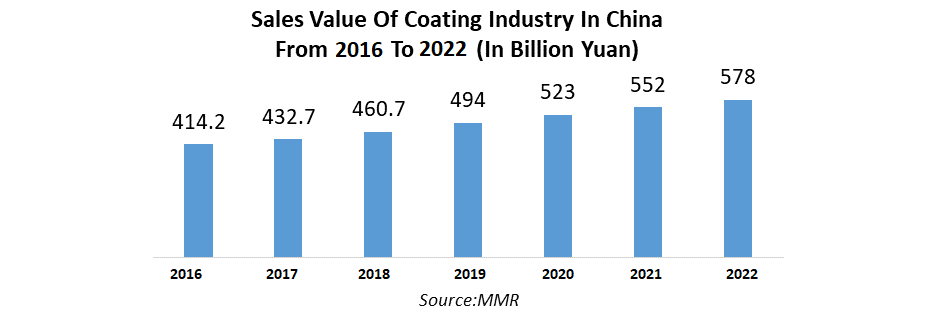
The investments in the transport industry increased in the near past. The Chinese government has spent over USD 72 billion on transportation projects such as railways, motorways, rivers, airports, and urban rail. The investment plan would improve the country's connection between key cities, which would benefit the region's overall economic and social growth. Commercial vehicle and automobile production are declining in the automotive sector. However, as electric vehicles become more popular, demand for waterborne coatings is expected to increase throughout the forecast period.
The North American region is expected to grow rapidly during the forecast period for the Waterborne Coatings market. The growth is attributed to the presence of the major competitors in the market. For Example, in , The Sherwin-Williams Company (US) dominated the global waterborne coatings market. It has a diverse product portfolio and has made many investments in capacity expansion and the construction of new plants. Customers can select from a wide range of aqueous coatings. It has a robust network for distributing and producing coatings across the US, Canada, Mexico, and China, with 15 manufacturing and 79 facility sites to satisfy the changing demands of the paints and coatings business globally.
The Middle East and Africa market is expected to grow at a moderate rate during the forecast period, owing to increased building and construction activities and infrastructure projects in the region, improved quality of industrial manufacturing in developing countries, and the need for coated product protection.
Waterborne Coatings Market Scope: Inquire before buying
| Waterborne Coatings Market | |||
|---|---|---|---|
| Report Coverage | Details | ||
| Base Year: | 2025 | Forecast Period: | 2026-2032 |
| Historical Data: | 2020 to 2025 | Market Size in 2025: | 94.21 USD Billion |
| Forecast Period 2026-2032 CAGR: | 3.8% | Market Size in 2032: | 122.31 USD Billion |
| Segments Covered: | by Resin Type | Acrylic Polyester Alkyd Epoxy Polyurethane Polytetrafluoroethylene Polyvinylidene Fluoride Polyvinylidene Chloride Others |
|
| by Application | Architectural Residential Non-Residential Industrial Automotive General Industrial Protective Wood Marine Packaging Coil Others |
||
Waterborne Coatings Market, by Region
North America (United States, Canada and Mexico)
Europe (UK, France, Germany, Italy, Spain, Sweden, Austria and Rest of Europe)
Asia Pacific (China, South Korea, Japan, India, Australia, Indonesia, Malaysia, Vietnam, Taiwan, Bangladesh, Pakistan and Rest of APAC)
Middle East and Africa (South Africa, GCC, Egypt, Nigeria and Rest of ME&A)
South America (Brazil, Argentina Rest of South America)
Waterborne Coatings Market, Key Players
1. BASF SE
2. AkzoNobel N.V.
3. PPG Industries Inc.
4. RPM International Inc.
5. The Sherwin-Williams Company
6. Asian Paints Limited
7. Axalta Coating Systems LLC.
8. Nippon Paint Holdings Co. Ltd.
9. Kansai Paint Co. Ltd.
10.Jotun Group.
11.Benjamin Moore & Co.
12.Berger Paints India Limited
13.Hempel Group
14.Jotun
15.KCC CORPORATION
16.PPG Industries
17.Sika AG
18.Covestro AG
19.Dow
20.Solvay
21.SILBERLINE MANUFACTURING CO.
22.Hexion
23.The Lubrizol Corporation
24.Eastman Chemical Company
FAQs:
1. Which is the potential market for Waterborne Coatings in terms of the region?
Ans. In Asia-Pacific region, the growing business and educational sectors are expected to help drive the use of collaborative screens.
2. What are the opportunities for new market entrants?
Ans. The key opportunity in the market is new initiatives from governments that provide funding for Waterborne Coatings in educational institutes
3. What is expected to drive the growth of the Waterborne Coatings market in the forecast period?
Ans. A major driver in the Waterborne Coatings market is the prevalence of work from home and remote collaboration created by the COVID-19 pandemic
4. What was the Global Waterborne Coatings Market size in 2025?
Ans: The Global Waterborne Coatings Market size was USD 94.21 Billion in 2025.
5. What segments are covered in the Waterborne Coatings Market report?
Ans. The segments covered are Resin Type, Application and, Region.