
Water Purifier Market by Technology, End-User, Portability, Distribution Channel and Region – Global Market Size Estimation, Industry-Wide Analysis, Competitive Landscape Assessment & Long-Term Forecast to 2032
Overview
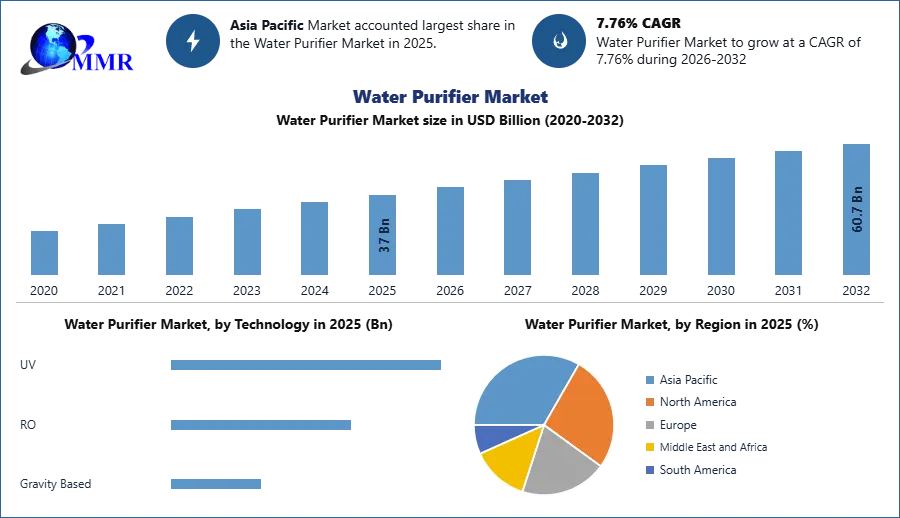
The Water Purifier Market size was valued at USD 37 Billion in 2025 and the total Water Purifier revenue is expected to grow at a CAGR of 7.5% from 2026 to 2032, reaching nearly USD 60.7 Billion.
The water purifier industry plays an important role in addressing the global concern of providing safe and clean drinking water. Water purifiers, distinct from simple filters, not only eliminate impurities but also take a step further by eliminating biological contaminants and extracting minerals from water. According to trade data from 2021, water filtering or purifying machinery was the 317th most traded product globally, accounting for 11.4 billion in total trade. The sector experienced an 11.6% growth in exports from 2020 to 2021, reaching 11.4 billion.
To know about the Research Methodology :- Request Free Sample Report
There is an increasing demand for high-quality smart water purifiers due to the serious health risks associated with living in environments that are heavily contaminated. These advanced systems employ sophisticated decontamination processes to eliminate pollutants and microorganisms, ensuring the safety of the water supply. Technological advancements in the field have given rise to the smart water purifier market that leverages Internet of Things (IoT) technology, enabling connectivity to the Internet for data exchange. This integration facilitates features such as remote monitoring, filter replacement alerts, and real-time water quality analysis. Users usefully manage their purifiers through smartphone apps or voice-activated devices, enhancing ease of use and performance optimization. The incorporation of Artificial Intelligence (AI) into smart water purifiers allows continuous learning and adaptation to specific water conditions and usage patterns. AI algorithms optimize filtration processes, adjust purification settings based on water quality, and predict filter lifespan. This intelligent operation not only improves efficiency but also minimizes water wastage, which increases water purifier market demand globally.
1. Urban Company launches latest line of intelligent RO water purifiers, unveiled under the sub-brand Native. The Native M1 and M2 models have been intricately designed to furnish households with clean and secure drinking water. These purifiers are equipped with state-of-the-art technology and premium-quality filters, setting them apart in terms of performance in October 11, 2023.
2. March 22, 2022 — LG Electronics marks a milestone with the introduction of their pioneering UF+UV Water Purifier. Engineered to guarantee safe drinking water, LG's UF+UV Water Purifier features a specialized filter for heavy metal removal, instilling confidence in every sip. The innovative ultrafiltration technology of the LG UF+UV Water Purifier ensures no water wastage, prioritizing efficiency and sustainability.
Future trends in the smart water purifier market are expected to focus on advanced filtration technologies to address emerging contaminants, including nanotechnology, electro-absorption, and hybrid filtration systems. These innovations effectively remove micropollutants, pharmaceutical residues, heavy metals, and emerging contaminants such as microplastics, ensuring the highest level of water purity. Sustainability and energy efficiency are also at the forefront of future developments in the water purifier industry. The water purifier Manufacturers are increasingly designing purifiers that minimize water wastage, optimize energy consumption, and use eco-friendly materials. This eco-conscious approach aligns with the growing global emphasis on sustainability and reducing environmental impact.
Government initiatives in water-scarce countries, through various campaigns and partnerships, contribute to raising awareness about the importance of safe drinking water. The scarcity of potable water resources worldwide further propels the demand for the water purifier market.
The increasing recognition of the advantages associated with consuming clean water, alongside factors such as urbanization, industrialization, government initiatives, and awareness campaigns, is propelling the worldwide market. Additionally, the rise in water-borne diseases, particularly in developing nations, is serving as an additional catalyst for market growth. The comprehensive global water purifier’s market report offers a detailed analysis of key market segments, trends, drivers, constraints, the competitive landscape, and influencing factors.
Water Purifier Market Dynamics:
Global Water Purifier Market Surges in Response to Urgent Need for Safe Drinking Water and Regulatory Standards
The global demand for water purifier market is significantly driven by the urgent need to address the widespread lack of access to safe drinking water, as highlighted by the World Health Organization (WHO) and UNICEF. In 2019, 2.2 billion people faced challenges in obtaining safe drinking water, contributing to an alarming 88% of the annual four billion cases of worldwide diarrhea, primarily attributed to inadequate access to safe water sources (United Nations, n.d.; Schroth, Lanfair, & Ambulkar, n.d.).
The Graphil project further underscores the market driver by responding to this pressing issue through the development of an innovative microfiltration membrane. This membrane, set to hit the market in 2025, is designed for easy integration into household sinks or as a portable purification device. Capable of removing contaminants, pesticides, heavy metals, and dangerous pathogens, it directly addresses the need for enhanced water purification solutions. Moreover, stringent regulations and standards set by environmental agencies, such as the United States Environmental Protection Agency (EPA) and the European Union Drinking Water Directive, propel the demand for water purifiers. Recent updates to EU rules on drinking tap water emphasize enhanced quality standards and minimum hygiene requirements, fostering a conducive market environment (European Drinking Water, n.d.).
On a global scale, initiatives such as the U.S. Global Water Strategy and the Jal Jeevan Mission in India reflect significant governmental investments in water security and infrastructure. The U.S. Global Water Strategy, mandated by the Water for the World Act of 2014, aims to improve health, prosperity, stability, and resilience by addressing water-related challenges. Simultaneously, India's Jal Jeevan Mission, with a substantial financial outlay, aims to provide potable tap water to every rural household by 2025, thereby driving the adoption of water purification technologies. In addition, the National Rural Drinking Water Programme (NRDWP) in India, which financially supports the construction of water treatment plants, and the mandatory Bureau of Indian Standards (BIS) certification for drinking water treatment plants further contribute to the growing market for water purifiers. These water purifier market policies and standards create a favorable landscape for companies operating in the water purification industry by emphasizing the importance of adherence to quality and safety measures in water treatment processes.
IoT and AI Propel Future-Ready Purifiers for Purer, Healthier Living
The water purifier market is witnessing a transformative trend with the rise of connected water filters, marking a significant evolution in smart home devices. These filters, equipped with Internet of Things (IoT) capabilities, are redefining water purification by providing continuous data to app platforms. Beyond monitoring water quality, they offer insights into daily water consumption, showcasing the potential for comprehensive integration into municipal settings.
The prospect of deploying sensors across municipal water systems presents an opportunity to not only immediately detect contaminants but also to enhance water level monitoring, ensuring widespread access to safe water in entire communities. Smart water purifiers, at the forefront of this trend, seamlessly combine cutting-edge water purification technology with IoT capabilities, resulting in efficient and intelligent water filtration. These purifiers typically feature multiple filtering stages employing various technologies like activated carbon, sediment removal and reverse osmosis to eliminate pollutants, toxins, and pathogens. The integration of IoT allows these purifiers to communicate with smartphones or centralized control systems over the internet.
The benefits of smart water purifiers market are extensive, encompassing improved water purity, convenience, and overall well-being. With real-time monitoring, smartphone connectivity, and configurable settings, these purifiers guarantee clean and wholesome drinking water. Not only do they eliminate impurities that regular filters might miss, but they also offer hands-free control through voice assistants, enhancing user convenience. The integration of artificial intelligence (AI) further elevates the capabilities of smart water purifiers. AI algorithms continuously learn and adapt to specific water conditions and usage patterns, optimizing filtration processes, adjusting purification settings, and predicting filter lifespan. This intelligent operation enhances efficiency, minimizes water wastage, and ensures optimal performance.
Looking ahead, the future of smart water purifiers market involves the integration of advanced filtration technologies to address emerging contaminants. Technologies such as nanotechnology, electro-absorption, and hybrid filtration systems are expected to be integrated into these purifiers, effectively removing micropollutants, pharmaceutical residues, heavy metals, and emerging contaminants like microplastics, ensuring the highest level of water purity. The recent advancement in the water purifier industry is marked by the utilization of IoT and AI technologies to map water quality in cities and provide customized solutions. This approach acknowledges the dynamic nature of water quality, illustrated by variations observed in areas like Electronic City in Bengaluru. The ability to customize water purifiers based on real-time data ensures an adaptive and effective solution to the fluctuating water quality levels in different regions, making these technological advancements a cornerstone in addressing the diverse challenges of water purification.
Consumers Look for Sustainable and Eco-friendly Solutions
The water purifier market is presented with a compelling opportunity as a result of a shifting consumer landscape influenced by rising environmental awareness and water quality concerns. The environment has emerged as a significant motivator for people to filter their drinking water. This concern is especially significant in the United States, where a growing proportion of the population believes that global warming has been overstated, which indicates increased environmental consciousness.
The rise in environmental awareness has led to a transformation in consumer behavior, favoring eco-friendly products. The "Eco-wakening" is particularly marked in the water purifier market as consumers increasingly select water filters over disposable plastic bottles, aligning with their desire to reduce environmental impact. The alarming statistics on plastic bottle usage, landfill contributions, and decomposition time highlight the environmental benefits of switching to water filters. In 2019 alone, water filtration systems displaced over 1.2 billion single-use plastic bottles, emphasizing the water purifier market potential to address environmental concerns. Apart from environmental considerations, the lack of trust in the quality of drinking water is another significant driver for the water purifier market, constituting the third highest motivation at 37%. Even with public tap water undergoing regular testing and treatment, consumers express dissatisfaction with environmental standards and are wary of potential recontamination during water transit from treatment facilities to homes.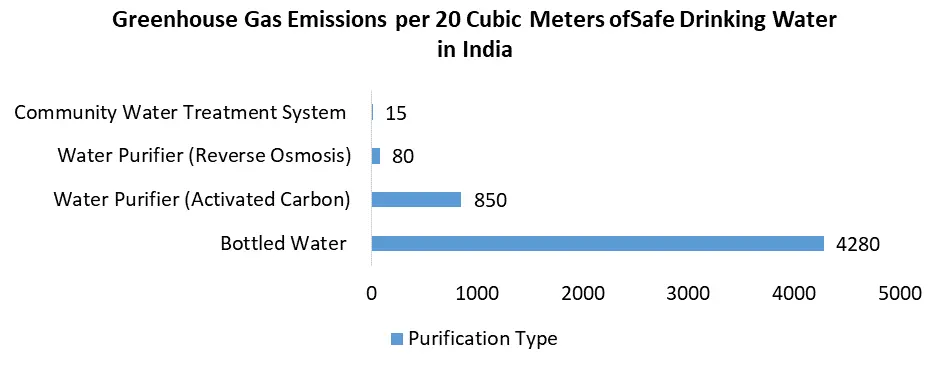 The evolving dynamics of trust and knowledge in water quality are significant water purifier market influencers. The water purifier market is poised for substantial growth driven by the "Eco-wakening," increased awareness of water quality, and a changing consumer preference for sustainable and trustworthy drinking water solutions. The convergence of environmental consciousness, health considerations, and evolving consumer behaviors positions water purifiers as a pivotal player in the broader context of clean water consumption.
By End-User, the water purifier market is segmented into commercial and residential, and residential is expected to dominate the water purifier market during the forecast period. Industrial water filters play a crucial role in diverse industrial applications, enhancing the overall efficiency of industrial operations. Employed across institutional, municipal, and industrial settings, these filters are essential components of the industrial process. Whether facing varying weather conditions or different climate scenarios, industrial water filters demonstrate resilience. However, it is imperative to choose the appropriate water tanks, filters, or valves to ensure optimal performance. The equipment utilized in these water filters holds significant prominence within the industrial landscape, offering versatility and utility across a spectrum of filtration needs.Notable investments in water purification infrastructure, such as the USD 170.0 billion by water companies in England and Wales, exemplify the commitment to enhancing water quality and ecosystem preservation. The implementation of innovative solutions, like the modular membrane system in California's Orange County Water District, has expanded microfiltration capacity, resulting in tangible improvements in Californian industrial water purification and a subsequent boost in demand for the industrial water purifiers market.
Across developed and developing countries, there is a primary focus on industrial water treatment and water recycling initiatives. Countries like Australia and Israel have made strides in wastewater reuse, with Australia reporting a 20% reuse rate in 2015 and Israel an impressive 70%. In African countries such as Senegal, Ghana, Kenya, and Egypt, investments in green economy policies are propelling the industrial water treatment market, concurrently driving the demand for industrial water purifiers in the region.
In regions like China and India, where water pollution levels are high, government initiatives such as the amendment of 300 environmental regulations and standards for industrial discharge in China are fostering the adoption of advanced industrial purifiers to meet environmental standards. The rising awareness of hygiene and health, coupled with strong government policies, is expected to further accelerate the growth of the industrial water purifier market. The industry stands at the forefront of addressing water contamination challenges, contributing to a sustainable and healthier future.
Water Purifier Market Regional Insights:
Asia Pacific is expected to dominate the water purifier market during the forecast period. In 2025, the global water purifier market exhibited diverse trade dynamics, with China leading in exports at USD 1.95 billion, followed by Germany (USD 890 million), South Korea (USD 820 million), Italy (USD 610 million), and Israel (USD 230 million). Conversely, the United States dominated imports at USD 620 million, accompanied by Malaysia (USD 265 million), Russia (USD 240 million), Saudi Arabia (USD 215 million), and Vietnam (USD 198 million).
China's water purifier market has gained substantial momentum due to deteriorating water quality driven by rapid industrialization and urbanization. The introduction of a wide range of water purifying products has further fueled market growth. The escalating water pollution crisis, affecting over half of China's population, has propelled the demand for water purifiers, with more than 70% of rivers, lakes, and waterways being reported as polluted. The China market is characterized by intense competition, with players like Xiaomi launching innovative products such as the Mi Water Purifier H600G and the Mi Desktop Water Dispenser.
India water purifier market is experiencing robust growth fueled by increasing consumer awareness, affordability, and a rising emphasis on clean water. Penetrating lower-income groups and rural households, water purifiers address health concerns, the expanding middle-class population, and the prevalence of fluoride and arsenic in water. In the context of increasing water pollution and the economic conditions affecting access to pure water, the market is flourishing, with growth expected in the forecast period. The region, including China, India, and Bangladesh, is witnessing a surge in water purifier sales due to heightened water pollution awareness, rising disposable incomes, and significant price differences between organized and unorganized players.
Vietnam water purifier market is experiencing significant growth, driven by factors such as growing health consciousness, a shortage of clean drinking water, and the availability of advanced and affordable water purifiers. The use of IoT and AI technologies to map water quality in cities is a recent advancement, providing customized solutions based on real-time data. Vietnam, with its uneven rainfall and insufficient infrastructure, witnesses a scarcity of drinking water, making water filtration imperative for consumption.
South Korea water purifier market is poised for robust growth, propelled by factors like industrial waste in rivers, rising health concerns, and the variety of water purifying filters available. Government support for water filtration and stringent parameters for monitoring chemical levels in tap water have heightened the role of membrane filters in the South Korean water purifier industry. The market is further stimulated by growing tie-ups for research and development, exemplified by Siemens and LG Electronics Inc.'s collaboration to create smart factories, enhancing manufacturing efficiency and reducing failure rates. The South Korean government's implementation of policies for safe tap water further emphasizes the importance of water filtration systems.
The regional analyses indicate unique market trends and drivers, reflecting the diverse challenges and opportunities in the global water purifier market. From the urgency to combat water pollution in China to the affordability and awareness-driven growth in India and the innovative advancements in Vietnam and South Korea, each region contributes distinct factors shaping the industry's trajectory.
Water Purifier Market Scope: Inquiry Before Buying
| Water Purifier Market | |||
|---|---|---|---|
| Report Coverage | Details | ||
| Base Year: | 2025 | Forecast Period: | 2026-2032 |
| Historical Data: | 2020 to 2025 | Market Size in 2025: | 37 USD Billion |
| Forecast Period 2026-2032 CAGR: | 7.76% | Market Size in 2032: | 60.7 USD Billion |
| Segments Covered: | by Technology | UV RO Gravity Based |
|
| by Portability | Portable Non Portable |
||
| by End User | Commercial Residential |
||
| by Distribution Channel | Retail Stores Direct Sales Online |
||
Water Purifier Market, by Region:
North America (United States, Canada, and Mexico)
Europe (UK, France, Germany, Italy, Spain, Sweden, Austria, and the Rest of Europe)
Asia Pacific (China, South Korea, Japan, India, Australia, Indonesia, Malaysia, Vietnam, Taiwan, Bangladesh, Pakistan, and the Rest of APAC)
Middle East and Africa (South Africa, GCC, Egypt, Nigeria, and the Rest of ME&A)
South America (Brazil, Argentina Rest of South America)
Key players / Competitors profiles covered in the Water Purifier Market report in strategic perspective
Kent RO Systems Ltd India
Eureka Forbes Ltd India
Panasonic Corporation Japan
A. O. Smith Corporation USA
3M Company USA
LG Electronics Inc. South Korea
Honeywell International Inc. USA
Whirlpool Corporation USA
Coway Co., Ltd. South Korea
Aquasana Inc.USA
Blue Star Limited India
Pentair plc United Kingdom
Brita GmbH Germany
Tata Chemicals Limited India
Xiaomi Corporation China
Unilever PLC United Kingdom
Haier Smart Home Co., Ltd China
Beko (Arçelik A.Ş.) Turkey
Midea Group Co., Ltd China
Koninklijke Philips N.V. Netherlands
Amway Corporation USA
Sharp Corporation Japan
Livpure Smart Homes Pvt. Ltd India
Nasaka Water Filters India Pvt. Ltd India
Culligan International Company USA
Enagic International Inc. Japan
Hydroflux Engineering Pvt Ltd Australia
Dow Water & Process Solutions USA
Karcher Futuretech GmbH Germany