
US Zero Trust Security Market – Analysis by Security Type, Authentication Type, Deployment Model, Industry Vertical and Regional Insights 2034
Overview
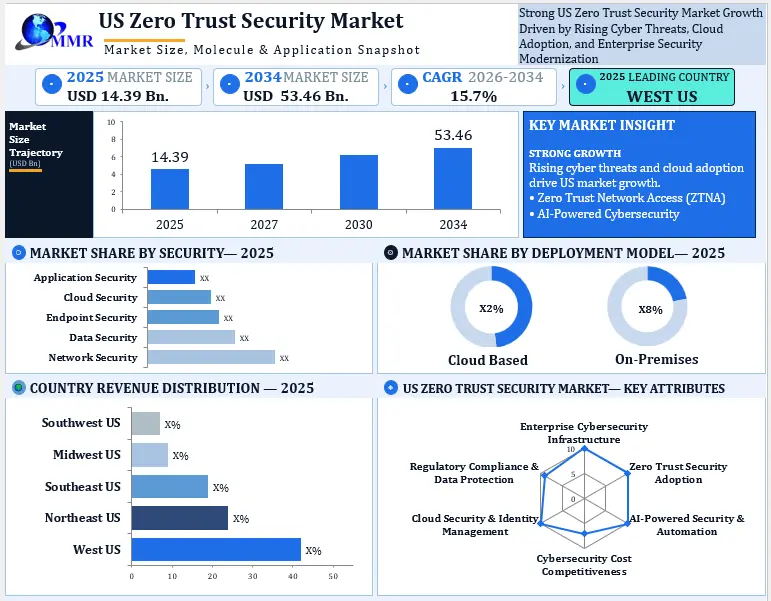
The US Zero Trust Security Market was valued at USD 14.39 Billion in 2025 and is projected to reach USD 53.46 Billion by 2034, growing at a CAGR of 15.7% during the forecast period 2026–2034.
| Parameter | Value |
| Market Size (2025) | USD 14.39 Billion |
| Market Size (2034) | USD 53.46 Billion |
| CAGR | 15.7% |
| Historical Period | 2020 to 2025 |
| Forecast Period | 2026 to 2034 |
| Leading Country | United States |
| Leading Key Players | Microsoft Corporation, Palo Alto Networks, Cisco Systems Inc., Zscaler Inc., Okta Inc. |
US Zero Trust Security Market Overview
The US Zero Trust Security Market focuses on advanced cybersecurity solutions that continuously verify user identities, devices, and network access to protect sensitive enterprise data. Zero Trust Security follows the principle of “never trust, always verify” and strengthens cloud security, identity and access management (IAM), endpoint security, and Zero Trust Network Access (ZTNA). Increasing cyber threats, ransomware attacks, cloud adoption, and hybrid work environments drive US Zero Trust Security Market growth. Banking, healthcare, government, IT, and telecommunications industries adopt Zero Trust Architecture to prevent unauthorized access, improve data protection, and maintain regulatory compliance.
The US Zero Trust Security Market trends highlight increasing adoption of AI-powered threat detection, multi-factor authentication (MFA), micro segmentation, and Secure Access Service Edge (SASE) solutions. Federal cybersecurity initiatives and NIST security frameworks support Zero Trust implementation across public and private organizations. Major buyers include federal agencies, financial institutions, healthcare providers, and large enterprises. Significant Zero Trust Security Market opportunities emerge in cloud-based security, identity protection, and managed cybersecurity services. The United States leads North American market demand, with California, Virginia, New York, and Texas serving as major cybersecurity technology hubs. Leading Zero Trust Security Market companies include Microsoft, Cisco Systems, Palo Alto Networks, Zscaler, Okta, and Cloudflare, which provide enterprise identity security, secure network access, and cloud protection solutions.
US Zero Trust Security Market Size, Growth & Share Analysis
To know about the Research Methodology :- Request Free Sample Report
Maximize Market Research (MMR) analysis identifies cloud migration, increasing cybersecurity investments, regulatory requirements, and enterprise digital transformation as major US Zero Trust Security Market growth drivers. The research examines market segmentation by authentication type, deployment model, solution, and industry vertical while evaluating competitive positioning and technology adoption. Cloud-based Zero Trust solutions, continuous authentication, and AI-driven security platforms create opportunities for cybersecurity providers and enterprise technology vendors. The US Zero Trust Security Market outlook emphasizes scalable security infrastructure, automated threat prevention, and integrated identity management as key factors influencing industry development and long-term investment opportunities.
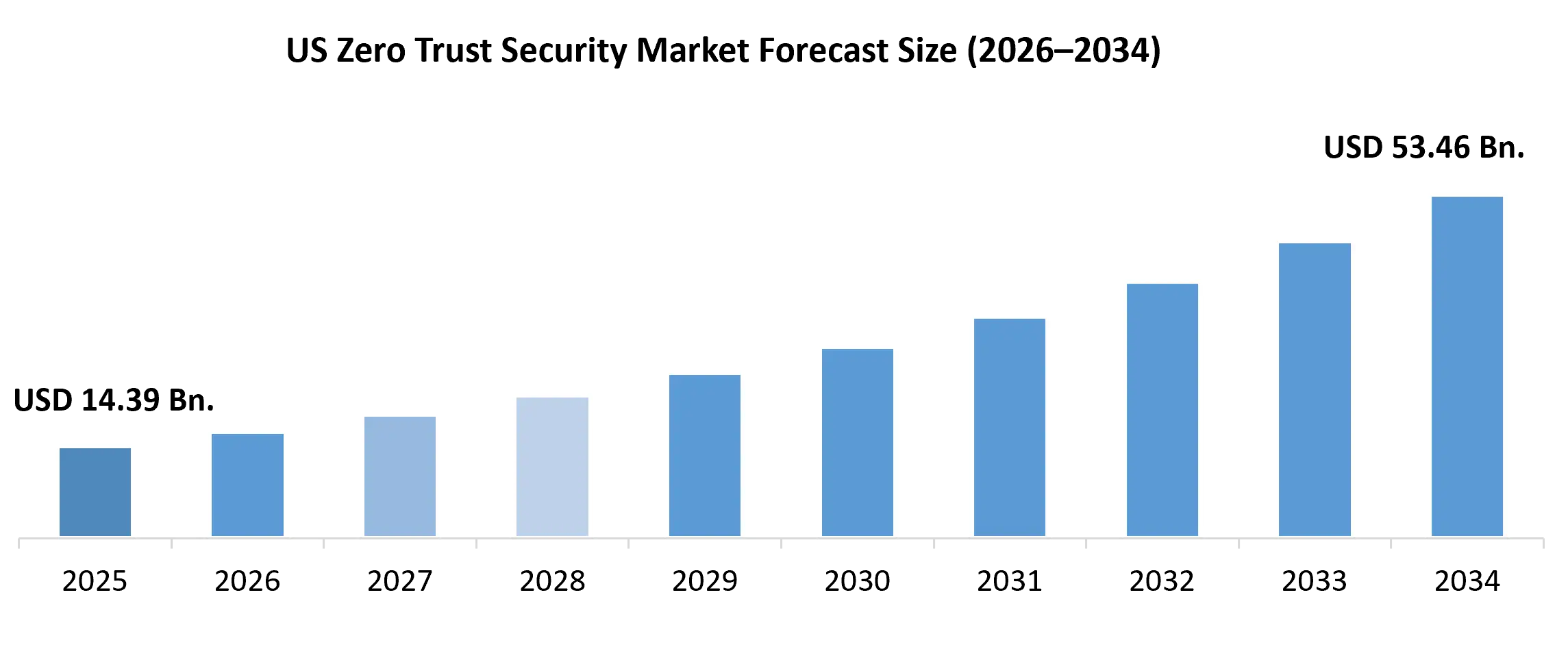
US Zero Trust Security Market Forecast Size (2026–2034)
| Year | Market Size | Growth Rate (YoY) |
| 2026 | USD 16.65 Bn. | 15.7% |
| 2027 | USD 19.26 Bn. | 15.7% |
| 2028 | USD 22.29 Bn. | 15.7% |
| 2029 | USD 25.79 Bn. | 15.7% |
| 2030 | USD 29.83 Bn. | 15.7% |
| 2031 | USD 34.52 Bn. | 15.7% |
| 2032 | USD 39.94 Bn. | 15.7% |
| 2033 | USD 46.21 Bn. | 15.7% |
| 2034 | USD 53.46 Bn. | 15.7% |
 US Zero Trust Security Market Key Highlights
• Strong Market Expansion: The US Zero Trust Security Market reaches USD 53.46 Billion by 2034, growing from USD 14.39 Billion in 2025 at a CAGR of 15.7%.
• Rising Cyber Threats Accelerate Adoption: Increasing ransomware attacks, data breaches, and identity theft drive demand for Zero Trust Architecture, ZTNA, and enterprise cybersecurity solutions.
• AI-Powered Security Transforms Enterprise Protection: Growing adoption of AI-driven threat detection, passwordless authentication, and continuous identity verification reshapes the US Zero Trust Security Market.
• Federal Cybersecurity Modernization Strengthens Demand: Government security initiatives and CISA's five-pillar Zero Trust framework support investments in identity security, endpoint protection, and network micro segmentation.
• Cloud Security Creates High-Value Opportunities: Expanding hybrid cloud infrastructure and demand for SASE, SSE, managed Zero Trust Security services, and cloud-native cybersecurity platforms create new opportunities for leading security providers.
US Zero Trust Security Market Dynamics
Market Drivers
Rising Data Breach Costs Accelerate US Zero Trust Security Market Growth
The US Zero Trust Security Market experiences increasing demand as enterprises strengthen protection against ransomware, credential theft, data breaches, and unauthorized network access. Growing financial losses associated with cyberattacks encourage banking, healthcare, retail, and technology companies to invest in Zero Trust Network Access (ZTNA), multi-factor authentication (MFA), and identity threat detection solutions. Organizations prioritize continuous identity verification, least-privilege access, and advanced network security to reduce cyberattack exposure and protect business-critical applications. Increasing cybersecurity investments and enterprise demand for secure digital infrastructure support US Zero Trust Security Market growth.
Five-Pillar Federal Security Framework Accelerates Zero Trust Architecture Adoption
Federal cybersecurity modernization represents a major US Zero Trust Security Market growth driver, increasing demand for enterprise security infrastructure and identity-based access controls. The CISA Zero Trust Maturity Model defines five security pillars: Identity, Devices, Networks, Applications and Workloads, and Data, supported by visibility, automation, and governance capabilities. Government agencies and federal contractors adopt Zero Trust Architecture, endpoint security, micro segmentation, and continuous authentication services to strengthen digital resilience. The framework encourages cybersecurity investments across multiple security functions rather than relying exclusively on traditional perimeter protection.
Market Restraints
Per-User Security Licensing Costs Restrain Zero Trust Security Market Adoption
Recurring software licensing expenses represent a significant US Zero Trust Security Market restraint, particularly for small and medium-sized enterprises. Microsoft Entra ID P1 carries a published US list price of USD 7 per user per month, while Entra ID P2 costs USD 10 per user per month, both with annual commitments. For an organization with 1,000 licensed users, these rates represent USD 84,000 and USD 120,000 in annual subscription expenditure, respectively, before additional security products and implementation costs. These expenses influence purchasing decisions and limit the affordability of comprehensive Zero Trust Identity Security solutions for budget-sensitive organizations.
Legacy Application Dependencies Restrain Enterprise Zero Trust Security Deployment
Outdated applications and traditional network configurations create significant Zero Trust Security Market restraints because many enterprise systems lack native support for modern authentication and granular access controls. Organizations operating legacy ERP systems, industrial control networks, and older business applications require application proxies, identity federation, and infrastructure modernization. Integrating Zero Trust Security platforms with existing IT environments increases engineering workloads, migration expenses, and deployment timelines. Compatibility limitations discourage rapid adoption among manufacturing companies, healthcare facilities, and enterprises managing complex on-premises infrastructure.
Market Opportunities
AI-Driven Adaptive Authentication Expands Zero Trust Security Market Opportunities
Artificial intelligence creates substantial US Zero Trust Security Market opportunities through adaptive authentication, behavioral risk assessment, and automated access decisions. Enterprises adopt AI-powered Zero Trust Security solutions that evaluate login behavior, device compliance, user risk, and unusual access patterns. Microsoft Entra ID P2, for example, provides risk-based Conditional Access and identity protection capabilities through its USD 10 per-user monthly US subscription tier. Cybersecurity vendors expand their product offerings through intelligent identity analytics, automated risk remediation, and continuous authentication services, creating recurring software revenue opportunities across regulated industries.
Cloud-Native Security Platforms Accelerate Zero Trust Security Service Opportunities
The expansion of hybrid cloud infrastructure creates new Zero Trust Security Market opportunities for Secure Access Service Edge (SASE), Security Service Edge (SSE), and managed Zero Trust Network Access providers. Enterprises increasingly require secure connections between cloud applications, remote employees, branch offices, and third-party contractors. Microsoft Entra Suite, with a published US list price of USD 12 per user per month, demonstrates the commercial packaging of identity protection, network access, governance, and verification capabilities. Demand for consolidated cloud security platforms supports subscription revenue, managed cybersecurity contracts, and enterprise security modernization projects.
Market Challenges
Multi-Vendor Security Integration Challenges Slow Zero Trust Security Implementation
Managing fragmented cybersecurity infrastructure presents a major US Zero Trust Security Market challenge as enterprises combine identity providers, endpoint protection tools, cloud access security brokers, and network monitoring platforms. The CISA maturity framework covers five security pillars and three cross-cutting capabilities, requiring coordinated policy enforcement across multiple technology layers. Organizations face difficulties integrating security telemetry, synchronizing access permissions, and maintaining consistent protection across cloud and on-premises systems. These technical challenges increase demand for unified Zero Trust Security platforms, centralized policy engines, and security orchestration technologies.
Measuring Security Effectiveness Challenges Enterprise Zero Trust Investments
Demonstrating measurable cybersecurity improvements represents another significant US Zero Trust Security Market challenge. Organizations must evaluate whether Zero Trust deployment improves access security, reduces unauthorized activity, and strengthens incident response without disrupting business operations. Security teams monitor operational indicators such as multi-factor authentication coverage, privileged account exposure, device compliance rates, policy violations, and mean time to detect security incidents. However, inconsistent measurement practices and limited integration between security monitoring systems complicate return-on-investment assessments. These challenges increase demand for Zero Trust Security analytics, continuous compliance monitoring, security posture management, and automated reporting services that demonstrate measurable operational value.
US Zero Trust Security Market Trends
| Key Market Trends | Market Impact |
| Zero Trust Adoption in Federal Agencies | Federal cybersecurity modernization increases demand for Zero Trust Architecture and identity-based security solutions. |
| AI Security for Generative AI Applications | Enterprises adopt Zero Trust Security solutions to protect AI models, sensitive prompts, and enterprise AI workloads. |
| Continuous Identity Verification | Risk-based authentication strengthens identity and access management (IAM) and limits unauthorized access. |
| Browser-Based Enterprise Security | Secure enterprise browsers improve Zero Trust Network Security for SaaS applications and remote employees. |
| Third-Party Access Security | Businesses implement Zero Trust Network Access (ZTNA) to secure vendor, contractor, and partner connectivity. |
| Zero Trust for IoT Devices | Connected device security increases demand for device authentication and IoT network segmentation. |
| Unified Security Platform Adoption | Enterprises consolidate cybersecurity tools into integrated Zero Trust Security platforms to simplify management. |
| Automated Access Governance | Automated permission reviews and privileged access controls strengthen enterprise Zero Trust Security. |
US Zero Trust Security Market Segment Analysis
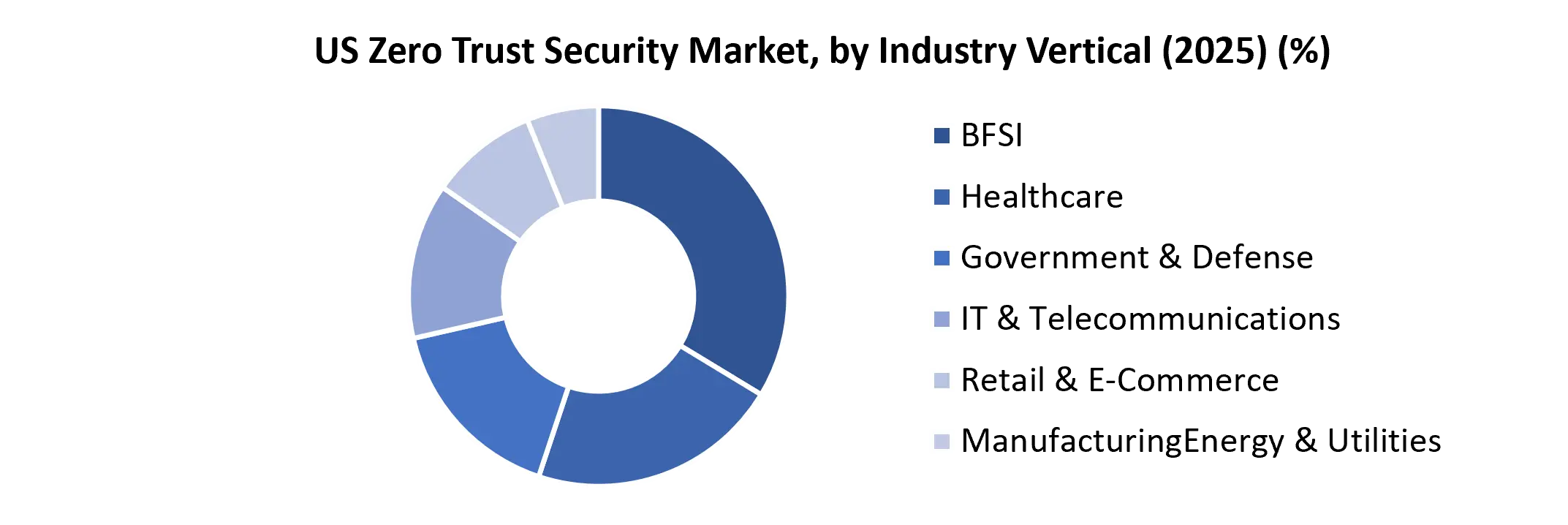
US Zero Trust Security Market Analysis, by Industry Vertical
The US Zero Trust Security Market by Industry Vertical covers BFSI, healthcare, government & defense, IT & telecommunications, retail & e-commerce, manufacturing, energy & utilities, and other industries. The BFSI sector adopts Zero Trust Security solutions to protect financial transactions, digital banking platforms, and sensitive customer data, while healthcare organizations prioritize electronic health records and medical device security. Government and defense agencies implement Zero Trust Architecture to secure critical infrastructure and confidential information. IT and telecommunications companies invest in Zero Trust Network Access (ZTNA) and cloud security to protect distributed networks. Retail and e-commerce businesses strengthen payment security and customer data protection, while manufacturing companies deploy network segmentation to secure industrial control systems. Energy and utilities providers focus on operational technology security and infrastructure resilience. Increasing demand for identity and access management (IAM), multi-factor authentication (MFA), and enterprise cybersecurity solutions supports US Zero Trust Security Market growth across these industry verticals.
US Zero Trust Security Market Analysis, by Authentication Type
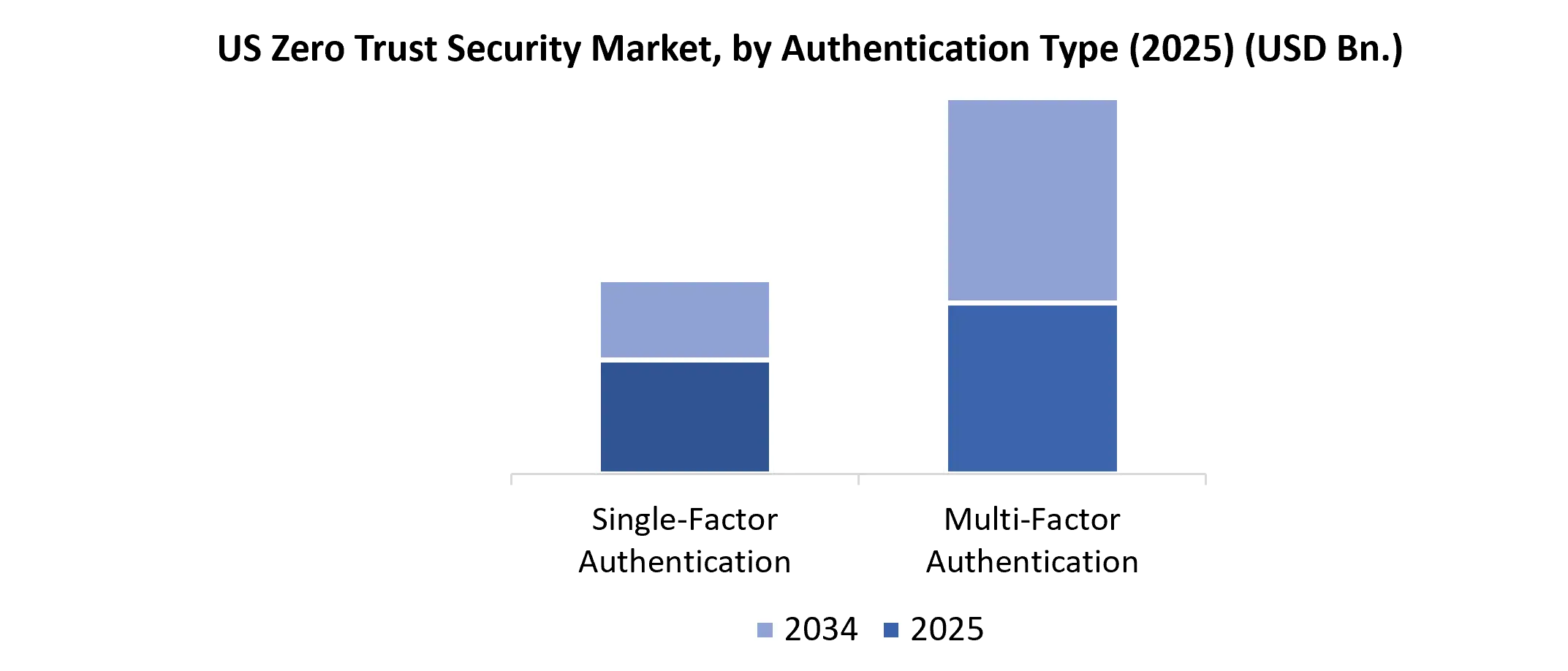
The US Zero Trust Security Market by Authentication Type is segmented into Single-Factor Authentication (SFA) and Multi-Factor Authentication (MFA). Single-Factor Authentication relies on one verification method, such as a password or biometric credential, and remains prevalent in legacy applications and basic access management systems. However, increasing cybersecurity threats and credential-based attacks strengthen demand for Multi-Factor Authentication solutions, which combine two or more independent verification factors, including passwords, security tokens, and biometrics. Enterprises increasingly adopt phishing-resistant MFA, password less authentication, and identity and access management (IAM) solutions to secure employee identities and sensitive business applications. Banking, healthcare, government, and IT organizations prioritize continuous identity verification and risk-based authentication to strengthen Zero Trust Architecture implementation. Growing investment in advanced authentication technologies supports US Zero Trust Security Market growth, improves enterprise access security, and creates opportunities for identity security providers.
US Zero Trust Security Market Regional Analysis
| Region | States | Regional Analysis |
| Western US | California, Washington, Oregon, Arizona | Advanced technology infrastructure, cloud computing, and AI innovation drive demand for Zero Trust Architecture, cloud security, and Zero Trust Network Access (ZTNA). Technology companies increasingly adopt identity-based security, automated threat detection, and endpoint protection. Growing enterprise digital transformation strengthens US Zero Trust Security Market growth. |
| Northeastern US | New York, Massachusetts, New Jersey, Pennsylvania | Banking, financial services, and healthcare industries accelerate adoption of Multi-Factor Authentication (MFA), Identity and Access Management (IAM), and Zero Trust Data Security. Increasing regulatory compliance requirements encourage continuous authentication and privileged access management. Strong financial technology infrastructure supports enterprise cybersecurity solutions. |
| Southern US | Texas, Virginia, Florida, Georgia | Federal cybersecurity modernization, defense investments, and expanding data center infrastructure strengthen demand for Zero Trust Security solutions, SASE, and network security platforms. Government agencies and enterprises prioritize secure remote access, cloud workload protection, and managed cybersecurity services. Expanding digital infrastructure supports Zero Trust Security Market opportunities. |
| Midwestern US | Illinois, Michigan, Ohio, Indiana | Manufacturing automation, industrial digitization, and connected infrastructure support demand for Zero Trust Security, operational technology (OT) security, and endpoint protection. Automotive and industrial companies implement network micro segmentation, device authentication, and secure access controls. Increasing Industry 4.0 adoption strengthens industrial cybersecurity and Zero Trust Security Market expansion. |
US Zero Trust Security Market Recent Developments
| Date | Company | Development Type | Recent Developments and Market Impact |
| September 2026 | Zscaler | Strategic Partnership | Zscaler expands its strategic partnership with CrowdStrike to integrate Zero Trust Security solutions, AI-powered threat detection, and automated cybersecurity workflows. The collaboration strengthens real-time adaptive access policies, cross-domain threat protection, and enterprise Zero Trust Architecture adoption. |
| September 2026 | Palo Alto Networks | Acquisition | Palo Alto Networks announces the acquisition of Console to advance agentic security capabilities. The development strengthens its AI-driven cybersecurity portfolio, supporting secure enterprise automation, identity-aware protection, and emerging Zero Trust Security Market opportunities. |
| August 2026 | Okta | Product Launch | Okta announces the general availability of Agent SSO, extending enterprise identity security to AI agents. The solution supports secure application connectivity, agent identity governance, and controlled access, strengthening Zero Trust Authentication, Identity and Access Management (IAM), and enterprise cybersecurity. |
| August 2026 | Microsoft | Product and Framework Expansion | Microsoft expands its Zero Trust for AI strategy with new AI-focused security assessment capabilities and DevSecOps guidance. The development supports enterprise risk evaluation, secure AI workloads, automated security controls, and Zero Trust Architecture implementation across US organizations. |
| June 2026 | Cloudflare | Product Launch | Cloudflare introduces the Cloudflare One stack, an agent-powered toolkit that simplifies the configuration, deployment, and management of Zero Trust environments. The innovation supports Zero Trust Network Access (ZTNA), cloud security automation, enterprise network protection, and cybersecurity modernization. |
US Zero Trust Security Market Competitive Landscape
The US Zero Trust Security Market competitive landscape features leading cybersecurity companies competing through technological innovation, cloud security integration, strategic partnerships, and advanced enterprise protection solutions. Major Zero Trust Security Market key players, including Microsoft, Palo Alto Networks, Cisco Systems, Zscaler, Cloudflare, Okta, CrowdStrike, and Fortinet, strengthen their market presence through Zero Trust Network Access (ZTNA), Identity and Access Management (IAM), Multi-Factor Authentication (MFA), and Secure Access Service Edge (SASE) solutions. Microsoft focuses on identity-centric security through Microsoft Entra, while Zscaler provides cloud-based Zero Trust Exchange services. Palo Alto Networks emphasizes integrated network security through Prisma Access, and Cisco offers secure networking and identity verification solutions. Increasing enterprise cybersecurity investments and demand for secure cloud infrastructure intensify competition across the US Zero Trust Security Market.
The US Zero Trust Security Market competitive environment increasingly focuses on AI-powered threat detection, continuous authentication, network micro segmentation, and automated security management. Companies such as Netskope, Akamai Technologies, Check Point Software Technologies, and CrowdStrike expand their cybersecurity capabilities through cloud-native Zero Trust Security platforms, endpoint protection, identity threat detection, and Security Service Edge (SSE) technologies. Leading vendors prioritize product innovation, subscription-based cybersecurity services, strategic acquisitions, and technology partnerships to strengthen enterprise customer relationships. Growing demand from banking, healthcare, government, defense, and IT industries supports Zero Trust Security Market growth opportunities. Competition centers on deployment flexibility, security effectiveness, interoperability, and cost efficiency, while integrated enterprise Zero Trust Security solutions strengthen vendor positioning across the United States.
US Zero Trust Security Market Market Scope: Inquire before buying
| US Zero Trust Security Market | |||
|---|---|---|---|
| Report Coverage | Details | ||
| Base Year: | 2025 | Forecast Period: | 2026-2034 |
| Historical Data: | 2020 to 2025 | Market Size in 2025: | 14.39 USD Billion |
| Forecast Period 2026-2034 CAGR: | 15.7% | Market Size in 2034: | 53.46 USD Billion |
| Segments Covered: | by Security Type | Network Security Data Security Endpoint Security Cloud Security Application Security |
|
| by Authentication Type | Single-Factor Authentication Multi-Factor Authentication |
||
| by Deployment Model | Cloud-Based On-Premises |
||
| by Industry Vertical | BFSI Healthcare Government & Defense IT & Telecommunications Retail & E-Commerce ManufacturingEnergy & Utilities Others |
||
US Zero Trust Security Market, by Country
Western US (California, Washington, Oregon, Arizona, Colorado)
Northeastern US (New York, Massachusetts, New Jersey, Pennsylvania, Connecticut)
Southern US (Texas, Virginia, Florida, Georgia, North Carolina)
Midwestern US (Illinois, Michigan, Ohio, Indiana, Wisconsin)
US Zero Trust Security Market Key Players
1. Microsoft Corporation
2. Palo Alto Networks, Inc.
3. Cisco Systems, Inc.
4. Zscaler, Inc.
5. Cloudflare, Inc.
6. Fortinet, Inc.
7. Okta, Inc.
8. CrowdStrike Holdings, Inc.
9. Netskope, Inc.
10. Check Point Software Technologies Ltd.
11. International Business Machines Corporation (IBM)
12. Broadcom Inc.
13. Akamai Technologies, Inc.
14. Illumio, Inc.
15. CyberArk Software Ltd.
16. Sentinel One, Inc.
17. Amazon Web Services, Inc.
18. Google Cloud
19. Ping Identity Corporation
20. SailPoint Technologies, Inc.
21. Beyond Trust Corporation
22. Cato Networks Ltd.
23. Versa Networks, Inc.
24. Appgate, Inc.
25. Forcepoint LLC
26. F5, Inc.
27. Trend Micro Incorporated
28. Ivanti, Inc.
29. Sophos Limited
30. One Identity LLC
31. RSA Security LLC
32. Vectra AI, Inc.
33. Tanium Inc.
34. Absolute Security
35. Lookout, Inc.
36. iboss, Inc.
37. Menlo Security, Inc.
38. SonicWall Inc.
39. Twingate Inc.
40. Teleport
41. Net Foundry, Inc.
42. Zero Networks Ltd.
43. Elisity, Inc.
44. Xage Security, Inc.
45. Jamf Holding Corp.
46. Arista Networks, Inc.
47. Hewlett Packard Enterprise (HPE)
48. Fortra, LLC
49. Proofpoint, Inc.
50. Tailscale Inc.
FAQ
1. What is the US Zero Trust Security Market size and growth forecast for 2034?
The US Zero Trust Security Market is valued at USD 14.39 Billion in 2025 and is projected to reach USD 53.46 Billion by 2034, growing at a CAGR of 15.7% during 2026–2034.
2. What are the major growth drivers of the US Zero Trust Security Market?
Rising cyberattacks, cloud adoption, federal cybersecurity initiatives, and increasing demand for Zero Trust Network Access (ZTNA), Identity and Access Management (IAM), and enterprise cybersecurity solutions drive market growth.
3. What are the latest US Zero Trust Security Market trends in 2026?
Major Zero Trust Security Market trends include AI-powered threat detection, password less authentication, continuous identity verification, cloud-native security, Secure Access Service Edge (SASE), and automated access governance.
4. Which authentication types are covered in the US Zero Trust Security Market?
The US Zero Trust Security Market by Authentication Type includes Single-Factor Authentication (SFA) and Multi-Factor Authentication (MFA). MFA strengthens enterprise identity protection through multiple verification methods and secure access controls.
5. Which industries are adopting Zero Trust Security solutions in the United States?
Major industries include BFSI, healthcare, government and defense, IT and telecommunications, retail, manufacturing, and energy and utilities. These sectors adopt Zero Trust Architecture to strengthen data security and regulatory compliance.
6. Which companies are the leading players in the US Zero Trust Security Market?
Leading Zero Trust Security Market companies include Microsoft, Palo Alto Networks, Cisco Systems, Zscaler, Cloudflare, Fortinet, Okta, CrowdStrike, and Netskope. These companies provide cloud security, identity protection, endpoint security, and ZTNA solutions.
7. What are the major investment opportunities in the US Zero Trust Security Market through 2034?
Key US Zero Trust Security Market opportunities include AI-driven cybersecurity, cloud-based Zero Trust Security platforms, managed security services, micro segmentation, phishing-resistant authentication, and secure access solutions for hybrid enterprises.