
US Makeup Market Size by Product Type, Price Tier, Consumer Group and Distribution Channel
Overview
The U.S. Makeup Market is estimated to be valued at USD 7.9 billion in 2025 and is expected to reach USD 12.2 billion by 2032, recording a CAGR of 6.4%. This market growth can be attributed to rising consumer spending on beauty and personal care products, growing demand for premium and innovative cosmetics, increasing influence of social media and beauty influencers, expansion of e-commerce and beauty platforms, and increasing adoption of clean, sustainable, and multifunctional makeup products.
US Makeup Market Definition
The U S Makeup Market comprises cosmetic products used to enhance, define, and alter facial and nail appearance. The market includes face makeup, lip makeup, eye makeup, and nail makeup, such as foundation, concealer, powder, blush, lipstick, lip gloss, eyeliner, eyeshadow, mascara, and nail polish.
The market involves the manufacturing, distribution, retail sales, and online sales of makeup products across the United States. It serves consumers seeking everyday grooming, professional, social, and occasion-based beauty solutions, with demand influenced by changing beauty preferences, rising product awareness, social media trends, and growing interest in premium, clean, natural, and innovative formulations.
| Parameter | Value |
| Market Size (2025) | USD 7.9 Billion |
| Forecast Market Size (2032) | USD 12.2 Billion |
| CAGR (2026–2032) | 6.4% |
| Base Year | 2025 |
| Historical Period | 2020–2025 |
| Forecast Period | 2026–2032 |
| Key Growth Opportunity | Clean Beauty & Personalized Cosmetics |
US Makeup Market Growth Outlook
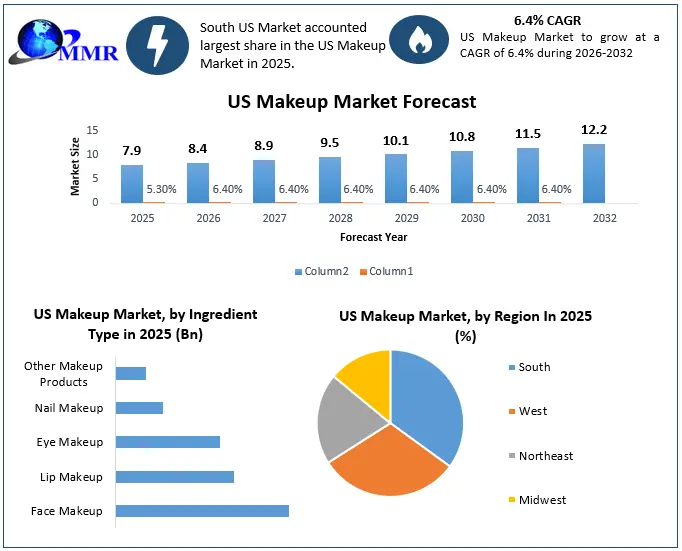
To know about the Research Methodology :- Request Free Sample Report
US Makeup Market Overview
The U.S. Makeup Market represents a complete and highly competitive segment within the beauty and personal care industry, driven by strong consumer spending, premiumization, changing beauty preferences, and increasing digital engagement. U.S. Makeup Market Analysis indicates sustained demand for accessible, innovative, premium, and inclusive beauty offerings as consumers increasingly discover makeup trends through social media, beauty influencers, digital platforms, and beauty communities. The U.S. Makeup Market Size is supported by established specialty beauty retailers, department stores, drugstores, brand-owned outlets, and rapidly expanding e-commerce channels. Estée Lauder, a leading U.S. beauty company, is a key player in the market, with a broad portfolio of established makeup brands and a strong global retail presence. Growing interest in skincare-infused cosmetics, clean formulations, multifunctional products, inclusive shade ranges, and personalized beauty solutions is strengthening U.S. Makeup Market Growth and shaping the long-term U.S. Makeup Market Outlook.
The U.S. Makeup Market Report provides a comprehensive assessment of the market landscape, covering market size, growth trends, forecasts, competitive dynamics, and key growth drivers. The report evaluates the market across product type, category, ingredient type, and distribution channel, while examining consumer preferences, pricing trends, brand positioning, purchasing behavior, and regional demand patterns. It also provides insights into emerging opportunities driven by premiumization, clean beauty, vegan and cruelty-free products, inclusive cosmetics, influencer-led marketing, social commerce, e-commerce expansion, and technology-enabled beauty experiences. In addition, the report assesses the competitive environment, strategic initiatives, market challenges, supply-chain developments, and regulatory factors, helping manufacturers, investors, retailers, distributors, and new market entrants identify high-growth segments, assess competitive positioning, and develop informed expansion and investment strategies.
US Makeup Market Historical Size (2020–2025)
| Year | Market Size | Growth Rate (YoY) |
| 2020 | USD 6.1 Bn | 5.2% |
| 2021 | USD 6.5 Bn | 6.6% |
| 2022 | USD 6.8 Bn | 4.6% |
| 2023 | USD 7.2 Bn | 5.9% |
| 2024 | USD 7.5 Bn | 4.2% |
| 2025 | USD 7.9 Bn | 5.3% |
US Makeup Market Forecast Size (2026–2032)
| Year | Market Size | Growth Rate (YoY) |
| 2026 | USD 8.4 Bn | 6.4% |
| 2027 | USD 8.9 Bn | 6.4% |
| 2028 | USD 9.5 Bn | 6.4% |
| 2029 | USD 10.1 Bn | 6.4% |
| 2030 | USD 10.8 Bn | 6.4% |
| 2031 | USD 11.5 Bn | 6.4% |
| 2032 | USD 12.2 Bn | 6.4% |
US Makeup Market Key Highlights
• Market Size (2025): USD 7.9 Billion, indicating steady market growth.
• Projected Market Size (2032): USD 12.2 Billion, reflecting continued market expansion.
• CAGR (2026–2032): 6.4%, demonstrating sustained growth during the forecast period.
• Competitive Market: Established beauty companies and emerging indie brands compete through product innovation, brand differentiation, influencer partnerships, and direct-to-consumer strategies.
• Market Outlook: With a 2025 market size of USD 7.9 billion and projected to reach USD 12.2 billion by 2032, the market is expected to maintain a 6.4% CAGR through the forecast period.
US Makeup Market Consumer Insights & Demand Analysis
Consumer behavior continues shifting toward personalized and sustainable beauty solutions.
| Consumer Dimension | Key Insights | Market Impact |
| Clean Beauty | Increasing ingredient transparency demand | Premium segment growth |
| Sustainability | Eco packaging preference | ESG investments |
| Digital Shopping | Social commerce growth | E-commerce expansion |
| Personalization | AI-based recommendations | Product innovation |
| Male Grooming | Growing acceptance | New customer segments |
US Makeup Market Dynamics
US Makeup Market Drivers
Social Commerce and Digital Beauty Discovery
The rapid expansion of e-commerce, social commerce, and creator-led beauty content is a major driver of the U.S. makeup market. Consumers increasingly discover, evaluate, and purchase makeup through digital marketplaces, social platforms, influencers, tutorials, and livestream shopping. The integration of product demonstrations, reviews, and direct purchasing is shortening the path from product discovery to purchase and supporting market growth.
US Makeup Market Restraints
Price Sensitivity and Competitive Pressure
Increasing consumer focus on value and affordability acts as a key restraint on the market. Consumers are becoming more selective about premium makeup purchases and are comparing products across mass-market, masstige, and prestige brands. Strong competition, frequent product launches, promotional pricing, and the availability of lower-priced alternatives can place pressure on premium brands and profit margins.
US Makeup Market Opportunities
AI-Powered Personalization and Hybrid Makeup
Growing adoption of AI-powered beauty recommendations, personalized product discovery, and makeup products incorporating skincare benefits creates significant opportunities. Consumers are showing greater interest in multifunctional products that combine makeup with hydration, skin treatment, or other skincare benefits. AI-based shade matching, virtual try-ons, and personalized recommendations can also improve product selection and customer engagement.
US Makeup Market Challenges
Rapidly Changing Consumer Preferences
Frequent changes in makeup trends and consumer preferences remain a major challenge for brands. Trends can shift rapidly through social media, requiring companies to continuously innovate in shades, textures, formulations, packaging, and product formats. Brands also need to balance trend-driven launches with long-term product relevance while maintaining competitive pricing and consistent product quality.
US Makeup Market Segment Analysis
US Makeup Market by Product Type
The US makeup market is segmented into Face Makeup, Eye Makeup, Lip Makeup, Nail Makeup, and Other Makeup Products. Face makeup remains a major category, supported by demand for foundations, concealers, blushes, bronzers, and highlighters. Lip makeup continues to benefit from product innovation in lip oils, glosses, liners, and long-wear formulations. Eye makeup maintains steady demand through mascara, eyeliner, eyeshadow, and brow products, while nail makeup benefits from changing fashion trends and at-home beauty routines.
US Makeup Market by Distribution Channel
The market includes Online Retail/E-Commerce, Specialty Beauty Stores, Department Stores, Supermarkets & Hypermarkets, Pharmacies & Drugstores, Brand-Owned Stores, and Other Channels. Specialty stores and department stores remain important for premium product discovery and personalized consultations. At the same time, online retail is expanding rapidly, supported by convenience, product reviews, social commerce, influencer marketing, virtual try-on tools, and direct-to-consumer beauty brands.
US Makeup Market Regional Analysis
The US makeup market shows significant regional variation, influenced by population size, purchasing power, beauty preferences, and retail development. The South holds the largest share at 35.0%, supported by its large consumer base and expanding beauty spending. The West accounts for 31.0% and benefits from strong beauty innovation, premium products, and influencer-driven trends. The Northeast represents 20.0%, driven by higher purchasing power and luxury beauty demand, while the Midwest holds 14.0%, supported by stable everyday makeup consumption and growing specialty retail penetration.
| Region | Market Share | Key Demand Drivers & Trends |
| South | 35% | Large population, rising beauty spending, and strong demand for everyday cosmetics |
| West | 31% | Beauty innovation, clean beauty, influencer culture, and premium cosmetics |
| Northeast | 20% | High purchasing power, luxury beauty adoption, and premium cosmetics |
| Midwest | 14% | Mass-market demand, specialty retail expansion, and value-focused products |
US Makeup Market Competitive Landscape
The US Makeup Market is highly competitive, with global beauty companies, established domestic brands, and digitally native players competing through product innovation, brand recognition, pricing, quality, and extensive distribution networks. Key players include L'Oréal S.A., The Estée Lauder Companies Inc., elf. Beauty, Coty Inc., Revlon Inc., Shiseido Co., Ltd., Natura &Co, Procter & Gamble, Colour Pop, Glossier, and LVMH.
Competitive dynamics are increasingly shaped by premiumization, clean beauty, inclusive shade ranges, skincare-infused makeup, social media marketing, and e-commerce. Established companies are strengthening their portfolios through innovation, omnichannel distribution, and advanced formulations, while emerging brands are gaining traction through direct-to-consumer models, influencer marketing, viral products, and community-driven branding. Overall, product innovation, affordability, brand loyalty, digital engagement, personalization, and distribution reach remain key factors shaping competition in the US makeup market.
US Makeup Market Key Players & Benchmarking
| Company | Headquarters | Classification | Product Specialization & Core Competencies |
| L'Oréal S.A. | France | Market Leader | Mass-to-Premium Makeup, Broad Brand Portfolio, Extensive U.S. Distribution |
| The Estée Lauder Companies | USA | Prestige Beauty Leader | Luxury & Premium Makeup, Prestige Brands, Specialty Retail |
| e.l.f. Beauty, Inc. | USA | Fast-Growing Market Leader | Affordable Makeup, Digital Marketing, Clean & Accessible Beauty |
| Coty Inc. | USA | Global Challenger | Prestige & Mass Makeup, Celebrity Brands, Color Cosmetics |
| Revlon Inc. | USA | Mass-Market Leader | Color Cosmetics, Lip & Face Makeup, Broad Retail Presence |
| Shiseido Co., Ltd. | Japan | Premium Beauty Player | Premium Makeup, Skincare-Makeup Integration, Product Innovation |
| Fenty Beauty | USA | Inclusive Beauty Specialist | Diverse Shade Ranges, Complexion Makeup, Inclusive Beauty |
| Rare Beauty | USA | D2C Beauty Challenger | Social-First Makeup, Inclusive Products, Community-Led Growth |
| LVMH Beauty | France | Luxury Beauty Leader | Dior & Givenchy Makeup, Luxury Cosmetics, Premium Positioning |
| Charlotte Tilbury Beauty | UK | Prestige Cosmetics Specialist | Premium Makeup, Complexion & Lip Products, Influencer-Led Marketing |
US Makeup Market Technology & Innovation Trends
| Innovation Area | Current Trend | Market Impact |
| AI Beauty | AI-based personalized recommendations | Higher engagement and conversions |
| AR Try-On | Virtual makeup testing | Better online shopping experience |
| Sustainable Packaging | Recyclable and refillable materials | Supports eco-conscious demand |
| Hybrid Products | Makeup with skincare benefits | Drives premium and multifunctional products |
| Smart Shade Matching | AI-powered shade identification | Improves inclusivity and satisfaction |
US Makeup Market Scope: Inquire before buying
| US Makeup Market | |||
|---|---|---|---|
| Report Coverage | Details | ||
| Base Year: | 2025 | Forecast Period: | 2026-2032 |
| Historical Data: | 2020 to 2025 | Market Size in 2025: | USD 7.9 Bn. |
| Forecast Period 2026 to 2032 CAGR: | 6.4% | Market Size in 2032: | USD 12.2 Bn. |
| Segments Covered: | by Product Type | Face Makeup Eye Makeup Nail Makeup Lip Makeup |
|
| by Price Tier | Mass-Market Mid-Market Premium Luxury Cosmetics |
||
| by Consumer Group | Women Men Gender-Neutral Consumer |
||
| by Distribution Channel | Online Retail/E-Commerce Specialty Beauty Stores Department Stores Supermarkets & Hypermarkets Pharmacies & Drugstores Brand-Owned Stores Other |
||
Frequently Asked Questions (FAQs)
1. What is the size of the U.S. makeup market?
The U.S. Makeup Market was valued at approximately USD 7.9 billion in 2025 and is projected to reach USD 12.2 billion by 2032, growing at a CAGR of 6.4%.
2. Which region dominates the U.S. makeup market?
The South dominates the U.S. Makeup Market with a 35% share, followed by the West at 31%, the Northeast at 20.0%, and the Midwest at 14%. Strong consumer spending, population concentration, and established beauty retail networks support demand in these regions.
3. What are the major trends shaping the U.S. makeup market?
Key trends include AI-powered beauty recommendations, AR virtual try-ons, inclusive shade ranges, clean beauty, sustainable packaging, and hybrid makeup-skincare products. Social commerce and digital beauty platforms are also influencing product discovery and purchasing behavior.
4. Which companies are the key players in the U.S. makeup market?
Major players include L'Oréal S.A., The Estée Lauder Companies, e.l.f. Beauty, Coty Inc., Revlon Inc., Shiseido Co., Ltd., LVMH, Fenty Beauty, Rare Beauty, and Glossier.
5. What factors are driving the growth of the U.S. makeup market?
Growth is driven by premiumization, rising beauty expenditure, social media and influencer marketing, product innovation, e-commerce expansion, and growing consumer demand for personalized and inclusive makeup products.