
Transplantation Market by Product Type, Application, End user and Region - Global Market Size Estimation, Industry-Wide Analysis, Competitive Landscape Assessment & Long-Term Forecast to 2030
Overview
The Transplantation Market size was valued at USD 14.32 Bn. in 2023 and the total Transplantation Market revenue is expected to grow at a CAGR of 8.5% from 2024 to 2030, reaching nearly USD 25.35 Bn.
Transplantation Market Overview
The market encompasses the healthcare sector responsible for organ and tissue procurement, preservation, and subsequent transplantation to patients in need. This market is propelled by the escalating prevalence of chronic conditions like diabetes, heart disease, and kidney failure, which heightens the demand for organ and tissue transplants. The growing number of accidents and trauma cases further contributes to the growing need for transplantation procedures. Within the healthcare industry, the transplantation market is a thriving segment marked by intense competition. Numerous entities are deeply invested in research and development efforts to create innovative products and services.
For instance, in 2021, Novartis International AG secured approval from the European Commission for its kidney transplant drug, Tafinlar (dabrafenib). This market encounters several challenges, including organ scarcity for transplantation, the substantial cost associated with transplant procedures, and the risks of rejection and infection. To surmount these challenges, various measures have been initiated by governments and healthcare organizations. These efforts include raising awareness about organ donation and transplantation, enhancing organ procurement and allocation systems, and advancing new technologies and therapies aimed at improving transplant outcomes.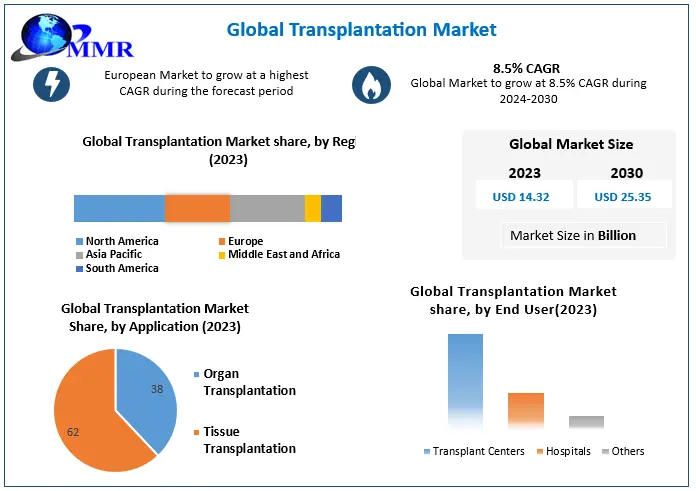 To know about the Research Methodology :- Request Free Sample Report
Transplantation Market Report Scope and Research Methodology:
The Transplantation market report presents a comprehensive analysis of various segments, encompassing Product Type, Application, and Region. It offers valuable insights by delving into data from market participants and covers regions such as North America, Asia Pacific, Europe, the Middle East and Africa, and South America. The report meticulously dissects different segments, including Types, Applications, End-User categories, Age groups, and Transplant types, further breaking them down into subtypes for a detailed examination. The report goes beyond data analysis to explore the factors driving and limiting the market, as well as the opportunities and challenges it presents.
It also offers a comprehensive view of companies involved in this sector, including their company overview, financial standing, global presence, capacity portfolio, business strategies, and recent developments. The information in this report is derived from a blend of primary and secondary research methodologies. Primary research involves data collection from key industry leaders, subject matter experts, and market players. Secondary research encompasses the study of company reports, investor presentations, annual reports, and regulatory filings. This research aims to provide a deeper understanding of the current state and future prospects of the transplantation market, serving as a valuable resource for strategic decision-making among industry stakeholders, investors, and policymakers.
Transplantation Market Dynamics:
Rising Chronic Disease Prevalence Drives Organ Demand:
The increasing incidence of chronic diseases like diabetes, heart disease, and kidney ailments is a key driver. For instance, over 34 million Americans have diabetes, creating a high demand for organ transplants to address complications arising from this condition. Technological progress in surgical procedures, such as minimally invasive techniques, has enhanced transplant success rates. Improved techniques have made patients more willing to opt for transplant surgery, resulting in higher demand. The aging global population, with the number of individuals aged 60 and above expected to reach 2 billion by 2050, is driving demand. As older individuals are more prone to chronic illnesses, the need for organ transplantation grows significantly.
The persistent shortage of donor organs motivates significant investments in research and development. Alternative transplant options, like xeno-transplants, are being explored to address the demand-supply gap. Government initiatives, such as the National Organ Transplant Act in the US and the Transplantation of Human Organs Act in India, provide regulatory frameworks and funding support to bolster the transplantation market.
Increasing awareness campaigns and education about organ donation have led to a rise in potential donors and recipients, thereby expanding the transplantation market. Medical tourism for transplant procedures is on the rise, driven by lower costs and shorter waiting times in certain countries. This trend fuels market growth as more patients seek transplantation options abroad. Ongoing research into pharmaceuticals, like immunosuppressants and anti-rejection medications, is improving transplant outcomes. These innovations encourage more individuals to consider transplantation as a viable option.
Tailoring transplant options to an individual's genetic profile is becoming more feasible. Precision medicine is enhancing success rates and attracting patients to seek personalized solutions. The integration of advanced technologies, like 3D printing for organ scaffolds and telemedicine for post-transplant care, is increasing the effectiveness and accessibility of transplant procedures, contributing to market expansion. Severe Organ Scarcity Hinders Transplantation Market:
The transplantation market grapples with significant constraints, the most pressing of which is the severe scarcity of available organs. The demand for organs vastly surpasses their supply, leading to extensive waiting lists and, tragically, a high mortality rate among individuals awaiting transplantation. For instance, in the United States, the waiting list for organ transplants exceeds 100,000 people, with approximately 6,000 individuals succumbing to their conditions while awaiting a transplant in 2021.
The cost associated with transplantation acts as a barrier for many patients, limiting their access to life-saving treatment. Transplantation procedures inherent risks, including the potential for rejection and infection. Patients are required to undergo lifelong immunosuppressant therapy, which leads to complications. Immunosuppressant medication makes recipients highly vulnerable to infections, elevating the risk of transplant rejection.
While the transplantation market presents promising factors for growth, including increased investments, technological advancements, and emerging opportunities such as transplant tourism and personalized medicine, it also faces substantial challenges. Ethical concerns and regulatory hurdles are notable obstacles that could hinder market expansion, complicating the landscape for industry stakeholders, healthcare providers, and policymakers.
Personalized Medicine Reduces Rejection Risks:
Continued innovation in transplant technologies opens doors to more efficient and accessible procedures. For instance, the development of ex vivo organ perfusion systems allows for better organ preservation and evaluation, increasing transplant success rates. Tailoring transplant treatments to individual patient profiles improves outcomes. These are expected to drive the transplantation market growth. For example, genetic matching and precision medicine enhance compatibility, reducing the risk of rejection. The rise of medical tourism for organ transplantation offers growth potential. Countries like India and Turkey attract international patients due to lower costs and reduced waiting times, boosting market expansion. Advancements in regenerative therapies, such as stem cell-based organ regeneration, offer novel approaches to address organ shortages and provide potential growth avenues.
Exploring non-traditional sources, like deceased donors with infectious diseases (HCV-positive donors), broadens the pool of available organs and offers opportunities for transplantation. Collaborations between governments and private entities can drive investment in transplantation infrastructure and raise public awareness to foster market growth. Integrating telemedicine into post-transplant care enhances patient management and ensures better outcomes, providing opportunities for technology-driven growth. Advancements in artificial organs and 3D printing technology hold the potential to revolutionize transplant options and expand the market. Introducing incentives or reimbursement programs for organ donors can increase the supply of organs, reducing waiting times and mortality rates. Organ procurement organizations and transplant centers can establish global outreach initiatives to connect with potential donors and recipients worldwide, expanding the transplantation market's reach.
 Transplantation Market Segment Analysis:
Based on Product Type, The Transplantation Market, is segmented based on Product Type, which includes Tissue Products, Immunosuppressive Drugs and Preservation Solutions revealing varying degrees of application and adoption. Tissue products play a critical role in various transplantation procedures, particularly in the fields of orthopedics and cardiovascular surgery, where demand is consistently high. Immunosuppressive drugs, essential for preventing organ rejection post-transplant, find widespread application, primarily in kidney, heart, and liver transplantations.
Preservation Solutions also hold substantial importance, enabling the safe transportation and storage of organs before transplantation, and are extensively used in heart and lung transplants. The other encompasses a range of products like diagnostic tools and equipment used during transplantation surgeries, contributing to the successful transplantation process. While the adoption of these product types is driven by specific transplant applications, it is crucial to note that they collectively contribute to the growth and advancement of the transplantation market, ultimately enhancing patient outcomes and extending life-saving treatment options to a broader spectrum of patients in need.
 Transplantation Market Regional Insights:
Regional insights into the Transplantation Market underscore the diverse landscape influenced by a myriad of factors and drivers. North America emerges as the largest market, wielding substantial global market share, propelled by the surge in chronic diseases, an aging population, and remarkable technological advancements. For instance, the United States, grappling with a 51.8% population afflicted by chronic diseases in 2018, plays a pivotal role in shaping this regional dominance.
North America boasts key market players like AbbVie Inc. and Pfizer Inc., which further solidifies its position as a market leader. Europe stands as the second-largest market, driven by factors such as the prevalence of chronic diseases, a burgeoning aging demographic, and robust government support, as highlighted by Spain's remarkable 98 percent organ transplant rate in 2021.
The Asia Pacific region emerges as a rapidly evolving transplantation market, benefitting from its substantial population, and contributing to a significant pool of potential transplant recipients. The region also experiences an upsurge in research on stem cells for organ development and in vitro tissue creation, along with augmented investment in research and development. These trends collectively underscore the region's potential for significant market expansion. It is essential to acknowledge the common thread binding these regions - the impact of chronic diseases and aging populations, which continue to drive the global transplantation market's growth.
Competitive Landscape
Key Players of the Transplantation Market profiled in the report are 21st Century Medicine, AbbVie Inc., Arthrex, Inc., Astellas Pharma Inc., BiolifeSolutions, Inc, Bristol-Myers Squibb Company, GlaxoSmithKline plc, Glycorex Transplantation AB, Medtronic, Novartis International AG, OrganOx Limited, Pfizer Inc., Sanofi S.A. This provides huge opportunities to serve many End-users and customers and expand the Transplantation Market.
1. In February 2023, BD garnered FDA approval for its BD Onclarity HPV assay, a noteworthy accomplishment in the serology testing sector.
In March 2023, BioRad achieved recognition from AQAC International and AFNOR for its iQ-Check kits, marking a vital milestone in the realm of diagnostic solutions.
2. In January 2022, Hoffmann-La Roche Ltd. introduced Cobas Infinity Edge, a cloud-based point-of-care platform that enables healthcare practitioners to efficiently manage patient data, representing a significant step in diversifying its product portfolio.
3. In March 2022, Zimmer Biomet entered into a multi-year agreement with Biocomposites for the exclusive distribution of the Genex Bone Graft Substitute, offering new mixing systems and delivery options in the U.S.
4. In January 2022, Novartis AG collaborated with Alnylam, focusing on the exploration of targeted therapy to restore liver function using Alnylam's siRNA technology, which aims to stimulate the regrowth of functional liver cells as an alternative for liver failure patients.
5. In January 2022, BioLife Solutions extended its collaboration with Seattle Children's Therapeutics to optimize biopreservation and closed-system manufacturing by integrating Sexton's AF 500 cell processing tools, enhancing advancements in the field of bioprocessing.
Transplantation Market Scope: Inquire before buying
| Global Transplantation Market | |||
|---|---|---|---|
| Report Coverage | Details | ||
| Base Year: | 2023 | Forecast Period: | 2024-2030 |
| Historical Data: | 2018 to 2023 | Market Size in 2023: | US $ 13.20 Bn. |
| Forecast Period 2024 to 2030 CAGR: | 8.5% | Market Size in 2030: | US $ 25.35 Bn. |
| Segments Covered: | By Product Type | Tissue Products Immunosuppressive Drugs Preservation Solutions |
|
| By Application | Organ Transplantation Tissue Transplantation |
||
| By End user | Transplant Centers Hospitals Others |
||
Global Transplantation Market, by Region
North America (United States, Canada and Mexico)
Europe (UK, France, Germany, Italy, Spain, Sweden, Austria and Rest of Europe)
Asia Pacific (China, South Korea, Japan, India, Australia, Indonesia, Malaysia, Vietnam, Taiwan, Bangladesh, Pakistan and Rest of APAC)
Middle East and Africa (South Africa, GCC, Egypt, Nigeria and Rest of ME&A)
South America (Brazil, Argentina Rest of South America)
Transplantation Key Players
1. 21st Century Medicine
2. AbbVie Inc.
3. Arthrex, Inc.
4. Astellas Pharma Inc.
5. BiolifeSolutions, Inc
6. Bristol-Myers Squibb Company
7. GlaxoSmithKline plc
8. Glycorex Transplantation AB
9. Medtronic
10. Novartis International AG
11. OrganOx Limited
12. Pfizer Inc.
13. Sanofi S.A.
14. Strykers
15. Teva Pharmaceuticals
16. TransMedics
17. Veloxis Pharmaceutical
18. Zimmer Biomet
FAQs:
1. What are the growth drivers for the Transplantation Market?
Ans. Rising Chronic Disease Prevalence Drives Organ Demand and is expected to be the major driver for the Transplantation Market.
2. What is the major restraints for the Transplantation Market growth?
Ans. Severe Organ Scarcity Hinders Transplantation Market and is expected to be a major Opportunity in the Transplantation Market.
3. Which region is expected to lead the global Transplantation Market during the forecast period?
Ans. North America is expected to lead the Transplantation Market during the forecast period.
4. What is the projected market size and growth rate of the Transplantation Market?
Ans. The Global Transplantation Market revenue is expected to grow at a CAGR of 8.5% from 2024 to 2030, reaching nearly USD 25.35 Billion.
5. What segments are covered in the Transplantation Market report?
Ans. The segments covered in the Transplantation Market report are by Product Type, Application, End-use, and Region.