
Tethered Drone Market Size by Type, Technology Type, Solution, Application, End Use, Region – Revenue Pool Analysis, Margin Structure Assessment, Capital Flow Trends, Competitive Benchmarking & Forecast to 2032
Overview
Global Tethered Drone Market size was valued at USD 396.9 Mn in 2025 and is expected to reach USD 661.82 Mn by 2032 , at a CAGR of 6.6 % from the forecast period (2026 to 2032)
Tethered Drone Market Overview
A tethered drone is an unmanned aerial vehicle (UAV) that is connected to the ground by a physical tether, typically a cable or wire. This tether provides power and data transfer between the drone and a ground station, allowing for extended flight times and continuous operation. Tethered drones are employed in various industries for surveillance, monitoring, and communication purposes, where prolonged aerial presence is essential. Several manufacturers produce tethered drones, with notable players in the market including DJI, Elistair, Hoverfly Technologies, and Drone Aviation. DJI, a prominent drone manufacturer, offers the DJI Zenmuse T20 tethered drone system, catering to applications such as public safety, infrastructure inspection, and event monitoring. Elistair specializes in tethered drone solutions for surveillance and communication, offering products such as the Elistair Ligh-T and Safe-T.
The global market for tethered drones has witnessed significant growth due to their ability to provide persistent aerial surveillance and communication. Key applications include border security, crowd monitoring, disaster response, and industrial inspections. The Tethered Drone Market is expected to continue growing as industries recognize the benefits of tethered drones for long-duration missions and real-time data acquisition, addressing a wide range of operational needs across the world.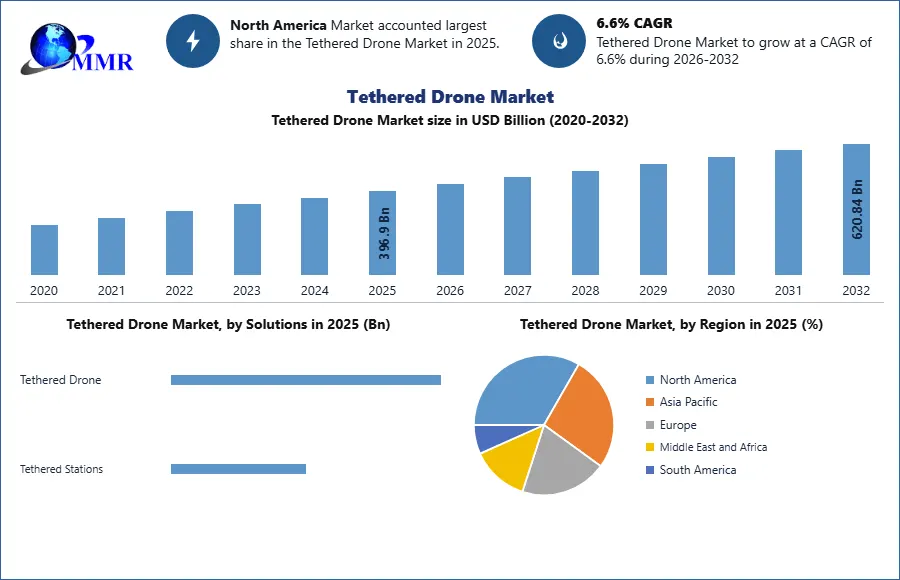 To know about the Research Methodology :- Request Free Sample Report
The Ministry of Defence (MoD) is advancing its capabilities with a call for technical and commercial bids to introduce cutting-edge technologies to the Indian Army, including robotic mules, jetpack suits, and tethered drones for surveillance across the challenging Himalayan terrain. For instance, tethered drones, like Mistral Kite, present a unique solution for extended flight times exceeding 45 minutes, making them ideal for applications with a limited operational area. Mistral Kite boasts a robust hexarotor drone with a modular architecture, designed for launch in confined spaces. Its quick-detach arms and undercarriage enhance storage and deployment convenience, with a take-off weight of up to 24kg. Notably, the Mistral Kite features smart power management and an automatic tether winding mechanism, ensuring an uninterrupted power supply. With a tether system capable of operating at a height of 120m, Mistral Kite's advantages include continuous surveillance, reliability in high-altitude terrains up to 3000m AMSL, and support for payloads up to 3kg. The tether system facilitates secure data communication and offers ultra-high-resolution data transfer. Applications span various defense and homeland security scenarios, from constant surveillance and aerial searchlight platforms to emergency response management and VIP event crowd control.
Tethered Drone Market Dynamics
Persistent Surveillance Needs to Drive the Market Growth
The increasing demand for continuous and persistent surveillance across various sectors, including defense, public safety, and critical infrastructure, is a key driver for the Tethered Drone Market. Tethered drones offer extended flight durations, allowing for prolonged monitoring without the limitations imposed by traditional battery-powered UAVs. According to an MMR study, the IMF Annual Report 2023 underscores the critical need for persistent surveillance in a world grappling with crises. The economic surveillance across 126 countries, highlights the importance of continuous monitoring for stability. Tethered drones align with this imperative, offering prolonged flight durations for uninterrupted surveillance in defense, public safety, and critical infrastructure. The report emphasizes tailored policy advice in times of uncertainty, mirroring the adaptability of tethered drones in diverse applications. The growing reliance on advanced technologies with the rising adoption of tethered drones, positioning them as vital tools for enhanced global surveillance and crisis management and driving the Tethered Drone Market growth.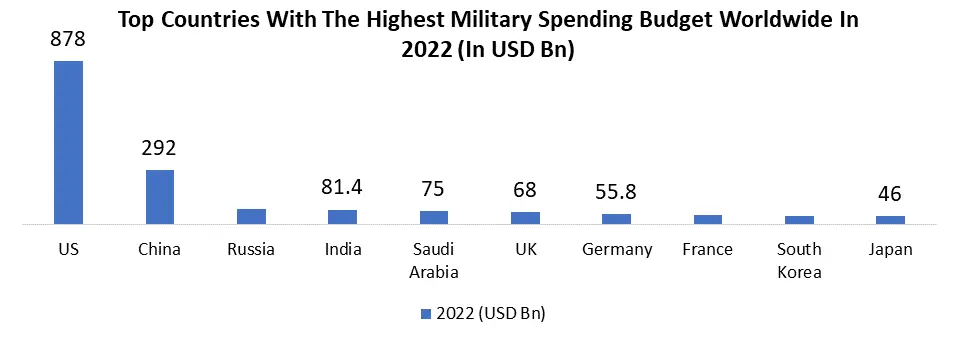 The United States accounts for almost 40% of global military expenditures, with its 2022 spend coming to $877 billion. Russia’s position as the third-largest military spender is a recent development, as the country’s military spending had a 9% increase between 2021 and 2022. Tethered drones present a significant advancement in aerial surveillance technology, offering extended flight time, stability, and increased payload capacity. Despite challenges, ongoing developments are poised to enhance their capabilities and unlock greater potential. The suitability of tethered drones for outdoor events, environmental research, disaster management, power sources, cost comparison with traditional drones, and more.
Rising Adoption of Tethered Drones in the Defense and Security Sector to Boost the Market Growth
Tethered drones play a crucial role in defense and security applications, providing persistent aerial surveillance for border control, critical infrastructure protection, and military operations. This application is expected to drive the Tethered Drone Market size growth. The ability to maintain constant vigilance and transmit real-time data enhances situational awareness and response capabilities.
Tethered Drone in the Military Industry: In defense, tethered drones are an emerging asset, with xCraft standing at the forefront. While unmanned aerial vehicles (UAVs) have long been integral to military operations, xCraft's tethered UAVs bring unique capabilities to specialized applications, particularly in safeguarding American troops. The distinctive feature of tethered UAVs lies in their physical connection to a ground station through a cable. This tether not only powers the drone, significantly extending flight times but also facilitates seamless data transmission. xCraft's Shadow V2.0 exemplifies these advancements, offering surveillance at altitudes up to 100 feet, 24-hour runtime, flight stabilization software, and HD video streaming – making it a go-to model for defense, security, and military industries.
Growing Advancements in Tethered Drone Technology to Fuel the Market
The technological advancements in tethered UAVs, focus on their applications, especially in scenarios requiring unlimited flight time and reliability. Tethered drones, such as Flyfocus's CableGuard, are highlighted for their capabilities in border patrols, live streaming events, communication towers, and low-altitude satellite surveillance. The piece emphasizes the growing market for tethered UAVs, with a projected CAGR of over 70%. It discusses the challenges of designing tether cables capable of delivering power while being lightweight and safe when detached for free flight. Tethered drones are presented as ideal for applications requiring data capture and telemetry due to the reliability of tethered connections.
Tethered Drones play a vital role in the telco towers sector. The data they provide is a useful tool enabling faster and safer inspections of telco towers for inventory and maintenance. Such a solution has already been tested by several companies around the world. Data captured by drones can also increase the efficiency of investment planning and support the process of network optimization. The potential value of the market for four types of drone-powered solutions is as follows
Regulatory Challenges and Opportunities for Market Growth
Tethered drones offer advantages in terms of safety, reliability, and operational flexibility. They prove beneficial in adhering to specific category regulations, as demonstrated by the Specific Operations Risk Assessment (SORA). Tethered drones, equipped with a follow-me capability, extend their application in various sectors, including civil and military aviation. While the lack of conformity assessment poses challenges for the tethered drones Industry, the advantages they offer in mitigating risks, ensuring constant power supply, and simplifying emergency response plans make them a viable option.
In 2019, the European Commission introduced two regulations governing unmanned aircraft operations and marketing. These regulations, effective in 2023, create a uniform framework for operators and manufacturers across the European Union, presenting opportunities for tethered drone market growth amidst the ongoing COVID-19 pandemic. The regulations classify unmanned aircraft (UA) into different classes (C0 to C6), each indicating technical specifications and suitability for specific operations. The UA classes, along with intended operations, determine remote pilot competency requirements. Tethered drones, falling under UA classes C2 to C3 and C5, receive attention due to their unique advantages. Tethered drones, with a secure cable connection, present lower risks in both technical specifications and operational requirements, offering benefits to manufacturers and operators.
For instance, under the EASA regulations, tethered drones are classified as a type of remotely piloted aircraft system (RPAS). This means that they are subject to the same rules and regulations as other types of RPAS. To operate a tethered drone for commercial purposes in Europe, operators must obtain a specific category of RPAS certification. In Europe, the European Union Aviation Safety Agency (EASA) is responsible for regulating unmanned aircraft systems, including tethered drones. The regulations that apply to tethered drones in Europe are similar to those in the United States. Such regulations are expected to pose a challenge or threat to market growth during the forecast period. Also, Tethered drones rely on a continuous power supply from the ground, usually through the tether. This dependence on an external power source can be a limitation, particularly in remote or inaccessible locations where establishing power infrastructure is expected to restrain the Tethered Drone industry growth.
Tethered Drone Market Segment Analysis
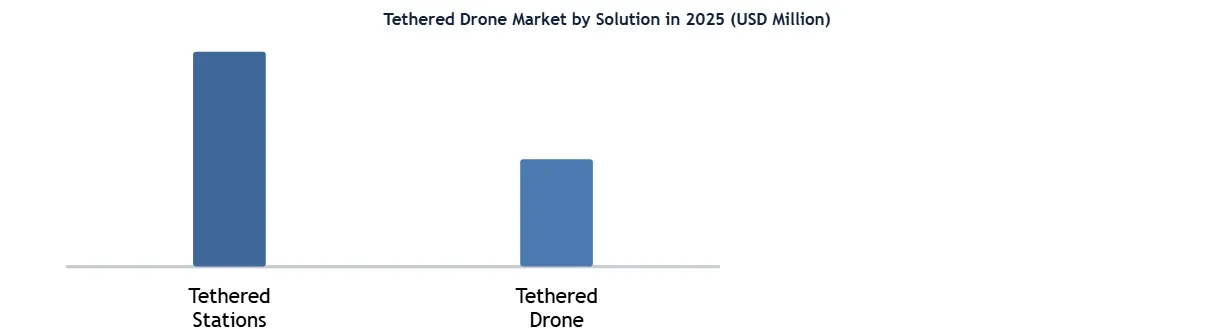
Based on solution, the tethered drone market is segmented into tethered drones and tethered stations. The tethered stations segment accounted for the largest market share in 2025 and is expected to maintain its dominance with a 45.99% share in 2026. Increasing demand for uninterrupted aerial surveillance, enhanced operational safety, and rapid deployment capabilities is driving adoption of advanced tethered station systems across military, homeland security, and industrial applications. Ground-based power systems, automated smart winches, and lightweight tether cables enable drones to remain airborne for extended durations without frequent battery replacements, significantly reducing operational downtime and manpower requirements.
Tethered stations also provide secure and stable data transmission in electronically contested or sensitive airspace environments where wireless communication may face interference or jamming risks. Vehicle-mounted tethered stations are gaining strong traction for mobile intelligence, surveillance, and reconnaissance (ISR) missions, allowing operators to rapidly relocate and maintain continuous situational awareness across dynamic operational environments. In addition, simplified regulatory approvals for tethered systems in urban airspace are supporting wider commercial deployment.Meanwhile, the tethered drone segment is projected to expand at a CAGR of 7.0% during the forecast period, supported by increasing adoption across emergency response, border monitoring, and temporary communication applications.
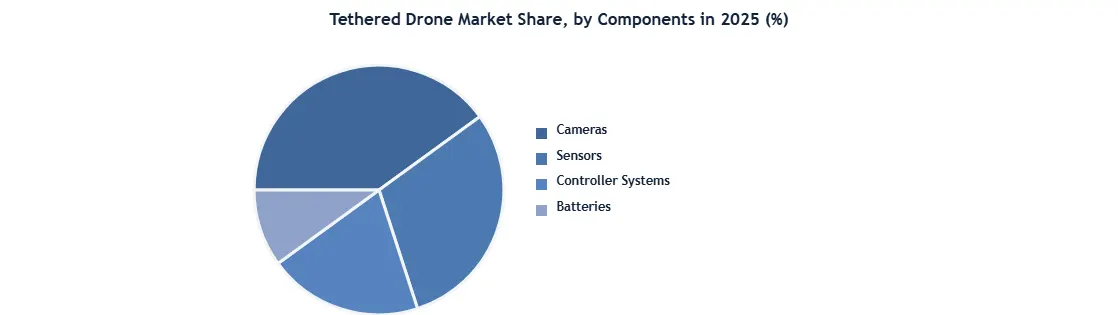
Based on components, the tethered drone market is segmented into sensors, controller systems, cameras, and batteries.The cameras segment held the dominant market share in 2025 and is anticipated to account for 34.22% of the market in 2026. Growing demand for high-resolution aerial imaging, thermal monitoring, and real-time surveillance is significantly driving investments in advanced electro-optical and infrared (EO/IR) camera technologies. These payload systems provide high-quality video intelligence, low-light target identification, and thermal anomaly detection capabilities essential for defense, critical infrastructure monitoring, disaster management, and law enforcement operations.Stabilized gimbal systems improve image accuracy and reduce false alarm rates during aerial surveillance missions, while secure onboard storage and encrypted communication links support regulatory compliance and evidence management requirements. Continuous technological advancements in zoom functionality, short-wave infrared (SWIR) imaging, lightweight payload integration, and low-SWaP (Size, Weight, and Power) camera systems are extending drone platform performance and operational lifespan. As a result, recurring investments in payload upgrades continue to strengthen revenue growth within the camera segment.The sensors segment is projected to register the fastest growth with a CAGR of 7.5% over the forecast period, driven by rising integration of environmental monitoring, RF detection, and advanced situational awareness technologies in tethered drone platforms.
Based on application type, the tethered drone market is segmented into search and rescue, telemetry and communication, surveillance and protection, and commercial and recreational applications.The surveillance and protection segment dominated the market in 2025 and is expected to hold a 48.87% market share in 2026. Increasing security concerns across airports, oil refineries, military bases, stadiums, ports, and critical infrastructure facilities are significantly boosting demand for persistent aerial surveillance solutions. Tethered drones provide continuous elevated monitoring capabilities that help eliminate blind spots commonly associated with fixed surveillance systems and ground-based cameras.These systems improve threat detection accuracy, reduce false-positive alerts, and enable rapid coordination of security personnel during emergency situations. Integrated AI-powered analytics, object tracking systems, intrusion detection software, and automated threat classification technologies are transforming aerial video feeds into actionable intelligence for security operators. In addition, tethered drone surveillance solutions help organizations reduce operational costs while improving compliance with government safety regulations and insurance requirements.
The telemetry and communication segment is anticipated to witness the fastest expansion at a CAGR of 7.6% during the forecast period, supported by rising deployment of tethered drones for temporary communication networks, disaster response connectivity, and battlefield communication relay applications.
Tethered Drone Market Reginal Insight
North America held the largest market share in 2025. North America has been a key adopter of drone technology, and the Tethered Drone Market has witnessed substantial growth. The region boasts a mature market with a strong presence of key industry players. The growth of the market is driven by the widespread adoption of drones for security and surveillance applications. Law enforcement agencies and military forces leverage tethered drones to achieve persistent monitoring capabilities, enhancing border control and ensuring event security. The regulatory environment, governed by the Federal Aviation Administration (FAA), plays a pivotal role in shaping the industry, emphasizing the need for adherence to safety guidelines. Ongoing technological advancements, coupled with investments from venture capitalists and government agencies, further contribute to the market's expansion. Tethered drones find applications in emergency response, public safety, industrial inspections, and infrastructure monitoring, fostering their acceptance across diverse sectors. The market's trajectory is influenced by strategic collaborations, public awareness, and the continuous evolution of drone technologies, positioning North America as a key hub for the burgeoning tethered drone industry.
In Asia Pacific Tethered Drone market is witnessing rapid expansion owing to a surge in infrastructure development projects and a growing emphasis on border security. Government initiatives promoting the adoption of drones for surveillance and public safety further propel market growth. The region's diverse landscape presents opportunities for applications in agriculture, disaster response, and industrial inspection. Local manufacturing and innovation hubs in countries such as China contribute to competitive pricing and technological advancements. With an increasing number of partnerships and collaborations between drone manufacturers and government agencies, the Asia Pacific Tethered Drone market is poised for sustained growth, addressing diverse regional needs.
For instance, India's growing drone industry, including tethered drones, reflects a strategic shift towards advanced technological manufacturing. With a focus on indigenous development, India's regulatory landscape, exemplified by the Drone Airspace Map and UAS Traffic Management policy, creates a conducive environment. The government's initiatives, such as the Drone Certification Scheme and Drone Import Policy, underscore its commitment to fostering a robust drone ecosystem. Incentives, like the PLI scheme, bolster local manufacturing and attract investments, with the sector poised to replace 80% of manned aircraft operations. As India strives to become a global drone hub by 2032, the industry's potential for economic growth, job creation, and technological innovation aligns with the nation's strategic objectives.
In Europe, the Tethered Drone Market growth is experiencing robust growth driven by increasing applications in surveillance, disaster management, and defense. Regulatory support for drone technology, coupled with the rising demand for persistent aerial surveillance, fuels market expansion. Key players are investing in advanced technologies, such as AI-based analytics, enhancing the capabilities of tethered drones for various sectors. Additionally, collaborations between drone manufacturers and research institutions contribute to technological advancements, fostering market growth. The European market showcases a trend toward customized solutions, catering to specific industry needs, thereby creating a diverse and dynamic landscape for tethered drones.
Competitive Landscape
The global tethered drone market features a competitive landscape shaped by key players such as Elistair, Fotokite, Yuneec, and others. The tethered drone manufacturers has witnessed significant growth due to the rising demand for persistent aerial surveillance, communication relays, and security applications. Tethered drones, equipped with a power and data cable, provide continuous and stable operations, making them ideal for various sectors, including defense, public safety, and industrial inspection. These companies are focused on developing innovative solutions for persistent aerial surveillance, communication relays, and security applications.
Trends in the market include the integration of AI and machine learning, enhanced payload capabilities, and expansion into new verticals such as agriculture and telecommunications. Competitive strategies involve continuous product innovation, strategic partnerships, and a focus on regulatory compliance. However, the industry faces challenges related to evolving regulations, technological barriers, and cost sensitivity. Despite these challenges, the future outlook is optimistic, with the market expected to grow as companies address regulatory issues, invest in R&D, and establish strategic collaborations to capitalize on the increasing demand for tethered drone solutions.
Tethered Drone Market Recent Development :
- In February 2025, Elistair partnered with Milrem Robotics to secure a defense contract for supplying Khronos tethered unmanned aerial systems to an allied military customer. The agreement also included operator training, spare parts, and long-term technical support, strengthening military adoption of persistent ISR tethered drone solutions.
- In June 2025, Elistair joined the European Union-funded SMAUG maritime security program to deploy tethered drones for continuous port surveillance and underwater threat detection. The project integrates AI-powered monitoring technologies to enhance protection of critical maritime infrastructure across Europe.
- In June 2025, Hoverfly Technologies delivered its Sentry tethered unmanned aerial system to an Australian government customer for defense trials and operational evaluation. The deployment supports Australia’s modernization initiatives focused on persistent aerial surveillance and tactical reconnaissance capabilities.
- In August 2025, Hoverfly Technologies introduced the Hoverfly NEXUS system designed to extend MANET radio command-and-control networks and improve integration between unmanned aerial, ground, and maritime systems. The solution enhances battlefield ISR, targeting, and tactical communication capabilities for defense operations.
- In October 2025, Hoverfly Technologies secured USD 20 million in Series B funding led by Leonardo DRS and Korea Robot Manufacturing to expand production capacity and strengthen U.S.-based tethered drone manufacturing capabilities for defense and homeland security applications.
- In May 2025, Ukraine-based Aerobavovna developed a high-altitude tethered aerostat platform designed for advanced electronic warfare and intelligence operations, supporting growing defense demand for persistent communication and surveillance systems.
- In September 2023, Drone Evolution launched the Sentinel tethered unmanned aerial vehicle during DSEI London, targeting defense, border security, and critical infrastructure surveillance applications with enhanced endurance capabilities.
Tethered Drone Market Scope: Inquiry Before Buying
| Tethered Drone Market | |||
|---|---|---|---|
| Report Coverage | Details | ||
| Base Year: | 2025 | Forecast Period: | 2026-2032 |
| Historical Data: | 2020 to 2025 | Market Size in 2025: | 396.9 USD Million |
| Forecast Period 2026-2032 CAGR: | 6.6% | Market Size in 2032: | 620.84 USD Million |
| Segments Covered: | by Solution | Tethered Stations Tethered Drone |
|
| by Components | Cameras Sensors Controller Systems Batteries |
||
| by Application | Search and Rescue Telemetry and communication Surveillance and Protection Commercial and Recreational |
||
| by End-User | Commercial Military |
||
Tethered Drone Market, by Region
North America (United States, Canada and Mexico)
Europe (UK, France, Germany, Italy, Spain, Sweden, Austria and Rest of Europe)
Asia Pacific (China, South Korea, Japan, India, Australia, Indonesia, Malaysia, Vietnam, Taiwan, Bangladesh, Pakistan and Rest of APAC)
South America (Brazil, Argentina Rest of South America)
Middle East & Africa (South Africa, GCC, Egypt, Nigeria and Rest of ME&A)
Tethered Drone Key Players
- Elistair
- Easy Aerial
- Hoverfly Technologies
- Drone Aviation Holding Corp.
- AeroVironment
- Lockheed Martin
- Northrop Grumman
- RTX Corporation
- Thales Group
- Leonardo S.p.A.
- Israel Aerospace Industries
- Rheinmetall AG
- Safran
- Elbit Systems
- SZ DJI Technology Co., Ltd.
- Parrot SA
- Yuneec International
- Textron Systems
- Kratos Defense & Security Solutions
- AltiGator
- Azur Drones
- Fotokite
- Freefly Systems
- Altitude Angel
- Drone Volt
- Sky Sapience
- Commaris
- TTTech Computertechnik AG
- FlyFocus
- Persistent Systems