
Telemetry Market Size by Component, Technology, Region – Segment-Level Market Assessment, Growth Opportunity Analysis, Competitive Mapping & Forecast to 2034
Overview
Telemetry Market size was valued at USD 163.06 Bn. in 2025 and the total Global Telemetry Market revenue is expected to grow at a CAGR of 10.1 % from 2026 to 2034, reaching nearly USD 387.66 Bn. by 2034.
Telemetry Market Overview
Telemetry is an automated process of collecting and transmitting data from remote sources for monitoring and analysis.
Global telemetry market growth has been driven by increasing demand for real-time data monitoring and remote communication in sector like healthcare, aerospace, automotive, energy, and defense. Growing continuous patient monitoring, remote diagnostics, and data-driven medical care boost the use of telemetry in medical applications. Similarly, the growing importance on predictive maintenance and operational efficiency is increasing its use in industrial and automotive sectors. Implementation of strict data agreement, cybersecurity standards, and regulatory advice are boosting the need for secure and reliable telemetry systems. Moreover, the market is fuelled by a shifting trend toward digital transformation, IoT integration, and development of advanced wireless technologies to improve data accuracy and communication potential. Stability in component sourcing and advancements in microelectronics are increasing the demand for high-precision modules and energy-efficient telemetry devices. North America dominated the telemetry market in 2024 due to technological maturity, strong presence of key aerospace and healthcare players, and high investment in smart infrastructure and defense modernization. Top key players of the telemetry market are Honeywell International Inc., GE Healthcare, Philips Healthcare, Siemens AG, and Schneider Electric. These companies are focus on product innovation, including cloud-based telemetry platforms, AI-enhanced analytics to meet global monitoring and communication standards. They are also investing in cybersecurity resilience, digital twin technologies, and sustainable, low-power communication protocols to match global safety and compliance targets and future regulatory requirements.
Report covers the telemetry market dynamics, structure by analyzing the market segments and projecting telemetry market size. Clear representation of competitive analysis of key players by product, price, financial position, product portfolio, growth strategies and regional presence in telemetry market.
Telemetry Market Growth and Share Analysis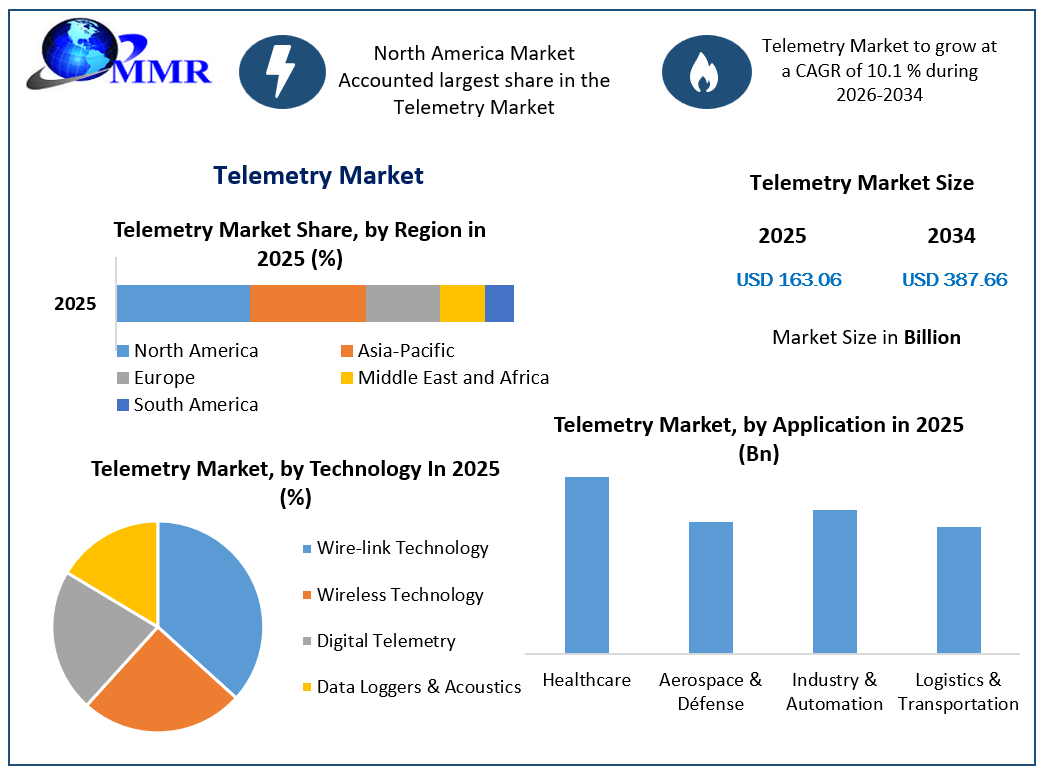
To know about the Research Methodology :- Request Free Sample Report
To know about the Research Methodology
The report includes an analysis of the drivers, restraints, and challenges that influence the telemetry market, and growth opportunities, through the forecast period. It also discusses the industry, market, technological trends that currently prevail in the market, and technological advancements expected to impact the telemetry demand, globally. The report also provides an in-depth analysis of the market's main competitors, as well as information on their competitiveness. Also, identifies and analyses important business strategies used by the main market players, such as mergers and acquisitions (M&A), affiliations, collaborations, and contracts.
Global Telemetry Market Dynamics:
Remote Patient Monitoring and Predictive Maintenance to Drive the Telemetry Market
The increased need for remote digital patient monitoring systems in the healthcare sector is driving the Telemetry Market. Wireless sensors and wireless communication are used to acquire and transmit data to the hospital while remote monitoring of patients. Sensors such as wearable and implantable (contact-based sensors) and non-contact ones are used through data acquisition. The acquired data is processed and transformed to a suitable form using an internal or external controller before being transmitted wirelessly to the hospital. Also, focusing on predictive Maintenance helps to drive the Telemetry Market. Industry 4.0 and smart manufacturing guidelines promote the use of data generated through manufacturing to improve factory performance, increase production agility, and reduce costs. Predictive maintenance in a semiconductor facility contributes to the areas such as fab, assembly, or test. Predictive maintenance is used to predict events and to minimize their negative impact on the target equipment’s performance and availability at an early stage, allowing corrective action to be taken before an event happens.
Cyber Threats to Restrain the Telemetry Market Growth
With the rise of cloud computing and IoT devices, the number and types of attacks also increase. Attackers often have a programmable infrastructure (e.g., botnets) to dynamically change the types and characteristics of the attacks to make the attacks harder to detect. To keep up with the attack dynamics, it is important to enable flexible measurement support that quickly captures attacks as they happen, rather than waiting for vendors to add a new attack detection feature at switches.
Additionally, the limited resources and also limited time for collecting information is one of the challenges of the Telemetry Industry. For example, for a 40 Gbps port at a switch, we have 12 ns to process each packet. In such a short time, switches have to complete many packet forwarding functions such as packet header parsing and table lookups, in addition to network telemetry. Similarly, a 10 Gbps port at a host, has 70 ns to process a packet using the host CPU.
Global Telemetry Market Segment Analysis:
By Technology, wireless technology segment held largest share of 50 % in 2025. Wireless communication technology is a modern alternative to traditional wired networking. Stellar Telemetry represents the rearmost technology advancements in implantable physiologic monitoring. The system allows the monitoring of numerous creatures with just one receiver and facilitates group casing and social commerce. Stellar implants are used in beast models ranging from mice to tykes and larger creatures including phenotyping, pharmacology, metabolic, and general physiology assessment. future-facing wireless network environments, the radio space is seeing several developments. In the U.S., 6 GHz is all the buzz as it's been added to the 802.11ax standard, also known as Wi-Fi 6E. Office equipment manufacturers are turning to telemetry to track fax, copier, and printer usage. Instead of relying on the outdated, inaccurate manual reporting process wherein company employees’ phone in a meter count, the copy count is sent in wirelessly using N-PCS telemetry. In another innovative implementation of the technology, an automotive anti-theft and tracking device company takes advantage of telemetry to monitor vehicle location remotely instead of more expensive means of data transmission. Narrowband PCS uses Motorola's ReFLEX 25 two-way advanced messaging protocol to transmit the data in two-way telemetry applications. N-PCS is ideal for telemetry applications because its low bandwidth needs make its cost competitive with other technologies. As businesses become telemetry savvy, it is expected they begin to take advantage of telemetry that uses the technology more extensively.
Telemetry Market Recent development:
| Date | Company | Development | Impact |
|---|---|---|---|
| 14 January 2025 | Schneider Electric | Schneider Electric unveiled its upgraded EcoStruxure Telemetry and Remote SCADA Solutions suite to enhance real-time data ingestion for critical water and energy utilities. | The enhancement increases operational efficiency and reduces field maintenance costs through advanced predictive analytics and secure field-to-cloud communication. |
| 22 April 2025 | Honeywell | Honeywell launched a next-generation wireless telemetry monitoring terminal designed for real-time tracking of hazardous industrial assets and remote pipelines. | This development significantly improves asset visibility and safety compliance across remote and off-grid industrial environments. |
| 18 September 2025 | Medtronic | Medtronic expanded its biotelemetry division by commercializing an advanced wearable cardiac telemetry sensor capable of continuous long-term patient monitoring. | The technology boosts diagnostic accuracy for arrhythmia while streamlining remote continuous care in the medical biotelemetry sector. |
| 12 November 2025 | Siemens AG | Siemens entered a strategic collaboration to integrate 5G IoT telemetry gateways into automated smart grid architectures. | This collaboration accelerates grid modernization, offering ultra-low latency data transmissions for power distribution management. |
| 10 February 2026 | L3Harris Technologies | L3Harris Technologies secured a major defense commercialization contract to supply high-speed aerospace flight test telemetry transceivers. | The acquisition enhances bandwidth capacity and signal security for airborne testing and satellite-ground telemetry communications. |
Global Telemetry Market Regional Insight:
North America dominated the region in 2025 with a market share of x. The United States boasts a staggering 227 million wireless subscribers. The immense figure not only underscores the sheer magnitude of wireless connectivity in America but also sheds light on the undeniable integration of wireless technologies into the fabric of modern society. The United States serves as a springboard for several of the advanced mobile applications reviewed because of the advanced wireless 4G infrastructure, currently being deployed in the country. Already, 75% of the world’s 4G subscribers (combining LTE and mobile WiMAX) are in the U.S., making it a hotbed for developing and testing powerful new applications. While several applications are delivered over feature phones or smaller wireless devices, many of the advanced applications and integrated services are tailored to harness the power of smartphones or tablet computers. The advanced infrastructure unlocks an entirely new world of wireless possibilities from applications that enable students to trace planets across the sky on a tablet, to inventions that turn a smartphone into a mobile medical device that enables delivery of critical health care services to rural communities. The better the infrastructure to deliver the services becomes, the greater the impact on society.
Europe was the fastest-growing region in the Telemetry Market. The adoption of Industry 4.0, which involves the use of advanced technologies such as IoT, AI, and robotics in manufacturing is driving the demand for the 5G market in Europe. There are several reasons why 5G is strategic for Europe and why it is urgent to address the issues limiting the financing and development of companies active in 5G communications and developing 5G applications. 5G is central to a large-scale technological, industrial, and innovation transition globally, which represents a significant opportunity for Europe. 5G technologies are a driver of European strategic digital autonomy. European businesses developing 5G technologies, equipment, and applications compete in a global market. 5G makes European supply chains and industrial ecosystems more efficient and resilient. It is deployed not only by traditional operators but also by industrial players, to cover specific industrial sites.
Telemetry Market Competitive Landscape
Top key players in telemetry market are Honeywell International Inc., GE Healthcare, Philips Healthcare, Siemens AG, and Schneider Electric. These players are focused on continuous innovation in wireless communication, sensor integration, and real-time data transmission technologies. Moreover, they concentrate on developing secure, power-efficient, and high-precision telemetry solutions, which are essential for industries such as healthcare, aerospace, automotive and defense. Honeywell International Inc. is known for its high-consistency telemetry systems used in aerospace and industrial automation, offering strong solutions for strict environments and mission-critical operations. The company continues to lead improvements in telemetry by compact hardware design, real-time analytics, and seamless system integration across platforms. GE Healthcare are known for its telemetry capabilities in patient monitoring, delivering scalable and flexible solutions that support continuous, remote observation in critical care environments. The company play an important role in clinical workflows and enhancing patient safety with its reliable telemetry infrastructure.
Telemetry Market Trends
• IoT & 5G–Driven Expansion
Massive IoT growth continues to fuel demand: telemetry systems are essential for gathering data across smart cities, agriculture, industrial automation, and wearable health devices.
• Edge Computing & AI Integration
Telemetry devices are now including on-device processing, reducing latency and bandwidth needs through local analysis at the edge.
• LPWAN & Remote Monitoring
LPWANs (LoRaWAN, Sigfox) provide low-power, long-range telemetry ideal for environmental sensors, agriculture, logistics, and industrial sites.
Telemetry Market Scope: Inquire before buying
| Telemetry Market | |||
|---|---|---|---|
| Report Coverage | Details | ||
| Base Year: | 2025 | Forecast Period: | 2026-2034 |
| Historical Data: | 2020 to 2025 | Market Size in 2025: | USD 163.06 Bn. |
| Forecast Period 2026 to 2034 CAGR: | 10.1% | Market Size in 2034: | USD 387.66 Bn. |
| Segments Covered: | by Component | Hardware Software |
|
| by Technology | Wire-link Technology Wireless Technology Digital Telemetry Data Loggers & Acoustics |
||
| by Application | Healthcare Aerospace & Défense Industry & Automation Logistics & Transportation Others |
||
Telemetry Market, by Region
North America (United States, Canada and Mexico)
Europe (UK, France, Germany, Italy, Spain, Sweden, Austria and Rest of Europe)
Asia Pacific (China, South Korea, Japan, India, Australia, Indonesia, Malaysia, Vietnam, Taiwan, Bangladesh, Pakistan and Rest of APAC)
Middle East and Africa (South Africa, GCC, Egypt, Nigeria and Rest of ME&A)
South America (Brazil, Argentina Rest of South America)
Telemetry Market Key Players
North America
1. Honeywell International Inc. (United States)
2. General Electric Company (United States)
3. GE Healthcare (United States)
4. Emerson Electric Co. (United States)
5. Rockwell Automation, Inc. (United States)
6. Teledyne Technologies Incorporated (United States)
7. L3Harris Technologies, Inc. (United States)
8. Baker Hughes Company (United States)
9. Orbcomm Inc. (United States)
10. Iridium Communications Inc. (United States)
11. Trimble Inc. (United States)
12. Rogers Communications Inc. (Canada)
Europe
13. Siemens AG (Germany)
14. Schneider Electric SE (France)
15. Philips Healthcare (Netherlands)
16. Kongsberg Gruppen ASA (Norway)
17. Leonardo S.p.A. (Italy)
18. Inmarsat plc (United Kingdom)
19. Telit Communications PLC (United Kingdom)
20. Laird Connectivity (United Kingdom)
Asia-Pacific
21. Advantech Co., Ltd. (Taiwan)
22. Mitsubishi Electric Corporation (Japan)
Frequently Asked Questions:
1. Which region has the largest share in the Telemetry Market?
Ans: The North America region held the highest share in 2025 in the Telemetry Market.
2. What are the key factors driving the growth of the Telemetry Market?
Ans: Remote Patient Monitoring and Predictive Maintenance to Drive the Telemetry Market growth.
3. Who are the key competitors in the Telemetry Market?
Ans: Honeywell International Inc., GE Healthcare, Philips Healthcare, Siemens AG are the key competitors in the Telemetry Market.
4. What are the opportunities for the Telemetry Market?
Ans: Growth in Remote Healthcare & Patient Monitoring creates opportunities in the Telemetry Market.
5. Which technology segment dominates the Telemetry Market?
Ans: The wireless technology segment dominated the Telemetry Market.