
Technetium-99m Market Size by Application, Isotopic Services, End User, Region, Industry-Wide Analysis, Competitive Landscape Assessment & Long-Term Forecast to 2032
Overview
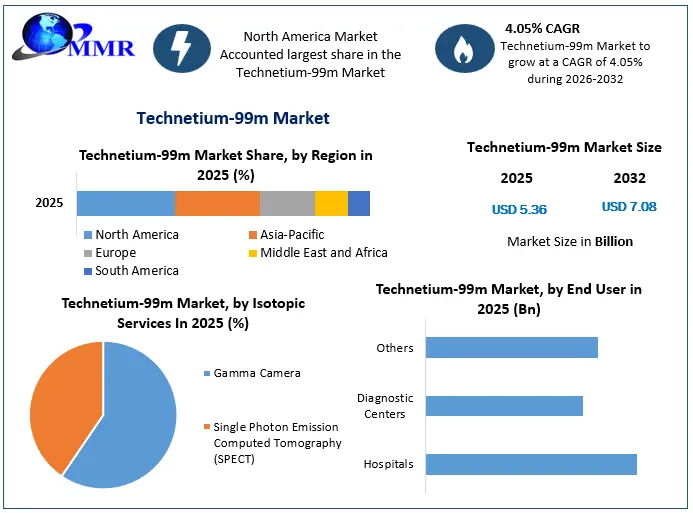
The Technetium-99m Market size was valued at USD 5.36 Billion in 2025 and the total Technetium-99m Market size is expected to grow at a CAGR of 4.05% from 2026 to 2032, reaching nearly USD 7.08 Billion by 2032.
Technetium-99m Market Overview
Technetium-99m is an FDA-approved radioactive substance used in nuclear medicine to create diagnostic images of different body parts. It helps in imaging organs like the brain, bones, lungs, kidneys, thyroid, heart, liver, and more. The global Technetium-99m market is experiencing significant growth, driven by its critical role in nuclear medicine. Technetium-99m, known for its ideal imaging characteristics and used in over 110,000 medical imaging procedures daily worldwide, including more than 40,000 in the United States alone. Its short half-life of six hours, optimal gamma energy, and low radiation dose make it the preferred isotope for a wide range of diagnostic applications. The rising demand for Tc-99m-based radiopharmaceuticals, particularly for cardiovascular imaging, cancer detection, and other clinical applications, is expected to fuel market growth.
In terms of market segmentation, Technetium-99m is utilized in various applications such as cardiovascular imaging, bone scans, respiratory imaging, tumor imaging, and others. The cardiovascular segment held the largest market share in 2025, primarily due to its critical role in myocardial perfusion imaging, which assesses blood flow in the heart. In 2025, North America led the global market, holding a significant share due to its advanced healthcare infrastructure, high prevalence of chronic diseases, and significant investments in medical imaging technology. The United States and Canada are major contributors, with the U.S. alone conducting over 40,000 Tc-99m-based imaging procedures daily.
GE Healthcare and Siemens Healthineers stand out as Technetium-99m market leaders due to their advanced imaging technologies and extensive distribution networks. Recent developments highlight the ongoing innovation in the market, such as the collaboration between IBA and NorthStar Medical Radioisotopes in March 2021 to expand global access to Tc-99m, and the February 2023 milestone by BWXT Medical and Laurentis Energy Partners, which enabled the production of Mo-99 at Ontario Power Generation’s Darlington Nuclear Generating Station.
• Technetium-99m is used in about 85% of all nuclear medicine diagnostic imaging procedures around the world.
• Every day, around 110,000 medical imaging procedures worldwide, including over 40,000 in the U.S., use the radioactive isotope technetium-99m (Tc-99m) to produce images of the inside of the human body.
To know about the Research Methodology :- Request Free Sample Report
Technetium-99m Market Dynamics
Advancements in Technetium-99m Radiopharmaceuticals to drive Technetium-99m Market Growth
The development of new radiopharmaceutical products, especially those based on Technetium-99m (Tc-99m), play a crucial role in the growth of the Technetium-99m market. Technetium-99m is widely recognized for its ideal properties in nuclear medicine, including a short half-life of 6 hours, optimal gamma energy for imaging, and a relatively low radiation dose to the patient. Ongoing research and development efforts are focused on creating new Tc-99m-based radiopharmaceuticals with improved specificity and sensitivity, enabling more accurate diagnosis and targeted imaging of various diseases, including cancer, cardiovascular disease, and neurological disorders. These advances increase the utility of Tc-99m in a wider range of clinical applications, expanding its adoption in hospitals and diagnostic centers worldwide. As these new radiopharmaceuticals offer enhanced diagnostic capabilities, healthcare providers are more likely to prefer Tc-99 m-based imaging techniques, thus driving market growth.
• In developed countries (about a quarter of the world's population), the frequency of nuclear medicine diagnostic procedures is about 2% per year, and the frequency of radioisotope treatment is about a tenth of this figure. In the United States, there are more than 20 million nuclear medicine procedures per year, and in Europe about 10 million, including 2 million of a therapeutic nature.
• In the United States, Technetium-99m is used in more than 80% of all nuclear medicine procedures.
In addition, the development of these new radiopharmaceuticals based on Tc-99m is expected to significantly increase the demand for Technetium-99m itself. As these new formulations are introduced into clinical practice, the need for Technetium-99m to label these radiopharmaceuticals increase accordingly. The growing demand is driven by the growing number of diagnostic procedures using Tc-99m, which provides more accurate and early disease detection. In addition, continued innovation in Tc-99m-based radiopharmaceuticals also leads to an increase in patient treatment output, as more advanced and accurate imaging techniques simplify the diagnostic process, thereby reducing the need for numerous texts. This, in turn, drives the demand for continuous and reliable supplies of Tc-99m, also contributing to the expansion of the technetium-99m market.
• In 2023, the global radiopharmaceuticals market was valued at USD 5.60 billion, and it is expected to grow to almost USD 11.30 billion by 2030.

Technetium-99m Market Opportunity
Rising Demand for Tc-99m SPECT Imaging Presents Growth Opportunities in China and Beyond
The sustained imaging power of single photon emission computed tomography (SPECT) using technetium 99m (Tc-99m) radiopharmaceuticals, especially in emerging markets such as China, creates significant opportunities in the global technetium-99m market. SPECT imaging is a widely used nuclear medicine technique, and Technetium-99m remains the isotope of choice because of its optimal imaging characteristics such as its short half-life and suitable gamma energy. In regions such as China, where healthcare infrastructure is developing rapidly, the demand for reliable and cost-effective diagnostic tools, such as Tc-99m-based SPECT imaging, is increasing. Additionally, while there is continued interest in the transition to more advanced imaging modalities such as cardiac MRI or PET in markets such as the United States, the infrastructure required for this transition is not yet fully established. Therefore, even if the use of Tc-99m MPI (Myocardial Perfusion Imaging) SPECT declines over time in developed markets, it is likely to remain a more widely used modality than other cardiac imaging techniques, further sustaining its market demand.
Emerging players in the Technetium-99m market have a unique opportunity to capitalize on this scenario by focusing their efforts on supplying and innovating within the SPECT imaging space, particularly in rapidly growing markets such as China and other parts of Asia. These players can capitalize on the growing demand for technetium-99m radiopharmaceuticals by developing high-quality, cost-effective technetium-99m products tailored to the specific needs of these emerging markets.
• In 2023, around 20 million nuclear medicine procedures were done in the U.S., with about 60% using Tc-99m. Out of these, 12 million procedures were approved and covered by the Center for Medicare and Medicaid Services (CMS).
Technetium-99m Market Challenge
The technetium-99m market is facing serious challenges due to its complex and delicate supply chain. The production and distribution of technetium 99m (Tc-99m) relies on a just-in-time model that requires continuous production and careful coordination between government and commercial entities. The supply of Technetium-99m is closely linked to government-controlled enriched uranium, and governments also influence nuclear medicine rules and payment systems. One of the main problems is the increasing power of some manufacturers of processors and generators, making the supply chain more vulnerable to disruptions. Also, older nuclear reactors that produce Tc-99m often struggle financially because they cannot charge enough to cover their costs. This economic pressure, along with insufficient investment in infrastructure, makes the supply chain prone to disruptions, which can lead to shortages that impact patient care. Overall, this unstable supply chain threatens the availability and access of Tc-99m worldwide.
Technetium-99m Market Segment Analysis
Based On Application, the Technetium-99m Market is segmented into Cardiovascular, Bone Scan, Respiratory, Tumor Imaging, and Others. Cardiovascular Segment held the largest market share about XX% in 2025. According to MMR analysis, the segment is further expected to grow at a CAGR of XX% during the forecasted period (2026-2032). Technetium 99m is commonly used in myocardial perfusion scans to evaluate cardiovascular disease, cardiac stress, and myocardial infarction. These scans use Tc-99m to assess blood flow to the heart muscle.
The popularity of Technetium-99m in cardiovascular imaging is driven by its ability to provide clear, high-resolution images that aid in accurate diagnosis and treatment planning. For example, a common procedure is single-photon emission computed tomography (SPECT), which uses technetium-99m to visualize blood flow in the heart during exercise and at rest, allowing doctors to detect effectively heart problems such as blocked arteries. Technetium-99 m pyrophosphate is very accurate for the diagnosis of transthyretin cardiac amyloidosis (ATTR AC), with a positive predictive value of 100% when concomitant serum and urine tests for the AL light chain amyloidosis. (AL AC) are negative.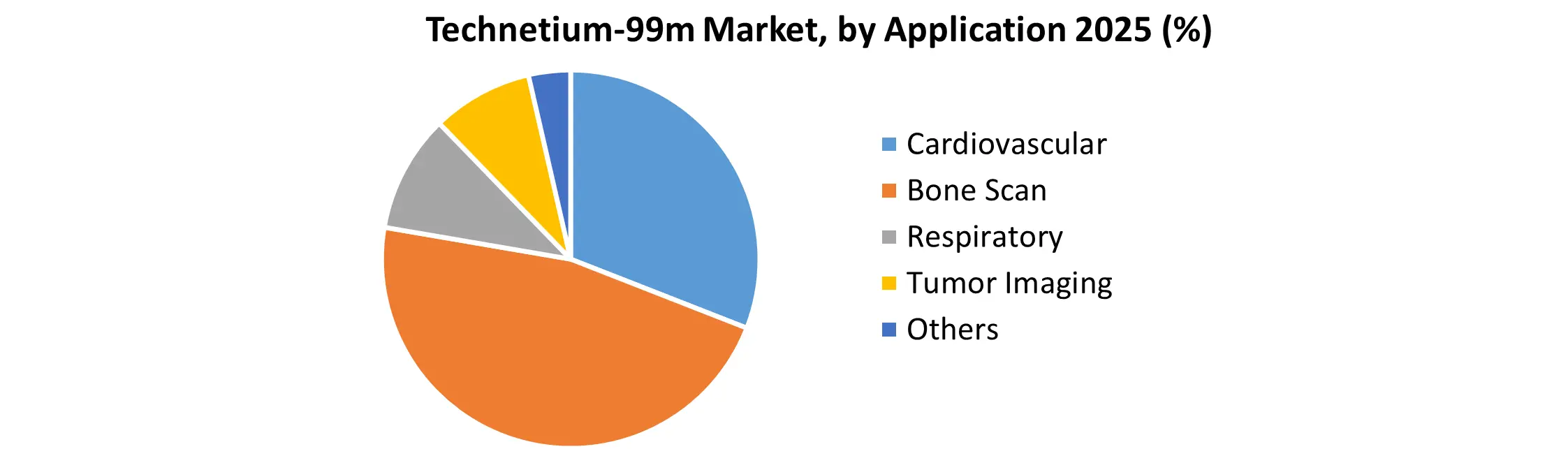
Technetium-99m Market Regional Insights
In 2025, North America dominated the Technetium-99m Market holding a significant market share of more than xx%. North American Technetium-99m industry has seen significant growth due to advanced healthcare infrastructure, high prevalence of cardiovascular diseases, and significant investment in medical imaging technology. An increasing number of chronic diseases such as cancer drives the medical imaging technology market expansion. According to the American Cancer Society, in 2025, approximately 1,958,310 new cases of cancer were diagnosed in the United States and 6,09,820 people died due to cancer. Additionally, the US Centers for Medicare & Medicaid Services (CMS) has set new standards for laboratory research which has drives the growth of the Technetium-99m Market.
The United States and Canada are the main contributors to this region. Tc-99m is an important isotope in nuclear medicine and is used in over 40,000 medical imaging procedures in the U.S. every day. In the United States, the widespread use of technetium 99m in myocardial perfusion imaging and other diagnostic procedures has been driven by the country's high demand for advanced medical technology and well-established healthcare facilities. Canada is also a notable contributor due to its robust healthcare system and increased adoption of nuclear medicine.
• Every day, around 110,000 medical imaging procedures around the world (including over 40,000 in the U.S.) use technetium in its radioactive form.
Technetium-99m Market Recent Industry Developments
| Date | Company | Development | Impact |
|---|---|---|---|
| 21 May 2025 | Curium Pharma | Curium Pharma and NRG PALLAS extended their collaboration through a new multi-year agreement to produce molybdenum-99 (Mo-99) at the High Flux Reactor in the Netherlands. | The partnership secures a stable, long-term global supply of technetium-99m (Tc-99m), ensuring continuity for over 50 million diagnostic procedures annually. |
| 02 January 2026 | SHINE Technologies | SHINE Technologies completed its strategic acquisition of Lantheus' SPECT manufacturing business, including its North Billerica production facility and portfolio of diagnostic radiopharmaceuticals. | The transaction expands SHINE's medical radioisotope capabilities by combining its fusion-generator-based Mo-99 production with Lantheus' established downstream processing and distribution network. |
| 28 March 2025 | Curium Pharma | Curium Pharma finalized the acquisition of Eczacıbaşı-Monrol Nuclear Products Co. (Monrol) to merge manufacturing and logistical infrastructure. | The acquisition immediately scales Curium's vertically integrated footprint, significantly expanding its SPECT and PET geographic coverage across Eastern Europe and the MENA region. |
| 20 February 2026 | Telix Pharmaceuticals | Telix Pharmaceuticals announced full-year 2025 financial results showcasing a 56% revenue surge to $803.8 million, driven by clinical development and the integration of its technetium-99m (99mTc) besilesomab (Scintimun®) franchise. | The record earnings provide a highly robust commercial foundation to accelerate multi-center therapeutic pipelines and expand infrastructure across 32 European markets and Mexico. |
Technetium-99m Market Competitive Landscape
The technetium-99m Market is highly competitive, with global and regional players vying for market share. Some of the major key players are Siemens Healthineers, GE Healthcare, Medi-Radiopharma, Lantheus Holdings, Inc., and NorthStar Medical Radioisotopes, LLC. These companies are well established and have wider experience in the field of nuclear medicine as well as a significant market presence. Among all key players GE Healthcare and Siemens Healthineers are market leaders due to advanced technology and extensive distribution channel.
In March 2021, IBA and NorthStar Medical Radioisotopes expanded their collaboration to make the diagnostic radioisotope technetium-99m (Tc-99m) more widely available around the world. IBA, known for its proton therapy solutions, and NorthStar, an innovator in radiopharmaceuticals, are working together to provide Tc-99m Generation Systems. These systems use NorthStar’s special non-uranium-based Mo-99, produced with IBA’s advanced accelerators. This partnership will help ensure that Technetium-99m which is used in medical imaging for about 30 million patients each year, is accessible to more countries beyond the United States.
In February 2023, BWXT Medical and Laurentis Energy Partners achieved a major milestone in their Tc-99m generator program. They successfully installed and began testing a new isotope system at Ontario Power Generation’s Darlington Nuclear Generating Station. This breakthrough allows for the production of life-saving molybdenum-99 (Mo-99) isotopes, which are essential for creating technetium-99m used in medical imaging.
Technetium-99m Market Scope: Inquiry Before Buying
| Technetium-99m Market | |||
|---|---|---|---|
| Report Coverage | Details | ||
| Base Year: | 2025 | Forecast Period: | 2026-2032 |
| Historical Data: | 2020 to 2025 | Market Size in 2025: | US $ 5.36 Bn. |
| Forecast Period 2026 to 2032 CAGR: | 4.05% | Market Size in 2032: | US $ 7.08 Bn. |
| Segments Covered: | by Application | Cardiovascular Bone Scan Respiratory Tumor Imaging Others |
|
| by Isotopic Services | Gamma Camera Single Photon Emission Computed Tomography (SPECT) |
||
| by End User | Hospitals Diagnostic Centers Others |
||
Technetium-99m Market Key Players
1. Radioisotope Production & Nuclear Medicine Companies
These companies produce Technetium-99m generators, Molybdenum-99 (Mo-99), and nuclear medicine isotopes used in diagnostic imaging.
North America
1. Curium Pharma – United States
2. NorthStar Medical Radioisotopes, LLC – United States
3. BWX Technologies, Inc. – United States
Europe
1. Curium Pharma – France
2. Eckert & Ziegler SE – Germany
3. POLATOM (National Centre for Nuclear Research) – Poland
Asia Pacific
1. China Isotope & Radiation Corporation (CIRC) – China
2. Japan Radioisotope Association – Japan
2. Radiopharmaceutical Manufacturers
These companies develop and commercialize Technetium-99m-based radiopharmaceutical kits used in nuclear medicine diagnostics.
North America
1. Lantheus Holdings, Inc. – United States
2. Jubilant Radiopharma – United States
Europe
1. Curium Pharma – France
2. ROTOP Pharmaka GmbH – Germany
Asia Pacific
1. Nihon Medi-Physics Co., Ltd. – Japan
2. Dongkook Pharmaceutical Co., Ltd. – South Korea
3. Nuclear Medicine & Molecular Imaging Companies
These companies provide diagnostic imaging solutions and radiotracers used in SPECT and molecular imaging procedures.
North America
1. GE HealthCare Technologies Inc. – United States
2. Lantheus Holdings, Inc. – United States
Europe
1. Siemens Healthineers AG – Germany
Asia Pacific
1. Nihon Medi-Physics Co., Ltd. – Japan
4. Radioisotope Generator & Radiochemistry Solution Providers
These companies manufacture Tc-99m generators and radiochemistry products used by hospitals, diagnostic centers, and nuclear medicine facilities.
North America
1. NorthStar Medical Radioisotopes, LLC – United States
2. Curium Pharma – United States
Europe
1. POLATOM – Poland
2. Eckert & Ziegler SE – Germany
Asia Pacific
1. China Isotope & Radiation Corporation (CIRC) – China
5. Nuclear Research & Medical Isotope Organizations
These organizations support the production, development, and supply of Technetium-99m and related medical isotopes.
North America
1. BWX Technologies, Inc. – United States
Europe
1. National Centre for Nuclear Research (NCBJ) – Poland
2. Institute for Radioelements (IRE) – Belgium
Asia Pacific
1. Australian Nuclear Science and Technology Organisation (ANSTO) – Australia
2. Japan Atomic Energy Agency (JAEA) – Japan
Frequently Asked Questions:
1] What is the growth rate of the Technetium-99m Market?
Ans. The Technetium-99m Market is expected to grow at a CAGR of 4.05% during the forecast period of 2026 to 2032.
2] Which region is expected to hold the highest share of the Technetium-99m Market?
Ans. North America is expected to hold the highest share of the Technetium-99m Market.
3] What is the market size of the Technetium-99m Market?
Ans. The Technetium-99m Market size was valued at USD 5.36 billion in 2025 reaching nearly USD 7.08 billion in 2032.
4] What is the significant Opportunity for the Technetium-99m Market?
Ans. The sustained imaging power of single photon emission computed tomography (SPECT) using technetium 99m (Tc-99m) radiopharmaceuticals, especially in emerging markets such as China creates significant opportunities in the global technetium-99m market.
5] What segments are covered in the Technetium-99m Market report?
Ans. The segments covered in the Technetium-99m Market report are based on Applications, Isotopic services, and End Users.