
Tape Storage Market by Component, by Technology, Regional Analysis and Share by Region, Regional Opportunity Assessment 2034
Overview
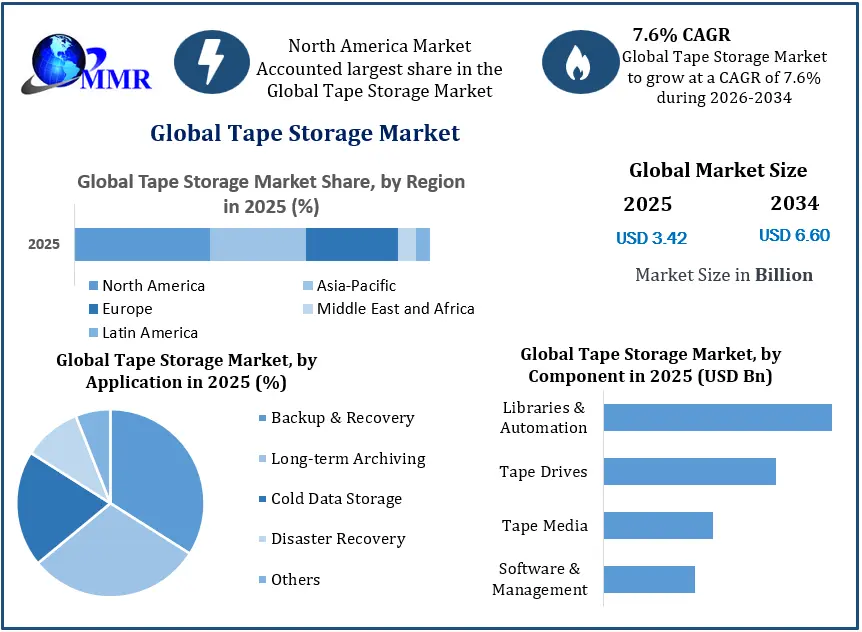
The global Tape Storage Market reached USD 3.42 billion in 2025, and MMR expects it to grow at a CAGR of 7.6% during 2026–2034 to reach USD 6.60 billion by 2034. Demand for AI data retention, hyperscale cold storage, long-term data archiving and ransomware-resistant backup storage drives this growth. Tight nearline HDD supply and the launch of high-capacity LTO-10 tape cartridges strengthen the case for magnetic tape storage further. LTO tape technology holds about 85% of tape sales, and Fujifilm and Sony together supply all LTO tape media. Annual shipments fluctuate, yet rising archival storage needs and steady gains in tape cartridge capacity keep the long-term outlook for the tape storage industry positive.
Tape Storage Market Growth and Share Analysis
To know about the Research Methodology :- Request Free Sample Report
Key Market Takeaways
| 01 | Tape libraries and tape drives generate most tape storage market revenue, while tape media holds a smaller share of value because LTO-9 media now sells at roughly USD 5–7 per native TB at retail. | 05 | LTO-10 drops backward read compatibility, so LTO-7 and LTO-8 users move straight to LTO-10 tape, while LTO-9 stays the conservative choice for sites that must read existing cartridges. |
| 02 | Hyperscale data centres and cloud providers drive the largest tape storage orders; one Asia Pacific hyperscaler order for Quantum Scalar i7 tape libraries exceeded USD 80 million in 2026. | 06 | A few suppliers control the tape storage supply chain: Fujifilm and Sony coat all LTO tape, and IBM manufactures every LTO tape drive, which concentrates both pricing power and supply risk. |
| 03 | AI turns archives into retained training assets. Organisations keep AI training data, checkpoints and derived datasets for reproducibility and governance, and tape offers the lowest-cost storage tier for holding them a decade or more. | 07 | North America holds the largest tape storage market share through hyperscale, federal and media archives, while Asia Pacific grows fastest on cloud data centre build-outs in China, Japan, India and Southeast Asia. |
| 04 | The 2025–2026 HDD shortage, with nearline lead times of 52 weeks or longer and HDD prices up roughly 46–50% since September 2025, makes tape the one bulk storage medium outside the AI component shortage. |
Demand Signals Behind the Forecast
| 1 | AI data retention | AI training data, superseded model checkpoints and lineage records kept for reproducibility and audit |
| 2 | HDD supply squeeze | Nearline HDD lead times of 52 weeks or more push cold data storage toward tape |
| 3 | Cyber resilience | Offline, air-gapped, immutable tape backups demanded by cyber insurers and regulators |
| 4 | Density roadmap | 40 TB LTO-10 cartridges today; roadmap target of 913 TB compressed at LTO-14 |
| 5 | Energy and carbon | Tape cartridges draw no power at rest, easing energy limits in power-constrained data centres |
Tape storage adoption follows two clear patterns. Enterprises use LTO tape mainly for the offline copy in a 3-2-1 or 3-2-1-1-0 backup strategy and for regulatory data retention, usually in tape libraries ranging from a few dozen to a few thousand slots. Hyperscalers and research centres run tape storage at exabyte scale, often behind object storage interfaces, to keep deep-archive cloud storage profitable at sub-cent prices per gigabyte-month. Industry reports place Microsoft, Amazon, OVH and Baidu among the hyperscale users of tape, although cloud providers rarely disclose the media beneath individual archive tiers.
Tape Storage Demand Indicators: LTO Capacity Shipped (Shipment Basis, not Revenue)
| Year | Compressed EB shipped | Native EB (÷2.5) | Change in shipped capacity |
| 2021 | ≈148 | ≈59 | Up about 40% from 2020 |
| 2022 | 148.3 | 59.3 | Up 0.5% |
| 2023 | 152.9 | 61.2 | Up about 3% |
| 2024 | 176.5 | 70.6 | Up 15.4% (record) |
| 2025 | 160.3 | 64.1 | Down about 9% |
| Q1 2026 | Not published | – | Up 57% year on year |
Installed Base and LTO Tape Adoption: The LTO tape ecosystem has shipped more than 5.7 million tape drives and 383 million tape cartridges since launch, equal to 649 billion GB of compressed capacity as of the 2024 shipment report. Cartridge volumes stay flat or decline because each new LTO generation packs more terabytes into the same cartridge. Capacity shipped therefore offers a stronger indicator of tape storage demand than unit shipments, while higher storage density and falling media cost per TB keep revenue growth below capacity growth.
Tape Storage Industry Ecosystem and Value Chain Analysis
The tape storage value chain rests on a narrow supply base and a broad downstream market. Fujifilm and Sony manufacture all LTO tape media, and IBM produces every LTO tape drive. Tape library vendors, OEM brands, data archiving software providers and system integrators then deliver complete tape storage solutions to enterprises, research centres and hyperscale data centres. Scarce technology and few suppliers give pricing power to drive manufacturers, enterprise tape library providers and software vendors that make tape work like cloud object storage, so these players capture the largest share of value in the tape storage ecosystem.
| Value-chain layer | Representative activities and participants | Commercial considerations |
| Materials and magnetic media | Base film (including aramid for 40 TB LTO-10), barium and strontium ferrite particles, coating; Fujifilm, Sony | Two-supplier concentration, film availability, yield on new particle technology |
| Cartridge manufacturing and branding | Cartridge assembly, LTO compliance testing; branded media from IBM, HPE, Quantum, Dell, Spectra Logic and others | Brand premium over unbranded media, certified-media programmes, channel inventory |
| Tape drive manufacturing | LTO and IBM 3592 drive design and production; IBM as sole LTO drive maker, supplied to OEMs | Drive supply sets library shipment pace; firmware and interface roadmap |
| Libraries and automation | Robotics, frames, library software; IBM, Quantum, Spectra Logic, HPE, Dell, Qualstar, BDT, MagStor | Slot density per rack, energy use, serviceability, hyperscale design wins |
| Software and data management | LTFS, S3-to-tape gateways, HSM and archive software; IBM Storage Archive, Spectra StorCycle, Quantum StorNext and ActiveScale, Versity, XenData, Archiware | Makes tape usable for non-specialists; recurring subscription revenue |
| Integrators and distributors | VARs, system integrators, OEM channels, maintenance providers, tape-as-a-service operators | Migration services, third-party maintenance, financing of library refreshes |
| End users | Hyperscalers, cloud providers, enterprises, government, HPC and research, media and entertainment, BFSI, healthcare | Retention mandates, cyber-insurance requirements, cost per TB over 10+ years |
Tape Storage Market Dynamics
Global Tape Storage Market Growth Drivers
Rapid Growth in Cold Data Boosts Demand for Tape Storage
Enterprises, cloud providers and research institutions generate data faster than their primary storage budgets grow. Much of this data turns cold within months, yet businesses must keep it for analysis, reuse or compliance. Horison Information Strategies estimates that at least 80% of enterprise data is archival or cold data. As organisations move infrequently accessed data from disk to low-cost tape storage systems, demand for LTO tape capacity keeps rising.
Long-Term Data Archiving and Regulatory Data Retention Drive LTO Tape Adoption
Financial records, medical images, legal documents, seismic surveys and public archives carry retention periods from several years to several decades. Magnetic tape storage gives organisations a cost-effective way to keep these large data volumes for the long term. Tape media rated for 30 years or more, WORM (Write Once, Read Many) cartridges and built-in AES-256 encryption support data integrity and regulatory compliance, and cut the cost of repeated storage hardware refreshes.
Global Tape Storage Market Restraints
Sequential Access, High Upfront Cost and Skills Gaps Limit Tape Adoption
Tape storage cannot serve random reads quickly, so it suits only data that can wait minutes for retrieval. Buyers must also invest in tape drives and tape libraries before writing the first cartridge, which makes tape uneconomic for small archives; a mid-range tape library can cost as much as a decade of cloud archive fees for a few hundred terabytes. Many IT teams have lost the skills needed to run tape libraries, rotate media, and plan data migrations, and cloud archive services and high-capacity HDDs remain strong rivals wherever data volumes stay modest.
Global Tape Storage Market Opportunities
Hyperscale and Hybrid Cloud Archival Storage Opens New Tape Opportunities
Cloud service providers and large enterprises are adding high-capacity tape libraries to manage archival storage growth at lower cost. Large deployments such as Quantum's APAC hyperscaler project and Spectra Logic's selection for TACC's Horizon archive show how tape now anchors exabyte-scale storage. S3-compatible tape storage and tape-as-a-service models let cloud providers and enterprises add a tape tier to their storage infrastructure without running the hardware themselves.
Global Tape Storage Market Challenges
Legacy Tape Estates, Slow Data Retrieval and Operational Complexity
Many organisations hold tape archives spread across LTO-5 to LTO-8 media, often in proprietary backup formats. Overland-Tandberg ceased operations in February 2025 and voided its service contracts, leaving installed NEO tape libraries dependent on third-party support. Large-scale data retrieval also needs careful queueing; without archive-aware software, a restore that touches thousands of cartridges can take days.
Tape Storage Technology Roadmap: LTO-10, LTO-11 and Beyond
Native capacity gives the most realistic measure of usable tape storage, because assumed compression ratios overstate capacity for video, images and encrypted backups. This report therefore uses native, uncompressed capacity for all tape storage cost comparisons. LTO-10 keeps the 400 MB/s native transfer rate of LTO-9, and gains capacity from an improved recording head, advanced servo control and a thinner aramid base film that adds about 30% more tape length to the 40 TB LTO-10 cartridges.
Tape library manufacturers now build high-density, hyperscale-ready tape libraries that store more cartridges per rack and use less power and maintenance per petabyte. Modular frames, hot-swappable components and higher slot density help data centres scale archival storage efficiently. Vendors also add multifactor authentication, secure partitioning and access controls to tape library firmware to strengthen data protection. S3-compatible object storage interfaces let enterprises and cloud providers connect tape libraries directly to cloud archive workflows.
Global Tape Storage Market Segment Analysis
Tape Storage Market by Component: Tape Libraries, Tape Drives, Tape Media and Software
Tape libraries and automation systems hold the largest share of the tape storage market by component. Demand for high-capacity storage infrastructure, automated cartridge handling, and enterprise-scale archival systems supports this segment. Hyperscale data centres and large enterprises invest in advanced tape libraries to raise storage density, cut power consumption and keep offline data protection in place.
Tape storage software and management solutions form the fastest-growing component segment over the forecast period. Organisations adopt LTFS, S3-compatible tape interfaces, hierarchical storage management (HSM) and automated data tiering to link tape storage with cloud and hybrid storage environments.
Tape Storage Market by Technology: LTO vs Enterprise Tape Formats
Linear Tape-Open (LTO) technology leads the tape storage market through its open standard, multi-vendor ecosystem and broad compatibility across enterprise tape drives and tape libraries. A clear LTO technology roadmap and high-capacity LTO-9 and LTO-10 cartridges sustain adoption among cloud providers, enterprises and research institutions.
Enterprise tape formats retain steady demand in specialised high-capacity storage environments, especially among mainframe users and operators of very large archives. IBM 3592 enterprise tape, with 50 TB native capacity on the TS1170 drive, serves workloads that need maximum capacity per cartridge, high reliability and tight integration with enterprise storage systems.
Tape Storage Market Regional Analysis and Share by Region
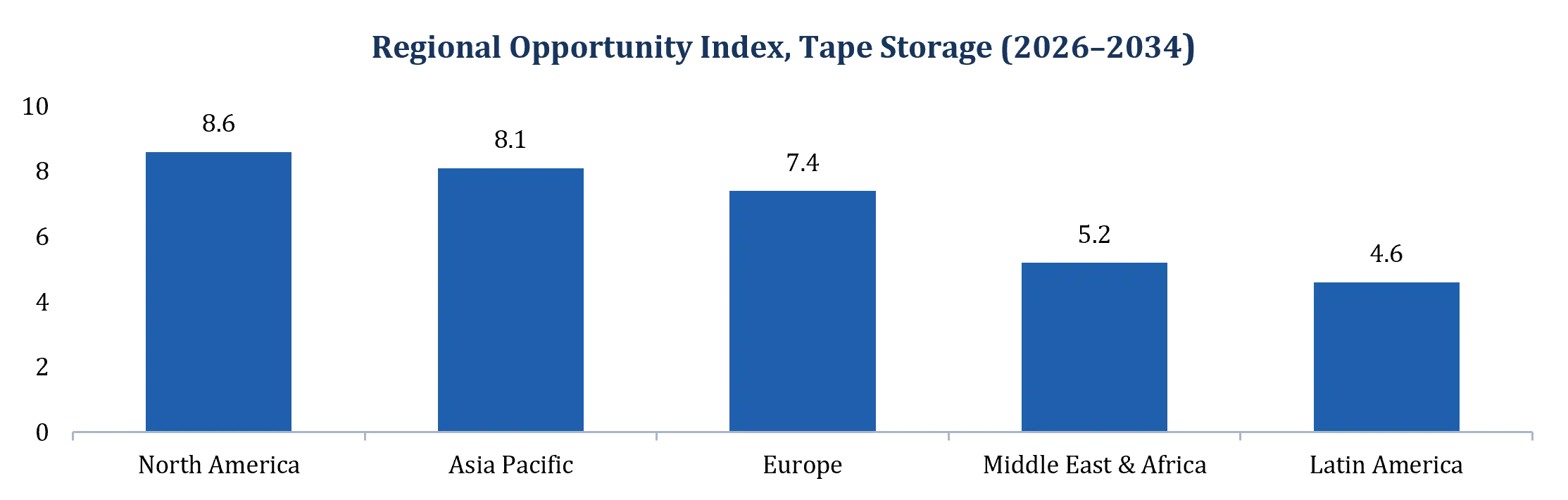
Regional demand for tape storage follows the location of hyperscale data centres, regulated industries and large research facilities. North America leads the tape storage market with the largest cloud and federal archives; data protection and operational resilience rules such as DORA and NIS2 shape tape demand in Europe; and Asia Pacific records the fastest growth as cloud providers expand and the region hosts all LTO tape media production.
Three pricing trends stand out. LTO-9 tape offers the lowest media cost per terabyte on sale, while older LTO generations cost more per terabyte as production volumes fall, which penalises organisations that delay tape refreshes. LTO-10 tape media carries an early-life premium of roughly 40–70% per terabyte over LTO-9, partly because of tight supply of aramid base film. Enterprise tape media follows separate pricing; one reseller listed an IBM 3592 JF 50 TB cartridge at USD 423.50 against a manufacturer list price of USD 977.43, which shows the gap between list and transaction prices.
Tape drive and tape library prices vary widely by configuration, and vendors rarely publish them. As a reference point, a desktop LTO-9 tape drive with an external enclosure retailed at just over USD 5,000 at launch, entry-level tape libraries start in the low five figures, and vendors sell hyperscale tape systems as multi-million-dollar projects. MMR therefore models tape drive and tape library revenue from vendor disclosures and channel checks rather than list prices.
LTO Tape Shipment and Migration Patterns
LTO-9 media carried most tape shipments in 2025, while LTO-10 media ramped from mid-2025 and accelerated with the 40 TB cartridge in early 2026, lifting first-quarter shipped capacity by 57%. One trade publication extrapolated the first-quarter rate to a possible 2026 total near 252 EB; MMR treats that figure as an upper bound because quarterly tape shipments move unevenly. Buyers typically skip a generation, so LTO-7 and LTO-8 users generate most LTO-10 demand, while LTO-9 users tend to wait for LTO-11, which trade press expects around 2028.
Global Tape Storage Market Future Outlook and Forecast to 2034
Through 2034, tape storage looks set to strengthen its role as the standard cold storage tier for hyperscale, AI and regulated data. The LTO roadmap targets up to 70 TB native for LTO-11 around 2028, followed by 120 TB, 210 TB and 365 TB native for later generations. Fujifilm plans to raise LTO tape output fivefold by fiscal 2028, expanding media supply sharply. Tape automation, S3-compatible interfaces and tape-as-a-service lower the skills barrier, while hybrid cloud storage architectures move data between flash, disk, cloud and tape by policy. Drive supply, the length of the hard-drive shortage and the commercial progress of alternative archive media set the pace of tape storage market growth to 2034.
Tape Storage Market Competitive Landscape and Key Companies:Inquire before buying
The tape storage market shows high concentration at the technology layer and moderate fragmentation at the system and software layers. HPE, IBM and Quantum govern the LTO format as Technology Provider Companies; IBM manufactures all LTO tape drives and also supplies 3592 enterprise tape drives; Fujifilm and Sony produce all LTO tape media. Tape library vendors build systems around IBM drives and certified media and compete on density, reliability, software and service. Overland-Tandberg, a long-standing tape library supplier, ceased operations in February 2025, and MagStor and Qualstar now support parts of its installed base. The organisations below participate in one or more covered categories; their order does not indicate market ranking.
Competitive Benchmarking of Leading Tape Storage Vendors
| Company | Media | LTO drives | Enterprise drives | Libraries | Software | Positioning |
| HPE | Branded | Branded | ○ | ● | ● | LTO TPC; MSL libraries for enterprise |
| Quantum | Branded | Branded | ○ | ● | ● | LTO TPC; Scalar i7 RAPTOR hyperscale density |
| Spectra Logic | Certified | Integrated | Integrated | ● | ● | TFinity Plus, multi-format, research and cloud |
| Dell Technologies | Branded | Branded | ○ | ● | ○ | PowerVault ML3 within data protection portfolio |
| Qualstar | Branded | Integrated | ○ | ● | ○ | Entry and mid-range LTO libraries |
| MagStor | Branded | Integrated | ○ | ● | ○ | Desktop drives; Overland NEO support |
Key Players in the Global Tape Storage Market
| Organisation | Organisation |
| 1. IBM Corporation | 2. Hewlett Packard Enterprise |
| 3. Quantum Corporation | 4. Spectra Logic Corporation |
| 5. Dell Technologies | 6. FUJIFILM Corporation |
| 7. Sony Group Corporation | 8. Qualstar Corporation |
| 9. BDT Media Automation GmbH | 10. MagStor |
| 11. Symply | 12. Lenovo (IBM TS4300-based libraries) |
| 13. Oracle (StorageTek, legacy support) | 14. XenData |
| 15. Versity Software | 16. Archiware |
| 17. Geyser Data | 18. TapeArk |
| 19. Veeam Software | 20. Commvault |
| 21. Fujitsu Limited (ETERNUS LT tape libraries) | 22. Iron Mountain (offsite tape vaulting) |
| 23. Cohesity (Veritas NetBackup) | 24. Arctera (Backup Exec) |
| 25. OpenText (Data Protector) | 26. Arcserve |
| 27. Atempo (Miria archiving) | 28. PoINT Software & Systems |
| 29. Grau Data (XtreemStore) | 30. QStar Technologies |
| 31. StrongBox Data Solutions | 32. ATTO Technology (tape connectivity) |
| 33. OWC (Other World Computing) | 34. mLogic |
Frequently Asked Questions (FAQs) on the Global Tape Storage Market
Q1. What is the size of the global tape storage market in 2025?
The global tape storage market reached USD 3.42 billion in 2025, covering tape media, tape drives, tape library systems, tape storage software, and related support services.
Q2. What is the tape storage market growth rate and forecast to 2034?
MMR projects the global tape storage market to grow at a CAGR of 7.6% during 2026–2034 and reach about USD 6.60 billion by 2034.
Q3. Which region leads the global tape storage market?
North America leads the tape storage market, backed by hyperscale data centres, government archives, research institutions, and mature enterprise storage infrastructure. Asia Pacific records the fastest growth in tape storage demand.
Q4. Which component holds the largest share of the tape storage market?
Tape libraries and automation systems hold the largest revenue share, supported by demand for high-capacity archival storage infrastructure. Tape storage software and management solutions grow fastest as organisations adopt cloud-integrated storage and automated data management.
Q5. How does LTO-10 tape compare with LTO-9?
LTO-10 tape stores 30 TB or 40 TB native per cartridge, compared with 18 TB for LTO-9, at the same 400 MB/s native speed. LTO-10 drives read and write only LTO-10 media, so LTO-9 remains the safer choice for users who need to read older cartridges.
Table of Contents
Table of contents is available on request.