
Ambient Light Sensor Market Size by Sensor Type, Output Type, End-User Industry, Region, Industry-Wide Analysis, Competitive Landscape Assessment & Long-Term Forecast to 2032
Overview
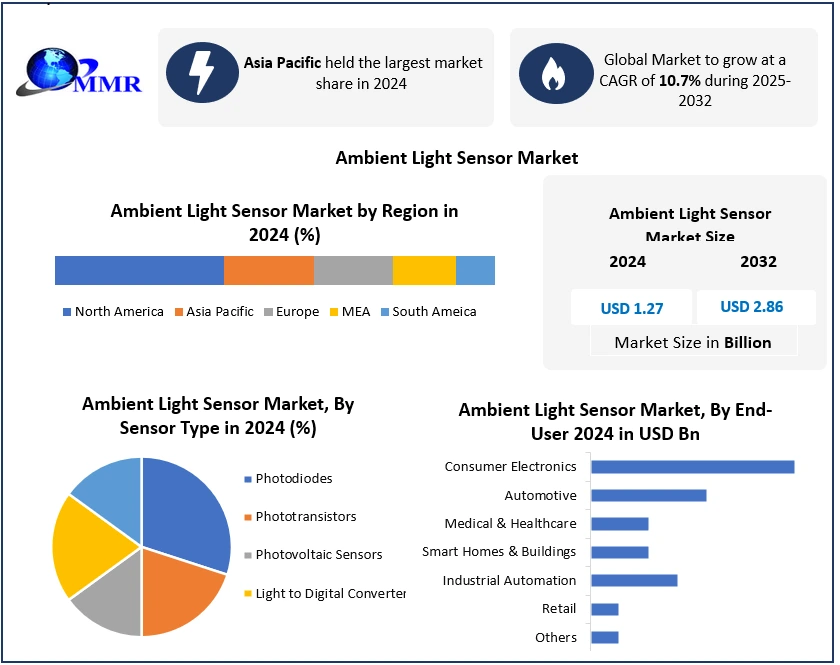
Ambient Light Sensor Market was valued at USD 1.27 Bn in 2024, and total global Ambient Light Sensor Market revenue is expected to grow at a CAGR of 10.7% and reach nearly USD 2.86 Bn from 2025-2032. Rising need for energy-efficient devices, IoT, and smart lighting solutions.
Ambient Light Sensor Market Overview
An ambient light sensor is an electronic component, which is used in smartphones, notebooks, automotive displays and LCD TVs. It is a photodetector, which is used to sense the amount of ambient light present. Ambient light sensors are used to detect light or brightness. It is most commonly used in industrial lighting, consumer electronics, and automotive systems. Ambient light sensors are also called illuminance or illumination sensors, optical sensors, brightness sensors or simply light sensors.
 To know about the Research Methodology :- Request Free Sample Report
The Ambient Light Sensor Market is majorly driven by increasing demand for smart devices and energy-efficient solutions and is poised to grow significantly due to technological advancements with expanding applications across various industries. The continuous evolution of sensing technologies and the growing emphasis on smart and sustainable solutions are expected to drive the global market in the future.
Ambient Light Sensor Market Dynamics
The demand for ambient light sensor is increasing because of presence of high consumer base for consumer electronics products like smartphones, laptops, and other portable devices. The growing popularity of industrial wearables, adoption of IOT projects like smart homes are expected to boost the demand for ambient light sensor. It offers ultra-low light sensitivity, low power consumption, ideal spectral response, and easy-to-use simple output algorithm. It has also application scope from electronics industry like outdoor light control, traffic signals, street lights, general lighting, and other electrical applications.
The presence of the high smartphone user base is one of the prominent drivers behind the ambient light sensor market growth. High adoption of ambient light sensors in smart indoor and outdoor lighting systems, need for low energy consumption or energy management by automatic control of brightness level in mobile phones and demand for ambient light sensor in auto ON/OFF of street lights are boosting the market growth. The ambient light sensors are widely used in every type of illumination sources such as natural sunlight, fluorescent and incandescent lamps, that also boost its adoption. On the other hand, low current output and the need for external amplification circuit are expected to limit the ambient light sensor market growth.
Energy Efficiency and Sustainability Driving the Global Ambient Light Sensor Market
Ambient light sensors are integral to smart lighting solutions that adjust artificial lighting based on natural light availability, thus reducing energy consumption. Environmental sensors play a crucial role in optimizing energy management and building operations by monitoring energy usage and various environmental parameters. This optimization leads to significant energy savings and reductions in emissions. Additionally, these sensors are instrumental in monitoring environmental pollutants, air quality, and water quality data. By detecting environmental issues promptly, they enable the implementation of effective measures to protect and improve the environment. Therefore, the demand for them is increasing, driving the Ambient Light Sensor Market growth.
Newcastle University researchers, have developed high-efficiency, sustainable solar cells that harness ambient light to power IoT devices. These dye-sensitized cells, featuring a copper(II/I) electrolyte, achieve a power conversion efficiency of 38% and 1.0V open-circuit voltage at 1,000 lux, and are environmentally friendly. This innovation is poised to revolutionize IoT device power sources. The team also introduced an AI-driven energy management system using LSTM neural networks to optimize sensor energy consumption. This breakthrough enables IoT sensors to dynamically adapt, reducing energy usage and enhancing sustainability.
High Development Costs Challenging the Ambient Light Sensor Market Growth
Developing advanced ambient light sensors entails significant research and development (R&D) costs. These expenses stem from various factors, including the creation of innovative materials that enhance sensor performance, the refinement of intricate manufacturing processes to ensure precision and efficiency, and the rigorous compliance with international standards and regulations to guarantee safety and interoperability. High R&D costs pose a substantial barrier, particularly for smaller companies with limited financial resources. This financial strain stifle innovation, as these companies struggle to fund the necessary R&D activities to develop cutting-edge technologies. Consequently, their ability to enter and compete in the Ambient Light Sensor market is hindered, slowing the overall pace of technological advancement in the industry. Moreover, the high costs may lead to a concentration of innovation within larger, well-funded organizations, potentially reducing the diversity of approaches and solutions available in the market.
Ambient Light Sensor Market Segment Analysis
Based on Sensor Type, the ambient light sensor market is segmented into photodiodes, phototransistors, photovoltaic sensors, light-to-digital converters, and light-to-frequency converters. Photodiodes are commonly used for their high sensitivity and fast response to varying light levels, making them ideal for smartphones and display brightness adjustment. Phototransistors are preferred in applications requiring signal amplification and reliable performance under different lighting conditions. Photovoltaic sensors are utilized for energy-efficient operations and are often found in solar-based devices. Light-to-digital converters are valued for their ability to directly convert light into digital signals, simplifying the integration process in modern electronics. Light-to-frequency converters are chosen for applications where precise conversion of light intensity into frequency signals is needed, particularly in industrial and measurement systems.
Based on End-User Industry, the market is segmented into Automotive, Consumer Electronics, Retail, Industrial, Healthcare and Others. The Consumer Electronics segment dominated the global market with the largest Ambient Light Sensor Market share in 2024 and is expected to grow rapidly during the forecast period. The ambient light sensor widely used in various electronic products such as in mobile devices, notebooks, automotive displays. It detects light in an object’s locality. It is used in various LCD displays for back light control in automotive to consumer electronics products. The adoption rate of ambient light sensors is high in smartphone deployment. It reduces the power consumption of the displays and enhances the smartphone user readability. An increase in adoption of smartphone is boosting the demand for ambient light sensors at exponential rate. In the smartphone, When the Smartphone is used outside in bright sunlight, the sensor senses the ambient light and transmits a signal which would cause the LED Backlight to increase its brightness. The ambient light sensor offers optimum viewing experience automatically in lighting conditions through backlight control.
Ambient Light Sensor Market Regional Insights
Asia Pacific Ambient Light Sensor Market dominated the global market with the largest share in 2023. The region is one of the largest consumers for electronic products. It has high consumer base for consumer electronics. High smartphone penetration is one of the key drives in the market growth. The demand for ambient light sensor is expected to continue in the near future as a result of rapid expansion of the end-user industries like electronics, automotive, and healthcare sectors in the developing economies as China, India, South Korea, Taiwan, and other developing countries
North American Ambient Light Sensor Market held the second-largest share in the global market in 2023 and is expected to grow at a high rate during the forecast period. This is attributed to the ongoing technological advancements and expanding applications across various sectors. The integration of ambient light sensors in emerging technologies, such as augmented reality (AR) and virtual reality (VR), further underscores their increasing importance. The regional market is characterized by significant growth opportunities, driven by innovations in consumer electronics, automotive, smart homes, healthcare, and industrial applications.
Ambient Light Sensor Market Competitive Landscape
Key players are stepping up their investment in innovations and marketing across the globe, thanks to continuous focus on cost management, higher efficiency of process. Some of the prominent key players are focusing on the innovation activities. For instance, ST microelectronics offers ambient light sensors, which are available in optimized packages, photopic or color filters with precise responses. Renesas' ambient light sensors are helps to adjust a display’s backlight and improves user experience and power savings by optimizing the display’s viewability.
Key players are forming robust footprints in the global ambient light sensor market by introducing new products and high investment in the manufacturing sector. In 2023, AMS a leading worldwide supplier of high-performance sensor solution has launched the AS7350, an advanced spectral ambient light sensor (ALS) for high-end mobile phone cameras. It enables the highest quality images even in situations with extreme color contrast light source conditions. With the consumer demand for more advanced camera capabilities, mobile phone vendors are continuously focusing on their devices by enhancing picture quality with the usages of premium AS7350 spectral ALS sensor.
Ambient Light Sensor Market Scope: Inquiry Before Buying
| Global Ambient Light Sensor Market | |||
|---|---|---|---|
| Report Coverage | Details | ||
| Base Year: | 2024 | Forecast Period: | 2025-2032 |
| Historical Data: | 2019 to 2024 | Market Size in 2024: | USD 1.27 Bn. |
| Forecast Period 2025 to 2032 CAGR: | 10.7% | Market Size in 2032: | USD 2.86 Bn. |
| Segments Covered: | by Sensor Type | Photodiodes Phototransistors Photovoltaic Sensors Light to Digital Converters Light to Frequency Converters |
|
| by Output Type | Analog Digital |
||
| by End-User Industry | Consumer Electronics Automotive Medical & Healthcare Smart Homes & Buildings Industrial Automation Retail Others |
||
Ambient Light Sensor Market, by Region
North America (United States, Canada, and Mexico)
Europe (UK, France, Germany, Italy, Spain, Sweden, Austria, and the Rest of Europe)
Asia Pacific (China, South Korea, Japan, India, Australia, ASEAN, Indonesia, Philippines, Malaysia, Vietnam, Thailand, ASEAN, Rest of Asia Pacific)
Middle East & Africa (South Africa, GCC, Nigeria, Rest of ME&A)
South America (Brazil, Argentina, Rest of South America)
Ambient Light Sensor Key Players
1. Semiconductor Components Industries, LLC
2. Rohm Semiconductors
3. AMS AG
4. Broadcom Ltd.
5. Texas Instrument
6. Renesas Electronics Corporation.
7. Panasonic Corporation
8. Maxim Integrated
9. OSRAM Opto Semiconductors
10. Vishay Semiconductors
11. Philips’s lighting Holding B.V
12. General Electric
13. Signify N.V.
14. Acuity Brands
15. Samsung Electronics
16. S.T. Microelectronics
17. Lite-On Technology Corporation
18. Everlight Electronics Co., Ltd
19. Sensortek
20. Silicon Laboratories
Frequently Asked Questions:
1] What segments are covered in the Global Market report?
Ans. The segments covered in the Ambient Light Sensor Market report are based on Sensor Type, Output Type, End -User Industry and Region.
2] Which region held the largest Ambient Light Sensor Market share in 2024?
Ans. The Asia Pacific region held the largest Ambient Light Sensor Market share in 2024 in which China was the leading country.
3] What is the expected Ambient Light Sensor Market size by 2032?
Ans. The Ambient Light Sensor Market size is expected to reach USD 2.86 Bn by 2032.
4] What was the key driver of the Global Ambient Light Sensor Market?
Ans. The proliferation of smartphones, tablets, and laptops with adaptive brightness features is a major driver.
5] What is the expected CAGR of the Global Market during the forecast period?
Ans. The expected CAGR of the Ambient Light Sensor Market is 10.7% during the forecast period.