
Global Tactical Footwear Market Size by Product Type, Application, Distribution Channel, by Region and Forecast 2034
Overview
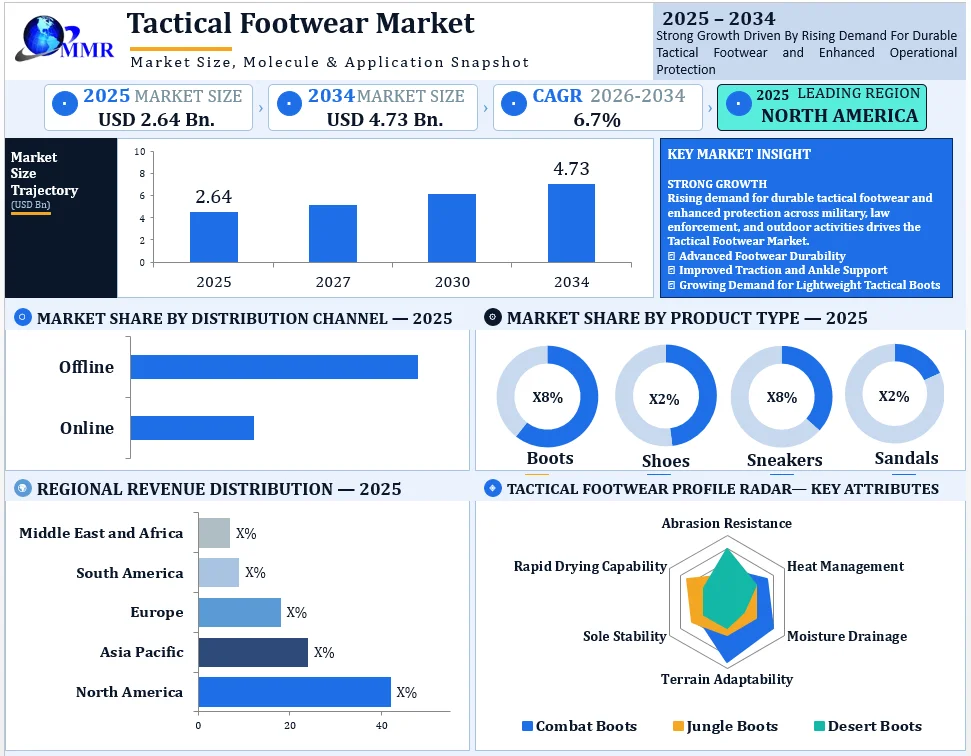
The Global Tactical Footwear Market Size was valued at USD 2.64 Bn. in 2025 and is expected to grow by 6.7 % from 2026 to 2034, reaching USD 4.73 Bn. by 2034.
Tactical Footwear Market Overview
Tactical footwear refers to specialized boots and shoes designed to provide durability, traction, foot protection, stability, and comfort in demanding working environments. These products serve military personnel, law enforcement officers, private security teams, emergency responders, and outdoor users who require reliable footwear across challenging terrain and weather conditions. Tactical footwear combines functional construction with performance-focused materials to support operational mobility and prolonged wear.
The tactical footwear market is growing as defence modernization, public safety requirements, and demand for rugged outdoor footwear encourage buyers to prioritize lightweight construction, improved grip, breathable materials, and long-lasting performance. Military and law enforcement agencies remain important purchasers, while private security providers and outdoor enthusiasts create additional demand for versatile tactical shoes and boots. North America holds a prominent position in the market, supported by established defence procurement and specialist footwear suppliers, while Asia Pacific offers opportunities through military modernization, domestic manufacturing, and increasing demand for performance-oriented footwear. Companies such as 5.11 Tactical and Under Armour compete through tactical footwear designs that combine functional protection with mobility and comfort. Government procurement information, including defence contract statistics published by the United Kingdom Ministry of Defence, helps illustrate the role of institutional purchasing in the wider defence supply chain.
MMR’s research evaluates tactical footwear market trends, product segmentation, application demand, distribution channels, regional performance, competitive positioning, and growth opportunities. The analysis helps businesses identify demand for mission-specific footwear, advanced materials, improved comfort, and application-focused product development.
Tactical Footwear Market Size, Growth & Share Analysis
To know about the Research Methodology :- Request Free Sample Report
Global Tactical Footwear Market Key Highlights
| Market Highlight |
Insight |
|---|---|
| Consistent Market Growth |
The Tactical Footwear Market is valued at USD 2.64 billion in 2025 and is projected to reach USD 4.73 billion by 2034, reflecting a compound annual growth rate of 6.7% during the forecast period. |
| Tactical Boots Maintain Product Relevance | Boots are positioned as the leading product category because they provide ankle support, traction, durability, and protection for military operations, law enforcement duties, and demanding outdoor environments. |
| North America Leads Regional Demand |
Established defence procurement systems, law enforcement requirements, specialist footwear suppliers, and outdoor recreation support North America's leading position in the market. |
| Online Distribution Creates New Sales Opportunities |
E-commerce platforms and direct-to-consumer channels improve product accessibility, enable price comparisons, and allow tactical footwear brands to reach individual buyers beyond specialist physical stores. |
| Performance Innovation Strengthens Competition |
Lightweight materials, breathable construction, waterproof protection, improved outsole grip, and athletic-inspired designs help manufacturers differentiate products for specific operational requirements and user preferences. |
Tactical Footwear Market Dynamics
Rising Demand for Durable Tactical Footwear Drives Market Growth Across Defence and Law Enforcement
The tactical footwear market is driven by rising demand for durable, high-traction boots among military personnel, law enforcement officers, security professionals, and outdoor workers who require dependable protection in demanding environments. Tactical boots featuring slip-resistant outsoles, reinforced toe protection, ankle support, and abrasion-resistant materials help improve stability across rough terrain and during prolonged duty shifts. Operational duties that last 8 to 12 hours increase the importance of cushioning, breathable linings, moisture management, and ergonomic construction. Defence training, border patrol, emergency response, and private security operations further drive demand for tactical footwear that combines comfort, durability, and mobility, encouraging manufacturers to develop application-specific designs for varied climates and terrain conditions.
High Tactical Footwear Prices and Specialized Manufacturing Costs Limit Market Adoption
High tactical footwear prices remain a key restraint, particularly for budget-conscious consumers, small security agencies, and organizations purchasing boots for large workforces. Advanced materials such as waterproof membranes, puncture-resistant midsoles, heat-resistant components, and specialized rubber compounds can increase manufacturing costs compared with conventional work boots. Institutional buyers must often balance footwear procurement against budgets for uniforms, protective equipment, and training. Frequent use in demanding conditions can also accelerate outsole wear, stitching damage, and material deterioration, increasing replacement and maintenance expenses. These cost pressures encourage buyers to compare product lifespan, warranty coverage, comfort, and performance before purchasing premium tactical footwear.
Growing Demand for Lightweight Tactical Boots Creates New Product Development Opportunities
Demand for lightweight tactical boots creates opportunities for manufacturers to improve mobility, comfort, and protection across defence, law enforcement, industrial security, and outdoor applications. Reducing unnecessary footwear weight while maintaining ankle stability, impact absorption, and outsole grip can improve comfort during extended patrols and training exercises. Manufacturers can differentiate products through breathable uppers, moisture management, quick-drying materials, puncture-resistant construction, and heat-resistant outsoles tailored to specific operating environments. Boots designed for hot climates can prioritize ventilation and moisture control, while footwear for wet terrain can emphasize water resistance and multidirectional traction. Direct-to-consumer websites and specialized online retailers also provide opportunities to reach buyers through detailed size guides, product comparisons, and application-specific recommendations.
Changing Operational Conditions Challenge Tactical Footwear Design and Performance
Tactical footwear manufacturers face the challenge of balancing durability, protection, traction, weight, and comfort across different operating conditions. Boots designed for rocky terrain, wet surfaces, hot climates, and cold environments may require different outsole compounds, insulation levels, waterproofing systems, and upper materials, making product standardization difficult. Military and law enforcement buyers may also require compliance with specific procurement specifications and applicable occupational safety standards, increasing testing and product validation requirements. Manufacturers must maintain consistent sizing, material quality, and construction across production batches while managing supply costs and delivery schedules. Field evaluations and extended wear testing remain important for identifying discomfort, inadequate grip, or durability issues that may not appear during short product assessments.
Global Tactical Footwear Market Key Trends
| Market Trend | Description |
|---|---|
| Lightweight Tactical Footwear Construction | Manufacturers are moving toward lighter tactical boots that support mobility and reduce fatigue during long patrols and field operations. Advanced upper materials and lightweight structural components help balance reduced weight with durability and foot protection. |
| Waterproof and Breathable Tactical Boots |
Tactical footwear increasingly combines water-resistant protection with breathable membranes to help manage moisture during outdoor duties. This combination is particularly relevant for personnel operating in wet conditions, humid climates, and environments where activity levels change throughout a shift. |
| Athletic-Inspired Tactical Footwear Design | Boot designs are adopting features associated with athletic footwear, including flexible construction, responsive cushioning, and more comfortable fits. This approach helps address the need for agility and all-day wear without removing the protective structure required for tactical applications. |
| Mission-Specific Outsole and Traction Engineering |
Manufacturers are tailoring outsole patterns and rubber compounds to suit different operational surfaces, including mud, gravel, wet flooring, and rocky terrain. Improved grip, abrasion resistance, and stability are becoming important product-selection factors for military, law enforcement, and emergency response users. |
| Sustainable and Fast-Drying Footwear Materials | Material development is placing greater emphasis on reducing water absorption, improving drying performance, and making footwear construction more resource-efficient. New upper-material concepts aim to maintain durability while helping boots stay lighter in wet conditions and supporting more efficient manufacturing processes. |
| Fit Optimization and Performance Validation |
Tactical footwear development increasingly emphasizes fit, wear comfort, durability testing, and performance under realistic conditions. Manufacturers and institutional buyers are paying attention to sizing consistency, slip resistance, abrasion performance, and long-duration comfort to help reduce fit-related issues and improve product suitability for specific duties |
Global Tactical Footwear Market Segment Analysis
By Application, Tactical boots are the leading product segment, supported by demand from military and defence personnel, law enforcement officers, and users working in rugged environments. Their ankle support, durable construction, traction, and protective features make them suitable for demanding operations. Tactical shoes are also gaining attention because their lighter construction supports patrol duties, training, and outdoor activities that require greater mobility. Tactical sneakers appeal to users seeking athletic-style comfort and flexibility, while tactical sandals remain a niche option for specialized warm-weather and outdoor applications. Available market research identifies boots as the largest segment and shoes as a faster-growing category, although published estimates differ by market scope and classification.
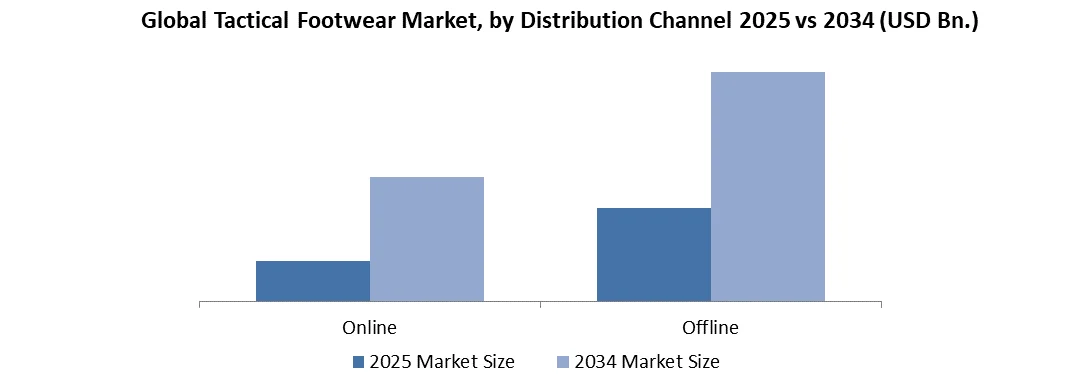
By Distribution Channel, Offline distribution remains the leading channel in the tactical footwear market because military personnel, law enforcement agencies, and professional buyers often prefer physical inspection, fitting, and specialist advice before purchasing tactical boots. Specialty footwear stores and institutional suppliers also serve buyers with specific requirements for fit, durability, and operational performance. Online distribution is gaining momentum as digital platforms offer wider product selections, customer reviews, price comparisons, and convenient delivery. Online sales are expected to grow faster than offline sales, supported by e-commerce adoption and direct-to-consumer purchasing options.
Tactical Footwear Market Regional Insights
North America is the leading region in tactical footwear market, supported by established defence procurement networks, military modernization, and consistent demand from law enforcement, emergency response teams, and private security professionals. Buyers prioritize durable tactical boots with reliable traction, ankle support, and comfort for extended duty shifts. Outdoor activities such as hiking, hunting, and camping also sustain civilian demand, while specialist retailers and institutional suppliers help meet specific footwear requirements.
Asia Pacific presents substantial growth opportunities for the tactical footwear market, driven by defence modernization, industrial activity, border security requirements, and demand from law enforcement agencies. Countries such as India, China, Japan, and South Korea have varied operational needs, encouraging demand for tactical boots with breathable materials, durable outsoles, moisture management, and terrain-specific traction. Local manufacturing capabilities and the wider availability of competitively priced footwear also support regional supply. Increasing participation in hiking and other outdoor activities provides an additional source of consumer demand.
Europe maintains a strong position in the tactical footwear market through defence readiness initiatives, police equipment upgrades, and demand from firefighting and emergency services. Buyers across the region value footwear that combines durability, weather resistance, grip, and ergonomic design for different operational environments. Varied climatic conditions create demand for products suited to cold-weather deployments, wet terrain, and warmer outdoor conditions. Growing attention to product quality, occupational safety requirements, and material performance also influences purchasing decisions.
South America demonstrates demand for tactical footwear through public security operations, military requirements, private security services, and outdoor activities across diverse terrain. Buyers often seek cost-effective footwear that can withstand heat, humidity, uneven ground, and frequent use. Brazil, Argentina, and other regional markets offer opportunities for suppliers providing durable boots with dependable grip, reinforced construction, and practical maintenance requirements. Distribution through specialist retailers and local equipment suppliers remains important for reaching institutional and individual customers.
The Middle East and Africa region is supported by demand from military organizations, border protection units, law enforcement agencies, and security contractors operating in challenging environments. Hot temperatures, sandy terrain, dust exposure, and long outdoor duty periods create demand for tactical footwear with heat management, breathable uppers, abrasion resistance, and secure traction. Buyers also consider product durability and replacement costs when selecting equipment for repeated field use. Opportunities are particularly relevant for manufacturers offering climate-adapted designs and dependable supply for institutional procurement.
Different tactical boots along with their associated technologies, features, and applications
| Tactical Boots Model | Technologies | Features | Applications |
| Model 1: Rugged Guard | Advanced Polymer Blend | Lightweight and Durable Materials | Military Operations |
| Impact-Resistant Reinforced Toe | Law Enforcement | ||
| Waterproofing Technology | Hiking and Outdoor Exploration | ||
| Quick-Lace System for Rapid Deployment | |||
|
Model 2: Urban Flex |
Shock Absorption | Urban Design with Tactical Functionality | Covert Operations |
| Breathable Mesh | Cushioned Insole for Comfort | Every day Wear | |
| Slip-Resistant Outsole | Mountain and Alpine Environments | ||
| Model 3: AlpineTech | Temperature Regulation | Insulated for Cold Weather Conditions | Mountain and Alpine Environments |
| Vibram Traction System | Gaiter-Compatible Design | Arctic and Subarctic Operations | |
| Thinsulate Insulation Technology | Extreme Cold Weather Expeditions | ||
|
Model 4: Aqua Guard |
Quick-Dry Technology | Drainage Channels for Wet Environments | Waterborne Special Operations |
| Non-Corrosive Materials | Adjustable Straps for Secure Fit | River Crossings and Water-Based Missions | |
| Antimicrobial Insole | Amphibious Assaults |
Tactical Footwear Market Competitive Landscape
The tactical footwear market is characterized by competition among established footwear brands, specialist tactical equipment manufacturers, and military boot suppliers that differentiate their offerings through durability, lightweight construction, slip-resistant outsoles, ankle support, waterproof protection, and all-day comfort. Key companies such as Under Armour, 5.11 Tactical, Belleville Boot Company, Wolverine World Wide, Danner, Magnum Boots, Garmont International, and adidas compete to meet the requirements of military personnel, law enforcement agencies, private security professionals, and outdoor users. Competitive strategies focus on product innovation, application-specific footwear designs, institutional procurement relationships, specialist retail networks, and online sales. Manufacturers are also responding to demand for lighter tactical boots, breathable materials, improved traction, and footwear suited to different climates and operational conditions. Companies that combine reliable product performance with competitive pricing, consistent quality, and effective distribution are well positioned to strengthen their presence in the tactical footwear market.
| Region | Country | Key Company | Competitive Positioning and Market Relevance |
|---|---|---|---|
| North America | United States | 5.11 Tactical | Specializes in tactical boots and shoes for law enforcement, military professionals, security personnel, and outdoor users. Its combination of functional design and direct-to-consumer distribution strengthens brand visibility. |
| North America |
United States |
Belleville Boot Company |
Focuses on military and combat boots, with product offerings designed around operational durability, foot protection, and demanding field conditions. |
| North America | United States | Under Armour | Competes through athletic-inspired tactical footwear that combines lightweight construction, cushioning, flexibility, and durability for duty and training applications. |
| Europe | Germany | adidas AG | Brings sports footwear engineering into specialist tactical and duty footwear, competing through fit, grip, movement flexibility, and performance-oriented design. |
| Europe | France | Salomon | Offers technical footwear relevant to demanding outdoor, mountain, and tactical environments, with strengths in traction, stability, and lightweight construction. |
| Asia Pacific |
China | Qingdao Glory Footwear |
Manufactures and supplies footwear for law enforcement applications, contributing to regional competition in specialized tactical footwear production. |
| Asia Pacific | India | Liberty Shoes Limited | Represents an established Indian footwear manufacturer with potential relevance to institutional and work-oriented footwear supply; its specific tactical footwear portfolio should be verified before assigning tactical-market revenue. |
| Middle East and Africa |
United Kingdom |
Magnum Boots |
Specializes in tactical and duty footwear, including products designed for security and law enforcement use. Its product positioning is relevant to buyers seeking durable footwear for demanding operational conditions. |
Tactical Footwear Market Recent Development
| Month | Company | Recent Development |
|---|---|---|
| January 2026 | 5.11 Tactical | 5.11 Tactical introduced its 2026 product lineup at SHOT Show, highlighting A/T technology in the V.XI footwear series and new colour options for the A/T Boa Lite Mid Boot. |
| March 2026 | AKU | AKU presented the Sentinel GTX Mid, a lightweight tactical patrol boot developed for security personnel and first responders, emphasizing mobility and operational comfort. |
| June 2026 | Belleville Boot Company | Belleville Boot Company launched the Blackout Mini-MiL barefoot duty and activity shoe, featuring a wide toe box, zero-drop construction, and a slip-resistant outsole for duty and training applications. |
| July 2026 | OTB Boots | OTB Boots launched the reengineered T-KOOL 2.0 tactical boot, combining an athletic-inspired design with an updated outsole and reinforced fast-rope guard for operational use. |
| August 2026 | LOWA | LOWA introduced the Z-8N MK2 GTX PR mid-height boot for police and military applications, updating its tactical footwear offering for demanding professional environments |
Tactical Footwear Market Scope: Inquiry Before Buying
| Tactical Footwear Market | |||
|---|---|---|---|
| Report Coverage | Details | ||
| Base Year: | 2025 | Forecast Period: | 2026-2034 |
| Historical Data: | 2020 to 2025 | Market Size in 2025: | USD 2.64 Billion |
| Forecast Period 2026 to 2034 CAGR: | 6.7% | Market Size in 2034: | USD 4.73 Billion |
| Segments Covered: | by Product Type | Shoes Sandals Boots Sneakers |
|
| by Application | Military and Defence Law Enforcement Outdoor and Hiking Industrial and Work Others |
||
| by Distribution Channel | Offline Online |
||
Tactical Footwear Market, by region
North America (United States, Canada and Mexico)
Europe (UK, France, Germany, Italy, Spain, Sweden, Austria, Turkey, Russia and Rest of Europe)
Asia Pacific (China, India, Japan, South Korea, Australia, ASEAN and Rest of APAC)
Middle East and Africa (South Africa, GCC, Egypt, Nigeria and Rest of ME&A)
South America (Brazil, Argentina, Columbia and Rest of South America)
Tactical Footwear Market Key Players are
1. Salomon
2. Nike
3. Under Armour
4. Merrell
5. Danner
6. 5.11 Tactical
7. Bates Footwear
8. Altama
9. LOWA
10. Oakley
11. Rocky Boots
12. Smith and Wesson
13. Blackhawk
14. HAIX
15. Timberland PRO
16. Belleville Boot Company
17. Magnum Boots
18. Garmont
19. adidas
20. Wolverine
21. Original S.W.A.T.
22. Reebok Work
23. Tactical Research
24. McRae Footwear
25. Matterhorn Boots
26. Corcoran Boots
27. Thorogood
28. Georgia Boot
29. Keen Utility
30. Red Wing Shoes
31. Blundstone
32. Lowa Professional
33. Meindl
34. Crispi
35. AKU
36. Scarpa
37. Asolo
38. Hanwag
39. Haix Black Eagle
40. First Tactical
41. Viktos
42. Rocky S2V
43. Nicks Boots
44. Jim Green Footwear
45. Bates Tactical
46. Under Armour Tactical
47. Belleville Tactical Research
48. Xtratuf
49. Cofra
50. Safety Jogger
Frequently Asked Questions:
1. What are the growth drivers for the Tactical Footwear market?
Ans. The tactical footwear market is significantly influenced by the defense and military sectors. Increased defense budgets in various countries lead to higher demand for advanced tactical footwear for military personnel.
2. What are the major Challenges for the Tactical Footwear market growth?
Ans. The use of advanced materials and technologies in tactical footwear often results in higher production costs. This can limit the affordability of these products for some consumers and pose a challenge to market penetration, especially in price-sensitive markets.
3. Which region is expected to lead the global Tactical Footwear market during the forecast period?
Ans. North America is expected to lead the global Tactical Footwear market during the forecast period.
4. What is the projected market size & and growth rate of the Tactical Footwear Market?
Ans. The Global Tactical Footwear Market size was valued at USD 2.64 Billion in 2025 and the total Tactical Footwear revenue is expected to grow at a CAGR of 6.7 % from 2026 to 2034, reaching USD 4.73 Billion.
5. What segments are covered in the Tactical Footwear Market report?
Ans. The segments covered in the Tactical Footwear market report are Product Type, Application, and Distribution Channel.