
Switzerland Cocoa Butter Market Size by Product Type, Nature, Grade, Form, Application and End User
Overview
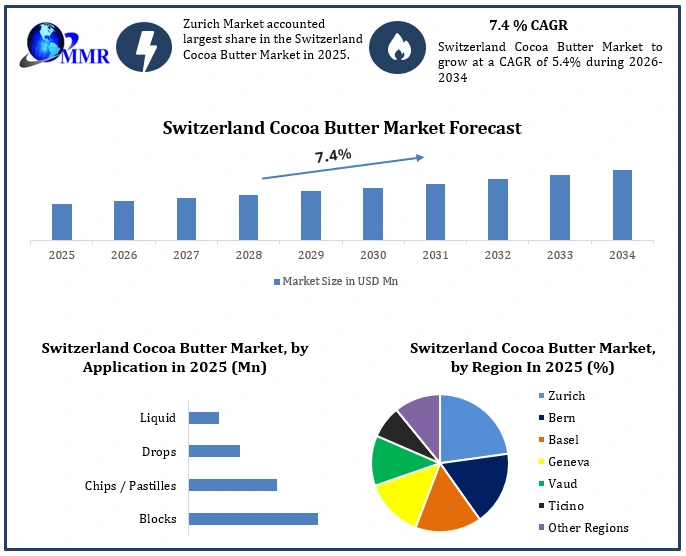
The Switzerland Cocoa Butter Market was valued at USD 344.70 Million in 2025 and is projected to reach USD 656.10 Million by 2034, registering a CAGR of 7.4% during the forecast period (2026–2034).
Switzerland Cocoa Butter Market Definition
The Switzerland Cocoa Butter Market is a market for cocoa butter, a fatty substance obtained from cocoa beans and used as an ingredient in various food and cosmetic products. This market covers the production, processing, import, distribution, and use of cocoa butter for the purposes of food, pharmaceutical, cosmetic, and pharmaceutical industries, as well as other needs, with specific attention paid to the quality and characteristics of the product. The market is determined by the developed chocolate, food, cosmetics, and pharmaceuticals production sectors in Switzerland, where cocoa butter is in demand for its beneficial effects on the quality and taste of products, as well as its emollient properties. The key factors affecting the market include the need for premium chocolate products, the development of innovative technologies, and the growing popularity of natural products in general and cocoa derivatives in particular.
| Parameter | Value |
| Market Size (Base Year 2025) | USD 344.70 Million |
| Forecast Market Size (2034) | USD 656.10 Million |
| CAGR (2026–2034) | 7.4% |
| Base Year | 2025 |
| Forecast Period | 2026–2034 |
| Historical Period | 2020–2025 |
Switzerland Cocoa Butter Market Overview
The Switzerland cocoa butter market occurs in a developed cocoa-processing and chocolate making environment of established processing infrastructure, networks for import and international trade, and a thriving premium chocolate market. Cocoa butter imports into Switzerland grew from 3,193 tonnes in 2020 to 5,213 tonnes in 2024, showing increased demand for semi-finished cocoa products. The German-speaking region (Zurich) is the major market area for cocoa butter, representing the highest percentage of cocoa and chocolate manufacturers in the country. Barry Callebaut is a major participant in the Swiss cocoa butter market, with Lindt & Sprüngli, Nestlé, PRONATEC, Felchlin, Stella Bernrain, Cargill, ofi, and ECOM being other nearkey manufacturers.
The Switzerland Cocoa Butter Market Report contains comprehensive information on the size, growth, segmentation, and regional distribution of the market, competitive landscape, demand outlook, and market forecast. The report reviews the premium chocolate production environment, sustainability and traceability requirements, and specialty cocoa and supply chain needs, as well as the shifting dynamics and preferences of manufacturers, identifying opportunities for the Swiss cocoa butter market. Additionally, it highlights the scope of growth, expansion, and the potential for value-added sales of certified and specialty cocoa ingredients and products, as well as the demand outlook for the Swiss cocoa butter market.
Switzerland Cocoa Butter Market Growth and Forecast Analysis
To know about the Research Methodology :- Request Free Sample Report
Switzerland Cocoa Butter Market Historical Size (2020–2025)
| Year | Market Size | Growth Rate (YoY) |
| 2020 | USD 269.96 Mn | 4.2% |
| 2021 | USD 283.73 Mn | 5.1% |
| 2022 | USD 291.68 Mn | 2.8% |
| 2023 | USD 304.22 Mn | 4.3% |
| 2024 | USD 320.95 Mn | 5.5% |
| 2025 | USD 344.7Mn | 7.4% |
Switzerland Cocoa Butter Market Size Forecast (2026–2034)
| Year | Market Size | Growth Rate (YoY) |
| 2026 | USD 344.7 Mn | 7.4% |
| 2027 | USD 370.25 Mn | 7.4% |
| 2028 | USD 397.7 Mn | 7.4% |
| 2029 | USD 427.19 Mn | 7.4% |
| 2030 | USD 458.86 Mn | 7.4% |
| 2031 | USD 492.87Mn | 7.4% |
| 2032 | USD 529.41 Mn | 7.4% |
| 2033 | USD 610.82 Mn | 7.4% |
| 2034 | USD 656.1 Mn | 7.4% |
Switzerland Cocoa Butter Market Key Highlights
|
Switzerland Cocoa Butter Market Consumer Insights & Demand Analysis
| Consumer Dimension | Key Insights | Market Implication |
| World-Class Chocolate Heritage | Switzerland produces globally-recognised luxury chocolate brands (Lindt, Toblerone, Cailler) requiring the finest cocoa butter for signature melt, flavour, and finish | Ultra-premium cocoa butter from specific origins (Ecuador Nacional, Madagascar Criollo) commands significant Swiss market premiums |
| World's Highest Per-Capita Consumption | Switzerland consistently ranks among the world's top per-capita chocolate consumers, creating concentrated domestic demand for premium confectionery containing cocoa butter | Domestic Swiss chocolate market provides stable, premium demand base supporting high-quality procurement standards |
| Cosmetics & Luxury Personal Care | Switzerland is home to luxury beauty brands (La Prairie, Weleda, Clarins European operations) using cocoa butter in premium formulations | Swiss pharmaceutical and cosmetics demand for cocoa butter growing at 10%+ CAGR in the premium segment |
| Organic & Sustainability Leadership | The Swiss Platform for Sustainable Cocoa coordinates industry-wide sustainable sourcing, with 85%+ of Swiss cocoa butter procurement sustainability-certified | Switzerland among the EU's most advanced markets for certified-sustainable cocoa butter procurement |
Switzerland Cocoa Butter Market Dynamics
Switzerland Cocoa Butter Market Drivers
• Expansion of Swiss Chocolate Manufacturing: The established chocolate manufacturing industry in Switzerland creates a stable demand for cocoa butter as a key ingredient in confections, fillings, coatings, and premium formulations. Cocoa butter imports to Switzerland have increased significantly in 2020 -2024, reflecting stronger industrial utilization.
• Strong Demand for Premium Chocolate Products: Swiss manufacturers are pursuing premium, high-quality, and specialty chocolate products, and cocoa butter has a key role in this context because of its functionality in creating the characteristic melting profile, texture, mouthfeel, and stability of premium chocolate formulas.
• Growing Use in Cosmetics and Personal Care: Cocoa butter’s emollient and skin-conditioning properties lend to its use in moisturizers, body-care products, lip-care formulations, soaps, and other personal-care products, and it offers additional consumption potential.
• Increasing Preference for Traceable Cocoa Ingredients: Manufacturers and buyers are placing greater importance on responsible sourcing, traceability, and sustainability throughout the cocoa supply chain, and this drives demand for cocoa butter with documented origin and provenance.
Switzerland Cocoa Butter Market Restraints
• High Cocoa Raw-Material Costs: Cocoa price volatility directly impacts cocoa butter production and purchasing costs. Already high cocoa prices have pushed cost pressure throughout Switzerland’s chocolate value chain, and cocoa butter becomes increasingly expensive to manufacturers and processors.
• Dependence on Imported Cocoa Supply: Switzerland has no domestic cocoa production at a commercial scale, and it relies on international supply chains for cocoa. Disruptions in producing countries or transport infrastructure can therefore impact cocoa butter supply and procurement costs.
• Price Sensitivity in Industrial Formulations: Rising cocoa butter costs can encourage food manufacturers to optimize formulations, usage, or seek alternative fats, and this can curb volume growth in applications where such cost factors are a priority.
• Limited Domestic Market Scale: The domestic market in Switzerland is relatively small, and it has limited headroom for long-term growth, which means that Switzerland’s chocolate industry must rely on industrial processing, exports, specialty products, and international supply chains to grow.
Switzerland Cocoa Butter Market Opportunities
• Growth of Sustainable and Traceable Cocoa Butter: Suppliers that deliver reliable origin documentation, traceability, and sustainability credentials can address increasing procurement requirements from Switzerland’s manufacturers and exporters, and can take advantage of the demand for cocoa butter with documented origin and provenance.
• Expansion of Specialty and Single-Origin Products: Swiss chocolate producers can leverage demand for specialty cocoa butter products of single origin, processing methods, and quality, and such products can offer greater value than standard formulations in premium chocolate and artisanal applications.
• Increasing Demand from Cosmetics and Personal Care: Cocoa butter can be used in skincare, body-care, lip-care, and natural personal-care formulations, and it can allow suppliers to diversify demand in Swiss chocolate manufacturing. Suppliers can also target refined, deodorized, and specification-controlled cocoa butter for use in cosmetics.
• Supply-Chain Integration for European Markets: Switzerland’s central position in Europe and its established food-processing and trading ecosystem present opportunities for companies that can meet the sustainability and traceability demands of manufacturers linked to the European market. In addition, Swiss companies that are exporting relevant products to the EU have increasing incentives to strengthen their traceability and compliance systems.
Switzerland Cocoa Butter Market Challenges
• Compliance with Evolving Deforestation Requirements: Swiss companies that export cocoa-related products to the EU can be affected by the EU Deforestation Regulation (EUDR). From the implementation dates onwards, businesses must comply with requirements on deforestation-free sourcing and supply-chain due diligence, and this makes reliable origin data and documentation even more important.
• Supply Disruptions in Cocoa-Producing Countries: Cocoa production is concentrated in producing regions that can be impacted by adverse weather, crop diseases, transport infrastructure, and changes in agricultural conditions, and it can translate to tighter cocoa butter availability and procurement challenges for Swiss buyers.
• Increasing Sustainability Requirements: Cocoa buyers face increasing expectations related to deforestation, biodiversity, farmers’ livelihoods, responsible sourcing, and supply-chain transparency. It can require greater effort and investment to ensure compliance with requirements from customers and regulators.
• Volatile Manufacturing Economics: Swiss chocolate manufacturers face pressures from rising raw-material, production costs, and international value-chain dynamics. In 2025, Swiss chocolate sales volumes declined while revenue grew mainly because higher costs increased product prices, illustrating the difficulty of achieving sales volume growth in parallel with higher market value.
Switzerland Cocoa Butter Market Segment Analysis
Switzerland Cocoa Butter Market, by Type
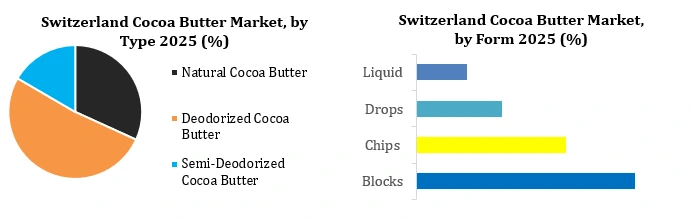
The Switzerland Cocoa Butter Market is segmented into Natural Cocoa Butter, Deodorized Cocoa Butter, and Semi-Deodorized Cocoa Butter. Natural cocoa butter is in demand in high-end chocolate and confectionery products, which value the unique aroma and taste of cocoa. Deodorized cocoa butter is in demand in the cosmetics, personal care, and selected food product industries, which seek a neutral aroma and flavor. Semi-deodorized cocoa butter satisfies the need for a mild cocoa aroma to flavor specific food items, and it is appropriate for other specialized uses.
Switzerland Cocoa Butter Market, by Form
The Market is divided into Blocks, Chips, Drops/Pastilles, and Liquid. Blocks are suitable for large-scale manufacturing and specific uses that require controlled and measured melting before incorporating cocoa butter into the final products. On the other hand, chips and drops or pastilles are easy to dose and handle and are, therefore, applied in specialized manufacturing and small-scale production. Finally, liquid cocoa butter is appropriate for continuous processing and large-scale manufacturing.
Switzerland Cocoa Butter Market Regional Analysis
| Region | Market Share | Key Demand Drivers & Trends |
| Zurich | 22.80% | Strong food manufacturing, premium confectionery demand, and concentration of commercial and distribution activities. |
| Bern | 17.40% | Demand from food processors, bakeries, confectionery manufacturers, and specialty food producers. |
| Basel | 15.60% | Pharmaceutical and cosmetics industries support demand for higher-specification cocoa butter products. |
| Geneva | 13.90% | Premium food, cosmetics, and international trading activities support specialty cocoa butter consumption. |
| Vaud | 11.80% | Growing artisanal chocolate, bakery, and premium food production supports demand for quality cocoa butter. |
| Ticino | 7.60% | Demand is supported by confectionery, bakery, hospitality, and cross-border commercial activity. |
| Other Regions | 10.90% | Smaller-scale food processing, artisanal producers, cosmetics applications, and regional distribution contribute to demand. |
Switzerland Cocoa Butter Market Competitive Landscape
Key Players & Benchmarking
| Company | Segment / Product | Market Position |
| Barry Callebaut AG | Cocoa butter, cocoa ingredients, chocolate | Major cocoa and chocolate ingredient supplier |
| Cargill | Cocoa butter, cocoa liquor, cocoa powder | Major international cocoa processor and ingredient supplier |
| ofi (olam food ingredients) | Cocoa butter, cocoa ingredients, specialty cocoa | Major global cocoa ingredient supplier |
| ECOM Cocoa | Cocoa beans, cocoa butter, cocoa ingredients | Major cocoa trading and processing company |
| Nestlé S.A. | Chocolate, confectionery, cocoa-based products | Major Swiss chocolate manufacturer and cocoa user |
| Lindt & Sprüngli AG | Premium chocolate and confectionery | Major premium chocolate manufacturer and cocoa butter user |
| Max Felchlin AG | Cocoa butter, couverture, chocolate ingredients | Swiss specialty chocolate and ingredient supplier |
| Cocoasource | Cocoa beans, cocoa products, specialty cocoa | Swiss cocoa trading and sourcing company |
| Natra | Cocoa butter, cocoa powder, chocolate ingredients | European cocoa ingredient and chocolate supplier |
| ADM | Cocoa butter, cocoa liquor, cocoa powder | Large-scale cocoa processor and ingredient supplier |
Switzerland Cocoa Butter Market Technology & Innovation Trends
| Innovation Area | Current Trend | Market Impact |
| PRONATEC Organic Processing Plant | State-of-the-art organic cocoa processing facility in Beringen, Switzerland, producing certified organic cocoa butter with full traceability using Bühler equipment | Positions Switzerland as a European benchmark for organic, traceable cocoa butter production; commands significant premiums |
| Barry Callebaut Ruby Chocolate R&D | Swiss R&D headquarters leading development of new chocolate categories (ruby, gold) requiring specific cocoa butter quality and processing parameters | Drives global specialty cocoa butter innovation from Switzerland's R&D hub |
| Felchlin Single-Origin Cuvées | Felchlin AG developing estate-specific cocoa butter blends from certified origin farms for ultra-premium Swiss chocolate couvertures | Commands 50–100% premium over commodity cocoa butter; establishes Switzerland as ultra-premium cocoa butter standard-setter |
| ETH Zurich Cocoa Science | ETH Zurich food science research into cocoa butter crystallisation, polymorphism, and flavour chemistry informing Swiss industry innovations | Switzerland's academic-industry connection uniquely advances cocoa butter processing science globally |
| Swiss Platform for Sustainable Cocoa | Industry-wide platform coordinating 85%+ sustainable procurement of cocoa butter across all Swiss manufacturers | Switzerland among global leaders in certified-sustainable cocoa butter procurement; brand differentiation advantage |
Switzerland Cocoa Butter Market Scope: Inquire before buying
| Switzerland Cocoa Butter Market | |||
|---|---|---|---|
| Report Coverage | Details | ||
| Base Year: | 2025 | Forecast Period: | 2026-2034 |
| Historical Data: | 2020 to 2025 | Market Size in 2025: | USD 344.7 Mn. |
| Forecast Period 2026 to 2034 CAGR: | 7.4% | Market Size in 2034: | USD 656.1 Mn. |
| Segments Covered: | by Product Type | Natural Cocoa Butter Deodorized Cocoa Butter Semi-Deodorized Cocoa Butter |
|
| by Application | Chocolate & Confectionery Bakery & Desserts Cosmetics & Personal Care Pharmaceuticals Others |
||
| by Nature | Conventional Organic |
||
| by Grade | Food Grade Cosmetic Grade Pharmaceutical Grade |
||
| by Form | Blocks Chips Drops Liquid |
||
| by End User | Industrial Manufacturers Artisanal Producers Cosmetics Manufacturers Pharmaceutical Companies |
||
Frequently Asked Questions (FAQs)
1. What is the current size of the Switzerland Cocoa Butter Market?
The Switzerland Cocoa Butter Market was valued at USD 344.70 million in 2025 and is projected to reach USD 656.10 million by 2034, at a 7.4% CAGR during 2026–2034.
2. What are the key factors driving the Switzerland Cocoa Butter Market?
Key drivers include premium chocolate production, rising demand for natural ingredients, expanding cosmetics applications, and increasing demand for traceable and sustainably sourced cocoa butter.
3. Which application segment holds the largest share?
Chocolate & Confectionery is the largest application segment, accounting for an estimated 62.4% share in 2025, supported by Switzerland's strong chocolate manufacturing industry.
4. Which region dominates the Switzerland Cocoa Butter Market?
Zurich dominates the market with an estimated 22.8% share in 2025, supported by food manufacturing, premium confectionery, commercial activities, and distribution networks.
5. Who are the major players operating in the market?
Key players include Barry Callebaut, Cargill, ofi, ECOM Cocoa, ADM, Nestlé, Lindt & Sprüngli, Max Felchlin, PRONATEC, and Stella Bernrain.