
Sports Tourism Market Size by Sports Category, Traveller Type, Booking Channel, and Event Type – Industry Trends, Demand Insights, and Forecast 2026–2032
Overview
The Global Sports Tourism Market was valued at USD 831.51 billion in 2025 and is projected to surpass USD 2214.53 billion by 2032, advancing at a compound annual growth rate (CAGR) of 15.02% over the forecast period. The sports tourism market is one of the fastest-expanding segments within the global tourism industry, driven by rising demand for event-based travel and experience-led tourism. Increasing international sporting events, improved connectivity, and higher disposable incomes are encouraging cross-border fan mobility. Sports tourism includes travel for attending mega-events, participating in sports activities, and visiting iconic sporting venues, generating significantly higher per capita spending compared to traditional tourism.

To know about the Research Methodology :- Request Free Sample Report
The market is evolving from a ticket-centric model to an integrated experience economy, where travel, hospitality, and fan engagement are bundled into premium sports travel packages. Governments are leveraging sports tourism for economic development, infrastructure expansion, and destination branding. Technological advancements such as AI-driven personalisation, digital booking platforms, and immersive fan experiences are enhancing customer engagement, while millennials and Gen Z travellers are driving demand for customised and experiential travel. Overall, the market presents strong opportunities across the sports, travel, and hospitality ecosystem.
Global Sports Tourism Market Key Highlights
| Market Parameter | Value / Insight | Trend |
| Global Market Size (2025) | USD 831.51 Billion | Strong |
| Projected Market Size (2032) | USD 2214.53 Billion | Growing |
| Forecast CAGR (2025–2032) | 15.02% | Accelerating |
| Dominated Region | Europe | Leading |
| Fastest Growing Region | Asia Pacific | Emerging |
| Dominated Sport Type | Soccer/Football | Structural |
| Dominated Tourism Type | Passive Sports Tourism | Dominant |
| Key Booking Channel | Online Travel Platforms (OTAs) | Digital-Led |
| Leading Companies | TUI Group, BAC Sports, Expedia, MATCH Hospitality | Consolidating |
Historical Development of Sports Tourism
Sports tourism represents one of the earliest forms of organised travel, dating back to Ancient Greece, where individuals travelled to attend the Olympic Games and Panhellenic festivals, establishing the foundation for event-driven mobility. The modern evolution began in the late 19th and early 20th centuries with the revival of the Olympic Games (1896) and the globalisation of sports through structured competitions such as international football tournaments. Post-World War II expansion of commercial aviation enabled broader participation, transforming sports travel from an elite activity to mass-market tourism.
The commercialisation phase (1980s–2000s) marked a turning point, driven by media expansion, global fan engagement, and the emergence of sports hospitality and travel operators offering bundled experiences. Mega-events increasingly became tools for destination branding and economic development. Despite the disruption caused by the COVID-19 pandemic, the sector has rebounded strongly, supported by digital platforms, experiential travel demand, and government-led infrastructure investments, positioning sports tourism as a strategic growth pillar within the global tourism ecosystem.
Key Global Sports Tourism Market Trends
• Experiential & Immersive Fan Travel
The Global Sports Tourism Market is witnessing a major shift toward experiential travel and immersive fan engagement, transforming traditional sports travel into a multi-dimensional experience. Modern sports tourists increasingly demand stadium tours, behind-the-scenes access, fan zones, and curated travel itineraries, driving growth in event-based tourism. Travel operators are offering bundled sports tourism packages that integrate travel, hospitality, and entertainment, resulting in higher per capita spending and improved customer retention.
• Premium & VIP Sports Hospitality Packages
The premium sports tourism segment is expanding rapidly within the Global Sports Tourism Market, driven by demand for luxury travel experiences and VIP event access. High-value offerings such as corporate hospitality, premium seating, exclusive lounges, and luxury accommodations are becoming key revenue drivers. This trend is strengthening the sports hospitality market, attracting high-net-worth individuals (HNWIs) and corporate clients, and enabling higher revenue per tourist.
• AI-Driven Personalisation in Sports Travel
Technological advancements are reshaping the sports tourism industry, particularly through AI-driven personalisation and digital booking platforms. The integration of machine learning, dynamic pricing, and data analytics enables customized sports travel experiences, improving customer engagement and operational efficiency. Additionally, smart stadium technology, IoT, and mobile-based fan engagement platforms are enhancing the overall sports tourism experience.
Sports Tourism Market Key Segment Analysis
Sports Tourism Market Size and Share by Tourism Type
The Global Sports Tourism Market is segmented into passive, active, nostalgia, and hybrid sports tourism, with passive sports tourism dominating the market, accounted 56.23% share in 2025. This segment is driven by event-based travel, including major events such as the FIFA World Cup, Olympics, and cricket leagues, attracting large volumes of domestic and international tourists. It benefits from broad accessibility and high per capita spending, supported by bundled travel, ticketing, and hospitality packages.
Active sports tourism is the fastest-growing segment, driven by increasing participation in marathons, cycling, golf, and adventure sports, supported by rising health awareness and experiential travel demand. Nostalgia sports tourism focuses on visits to iconic stadiums and sports heritage sites, generating steady year-round tourism. Meanwhile, hybrid sports tourism combines participation and event attendance, reflecting growing demand for integrated and personalised travel experiences, particularly among younger travelers.
Sports Tourism Market Size and Share by Sports Category
Football/Soccer dominates the Global Sports Tourism Market, accounting for approximately 37.5% of total sports tourism market revenue in 2025, supported by a global fan base exceeding 3.5 billion. The segment benefits from a dense calendar of international tournaments and domestic leagues, including the FIFA World Cup, UEFA Champions League, Premier League, and La Liga, driving consistent cross-border and domestic travel demand. Mega-events such as the FIFA World Cup generate 1–1.5 million international visitors per host country, while leading clubs like Manchester United, Real Madrid, and FC Barcelona act as year-round tourism anchors. Average per-trip spending for football tourists ranges between USD 1,500–5,000, driven by ticketing, hospitality, and travel packages.
Cricket represents the second-largest and fastest-growing segment, particularly across India, the UK, Australia, and the Middle East. Franchise leagues such as the Indian Premier League (IPL) generate over USD 2 billion annually in tourism-linked economic activity, with strong domestic and diaspora-driven travel. ICC tournaments attract significant international visitor inflows, especially from South Asia.
Other sports such as motorsports (Formula 1), golf, and winter sports contribute high-value tourism, with F1 events attracting 300K–500K spectators per race and commanding premium spending. Collectively, these segments diversify demand and support year-round sports tourism growth globally.

Sports Tourism Market Infrastructure, Pricing & Investment Analysis
The Global Sports Tourism Market is driven by significant investments in sports infrastructure and stadium development, particularly in emerging regions. Large-scale programs such as Saudi Arabia’s Vision 2030 (USD 500+ billion) are accelerating the development of mega venues like the King Salman International Stadium (92,000 capacity), while India and China are expanding high-capacity stadiums and winter sports facilities. Europe continues to benefit from its mature infrastructure base, supported by renovation of iconic venues and strong event-hosting capabilities.
From a pricing perspective, the market is segmented into premium, standard, and budget travel categories. Premium packages for global events such as FIFA World Cup and Formula 1 range between USD 10,000–100,000, while standard packages typically range from USD 1,500–5,000. Airfare contributes around 30–35% of total costs, with dynamic pricing models driving revenue optimization.
Investment is led by governments, sovereign funds, and private equity, focusing on sports assets, infrastructure, and digital platforms, positioning sports tourism as a key driver of economic growth and destination competitiveness.
Global Sports Tourism Market Regional Analysis
Europe remains the dominant region in the Global Sports Tourism Market, accounting for approximately 35% share in 2025, supported by a dense network of iconic sporting events and advanced infrastructure. Key countries such as the United Kingdom (20.9% regional share), Spain, France, Germany, and Italy drive consistent demand through leagues like the Premier League, La Liga, and UEFA competitions, with major events attracting 100,000+ traveling fans and generating over EUR 2+ billion in event-driven tourism spending.
North America, led by the United States, Canada, and Mexico, continues to be a major contributor, driven by strong domestic leagues such as the NFL, NBA, and MLB, along with growing global appeal of soccer. The 2026 FIFA World Cup is expected to attract 5+ million international visitors, significantly boosting regional sports tourism demand and infrastructure utilization.
Asia-Pacific, including India, China, Japan, Australia, and Southeast Asia, is the fastest-growing region, driven by cricket leagues like the IPL, rising disposable incomes, and expanding sports infrastructure. The Middle East & Africa with key countries such as Saudi Arabia, UAE, Qatar, and South Africa is emerging rapidly through large-scale investments and mega-events, while South America, led by Brazil and Argentina, remains a strong football-driven tourism market supported by passionate fan bases and international tournaments.

Sports Tourism Market Scope: Inquire before buying
| Sports Tourism Market | |||
|---|---|---|---|
| Report Coverage | Details | ||
| Base Year: | 2025 | Forecast Period: | 2026-2032 |
| Historical Data: | 2020 to 2025 | Market Size in 2025: | USD 831.51 Bn. |
| Forecast Period 2026 to 2032 CAGR: | 15.02% | Market Size in 2032: | USD 2214.53 Bn. |
| Segments Covered: | by Tourism Type | Active Sports Tourism Passive Sports Tourism Nostalgia Sports Tourism Hybrid Sports Tourism |
|
| by Sports Category | Football / Soccer Cricket Motorsports (F1/MotoGP) Winter Sports Golf Tourism Adventure Sports Esports Events Others (Tennis, Athletics, Basketball) |
||
| by Traveler Type | Domestic Tourists International Tourists |
||
| by Booking Channel | Online Travel Platforms (OTAs) Direct Booking (Clubs / Events) Travel Agencies Corporate Travel Management |
||
| by End-User | Individual Travelers Corporate / Group Travelers Sports Teams & Athletes Media & Broadcasting Crew |
||
| by Package Type | VIP / Hospitality Packages Standard Fan Packages Budget / Self-Planned Travel |
||
| by Duration | Day Trips / Single Match Multi-Day Tournament Travel Extended Sports Holidays |
||
| by Event Type | Global Mega Events (FIFA, Olympics) Regional Tournaments Domestic Leagues (IPL, NFL) Motorsport Events (F1) Niche Sports Events Esports Championships |
||
Region and Countries Covered in the Sports Tourism Market
| Region | Countries |
| North America | United States, Canada, Mexico |
| Europe | United Kingdom, Germany, France, Spain, Italy, Netherlands, Switzerland, Austria, Nordics, Portugal, Poland, Rest of Europe |
| Asia-Pacific (APAC) | China, India, Japan, Australia, South Korea, Thailand, Singapore, Indonesia, Malaysia, Rest of Asia Pacific |
| Middle East & Africa (MEA) | United Arab Emirates, Saudi Arabia, Qatar, South Africa, Egypt, Morocco, Bahrain, Rest of MEA |
| South America | Brazil, Argentina, Colombia, Chile, Peru, Rest of South America |
Global Sports Tourism Market Competitive Landscape (2025)
The Global Sports Tourism Market remains highly fragmented, with no single player exceeding 5–8% market share, reflecting diversified demand across regions, sports, and customer segments. The competitive ecosystem operates across three tiers: digital distribution platforms, specialized sports travel operators, and regional niche players. Global platforms dominate booking and accessibility, while specialist operators focus on premium sports hospitality, event-based travel, and curated fan experiences. Regional players leverage localized sports demand, particularly in cricket, football, and motorsports-driven markets.
Strategic competition is centered on event exclusivity, premium experience curation, and digital integration. Operators are focusing on official partnerships with leagues and federations, enabling access to high-demand events and driving premium pricing. At the same time, AI-driven personalisation, dynamic pricing, and bundled travel packages are enhancing customer engagement and revenue optimization. Geographic expansion into Asia-Pacific and Middle East markets is emerging as a key growth strategy, supported by increasing demand and infrastructure investments.
A key structural shift is the direct-to-consumer (D2C) model, where sports leagues and clubs are offering official travel packages, reducing dependency on intermediaries. This trend is reshaping the value chain, intensifying competition while creating new collaboration opportunities for technology platforms and logistics providers.
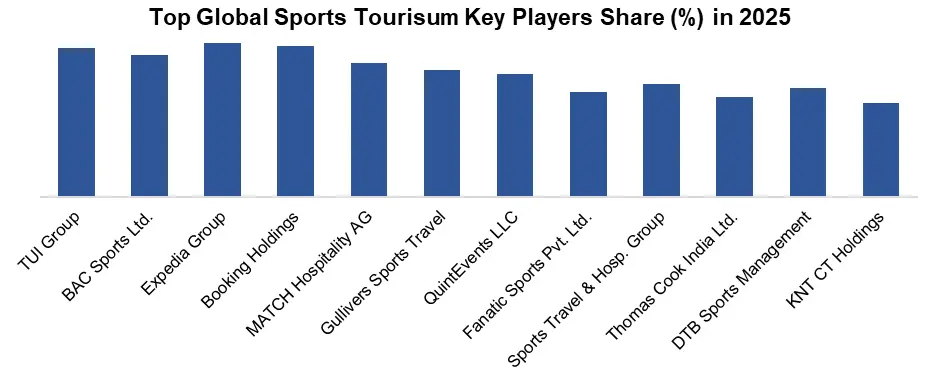
Key Players/Competitors Profiles Covered in the Sports Tourism Market Report in Strategic Perspective
| Sr. No. | Company Name | Headquarters | Business Focus |
| North America | |||
| 1 | BAC Sports | USA | Premium sports travel & hospitality |
| 2 | Fanatics Travel | USA | Fan-centric sports travel & ticketing |
| 3 | On Location Experiences | USA | Official premium event hospitality (IOC, NFL, FIFA) |
| 4 | Anthony Travel | USA | Collegiate & team sports travel |
| 5 | WorldSportsTours | USA | Group sports travel (fans & amateur athletes) |
| 6 | Roadtrips | Canada | Mega-event sports travel (Olympics, FIFA, F1) |
| 7 | Sports Illustrated Travel | USA | Branded sports fan travel experiences |
| Europe | |||
| 8 | Sportsbreaks.com | UK | Sports hospitality packages |
| 9 | Keith Prowse | UK | VIP sports hospitality & ticketing |
| 10 | STH Group | UK | Official hospitality partner (FIFA, Olympics) |
| 11 | Thomas Cook Sport | UK | Sports travel operator |
| 12 | Sports Tours International | UK | Multi-sport travel (football, cycling, winter sports) |
| 13 | Gullivers Sports Travel | UK | Football, cricket, motorsports travel |
| 14 | SportQuest Direct | UK | Active sports tourism (golf, ski, cycling) |
| 15 | Golf Holidays Direct | UK | Golf tourism specialist |
| 16 | Your Golf Travel | UK | Global golf travel platform |
| 17 | Sportsworld | UK | Official football club travel partner |
| 18 | Champions (UK) PLC | UK | Executive sports hospitality |
| 19 | DTB Sports Hospitality | UK | Premium event hospitality |
| 20 | Match Hospitality | Switzerland | FIFA World Cup hospitality |
| 21 | Infront Sports & Media | Switzerland | Sports events, media & hospitality |
| 22 | TUI Group | Germany | Mass sports tourism |
| 23 | Kuoni (DER Touristik) | Germany | Premium travel services |
| Asia-Pacific | |||
| 24 | DreamSetGo | India | Premium sports travel (IPL, FIFA, Olympics) |
| 25 | Golf Asian Tour Travel | Thailand | Golf tourism |
| 26 | Golfasian | Thailand | Southeast Asia golf travel |
| 27 | Asia Golf Experiences | Thailand | Premium golf tourism |
| 28 | World Sport Group / Sportfive Asia | Singapore | Sports events & travel ecosystem |
| 29 | Sporting Holidays | Australia | Cricket & rugby travel |
| 30 | FCM Sport | Australia | Team & federation travel |
| 31 | Asia Odyssey Travel | China | Customized sports & golf travel |
| 32 | MakeMyTrip (Sports Packages) | India | OTA with sports travel integration |
| Middle East | |||
| 33 | Qatar Airways Holidays | Qatar | Airline-led sports tourism packages |
| 34 | Emirates Holidays | UAE | Integrated sports travel (flight + hotel) |
| 35 | Saudi Tourism Authority – Sports | Saudi Arabia | Government-led sports tourism |
| 36 | Lusail Sports Events | Qatar | Event-driven tourism ecosystem |
Global Sports Tourism Market: Research Methodology
This report adopts a robust multi-layered primary and secondary research approach, validated through triangulation across tourism databases, sports governing bodies, event organizers, travel platforms, and hospitality data sources. The market sizing framework utilizes a bottom-up demand model, cross-verified through top-down validation using regional tourism flows, event attendance data, and infrastructure capacity. Country-level estimates are calibrated using international tourist arrivals, sports event footfall, consumer spending patterns, and pricing benchmarks for sports travel packages.
Research Component | Sources & Methodology
| Research Component | Sources & Methodology |
| Primary Research | 120+ in-depth interviews with sports travel operators, event organisers, hospitality providers, OTA platforms, stadium authorities, and tourism boards across key markets, including the USA, UK, Germany, India, UAE, and Australia |
| Secondary Research | UN Tourism (UNWTO) data, national tourism boards, sports federation reports (FIFA, IOC, ICC), event attendance records, airline and hotel data, company annual reports, and policy publications |
| Market Sizing Model | Bottom-up approach: number of sports tourists × average spend per trip (travel, accommodation, tickets, experiences); validated with top-down tourism expenditure and event-based demand data |
| Price Analysis | Benchmarking of sports travel packages (VIP, standard, budget) across regions; analysis of airfare, accommodation rates, ticket pricing, and hospitality packages |
| Competitive Intelligence | Analysis of sports tourism operators, event hospitality providers, digital platforms, and partnerships using company disclosures, product offerings, and strategic initiatives |
| Forecast Methodology | CAGR-based modelling combined with qualitative adjustments for event pipeline (FIFA, Olympics), infrastructure investments, digital adoption, and changing consumer travel behaviour |
Consulting Insight
The methodology ensures high accuracy through triangulation of event-driven demand, tourism flows, and spending behaviour, enabling reliable forecasting of the Global Sports Tourism Market across regions, segments, and event categories.