
Spiral Heat Exchanger Market – Global Market Size, Strategic Growth Drivers, Risk Assessment Framework, Regulatory Landscape Review, Competitive Intensity Mapping & Long-Term Industry Outlook to 2032
Overview
Spiral Heat Exchanger Market was valued at USD 720.72 Mn in 2025 and the total revenue is expected to grow at a CAGR of 3.8% from 2026 to 2032, reaching nearly USD 935.73 Mn.
Spiral Heat Exchanger Market Overview:
Two concentric spiral flow channels, one for each fluid, are included in spiral heat exchangers, which are circular in shape. The two media flow counters are now set up so that one fluid enters the unit from the center and travels outward, while the other enters from the outside and advances inward. The channels have a homogeneous cross section and are curved. No danger of mixing exists.
A spiral heat exchanger used in applications with considerable fouling potential. Even with thick process slurries, its single-channel design prevents fouling and erosion and helps to ensure high flow velocities.
The biggest cause of maintenance expenses and downtime is heat exchanger fouling and restraing market growth. Fouling is expected to cost the American industrial sector more than $5 billion a year. A conventional heat exchanger's heat transfer surfaces collect material over time, which eventually forms an insulating layer that slows down heat transmission and raises pressure drop across the exchanger. To recover the heat transfer rates and pressure drops necessary by the process, the heat exchanger must eventually be cleaned. Many conventional heat exchanger designs require periodic cleaning, which may be expensive and time-consuming. These issues can be prevented by processors using a spiral heat exchanger.
The report addresses a detailed review of the restraints shows the contrast to drivers and allows for strategic planning. Factors that influence market growth are important because they may be used to design diverse strategies for capturing the profitable possibilities that exist. To know about the Research Methodology :- Request Free Sample Report
Spiral Heat Exchanger Market Dynamics:
Thermal performance penetrate spiral heat exchanger market
The advantages that modern spiral heat exchangers have over traditional ones are a key factor in the growth of the global market for welded spiral heat exchangers. The global spiral heat exchangers market is expected to increase between 2020 to 2029 due to factors such as improved performance and consistent heat exchange. Additionally, the market for welded spiral heat exchangers is growing due to features like greater thermal performance. SHEs have a larger surface area and true counter-current flow than traditional smooth surface tube designs, which makes them theoretically more thermally efficient.
This, however, provides that the barrier between the product and service fluids is always clean and operating efficiently. Fouling happens often in practice, interfering with heat transmission. This fouling layer can form a double barrier to effective heat transmission when employed in sludge-to-sludge applications. These comparisons apply to smooth tube heat exchangers but not usually to curved tube heat exchangers. The tube-in-tube HRS DTI Series, for example, is a genuine counter-current heat exchanger, with the product flowing through the inner tube and the service fluid flowing through the surrounding shell, similar to SHEs. HRS corrugation technique improves heat transmission and operating efficiency while reducing fouling.
Better applications for handling harsh fluids and the prevention of fluid leakage are some other reasons that will propel the growth of the global market for welded spiral heat exchangers in the years to come.
Future risk of GPHEs
Fouling is only one of the dangers of GPHE failure. Major operational risks include gasket failure and corrosion. And these highly restrain the market growth Despite metal's durability, corrosion is an unavoidable side effect of its usage over time. Due to the considerable sealing that is necessary for GPHEs along each plate's edge, crevice corrosion may develop underneath gaskets. Chemicals emitted from the polymers used to create gaskets may accelerate localized corrosion.
Polymer gaskets can degrade over time in addition to the aforementioned mechanisms. No material is completely impervious, which is why the material selection is essential. This might be because of UV radiation impairing performance, incompatible fluids being heated to their maximum temperatures for extended periods, or extreme pressure.
Market restraint
Ironically, problems are primarily caused by solutions. Unintended effects may increase when industries develop and adopt more advanced technologies. This is how plate heat exchanger cleaning and fouling work. The spiral heat exchanger industry recently recognized a fresh set of difficulties it was facing.
For instance, more natural goods that provide a variety of heat transfer issues are a result of food and beverage diversity. As opposed to substances like sugars and other tried-and-true compounds, certain natural goods have a lesser tolerance for heat.
The food and beverage sector has to build operations to handle increased processing capabilities due to the pace of change and rate of population development. It must concurrently generate more while minimizing downtime, which obviously increases the danger of errors and unforeseen effects.
Spiral Heat Exchanger Market Segment Analysis:
By Type,
The Spiral Heat Exchanger Market is segmented into Type I, type III, Type G. Type I expected to dominate the market during forecast period. The Type II Spiral was designed to meet the process industries' increased demand for vaporizing and condensing capabilities. Although it functions on the same basic idea as Type I, the channel shape is drastically different. It just has one medium that flows spirally. The other flows crosswise, parallel to the spiral element's axis. With the crossflow fluid flowing through the spiral annulus, the spiral channel is closed on both sides.
Type II spirals are used in jobs that require huge amounts of vapor, vapor/gas, or vapor/liquid combinations. The channel shape allows for great liquid velocity in the Spiral tunnel while maintaining a very low-pressure drop on the vapor/mixture side. They are also employed in liquid/liquid applications, such as fermenter cooling cases, where one side must deal with a substantially higher amount of liquid than the other.
Type III is held the second largest market share in 2025. Type III is used as a condenser, the Type II accomplishes relatively little subcooling of the vapors or condensate. A second form of Spiral, the Type III, has to be designed for applications where this is a vital element of the process.
The unit is made of (typically) alternatively welded channels. The bottom face of the body has a cover, and the top face has a distribution cone with the outer turns closed and the inner turns open to the crossflow of the fluid entering the unit. The unit's perimeter is equipped with an upper connection for removing residual gas/vapor and a lower connection for condensate. The cooling medium is flowing in a spiral pattern. The unit's role is to condensate a vapor or vapor mixture with or without non-condensable gas, with the leftover vapor/gas combination being cooled to as low a temperature as feasible to achieve maximum condensation.
The condensate is effectively subcooled since the outer turns are in countercurrent flow to the coolant. Because the flow is in spiral mode at the outer turns, the heat and mass transfer coefficients are larger than if the vapor was solely in crossflow. The SHE type III is best suited for vapor mixes having small to moderate volumes of noncondensable gas at moderate pressure. It is rare to be able to operate at very low absolute pressure ("high vacuum").is seldom feasible due to the resulting excessive pressure drop in the outer turns.
Based on Product Type,
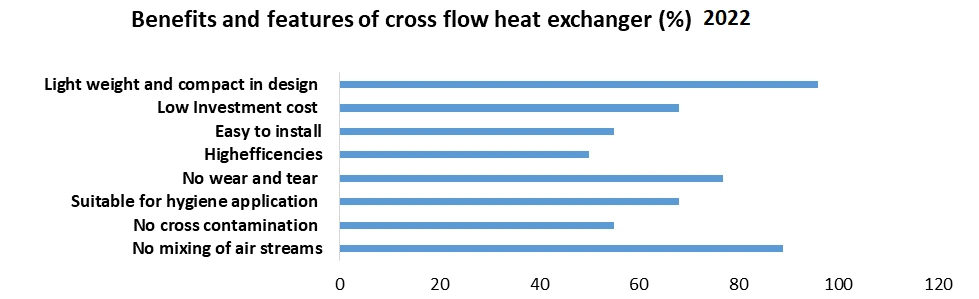
The Spiral Heat Exchanger Market has been segmented into Counter-current, Cross-flow, Cross-flow, and Counter-current Paths in the Same Unit. Cross flow held the largest market share in 2022. Cross Flow Heat Exchangers in the industrial sector are used to transfer heat between two gas streams or between a liquid and a gas. Examples include stack gas heat recovery, as in Waste Heat Recovery Units (WHRU), combustion air preheating, and process fluid heating. Cross-flow heat exchangers are constructed of thin metal panels, which are often made of aluminum. Thermal energy is transferred.
through these panels Cross flow heat exchangers feature a square cross-section with thermal efficiency ranging from 40 to 65%. For higher thermal efficiencies, counterflow or twin cross-flow heat exchangers with 75-85% efficiency can be used. The exhaust and fresh air streams run through channels constructed between the plates. Each air stream flows in alternating channels, with supply air flowing in one and return air flowing in the next. Sensible energy derived from heated air passing through one side of the exchanger is transferred to the cold air going through the other. Because the two air streams do not mingle, there is no short-circuiting or cross-contamination. There is no mixing of dirt, odors, moisture, or bacteria, and only heat is transmitted from exhaust air to fresh air via conduction as a result of temperature differences between the two air streams.
These devices are less costly than other types of energy recovery devices on the market. It is typically utilized when sanitary requirements demand that both airstreams be maintained totally distinct from one another. It is frequently utilized in big heat recovery installations in canteens, hospitals, and the food sector. these industries drive the market growth more details about heat exchanger is given in the report.
Based on the Application
The Spiral Heat Exchanger Market is segmented into Chemical Industry, Food Industry, and Others. The food Industry held the largest market share in 2025. A heat exchanger is a device designed to successfully transfer heat between two fluids of different temperatures. The media might be separated by a complete wall to prevent mixing, or they could be in direct touch. Spiral Heat exchangers are widely utilized in the food processing, dairy, biochemical, pharmaceutical, chemical, and petroleum industries, to mention a few. Heat exchangers are widely used in the bioprocess sector, from high-temperature pasteurization to low-temperature freezing. Spiral Heat exchangers have long been used in pasteurization, sterilizing, and other food processing applications. And, even if the technology is mature, there is still an opportunity for innovation.
Heat exchangers are extensively used in the food and beverage industries to reduce or destroy microbes, making items safe for ingestion and increasing shelf life. A heat exchanger can also be used to heat or cool goods before filling, drying, concentrating, or performing other procedures. Highest possible demands on food processing technology since they both depend heavily on the highest possible standards for chilling, shelf life, process cleaning, disinfection, and drying. Companies in the food and beverage sector must simultaneously compete on a global scale and develop sustainable solutions in their business. As a result, efforts made to assure quality, effectiveness, and dependability must work together seamlessly.
As essential parts for the food and beverage sector, we provide plate heat exchangers, finned tube heat exchangers, shell and tube heat exchangers, and modular cooling towers from a single source, ranging from highly standardized solutions to custom implementation. When it comes to heating or cooling, you can depend on us to provide an integrated solution that considers both your interests and the interests of your clients. All throughout the value-added process chain, we are your dependable collaborators.
Spiral Heat Exchanger Market Regional Insights:
The Asia Pacific region dominated the market with xx % share in 2025. The Spiral Heat Exchanger Market region is expected to witness significant growth at a CAGR of xx% through the forecast period. In 2025, Asia Pacific made up 37.6% of the market in total. From 2025 to 2032, it is expected to grow at a considerable pace of 5.2%, making it the largest regional market. The chemical sector is anticipated to drive the market in the area throughout the forecast period due to the soaring demand for petrochemical derivatives in a variety of end-use industries including plastics and packaging.
In 2025, Europe held 28.4% of the global market share. Due to the growing automotive and construction sectors, it is expected to grow to be the second-largest regional market throughout the projection period. Due to stringent regulatory requirements, the usage of welded plate heat exchangers in refineries and the chemical industry is expected to increase.
Spiral Heat Exchanger Market Market Insights
The global welded spiral heat exchangers industry is very competitive in general. As a result of the presence of multiple market players, the market is also fragmented. However, certain prominent companies dominate the worldwide spiral welded heat exchangers market. These companies shape the market's dynamics and account for the majority of the market's development. However, the presence of several competitors in the industry makes it difficult for a new company to enter the worldwide spiral heat exchangers market.
The new players are taking a number of smart actions to overcome these obstacles. They are leaning toward strategic alliances and mergers in order to have a long-term future in the market for welded spiral heat exchangers. These tactics are also enabling company to get the resources they need to compete with some of the market's major competitors in welded spiral heat exchangers.
While some of the industry's seasoned players are substantially spending on customer-focused methods including product launches, promotional discounts, and other customer-focused events to strengthen their brand visibility. Additionally, these firms are spending a sizable sum of money on R&D operations in order to provide clients with snipping items. However, several other major players in the global spiral heat exchangers market are acquiring numerous small and medium-sized companies in an effort to increase their production capacity and expand into new markets.
Spiral Heat Exchanger Market Recent Industry Developments (2025–2026)
| Date | Company | Development | Impact |
|---|---|---|---|
| 18 March 2026 | GEA Group | Launched the GSE 150 CPR, a new high-performance separator designed for clarifying pulp-rich citrus juices. | The design minimizes juice losses and stabilizes processing conditions for medium-capacity food processors. |
| 14 May 2025 | Standard Group | Introduced Glass Lined Shell and Tube Heat Exchangers in partnership with the AGI Group of Japan. | The new product provides superior corrosion resistance and durability for demanding chemical process applications. |
| 02 April 2025 | Alfa Laval | Launched the T25 semi-welded plate heat exchanger optimized for clean energy and green hydrogen production. | This unit enhances thermal efficiency and sealing reliability in heavy industrial and power production sectors. |
Spiral Heat Exchanger Market Scope: Inquire before buying
| Spiral Heat Exchanger Market | |||
|---|---|---|---|
| Report Coverage | Details | ||
| Base Year: | 2025 | Forecast Period: | 2026-2032 |
| Historical Data: | 2020 to 2025 | Market Size in 2025: | 720.72 USD Mn |
| Forecast Period 2026-2032 CAGR: | 3.8% | Market Size in 2032: | 935.73 USD Mn |
| Segments Covered: | by Type | Type I Type III Type G |
|
| by Product Type | Counter-current Cross-flow Cross-flow and Counter-current Paths in the Same Unit |
||
| by Material | Stainless Steel Carbon Steel Nickel & Nickel Alloys Titanium Copper & Copper Alloys Duplex & Super Duplex Steel |
||
| by Application | Chemical Industry Food Industry Others Application |
||
| by End-User Industry | Oil & Gas Power Generation Pulp & Paper HVAC & Refrigeration Marine Industry Pharmaceutical Industry Water & Wastewater Treatment |
||
Spiral Heat Exchanger Market, by Region
North America (United States, Canada and Mexico)
Europe (UK, France, Germany, Italy, Spain, Sweden, Austria and Rest of Europe)
Asia Pacific (China, South Korea, Japan, India, Australia, Indonesia, Malaysia, Vietnam, Taiwan, Bangladesh, Pakistan and Rest of APAC)
Middle East and Africa (South Africa, GCC, Egypt, Nigeria and Rest of ME&A)
South America (Brazil, Argentina Rest of South America)
Spiral Heat Exchanger Market key players
- Sentry Equipment Corp.
- COSMOTEC
- AViTEQ Vibrationstechnik GmbH
- VAU Thermotech GmbH and Co. KG
- Alfa Laval
- Polytetra GmbH
- Accessen Group
- AKG
- Nexson Group
- Danfoss A/S
- Gooch Thermal Systems, Inc.
- Elanco, Inc.
- Kurose Chemical Equipment Co., Ltd.
- Shanghai Shenglin M&E Technology Co., Ltd.
- SmartHeat Inc.
- Shineheat Corp.
- JANANI Enterprises
- Inproheat Industries Ltd.
- HISAKA Works, Ltd.
- Kelvion Holding GmbH
- Mersen
- SPX FLOW, Inc.
- Tranter Inc.
- Barriquand Group
- Kinam Engineering Pvt. Ltd.