
Spinal Laminoplasty Market Size – Industry Structure Evaluation, Demand Drivers Analysis, Regional Growth Analysis and Identification, Competitive Positioning Review & Global Market Size Forecast to 2032
Overview
Spinal Laminoplasty Market size was valued at USD 11.56 Bn in 2025 and is expected to reach USD 15.74 Bn by 2032, at a CAGR of 4.5% forecast year.
Spinal Laminoplasty Market Overview:
The Spinal Laminoplasty Market is currently witnessing significant growth due to the rising incidence of spinal cord compression-related conditions, such as stenosis and disc degeneration or herniation. Laminoplasty, a surgical intervention that involves cutting and repositioning a portion of the lamina to alleviate spinal cord compression, has emerged as a crucial solution. Open-door laminoplasty, a widely used technique, involves creating a hinge on one side of the vertebra and carefully cutting through the other lamina to create an opening, effectively widening the spinal canal to relieve pressure on the spinal cord. The market's growth is being driven by the increasing aging population and the resultant higher prevalence of spinal disorders, as well as advancements in surgical techniques and technologies.
Spinal Laminoplasty market players are actively contributing to the recent developments in this field, focusing on enhancing surgical outcomes, reducing complications, and ensuring faster recovery. These developments include the introduction of minimally invasive laminoplasty procedures, improved implant materials, and patient-specific surgical planning using advanced imaging and navigation systems. These innovations are expected to further drive the Spinal Laminoplasty Market's expansion, as the demand for effective and less invasive solutions for spinal cord compression continues to grow.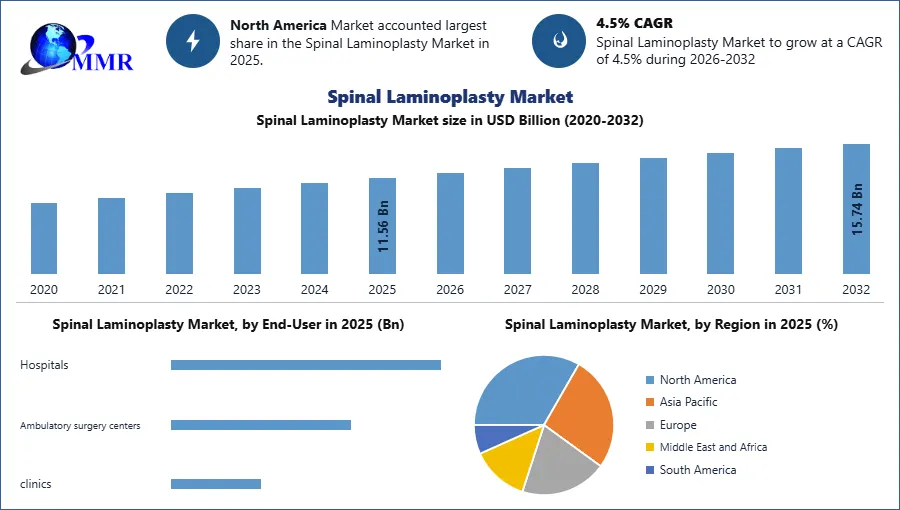 To know about the Research Methodology :- Request Free Sample Report
Spinal Laminoplasty Market Scope and Research Methodology
The Spinal Laminoplasty Market report offers a thorough evaluation of the market for the forecast period. It examines patterns and factors shaping the market, including drivers, constraints, opportunities, and challenges. The report also provides expected revenue growth for the Spinal Laminoplasty Market during the forecast period. The research on the Spinal Laminoplasty Market analyses major applications, business strategies, and influencing factors. The report examines market trends, volume, cost, share, supply, and demand, and utilizes methods like SWOT and PESTLE analysis. Primary research resources include databases and surveys.
Global Spinal Laminoplasty Market Dynamics:
Increasing Prevalence of Spinal Disorders
The Spinal Laminoplasty Market is being driven by several key drivers. The increasing prevalence of spinal disorders like spinal stenosis and spondylolisthesis is a major driver, primarily due to the aging global population and the rising rates of obesity. These disorders can result in debilitating symptoms, including pain, stiffness, and weakness, affecting patients' ability to perform daily activities. Spinal laminoplasty emerges as an effective solution to alleviate these symptoms and treat the conditions.
The growing popularity of minimally invasive spine surgery procedures, such as endoscopic laminoplasty, is driving market growth. These procedures offer advantages over traditional open surgery, including shorter hospital stays, reduced pain, and faster recovery times, thereby meeting the increasing demand for outpatient surgery. Spinal laminoplasty, often feasible on an outpatient basis, provides patients with the convenience and cost-effectiveness they seek. Technological advancements are fostering the development of new and improved spinal laminoplasty devices and procedures, enhancing the safety and efficacy of the treatment. Rising reimbursement rates for spinal laminoplasty in many countries are making the procedure more affordable for patients, expanding its accessibility. These collective factors are fueling the Spinal Laminoplasty Market, ensuring its continued growth and evolution.
Financial Constraints and Insurance Coverage
Patient suitability remains a paramount concern, as advanced age and underlying medical comorbidities increase surgical risks, potentially rendering older patients or those with significant health issues less suitable candidates. The intricacies of spinal cord compression and its specific location can further complicate the feasibility of laminoplasty, often necessitating more invasive procedures like laminectomy or fusion for optimal outcomes. Surgeon expertise is indispensable, as the technical demands of laminoplasty require skill and experience to minimize complications and ensure success.
Financial limitations and insurance coverage present additional constraints, given the expense of spinal surgery and inconsistent coverage by insurance plans. Patient expectations and commitment to post-operative rehabilitation are vital, as laminoplasty often entails extensive physical therapy. Complications such as infection, bleeding, or tissue damage can necessitate further interventions. Persistent neck pain post-surgery may affect patients' quality of life, and limited neck mobility can hinder certain activities. Recovery from laminoplasty is often lengthy and uncomfortable, requiring neck braces and physical therapy, and demanding patient dedication. The surgery itself carries inherent risks, including potential spinal cord or nerve damage leading to neurological deficits. In some cases, laminoplasty may not effectively alleviate symptoms, leaving patients with ongoing discomfort. Collectively, spinal laminoplasty, while valuable, poses market constraints related to complications, recovery challenges, mobility limitations, costs, and patient suitability, which require careful consideration in the medical landscape.
Advancements in Medical Technology with Expanding Demand for Minimally Invasive Surgery
A significant market opportunity emerges as the global geriatric population grows at a rapid pace, leading to an increased incidence of spinal disorders such as spinal stenosis and degenerative disc disease. Spinal laminoplasty, a safe and effective procedure for alleviating pressure on the spinal cord and nerves in these conditions, is gaining popularity among elderly patients. Additionally, the prevalence of spinal disorders is on the rise due to factors like obesity, sedentary lifestyles, and increased sports participation, further driving demand for spinal laminoplasty surgery. Furthermore, the escalating demand for minimally invasive surgical options is a promising opportunity, with minimally invasive spinal laminoplasty offering reduced trauma, shorter hospital stays, quicker recovery times, and less postoperative pain, making it an increasingly sought-after choice in the market.
Spinal Laminoplasty Market Segment Analysis:
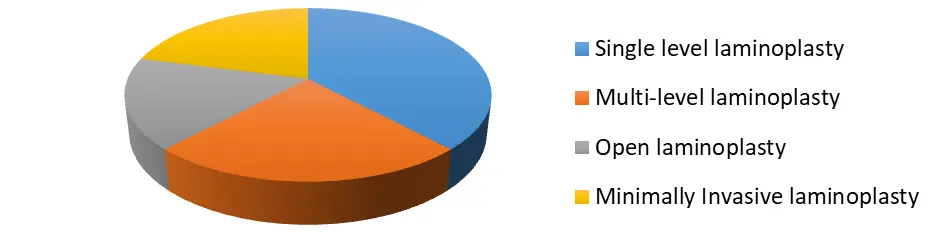
Based on Surgery type, Single-level laminoplasty dominated the spinal laminoplasty market, which is often utilized for localized spinal issues, has a wide application scope and is preferred when addressing isolated areas of spinal cord compression. In contrast, Multi-level laminoplasty is employed when multiple segments of the spine require intervention, primarily suitable for more extensive conditions. Open laminoplasty, while effective, is gradually losing ground to the growing adoption of Minimally Invasive laminoplasty, which offers reduced trauma, shorter hospital stays, and faster recovery times. Minimally Invasive laminoplasty, with its advantages, is gaining prominence as patients increasingly seek less invasive alternatives, resulting in its higher adoption rates. These comparative analyses demonstrate the evolving landscape of spinal laminoplasty, reflecting a preference for minimally invasive techniques and the tailored selection of procedures based on the extent and location of spinal cord issues.
Spinal Laminoplasty Market , by Surgery Type (%) In 2025
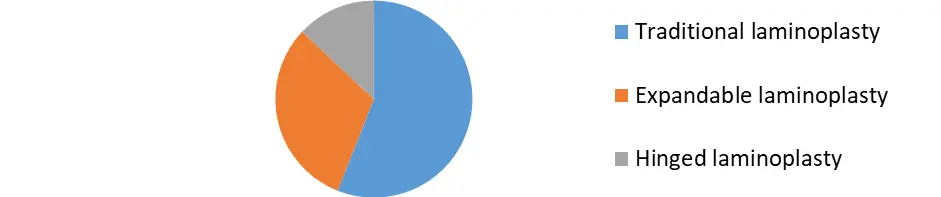
Based on Application, Traditional laminoplasty remains a widely used approach for addressing spinal cord compression issues, offering a proven and effective method for decompression. In contrast, Expandable laminoplasty, characterized by its flexibility and adaptability, has gained traction in scenarios where spinal cord compression varies in degree or location, enabling a more tailored approach to each patient's needs. Hinged laminoplasty, while less common, finds its application in specific cases where controlled stability of the lamina is necessary. The comparative analysis illustrates the dynamic landscape of spinal laminoplasty, showcasing a shift towards more adaptable and patient-centric solutions, with Expandable laminoplasty emerging as an increasingly favored choice, albeit Traditional laminoplasty's continued relevance in more conventional cases, and Hinged laminoplasty's niche application in specialized scenarios.
Spinal Laminoplasty Market , by Technology (%) In 2025
Spinal Laminoplasty Market Regional Insights:
Based on region, the market is segmented into North America, Europe, Asia Pacific, Latin America and Middle East & Africa (MEA). North America region is further bifurcated into countries such as U.S., and Canada. Asia Pacific emerged as the largest market for Spinal Laminoplasty market with 40 % share of the market revenue in 2025.
The Europe region is further categorized into U.K., France, Germany, Italy, Spain, Russia, and Rest of Europe. After Asia Pacific, North America contributed 30 % to globally worldwide. The Europe region is further categorized into U.K., France, Germany, Italy, Spain, Russia, and Rest of Europe. After North America, Europe contributed 20% to globally worldwide. Latin America region is further segmented into Brazil, Mexico, and Rest of Latin America, and the MEA region is further divided into GCC, Turkey, South Africa, and Rest of MEA.
Competitive Landscape Spinal Laminoplasty Market:
The competitive analysis of the Market includes the Market size, growth rate and key trends. The report provides information about the Key companies, such as their size, spinal laminoplasty market services, Global spinal laminoplasty market share, and geographic presence. The report provides such type of competitive landscape of all Key Players to assist new market entrants. The report provides such type of competitive landscape of all Global spinal laminoplasty market Key Players to assist new market entrants. The report offers Competitive benchmarking of the Global spinal laminoplasty market through the Market revenue, share and size of the key players.
The key players in spinal laminoplasty are, Pioneer Surgical Technologies, Zimmer Biomet, NuVasive, Inc., DePuy Synthes, NP Solutions, K2M, Medtronic, Orthofix, Globus Medical, KLS Martin, and Stryker. These players are focusing on expanding their product portfolio, investing in research and development, and expanding their distribution channels to gain a competitive edge in the market.
Spinal Laminoplasty Market Scope: Inquire Before Buying
| Spinal Laminoplasty Market | |||
|---|---|---|---|
| Report Coverage | Details | ||
| Base Year: | 2025 | Forecast Period: | 2026-2032 |
| Historical Data: | 2020 to 2025 | Market Size in 2025: | 11.56 USD Billion |
| Forecast Period 2026-2032 CAGR: | 4.5% | Market Size in 2032: | 15.74 USD Billion |
| Segments Covered: | by Vertebral Position | Lumbar laminoplasty Thoracic laminoplasty Cervical laminoplasty Sacral laminoplasty |
|
| by Surgery Type | Single level laminoplasty Multi-level laminoplasty Open laminoplasty Minimally Invasive laminoplasty |
||
| by Technology | Traditional laminoplasty Expandable laminoplasty Hinged laminoplasty |
||
| by End-User | Hospitals Ambulatory surgery centers clinics |
||
Spinal Laminoplasty Market, by Region
North America (United States, Canada and Mexico)
Europe (UK, France, Germany, Italy, Spain, Sweden, Austria, Turkey, Russia and Rest of Europe)
Asia Pacific (China, India, Japan, South Korea, Australia, ASEAN and Rest of APAC)
Middle East and Africa (South Africa, GCC, Egypt, Nigeria and Rest of ME&A)
South America (Brazil, Argentina, Columbia and Rest of South America)
Spinal Laminoplasty Market, Key Players
- Medtronic plc
- Johnson & Johnson (DePuy Synthes)
- Stryker Corporation
- Zimmer Biomet
- NuVasive, Inc.
- Globus Medical Inc.
- Orthofix Medical Inc.
- SeaSpine Holdings Corporation
- B. Braun Melsungen AG
- KLS Martin Group
- Ulrich Medical
- RTI Surgical Inc.
- Spineart
- Life Spine Inc.
- Pioneer Surgical Technologies
- NP Solutions
- ArthroKinetix
- K2M Group Holdings
- Exactech Inc.
- Centinel Spine LLC
- Medacta International
- Camber Spine Technologies
- Aurora Spine Corporation
- Captiva Spine Inc.