
South Korea Imitation Jewelry Industry Analysis, Key Players, Investment Opportunities and Forecast (2026-2032)
Overview
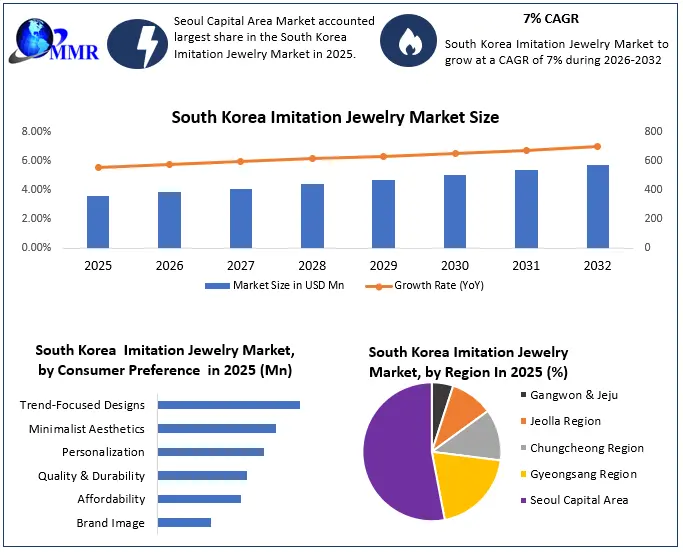
The South Korea Imitation Jewelry Market was valued at USD 360 million in 2025 and is projected to reach USD 580 million by 2032, registering a CAGR of 7% during the forecast period. This market growth can be attributed to various factors such as rising consumer interest in affordable fashion accessories, growing demand for trendy and personalized jewelry and the increasing influence of K-fashion and Korean pop culture.
South Korea Imitation Jewelry Market Definition
The South Korea Imitation Jewelry Market comprises affordable jewelry products designed to provide fashionable and decorative appeal without relying primarily on precious metals or gemstones. The market includes necklaces, earrings, rings, bracelets, bangles, pendants and other fashion jewelry, using materials such as alloys, stainless steel, glass, beads, artificial stones and plated metals.
The market involves the manufacturing, distribution, retail sales and online sales of imitation jewelry across South Korea. It serves consumers seeking affordable accessories for everyday wear, fashion styling, workplace use and special occasions, with demand influenced by changing fashion trends, K-fashion, social media, product personalization and growing interest in contemporary and minimalist designs.
South Korea Imitation Jewelry Market Overview
South Korea Imitation Jewelry Market is a dynamic part of South Korea fashion accessories industry that is driven by strong domestic demand, developed production infrastructure and sophisticated retail environment. The industry comprises jewelry for fashion, including necklaces, chains, earrings, rings, bracelets and other fashion accessories for all levels of demand and various end-use applications. The South Korea Imitation Jewelry Market is valued at USD 360 million in 2025 and is projected to reach USD 580 million by 2032, registering a CAGR of 7% during the forecast period. The market includes affordable fashion jewelry such as necklaces, earrings, rings, bracelets and other decorative accessories, with demand supported by changing fashion preferences and the growing availability of jewelry through retail and online channels.
South Korea Imitation Jewelry Market Report presents the analysis of market size, past market performance, future forecasts, market segmentation by product types, distribution channels, end user demand, competition, trends and opportunities. The research encompasses necklaces and chains, rings, bracelets, earrings and other jewelry products, online and offline distribution channels and end user’s men's and women's markets. The competitive positioning, supply and demand structure, imports, production, prices, cost structures, company landscape and emerging opportunities are analyzed too. J. Estina is an example of a domestic company operating in jewelry and fashion accessories markets. Thus, the report can be used by manufacturers, retailers, investors, distributors and newcomers for market attractiveness analysis, market entry and expansion strategy development, segmentation, and benchmarking.
South Korea Imitation Jewelry Market Forecast and Share Analysis
To know about the Research Methodology :- Request Free Sample Report
South Korea Imitation Jewelry Market Dynamics
South Korea Imitation Jewelry Market Drivers
Strong Fashion Consciousness and K-Culture Influence
South Korea imitation jewelry market is supported by the strong fashion consciousness of young consumers who perceive jewelry as a true lifestyle statement. K-pop, K-drama, celebrities and social media provide inspiration and encourage demand for modern, minimalist and trend-led jewelry. Recent market research reveals that Korean jewelry consumers are driven by fashion and celebrity culture and are interested in personalized and minimalist jewelry.
Expanding Digital Retail and Online Consumer Engagement
The growth of online stores, mobile commerce, social commerce and digital-first jewelry brands are improving access to imitation jewelry for consumers across South Korea. Brands can offer more product variety and quickly launch new collections with online channels in response to short fashion cycles. Smaller and emerging jewelry brands are also finding visibility without relying entirely on physical retail networks, thanks to digital marketing, influencer-led campaigns and online-only collections. At the same time, offline retail is still relevant, creating opportunities for brands to adopt an omnichannel strategy that merges digital product discovery with physical shopping experiences.
South Korea Imitation Jewelry Market Opportunities
Development of Material-Innovative and Sustainable Collections
South Korea is a platform for imitation jewelry brands to boost their positioning by using recycled metals, alternative materials, non-toxic coatings and eco-friendly packaging. Sustainability is becoming an increasingly valuable selling point for MZ consumers, giving brands room to offer greater material transparency and responsible production. Material innovation also allows companies to create unique collections with less reliance on traditional inputs.
Experiential Retail and Technology-Enabled Jewelry Experiences
The market also offers opportunities to develop experiential retail formats, interactive product displays, virtual try-on and technology-supported shopping experiences. Gen Z consumers are increasingly responsive to experience-led retail, while technological sophistication is identified as a potential source of differentiation in South Korea's personal accessories market. Pop-up stores, fitting experiences and interactive brand spaces can therefore help jewelry companies strengthen engagement and create memorable customer experiences beyond conventional product selling.
South Korea Imitation Jewelry Market Trends
Shift Toward Affordable Fashion Jewelry and Market Polarization
The South Korean jewelry market’s consumer structure is becoming increasingly polarized, with consumers either moving toward luxury products or toward more affordable options. This leads to a higher visibility of affordable fashion and imitation jewelry as the consumers look for trendy products that are not in the price range of fine jewelry. The Korean fashion jewelry market in 2025 will reach KRW 702.6 billion, a growth of 22.1%, while the average purchase price will fall by 30.7% to KRW 43,955, showing a strengthening demand for low-priced fashion jewelry.
Digitalization of Jewelry Consumer Engagement
Jewelry purchasing in South Korea is becoming increasingly driven by social-media discovery, image-led content and online curated shops. In 2025, consumer survey found that 32.0% of online jewelry shoppers first see jewelry information on social media. Instagram accounts for 61.4% of social-media jewelry information exposure. This has meant brands are working on visually distinct collections, short-form content, styling demonstrations and content-led product discovery, rather than just conventional advertising.
South Korea Imitation Jewelry Market Challenges
Limited Scale Among Smaller Businesses
Smaller jewelry firms struggle to achieve economies of scale and maintain profitability in the face of fierce market competition. The industry is made up of imitation-jewelry, brushes and personal items. In 2025, the number of companies in the wider South Korean imitation-jewelry, brushes and personal items market is 38,451. Profitability of the industry is 12.4% of production value and decreases during the year. The disjointedness of the business makes it harder for smaller players to invest in manufacturing efficiency, product development, quality control and brand building.
High Dependence on Imported Materials and Products
The market is subject to import-related risks, particularly because China is still a major supplier of imitation jewelry to South Korea. Changes in import costs, exchange rates, freight expenses and supplier conditions may influence product pricing and inventory planning. This will put more pressure on domestic brands and manufacturers to ensure they can secure stable procurement while keeping their retail prices competitive
South Korea Imitation Jewelry Market Key Highlights
• Market Size (2025): USD 360 Million, representing rising demand for affordable and stylish jewelry.
• Projected Market Size (2032): USD 580 Million, which is expected to witness a significant growth in the projected period.
• CAGR (2026–2032): 7%, which is consistent with the overall market growth rate.
• Rising demand for affordable fashion: Consumers are showing a rising preference for costume jewelry as an affordable way to embrace emerging trends.
• Growing demand for personalized jewelry: Trending products feature trendy, individualized and unique styles, which drive the growth of the market.
• K-fashion: South Korea’s thriving fashion industry is a critical factor influencing the global costume jewelry market.
• K-pop and Korean celebrities: South Korea’s increasing fame as a global pop culture icon fuels demand for its costume jewelry. Moreover, the popularity of K-pop stars, together with Korean actors and actresses, is another essential aspect of this market’s growth.
• Online shopping: E-commerce websites and social commerce are two more components of modern retailing that make products more accessible and encourage impulsive buying.
• Product development: Creating new products is becoming increasingly prominent, with a focus on light, minimalistic, layered and modern styles.
South Korea Imitation Jewelry Market Segment Analysis
by Consumer Preference: Affordability, designs that are oriented towards fashion trends, simple and minimalist styles, personalization, the image of the brand and the quality of the product all influence consumer preferences. Nowadays, younger consumers are more likely to look for jewelry which matches their clothing and shows off the latest fashion trends. There is growing interest in personalized and interchangeable items and durable jewelry made from skin-friendly materials is becoming more appealing for daily use. The influence of social media and fashion promoted by celebrities is also speeding up the uptake of new jewelry designs.
by Style: The types of styles available in the market are minimalist, contemporary, traditional, vintage or retro, statement and K-fashion or fusion designs. Minimalist jewelry is especially relevant in the South Korean market when it comes to everyday and professional outfits. Designs that are contemporary or inspired by K-fashion take advantage of the fast pace of trend changes and the influence of celebrities. People who want a distinctive appearance for social events are drawn to statement jewelry, while those interested in unique and personalized accessories will find opportunities in vintage and fusion styles. Korean fashion trends are increasingly combining simple silhouettes with modern and delicate jewelry designs.

By end user, the market is segmented into women, men and kids. Women represent a major consumer group because imitation jewelry is widely used for everyday fashion, professional styling, social occasions and gifting. Men demand are expanding through minimalist chains, bracelets, rings, earrings and other fashion accessories. The children's segment remains comparatively smaller and focuses mainly on lightweight, colorful and affordable accessories.
South Korea Imitation Jewelry Market Regional Analysis
The South Korea imitation jewelry market can be segmented into the Seoul Capital Area, Gyeongsang Region, Chungcheong Region, Jeolla Region and Gangwon & Jeju. Seoul Capital Area is the most demanded destination for imitation jewelry products. It is also the biggest market due to the high concentration of fashion-savvy buyers, fashion and jewelry retail stores and overall high purchasing capacity. Seoul is also the epicenter of K-fashion, K-pop, K-drama and social-media culture. The famous shopping streets in Seoul such as Jongno and Namdaemun host a substantial jewelry and accessory retail trade, with the former street alone housing 2,000 -4,000 jewelry shops and being the largest jewelry trading hub in the country.
Gyeongsang Region is one of the significant secondary markets, which offers a substantial amount of retail opportunities with the presence of major cities like Busan and Daegu, well-developed retail networks and an abundance of inexpensive fashion accessories. Chungcheong Region has a developing retail environment, fueled by urbanization and increased online shopping. Jeolla Region is driven by local buyers and traditional occasions and is characterized by a growing number of tech-savvy young people and increased online purchases. Gangwon & Jeju are popular among tourists and have a considerable demand for light-weight and fashionable jewelry. Moreover, the online shopping culture facilitates increased access to a wide variety of jewelry products for individuals living outside of Seoul.
| Region | Market Share | Demand Drivers & Trends |
| Gangwon & Jeju | 5% | Tourism-driven demand, seasonal purchases and lightweight fashion accessories |
| Jeolla Region | 10% | Traditional occasions, local retail and growing online shopping |
| Chungcheong Region | 12% | Urban expansion, younger consumers and increasing e-commerce adoption |
| Gyeongsang Region | 20% | Strong demand from Busan and Daegu, established retail networks and fashion consumption |
| Seoul Capital Area | 53% | Largest market-High purchasing power, fashion influence, dense retail networks, K-fashion and strong digital commerce |
South Korea Imitation Jewelry Market Competitive Landscape
The South Korea Imitation Jewelry Market is competitive and fragmented, with domestic fashion-jewelry brands, specialty retailers and international labels vying for consumer attention. According to recent industry statistics, domestic suppliers maintain a clear majority in the wider imitation jewelry and related personal items, market in South Korea, with the value of imports reaching 27.6% of the total value in 2025. The main domestic competitors in the South Korean fashion jewelry market, including imitation jewelry, are J. ESTINA, OST Jewelry, Stonehenge, Didier Dubot and many other local jewelry labels. J. ESTINA, for example, can be found in department stores, airports (duty-free shops), online platforms and through its extensive use of celebrity endorsements.
The competitive forces in the South Korea fashion jewelry market comprise inexpensive jewelry, modern Korean jewelry styles, the rising stars and K-content influence, online sales and rapid introduction of new styles, among others. Some local labels, like OST Jewelry, leverage lower prices to offer fashion jewelry, while others, including J. ESTINA, Stonehenge, Didier Dubot and other local jewelry labels, take a more premium approach. Moreover, in the context of jewelry retailing, online sales are growing in popularity and are beginning to rival traditional department store and specialty retail sales. Therefore, it can be asserted that product design, affordability, brand image, online presence, celebrity endorsements and omnichannel sales strategies play an important role in South Korea’s competitive jewelry retailing market.
South Korea Imitation Jewelry Market Key Players
| Company | Headquarters | Product Focus |
| J. ESTINA | Seoul, South Korea | Fashion jewelry, earrings, necklaces, rings, bracelets and accessories |
| STONEHENgE | Seoul, South Korea | Contemporary jewelry, earrings, necklaces, rings and everyday fashion pieces |
| Golden Dew | Seoul, South Korea | Fashion and fine-style jewelry, necklaces, earrings, rings and bracelets |
| OST | Seoul, South Korea | Affordable fashion jewelry, watches, rings, necklaces and earrings |
| LLOYD | Seoul, South Korea | Affordable jewelry, watches, rings, necklaces and earrings |
| Mzuu | Seoul, South Korea | Contemporary and trend-focused fashion jewelry |
| Numbering | Seoul, South Korea | Minimalist and contemporary silver jewelry, rings and earrings |
| H.R. Jewelry | Seoul, South Korea | Fashion jewelry, accessories and trend-led designs |
| J. Hanh | Seoul, South Korea | Contemporary Korean-designed jewelry and fashion accessories |
| TirrLirr | Seoul, South Korea | Affordable fashion jewelry, earrings, necklaces, rings and accessories |
South Korea Imitation Jewelry Market Scope: Inquire before buying
| South Korea Imitation Jewelry Market | |||
|---|---|---|---|
| Report Coverage | Details | ||
| Base Year: | 2025 | Forecast Period: | 2026-2032 |
| Historical Data: | 2020 to 2025 | Market Size in 2025: | USD 360 Mn. |
| Forecast Period 2026 to 2032 CAGR: | 7% | Market Size in 2032: | USD 580 Mn. |
| Segments Covered: | by Application | Everyday Wear Professional Wear Weddings & Special Occasions Parties & Social Events Gifting Fashion Styling |
|
| by Material | Metal Alloys Stainless Steel Silver-Plated Materials Plastic & Acrylic Glass & Crystal Beads Other Materials |
||
| by Product Type | Necklaces & Chains Earrings Rings Bracelets & Bangles Brooches & Pins Cufflinks & Studs Others |
||
| by Price Range | Economy Mid-Range Premium |
||
| by End User | Women Men Unisex |
||
| by Consumer Preference | Affordability Trend-Focused Designs Minimalist Aesthetics Personalization Brand Image Quality & Durability |
||
| by Style | Minimalist Contemporary Traditional Vintage/Retro Statement K-Fashion/Fusion |
||
| by Distribution Channel | Online Retail/E-Commerce Specialty Stores Department Stores Fashion & Accessory Stores Street-Level Retail Brand-Owned Stores Others |
||
South Korea Imitation Jewelry Market Frequently Asked Questions:
1. What is the current size of the South Korea Imitation Jewelry Market?
The South Korea Imitation Jewelry Market is valued at approximately USD 360 million in 2025 and is projected to reach USD 580 million by 2032, growing at a CAGR of around 7%.
2. Who are the leading companies operating in the South Korea Imitation Jewelry Market?
Key companies include J. ESTINA, STONEHENgE, Swarovski Korea, Golden Dew and OST. These players compete through trendy designs, brand positioning, product variety and strong retail and online presence.
3. Which region dominates the South Korea Imitation Jewelry Market?
The Seoul Capital Area dominates the market due to its large consumer base, high concentration of fashion retailers and strong purchasing power. Seoul also benefits from K-fashion, K-pop and influencer-driven trends.
4. What is driving the growth of the South Korea Imitation Jewelry Market?
Growth is driven by demand for affordable fashion accessories, K-pop and K-fashion influence, social media trends, personalization and expanding e-commerce. Younger consumers increasingly use imitation jewelry to complement changing fashion styles.
5. What are the key challenges facing the South Korea Imitation Jewelry Market?
Key challenges include intense price competition, rapidly changing fashion preferences, short product life cycles and competition from fine jewelry brands. Sustainability and material-quality expectations also create pressure on manufacturers.
6. Which South Korea Imitation Jewelry type holds the largest market share?
Necklaces hold the largest market share among major product types. Their popularity is supported by their versatility, wide design availability and suitability for both casual and formal fashion.