
Smart Toys Market – Industry Structure Evaluation, Demand Drivers Analysis, Regional Growth Analysis and Identification, Competitive Positioning Review & Global Market Size Forecast to 2032
Overview
The Smart Toys Market size was valued at USD 17.52 Billion in 2025 and the total Smart Toys revenue is expected to grow at a CAGR of 16.4% from 2026 to 2032, reaching nearly USD 50.75 Billion by 2032.
Smart Toys Market Overview
A smart toy refers to a digitally augmented plaything endowed with autonomous intelligence. Typically, these toys exhibit the capacity to acquire knowledge, exhibit adaptive behaviours, and modify their responses in reaction to external stimuli. In essence, they adjust their reactions to a player's interactions based on predefined programming. Smart toys commonly leverage the capabilities of cloud computing, artificial intelligence (AI), and sensor-driven technologies, including the Internet of Things (IoT), to augment and amplify the features of conventional toys. The graphical representation and structural exclusive information showed the dominating region of the Global Smart Toys Market. The detailed and constructive formation of key drivers, opportunities, and unique segmentation outputs structural and optimistic data. Validated using primary as well as secondary research methodology and scope of the Global Smart Toys Market.

To know about the Research Methodology :- Request Free Sample Report
Smart Toys Market Dynamics
Educational and Skill Development in the Smart Toys Industry also Entertainment and Engagement are the growth drivers in the Smart Toys Market
The rapid progress of technology, particularly in areas like artificial intelligence (AI), machine learning, and the Internet of Things (IoT), has paved the way for the emergence of smarter and more interactive toys within the smart toys market. These technological innovations empower various segments, including smart AI toys, interactive toy gadgets, robotics toys, and augmented reality toys, to offer distinct features that enhance user experiences and stimulate demand in the smart toys industry. Smart toys, spanning diverse categories such as robotics toys and interactive gadgets, have garnered recognition as effective educational tools.
These toys aid children in cultivating skills like problem-solving, creativity, and critical thinking, thus contributing significantly to their learning and development. This trend is particularly pronounced within the smart AI toys market and various other segments. Safety features are integral to the smart toys industry, encompassing elements such as parental controls and child-monitoring capabilities. This unwavering emphasis on safety is fundamental in the development of smart toys, spanning from remote-controlled toys to augmented reality toys, providing assurance to parents regarding their children's well-being during playtime.
Smart toys, including interactive gadgets and robotics toys, deliver immersive and captivating play experiences that elevate the entertainment value for users of all age groups. Features such as interactive storytelling, augmented reality experiences, and gamification are essential components of these smart toys, rendering them exceptionally appealing and engaging throughout the smart toys market. Many smart toys, encompassing categories ranging from remote-controlled toys to smart AI toys, offer customization options, enabling users to tailor their experiences to align with their unique preferences.
This prevailing theme of personalization within the smart toys industry caters to individual tastes and requirements. The seamless integration of smart toys, including augmented reality toys, into broader connected ecosystems such as smart homes, fosters fluid interactions among various devices. This interconnectedness enhances the overall user experience, offering convenience and extending to remote-controlled toys and other segments of the market.
The smart toys market is currently witnessing rapid expansion as numerous companies channel investments into research and development, unveiling innovative products across various segments, including interactive gadgets and smart AI toys. This diversification provides consumers with a more extensive array of choices, stimulating the adoption of smart toys. The smart toys industry is increasingly placing a stronger focus on sustainability and the use of eco-friendly materials in toy manufacturing.
This environmentally conscious approach holds particular significance in the development of smart toys, resonating with consumers who are environmentally aware and concerned about sustainability issues. A subset of smart toys is dedicated to promoting physical activity and fostering healthier lifestyles, particularly among children. Features such as fitness tracking and interactive gameplay align with the broader trend of health-conscious living within the smart AI toys market and smart toys market.
Smart Toys Market Segment Analysis
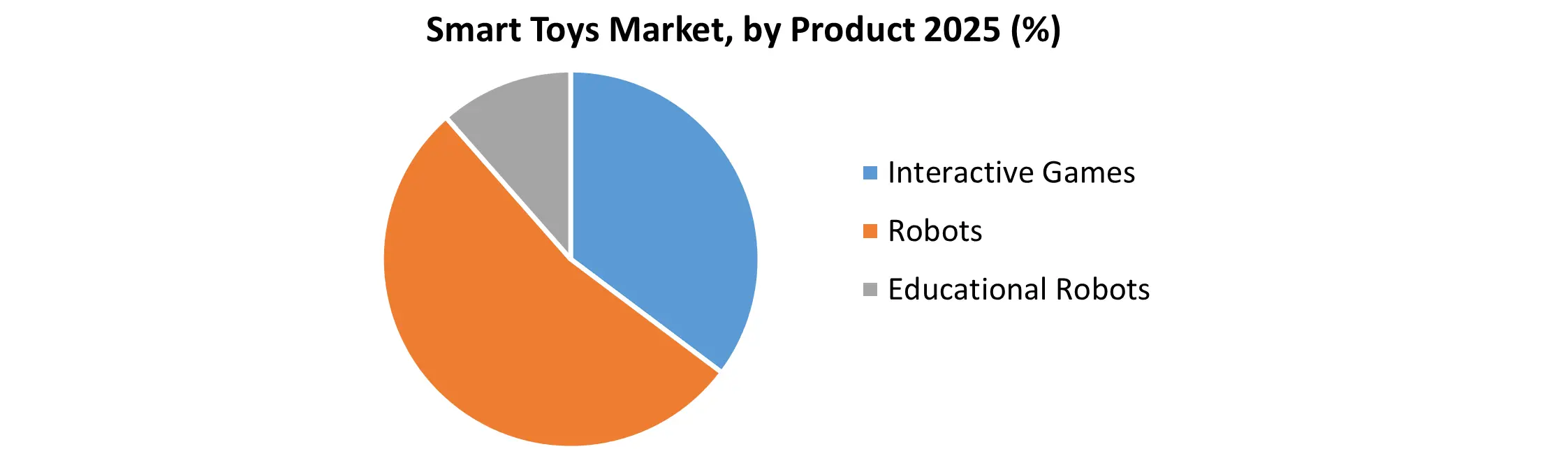
Product: The smart toys market comprises various product categories, each catering to distinct consumer needs. The smart AI toys market is a prominent sub-segment within this sector, featuring AI-powered smart toys that encompass an extensive range of offerings. These include interactive games, robots, and educational robots. The market also boasts a category of interactive toy gadgets, providing a diverse array of interactive games and educational features to engage and educate users.
Furthermore, the realm of smart toys encompasses robotics toys, which serve the dual purpose of stimulating learning and creativity while providing entertainment value. Another exciting sub-segment is augmented reality toys, which leverage augmented reality technology to offer immersive and interactive gaming and educational experiences. Lastly, the market encompasses a category of remote-controlled toys, including a variety of products such as remote-controlled vehicles and devices designed for both entertainment and educational purposes. Educational robots within this segment are gaining popularity, especially in educational settings.
They provide a unique platform for hands-on learning, encouraging skill development, problem-solving, and creativity in children. As the demand for quality educational tools increases, smart AI toys are positioned to meet these needs effectively. The combination of AI with augmented reality (AR) technology has created a compelling sub-segment of augmented reality toys. These toys provide interactive, educational, and gaming experiences that are highly appealing to consumers seeking innovative and immersive play.
Smart Toys Market Regional Analysis
In 2025, North America asserted its dominance in the smart toys market, securing a substantial revenue share exceeding 40.0%. This remarkable market share can be attributed to the increasing adoption of smart home devices within the region. The United States, in particular, has been a hotspot for the consumption of in-home smart products. A study conducted by Acquity Group revealed that approximately 30% of U.S. consumers now possess smart IoT devices, signalling a growing enthusiasm for smart technology. The robust growth of smart toys in North America can be attributed to several key factors. Firstly, the proliferation of smart home devices has catalysed the demand for complementary smart AI toys, many of which seamlessly integrate with existing smart home ecosystems, enhancing the play experience for children. Secondly, the consumer base in North America has shown a pronounced inclination toward educational and interactive learning toys. This preference aligns with the broader trend of leveraging technology for educational purposes, thereby propelling the demand for smart toys offering both entertainment and educational opportunities.
The Asia Pacific region is positioned to experience the most rapid growth within the smart AI toys market during the forecast period. This upswing can be attributed to several factors, including the burgeoning middle-class population, an increasing preference for educational learning toys, and strategic initiatives by smart toys industry leaders within the region. One notable contributor to the growth of the smart AI toys market in APAC is the Lego Group, a renowned toy manufacturer that has firmly established its presence in the region. This is primarily owing to its extensive distribution network and its effective customer engagement strategies. A prime example of this commitment is the company's expansion efforts in Singapore.
The LEGO Group has invested in the development of the digital industry in Singapore, having partnered with Singapore's Economic Development Board. This collaboration aims to expand the company's reach in East Asia, capitalizing on the burgeoning demand for smart AI toys in the region. The expanding middle-class population in APAC wields substantial purchasing power and is increasingly recognizing the value of educational and interactive smart toys for their children. This demographic shift, combined with the efforts of industry leaders and a growing awareness of the benefits of smart AI toys, provides a conducive environment for rapid Smart toys market growth in the Asia Pacific region.
Smart Toys Market Recent Developments
| Date | Company | Development | Impact |
|---|---|---|---|
| 01 March 2025 | VTech | The company showcased its latest interactive lineup at Toy Fair 2025, introducing products like the Kidi Superstar Jr. DJ Mixer and the Explore & Write Deluxe Activity Desk to merge active play with foundational learning. | The launch expands the company's electronic learning aids and preschool market footprint by embedding responsive audio and writing sensors into early-childhood consumer products. |
| 01 August 2025 | LeapFrog Enterprises, Inc. | The company introduced LeapMove, a motion-based interactive learning system that tracks physical movement to turn a child's body into the game controller. | This development addresses growing demand for screen-free interactive play while successfully combining physical health milestones with active educational curriculum. |
| 01 January 2026 | The LEGO Group | The company officially unveiled its LEGO SMART Play platform at the Consumer Electronics Show (CES), incorporating an ultra-small custom-made chip inside the core LEGO SMART Brick alongside smart tags and minifigures. | This platform embeds over twenty patented world-first technologies to create a responsive, screen-free physical building ecosystem capable of interactive feedback. |
| 27 January 2026 | The LEGO Group | The company expanded its smart tech ecosystem by revealing five new LEGO SMART Play sets within its Star Wars license line at the Nuremberg Toy Fair ahead of commercial release. | Integrating real-time digital logic with its legacy System-in-Play allows iconic toys like the Millennium Falcon to support interactive refuelling, repair, and laser-firing simulation. |
| 14 February 2026 | LeapFrog Enterprises, Inc. | The company launched an expanded 2026 lineup featuring a two-player cooperative gameplay mode for its LeapMove system and an updated My Pal Scout plush featuring Bluetooth wireless app configuration. | The application updates allow parents to deliver highly personalized learning, custom name spelling, and tailored routines directly to soft interactive smart toys. |
Smart Toys Market Competitive Landscape
Digital Dream Labs Acquires Anki Robotics & Artificial Intelligence Assets. Plans To Re-launch Product Line, Deploy New Features, and Develop New Robots in the smart toys market. The opportunity to acquire exclusive ownership of Cozmo, Vector, and Overdrive aligns seamlessly with Digital Dream Labs' mission and purpose-driven culture," states Matt Goren, Chief Marketing Officer at Digital Dream Labs. The company has ambitious plans to transform the current landscape of Robotics and Artificial Intelligence by empowering its customers. Digital Dream Labs intends to relaunch Cozmo, Vector, and Overdrive with a host of updates and new features in the pipeline.
The company's narrative is set to revolve around transparency and realism regarding the capabilities of its products at present. Equally important is the emphasis on revealing the exciting future prospects in this dynamic decade of the . Digital Dream Labs is committed to giving voice to its customers and ushering in a new era in the world of Robotics and Artificial Intelligence. In a significant development within the realm of STEM-based entertainment toys, Sphero and littleBits are merging into a unified entity. Sphero made this announcement, revealing its intention to acquire the New York-based electronic building block company.
These two companies, both established in and , respectively, initially pursued distinct paths but ultimately found themselves operating within similar domains. Sphero, formerly known as Orbotix, introduced the world to a smartphone-controlled 3D-printed ball that made its debut at CES in . Concurrently, in that very year, Ayah Bdeir's electronics kit side project evolved into a significant business venture under the banner of littleBits. Notably, both Sphero and littleBits share the distinction of being alumni of Disney's accelerator program. Sphero capitalized on this connection with the successful creation of the remote control BB-8 toy, coinciding with the release of Star Wars: The Force Awakens.
However, despite initial success with licensed products such as R2-D2, Lightning McQueen, and talking Spider-Man toys, the Colorado-based company made the strategic decision to terminate its Disney partnership early last year. This move led to a workforce reduction and an explicit commitment to shifting its focus entirely towards the development of educational toys in the smart toys industry.
Smart Toys Market Scope: Inquiry Before Buying
| Smart Toys Market | |||
|---|---|---|---|
| Report Coverage | Details | ||
| Base Year: | 2025 | Forecast Period: | 2026-2032 |
| Historical Data: | 2020 to 2025 | Market Size in 2025: | USD 17.52 Bn. |
| Forecast Period 2026 to 2032 CAGR: | 16.4% | Market Size in 2032: | USD 50.75 Bn. |
| Segments Covered: | by Product | Interactive Games Robots Educational Robots |
|
| by Technology | Wi-Fi Bluetooth Other |
||
| by End User | Toddlers Pre-schoolers School-going Stripling |
||
| by Distribution Channel | Online Offline |
||
Smart Toys Market by Region:
North America (United States, Canada, and Mexico)
Europe (UK, France, Germany, Italy, Spain, Sweden, Austria, and the Rest of Europe)
Asia Pacific (China, South Korea, Japan, India, Australia, Indonesia, Malaysia, Vietnam, Taiwan, Bangladesh, Pakistan, and the Rest of APAC)
Middle East and Africa (South Africa, GCC, Egypt, Nigeria, and the Rest of ME&A)
South America (Brazil, Argentina Rest of South America)
Smart Toys Key Players
1. Pillar Learning
2. Sega Toys Co. Ltd.
3. LeapFrog Enterprises Inc.
4. Mattel Inc.
5. Hasbro Inc.
6. Lego System A/S
7. Robofi LLC
8. Tomy Co. Ltd.
9. Doctor's Associates Inc.
10. Digital Dream Labs
11. Sphero
12. Wonder Workshop
13. TOSY Robotics
Frequently Asked Questions
1. What is the current size of the smart toys market?
Ans: The global smart toys market size reached USD 17.52 billion in 2025.
2. What are the key drivers of the smart toys market?
Ans: Increasing demand for interactive and educational toys, technological advancements, and growing awareness of STEM learning.
3. Which region dominates the smart toys market?
Ans: North America held the largest share in 2025, accounting for over 40% of the market.
4. What types of smart toys are popular?
Ans: Smart AI toys, interactive gadgets, robotics toys, augmented reality toys, and remote-controlled toys are gaining traction.
5.What is the future outlook for the smart toys market?
Ans.The market is set to continue its upward trajectory, evolving to meet consumer preferences in this exciting decade.