
Smart Bed Market – Industry Structure Evaluation, Demand Drivers Analysis, Regional Growth Analysis and Identification, Competitive Positioning Review & Global Market Size Forecast to 2032
Overview
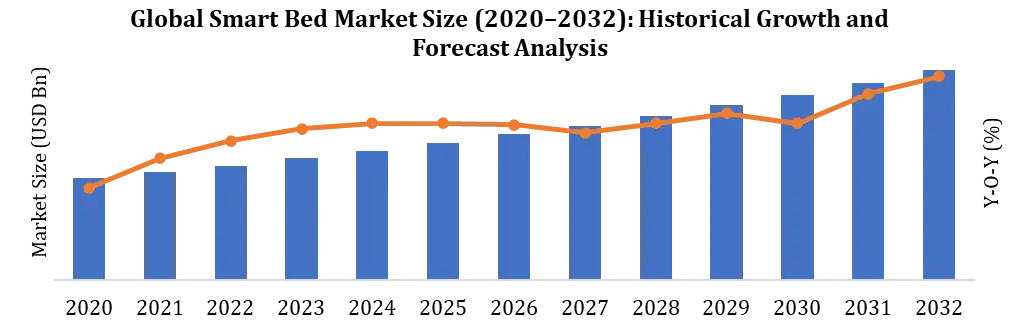
The Global Smart Bed Market Size was valued at USD 2.91 Billion in 2025 and is projected to reach USD 4.46 Billion by 2032, registering a CAGR of 6.3 % during the forecast period.
Smart Bed Market Overview
The global Smart bed market is experiencing robust growth driven by rising demand for advanced sleep solutions, connected healthcare furniture, and AI-powered comfort systems. Smart beds integrate technologies such as sleep-tracking sensors, automatic firmness adjustment, posture control, anti-snore positioning, temperature regulation, and IoT connectivity, making them increasingly popular across residential, hospitality, and healthcare sectors.
Growth is fuelled by increasing consumer awareness of sleep health, a rising elderly population, growing Smart-home adoption, and premium-lifestyle spending. The market spans residential spaces, hospitals and ICUs, luxury hotels, elderly care centres, and rehabilitation facilities.
To know about the Research Methodology :- Request Free Sample Report
Smart Bed Market Key Highlights
| Market Parameter | Value / Insight | Trend |
| Global Smart Bed Market Size (2025) | USD 2.91 Billion | Strong Growth |
| Projected Market Size (2032) | USD 4.46 Billion | Accelerating Expansion |
| Forecast CAGR (2026–2032) | 6.3% | High-Growth Industry |
| Dominant Product Type (2025) | Adjustable Smart Beds | Market Leader |
| Second Largest Segment | Healthcare Smart Beds | Rising Demand |
| Third Largest Segment | Luxury & Hospitality Smart Beds | Premium Adoption |
| Primary Application | Sleep Monitoring & Optimisation | Core Demand Driver |
| Healthcare Integration | Increasing use in patient monitoring & elderly care | High Growth |
| AI Integration in Smart Beds | Real-time sleep analytics & personalised comfort | Transformational Growth |
| IoT & Connected Ecosystem | Integration with Smart homes & mobile apps | Rapid Adoption |
| Wellness & Preventive Care Trend | Growing use as health-tracking and lifestyle devices | Disruptive Shift |
Global Smart Bed Market Trends
The Smart bed industry is evolving rapidly with several defining trends:
• AI-based sleep optimisation: Beds automatically adjust firmness, position, and temperature based on real-time biometric data.
• Personalisation demand: Over 50% of consumers in premium segments cite customisable comfort features as a primary purchase driver (internal primary research, 2025).
• Anti-snore technology and dual-zone temperature control are among the fastest-growing feature categories.
• Connected health monitoring integration with wearables and electronic health records (EHR) is accelerating in healthcare applications.
• Sustainable materials: Growing consumer preference for eco-certified foam and recycled-content fabrics.
• Bed-as-a-service and sleep analytics subscription models are creating recurring revenue streams for brands.
Global Smart Bed Market Drivers
Rising Awareness of Sleep Health
Consumers increasingly understand the importance of quality sleep for immunity, mental health, productivity, and fitness. Sleep disorder management technology is becoming mainstream, driving demand for Smart mattress solutions and wearable-free sleep trackers embedded in beds.
Smart Home Ecosystem Expansion
Integration with Amazon Alexa, Google Home, Apple HomeKit, and mobile apps is increasing adoption. Smart bed connectivity forms part of a broader Smart bedroom ecosystem.
Ageing Population
Older adults prefer adjustable beds for comfort, pain relief, and mobility support. ICU Smart bed and fall-detection bed technology is seeing strong institutional demand as elderly care centres expand.
Healthcare Digitisation
Hospitals are adopting connected Smart beds for patient monitoring, fall prevention, and remote patient monitoring. Hospital bed automation is a key application area, reducing nursing burden and improving patient safety outcomes.
Global Smart Bed Market Restraints
High Product Cost: Smart beds carry a significant price premium over conventional beds due to embedded sensors, motors, and AI systems limiting adoption to premium and institutional segments. Indicative consumer price bands.
| Tier | Price Range (USD) | Target Segment |
| Entry-level Smart bed | $500 – $1,500 | Mass-market residential |
| Mid-range Smart bed | $1,500 – $5,000 | Premium residential |
| Luxury Smart bed | $5,000 – $15,000+ | Ultra-premium / hospitality |
| Healthcare Smart bed | $3,000 – $20,000+ | Hospitals / elderly care |
Privacy Concerns: Smart beds collect sensitive sleep data, raising concerns about data security and potential misuse, which can reduce consumer trust and adoption.
Limited Awareness in Emerging Markets: Many consumers in developing regions view Smart beds as luxury items and lack awareness of their benefits, resulting in slower market growth.

Global Smart Bed Market Opportunities
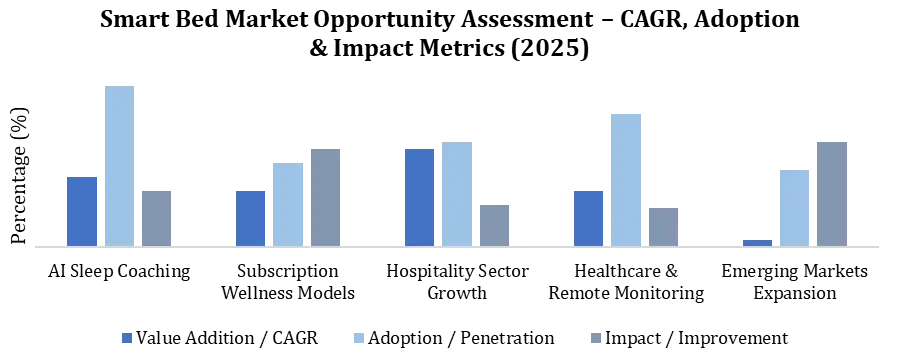
AI Sleep Coaching: Smart beds use AI to analyze sleep patterns and give personalized recommendations.
They automatically adjust comfort settings to improve sleep quality and overall health.
Subscription Wellness Models: Brands offer mattress-as-a-service and sleep analytics through subscriptions.
This ensures continuous insights, upgrades, and recurring revenue generation.
Hospitality Sector Growth: Luxury hotels adopt Smart beds to enhance guest comfort and experience.
This helps attract premium customers and strengthens brand positioning.
Global Smart Bed Market Consumer Behavior & Buying Pattern Analysis
• Consumer preferences strongly favour comfort, automation, and IoT-enabled connectivity features.
• Purchasing decisions are primarily influenced by price, brand reputation, and product quality.
• Rising health awareness and sleep-related disorders are key drivers of market adoption.
• Digital reviews, social media marketing, and lifestyle trends toward wellness are shaping buying behaviour.
• Disposable income and perceived value are critical determinants of affordability and willingness to purchase.
• Interest in personalised, technology-driven sleep solutions including wearable-free sleep trackers is growing across age groups.
• Online retail is the fastest-growing purchase channel, driven by detailed product reviews and comparison tools.
• Shifting trends toward preventive care and the sleep economy are positioning Smart beds as health investments, not just furniture.
Global Smart Bed Market Supply Chain & Value Chain Analysis
The Smart bed market supply chain involves sourcing raw materials such as foam, fabrics, and electronic components, followed by manufacturing of sensors, motors, and control systems. These components are assembled and integrated with software technologies like AI and IoT to create finished products. The products are then distributed through online platforms, retailers, and institutional channels, supported by logistics and after-sales services. Key stakeholders include suppliers, manufacturers, technology providers, and distributors, all contributing to operational efficiency. However, challenges such as high dependency on electronics, supply disruptions, and logistics complexity can impact the overall value chain.
Smart Bed Market Pricing Strategy & Cost Structure Analysis
• Pricing Strategy Impact on Market Share:
Evaluates how premium, competitive, and subscription-based pricing models are used by companies to capture and expand market share. Premium pricing targets high-end segments, while affordable pricing supports wider market penetration.
• Cost Structure & Competitive Positioning:
Analyzes key cost components such as raw materials, technology integration, manufacturing, and distribution. Efficient cost management enables competitive pricing, strengthening market share and regional presence.
| Cost Component | Share of Total Cost | Notes |
| Raw materials (foam, fabric, frame) | 25–30% | Commodity-linked; supply chain risk |
| Electronic components & sensors | 20–25% | Highest variability; semiconductor-dependent |
| Software development & AI/IoT integration | 15–20% | Growing share as platforms mature |
| Manufacturing & assembly | 15–18% | Labour and automation costs |
| Distribution & logistics | 8–12% | High due to product size/weight |
| After-sales service & warranty | 5–8% | Rising with product complexity |
| Marketing & brand building | 5–8% | Premium brands invest heavily |
Smart Bed Market Competitive Landscape Analysis
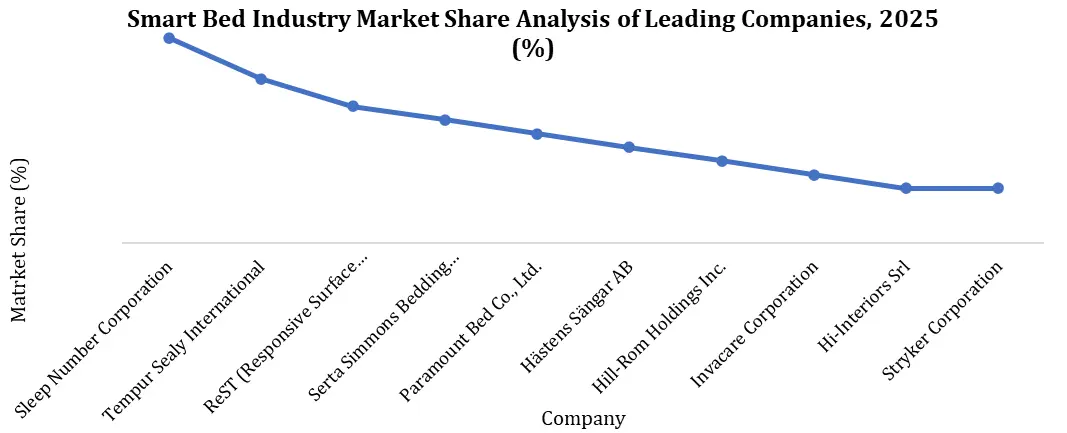
The Smart bed market is highly competitive and moderately fragmented, with the presence of both established global players and emerging innovators competing on technology, product differentiation, and pricing strategies. Leading companies such as Sleep Number Corporation, Stryker Corporation, Hill-Rom Holdings Inc., Paramount Bed Co., Ltd., and Invacare Corporation dominate the market by leveraging strong product portfolios, global distribution networks, and continuous innovation.
In addition, companies such as Tempur Sealy International, Eight Sleep, ReST, and Hi-Interiors are focusing on AI-driven sleep solutions and premium offerings to strengthen their market share. The competitive environment is driven by continuous R&D investments, strategic partnerships, product launches, and expansion into emerging markets, enabling companies to enhance their technological capabilities and gain a competitive edge.
Global Smart Bed Market Segment Analysis
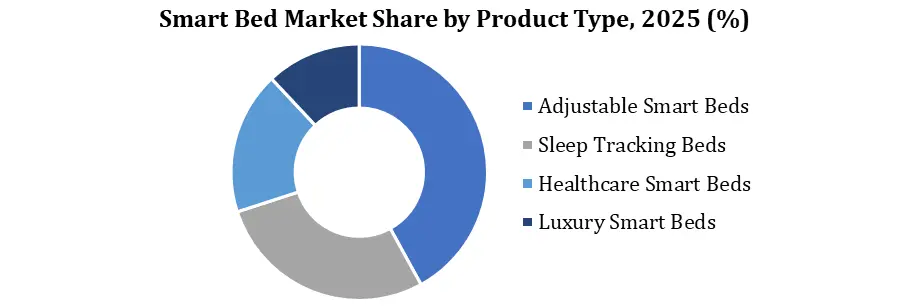
The Global Smart Bed Market is segmented by product type into Adjustable Smart Beds, Sleep Tracking Beds, Healthcare Smart Beds, and Luxury Smart Beds. In 2025, Adjustable Smart Beds accounted for 39.2% of the global Smart Bed Market share, driven by rising consumer demand for customizable comfort, automated posture adjustment, pressure relief features, and enhanced sleep quality support across residential and healthcare applications. Sleep Tracking Beds are growing due to rising wellness awareness and sleep monitoring features. Healthcare Smart Beds are used in hospitals and elderly care for patient support, while Luxury Smart Beds are gaining demand in premium homes and hotels.
 Based on technology, the market includes IoT-enabled beds, AI-powered beds, Sensor-Based Beds, App-Controlled Beds, and Voice-Controlled Beds. IoT-enabled beds connect with Smartphones and Smart home systems. AI-Powered Beds optimise sleep settings automatically. Sensor-Based Beds monitor movement and health data, while App-Controlled and Voice-Controlled Beds offer convenient remote and hands-free operation.
| Technology | Description | Growth Outlook |
| IoT Enabled Beds | Connect with Smartphones and Smart home systems | High |
| AI Powered Beds | Automatically optimise sleep settings using machine learning | Very High |
| Sensor-Based Beds | Monitor movement, pressure, heart rate, and respiration | High |
| App-Controlled Beds | Allow remote adjustment and sleep data review via mobile app | Moderate–High |
| Voice-Controlled Beds | Enable hands-free operation via Alexa, Google Assistant, or Siri | Moderate |
Smart Bed Market Regional Insights
North America Smart Bed Market – Leader
North America dominated the global Smart bed market with 38% market share in 2025, driven by high adoption of advanced healthcare technologies, strong presence of key players, and increasing demand for Smart home solutions. The region is expected to maintain its leadership during 2026–2032 due to rising healthcare expenditure and growing elderly population.
Europe Smart Bed Market – Mature Market
Europe accounted for nearly xx% share in 2025, supported by well-established healthcare infrastructure and increasing awareness regarding sleep health. The region is projected to experience steady growth over the forecast period due to technological adoption and rising demand for connected medical devices.
Asia Pacific Smart Bed Market – Fastest Growing Region
Asia Pacific held around xx% market share in 2025, driven by rapid urbanization, expanding healthcare sector, and growing disposable income in countries like China and India. It is expected to witness the fastest growth through 2032 due to increasing investments in healthcare infrastructure and Smart home technologies.
Middle East & Africa Smart Bed Market – Emerging Market
Middle East & Africa captured xx% share in 2025, supported by improving healthcare facilities and rising investments in Smart technologies. The region is expected to show notable growth during the forecast period.
South America Smart Bed Market – Steady Growth
South America accounted for about xx% market share in 2025, with steady growth anticipated due to gradual improvements in healthcare infrastructure and increasing awareness of Smart healthcare solutions.
Global Smart Bed Market Recent Key Developments
| Date | Company | Development | Impact |
| Feb-26 | Sleep Number Corporation | Expanded AI-enabled Smart bed portfolio with biometric sleep analytics and adaptive temperature regulation features | Strengthened premium Smart sleep ecosystem and improved personalized sleep optimization capabilities |
| Nov-25 | Hill-Rom Holdings, Inc. | Introduced connected hospital Smart beds integrated with remote patient monitoring and nurse-alert systems | Enhanced patient safety and accelerated adoption across digitally connected healthcare facilities |
| Aug-25 | Stryker Corporation | Expanded ICU Smart bed solutions with integrated mobility assistance and pressure injury prevention technologies | Increased adoption in critical care infrastructure and advanced hospital automation systems |
| May-25 | Paramount Bed Holdings Co., Ltd. | Launched automated positioning Smart beds focused on elderly care and rehabilitation applications | Strengthened presence in aging-care infrastructure and rehabilitation healthcare segments |
| Jan-25 | Invacare Corporation | Introduced homecare Smart beds featuring mobile-app connectivity and remote patient monitoring functionality | Expanded home healthcare penetration and improved patient monitoring efficiency |
Smart Bed Market Scope: Inquire before buying
| Smart Bed Market | |||
|---|---|---|---|
| Report Coverage | Details | ||
| Base Year: | 2025 | Forecast Period: | 2026-2032 |
| Historical Data: | 2020 to 2025 | Market Size in 2025: | USD 2.91 Bn. |
| Forecast Period 2026 to 2032 CAGR: | 6.3% | Market Size in 2032: | USD 4.46 Bn. |
| Segments Covered: | by Product Type | Adjustable Smart Beds Sleep Tracking Beds Healthcare Smart Beds Luxury Smart Beds |
|
| by Technology | IoT Enabled Beds AI Powered Beds Sensor-Based Beds App-Controlled Beds Voice-Controlled Beds |
||
| by Application | Residential Hospitals Elderly Care Centers Hospitality Rehabilitation Centers |
||
| by End-User | Individual Consumers Healthcare Institutions Hotels & Resorts Senior Living Facilities |
||
| by Distribution Channel | Online Retail Specialty Furniture Stores Direct Sales Hypermarkets / Retail Chains |
||
Global Smart Bed Market, By Region
North America (United States, Canada, and Mexico)
Europe (United Kingdom, France, Germany, Italy, Spain, Sweden, Russia, Ukraine, Austria, Poland, Portugal, Ireland, Switzerland, Romania, and Rest of Europe)
Asia Pacific (China, India, Japan, South Korea, Australia, Indonesia, Malaysia, Philippines, Thailand, Vietnam, and Rest of Asia Pacific)
Middle East and Africa (UAE, South Africa, Saudi Arabia, Egypt, Rest of ME&A)
South America (Brazil, Argentina, Chile, Colombia, and Rest of South America)
Key Players/Competitors Profiles Covered in the Global Smart Bed Market Report in Strategic Perspective
North America (Market Leaders)
1. Sleep Number Corporation
2. Stryker Corporation
3. Hill-Rom Holdings Inc.
4. Invacare Corporation
5. Tempur Sealy International Inc.
6. Serta Simmons Bedding LLC
7. Eight Sleep
8. ReST Performance
9. Kingsdown Inc.
10. Ergomotion Inc.
11. Joerns Healthcare LLC
12. Medline Industries Inc.
13. Drive DeVilbiss Healthcare
🇪🇺 Europe (Healthcare + Luxury Segment)
14. LINET Group SE
15. Arjo AB
16. Getinge AB
17. Stiegelmeyer GmbH & Co. KG
18. Malvestio S.p.A.
19. Hilding Anders
20. Hästens Sängar AB
21. Groupe Cauval
22. Recticel
23. Naturaliterie
Asia-Pacific (Fastest Growing)
24. Paramount Bed Co., Ltd.
25. Derucci International Holdings Limited
26. Sleepace
27. Zhangjiagang Medi Medical Equipment Co., Ltd.
28. Besco Medical Co., Ltd.
29. Pukang Medical Equipment Co., Ltd.
30. Kawamura Cycle Co., Ltd.
31. Nantong Zhenkang Medical Apparatus Co., Ltd.
Middle East & Africa (Emerging Demand)
32. Savion Industries
33. Gendron Inc.
34. NOA Medical Industries Inc.
South America (Developing Market)
35. Fanem Ltda.
36. Hospimetal Indústria Metalúrgica Ltda.
Global / Smart Tech & Innovation Players
37. Bryte
38. Ascion LLC
39. Vista Medical Ltd.
40. BodiTrak
41. Ultimate Smart Bed
42. Personal Comfort Bed
43. Purple Innovation Inc.
44. Casper Sleep Inc.
45. Nectar Sleep
46. Saatva
47. Hollander Sleep Products LLC
48. Leggett & Platt Incorporated
49. Responsive Surface Technology LLC
50. Sleep Number Innovation Labs
51. Eight Sleep Labs
Frequently Asked Questions.
1. What is the current size of the Smart Bed Market?
The global Smart bed market was valued at USD 2.91 billion in 2025 and is projected to reach USD 4.46 billion by 2032, growing at a CAGR of 6.3% during the forecast period. Growth is driven by rising demand for sleep optimization and connected healthcare solutions.
2. What are Smart beds and how do they work?
Smart beds are technologically advanced beds equipped with features such as sleep tracking sensors, automatic firmness adjustment, temperature control, anti-snore positioning, and IoT connectivity. They collect and analyze user data to automatically adjust settings and improve sleep quality and comfort.
3. What factors are driving the growth of the Smart bed market?
Key growth drivers include:
• Increasing awareness of sleep health and wellness
• Rapid adoption of Smart home technologies
• Growing aging population requiring comfort and medical support
• Rising use in healthcare for patient monitoring
• Higher consumer spending on premium lifestyle products
4. Which segment dominates the Smart bed market?
The adjustable Smart beds segment dominates the market due to its ability to provide customizable comfort and posture support. Additionally, the residential segment holds the largest share, driven by increasing consumer adoption of Smart home solutions.
5. What are the major challenges in the Smart bed market?
Major challenges include:
• High product cost, limiting affordability
• Complex maintenance and repair
• Data privacy concerns related to sleep tracking
• Limited awareness in emerging markets
6. Which region leads the global Smart bed market?
North America leads the market with around 38% share in 2025, driven by advanced healthcare infrastructure, strong presence of key players, and high adoption of Smart home technologies. Meanwhile, Asia-Pacific is the fastest-growing region due to rapid urbanization and increasing disposable income.