
Global Sesame Oil Market Analysis (2025-2032): Health-Driven Consumption Growth, Asia Pacific Dominance & Expanding Applications in Food, Pharma, and Cosmetics
Overview
Sesame Oil Market Size and Growth Potential
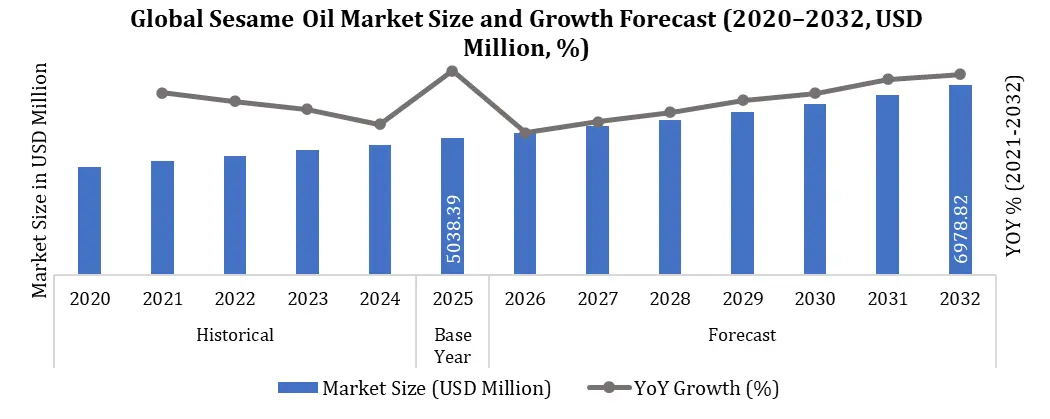
The global sesame oil market was valued at USD 5,038.39 million in 2025 and is projected to reach USD 6,978.82 million by 2032, advancing at a CAGR of 4.76% over the 2026–2032 forecast period. This growth is primarily driven by an increasing health-conscious consumer base, the rising popularity of natural oils in culinary applications, and growing demand from the personal care and pharmaceutical industries.
Worldwide, 825.57 thousand metric tons of sesame oil were consumed in 2025, further highlighting the widespread adoption of this versatile oil across multiple sectors. Asia Pacific was dominated with USD 1,791 Million in 2025 (35.6% of global value), growing at a 5.40% CAGR through 2032 the fastest of any region. Driven by China's scale production infrastructure, Japan and South Korea's premium culinary demand, and India's nutraceutical and Ayurvedic oil expansion. North America is the second-largest market at USD 1,257 Million in 2025, propelled by the clean-label movement, ethnic food culture adoption, and growing pharmacy-channel nutraceutical distribution.
 To know about the Research Methodology :- Request Free Sample Report
Sesame Oil Market Key Highlights
| Market Parameter | Value / Insight | Trend |
| Global Market Size (2025) | USD 5,038 Million | ↑ Strong |
| Projected Market Size (2032) | USD 6,979 Million | ↑ Growing |
| Forecast CAGR (2026–2032) | 4.76% | ↑ Accelerating |
| Volume (2025) | 825.57 thousand Metric Tons | ↑ Expanding |
| Volume CAGR (2026–2032) | 3.80% | ↑ Steady |
| Fastest Growing Region | Asia Pacific — CAGR 5.40% | ↑ Dominant |
| Largest Regional Market (2025) | Asia Pacific — USD 1,791 Mn | ↑ Leading |
| Leading Producer Country (2024) | China (30.38%), Myanmar (12.93%), Nigeria (7.54%) | ↑ Consolidating |
| Top Application Segment | Food & Beverage | ↑ Structural |
| Avg. Price (North America, 2025) | USD 6,800/MT | → Stable-Firm |
| Avg. Price (Asia Pacific, 2025) | USD 5,500/MT | → Competitive |
Global Sesame Oil Industry Landscape
Sesame oil derived from the seeds of Sesamum indicum is among the world's oldest cultivated oilseeds, with a documented cultivation history spanning more than 5,000 years across the Indian subcontinent, Middle East, and East Asia. It exists in two principal processing forms: unrefined (cold-pressed or expeller-pressed, retaining the characteristic toasted aroma and full antioxidant profile) and refined (solvent-extracted, neutralized, and deodorized for industrial food applications). Each form commands distinct market positioning, pricing, and end-use application profiles.
Global sesame oil production was reached around 995,662 metric tons in 2022 and an estimated 1 million metric tons in 2024. China, Myanmar, India, Japan, and sub-Saharan African nations collectively account for the majority of global production. The supply chain is structurally bifurcated: primary production is concentrated in developing nations with low labor costs and favorable agroclimatic conditions, while premium processing, branding, and consumer distribution are concentrated in developed markets commanding significantly higher per-unit value realization.
Sesame Oil Production Dynamics & Structural Insights
China's dominance in sesame oil production is reinforced by its vertically integrated supply chain from large-scale sesame cultivation in Henan, Hubei, and Anhui provinces to efficient cold-pressing and solvent-extraction facilities servicing both domestic demand and Asian export markets. China's 2024 production share of near 30.38% represents a steady consolidation from 28% in 2022, driven by agricultural policy support and capacity investments.
Myanmar's production, despite being the world's second-largest, has faced headwinds from political instability since 2021, with an estimated -3.43% YoY decline in 2023. This has created supply substitution opportunities for Nigeria and Iran, both of which recorded strong YoY production growth of 4.43% and 2.47% respectively in 2023.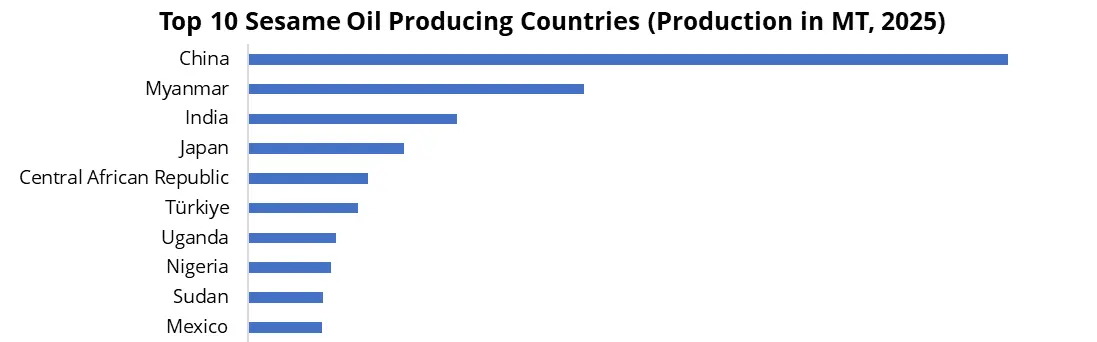
India presents an important structural anomaly: while India is the world's largest producer of sesame seeds (exceeding 800,000 tonnes annually), only a fraction (~80,000 tonnes) is processed into sesame oil domestically. A significant portion is exported as seeds or used in direct food consumption, placing India third in oil-specific production despite its seed production leadership. India's domestic sesame seed oil market has shown a contracting trend in volume (-5.8% CAGR over the last five years), primarily driven by substitution by lower-cost edible oils.
Sesame Oil Market DROCT Analysis (Drivers, Restraints, Opportunities, Challenges, and Trends)
| Category | Factor | Description |
| Driver | Health & Wellness Positioning | Sesame oil's documented cardiovascular benefits, primarily attributed to sesamin, sesamolin, and sesamol are driving category expansion into mainstream health retail. Clinical evidence linking sesame oil consumption to reduced LDL cholesterol and blood pressure supports positioning as a functional food ingredient. North America and Europe are the primary beneficiaries of this demand driver. |
| Restraint | Price Volatility from Sesame Seed Supply Disruptions | Sesame oil pricing is directly linked to sesame seed harvest outcomes, which are subject to significant monsoon variability in India and the Sahel, political instability in Myanmar, and climate-driven yield unpredictability. The 2022 price spike (up ~15–20% in peak periods) illustrates the market's vulnerability to agricultural supply shocks, creating demand uncertainty for price-sensitive food manufacturers. |
| Opportunity | Premium Cold-Pressed & Organic Market Expansion | The global cold-pressed oil market is growing at above 6.5% CAGR, significantly outpacing the broader edible oil category. Cold-pressed sesame oil commands a 30–45% price premium over refined grades, offering margin expansion opportunities for producers investing in quality-assured extraction infrastructure and international organic certification. |
| Challenge | Climate Change Impact on Sesame Cultivation | Sesame is a heat-tolerant but drought-sensitive crop. Increasing climate variability erratic monsoon patterns, extended dry spells in sub-Saharan Africa poses a medium-to-long-term threat to production stability in key origin countries. Investment in drought-resistant sesame varieties and precision irrigation is critical for supply security through 2032. |
| Trend | Sustainability & Ethical Sourcing Certifications | Organic certification, Fair Trade sourcing, and Rainforest Alliance partnerships are becoming competitive differentiators for sesame oil brands in European and North American premium retail. ESG-linked sourcing mandates from multinational food companies are progressively penetrating sesame oil supply chains. |
| Trend | Sesame Oil in Asian-Inspired Functional Food Innovation | Sesame oil is increasingly appearing as a functional ingredient in Korean-inspired kimchi seasonings, Japanese miso dressings, and tahini-based protein products. Product innovation is bridging traditional sesame oil applications with modern protein-forward, gut-health-positioned food categories that command premium shelf placement. |
Sesame Oil Import–Export Analysis (2020–2025)
The global sesame oil trade is characterized by a clear geographical asymmetry: production-surplus countries in Asia and Sub-Saharan Africa export primarily to value-added processing and consumption markets in East Asia (Japan, South Korea), Europe, and North America. Export revenues are significantly amplified at the destination end by branding, packaging, and retail margin capture.
Key Sesame Oil Export Origins: China is the world's dominant sesame oil exporter, leveraging its large processing infrastructure to serve both East Asian premium markets (Japan, South Korea, Southeast Asia) and growing Western markets. Myanmar, despite production challenges, remains a significant exporter of raw and semi-processed sesame oil to regional markets. Ethiopia and Sudan export primarily as sesame seeds (rather than processed oil), capturing lower value in the supply chain.
Key Sesame Oil Import Destinations: Japan is consistently one of the world's largest sesame oil importers in per-unit value terms domestic demand of around 49,000–51,000 thousand metric tons significantly exceeds domestic production capacity, necessitating large-scale imports primarily from China, Myanmar, and Southeast Asia. The United States and Canada are growing import markets, with the US importing across both bulk commodity grades (for food processing) and premium branded grades (for retail). Germany, France, and the Netherlands serve as primary European import hubs, re-exporting to wider European markets.
Sesame Oil Market: Demand Analysis
Rising Global Health Consciousness and Culinary Globalization Drive Structural Demand for Sesame Oil Across All Regions
Global sesame oil market demand is structurally anchored by the intersection of deep culinary traditions across Asia, the Middle East, and Africa, overlaid by an accelerating health-and-wellness demand layer in Western markets. The growing prevalence of cardiovascular disease, rising health consciousness across North America and Europe, and the accelerating clean-label food movement are catalysing premium sesame oil adoption well beyond its traditional strongholds.
Japan's sesame oil demand of around 49,000–51,000 thousand metric tons (2024–2028) reflects one of the world's highest per-capita consumption rates, anchored by the ingredient's indispensable role in Japanese cuisine. The United States market showed a +2.13% demand growth in 2023, driven by health-conscious consumers, and Canada projects a steady ~1.62% annual volume growth through 2028. Myanmar leads global demand volume at 33.39 thousand metric tons in 2023, with China at 24.92 thousand metric tons reflecting its dual role as the world's largest producer and a major consumer.
| Country | Demand (000 MT, 2025) | YoY Growth | Demand Driver |
| Myanmar | XX | XX | Domestic production-consumption integration; cooking oil staple |
| China | XX | XX | Scale consumption; health trends; export-grade processing |
| Nigeria | XX | XX | Growing urban food culture; traditional use |
| India | XX | XX | Market contraction; substitution by cheaper oils; declining traditional use in younger demographics |
| Japan | XX | XX | Premium culinary demand; stable high per-capita consumption |
| Uganda | XX | XX | Traditional use; stable |
| Iran | XX | XX | Traditional cuisine; stable |
| Saudi Arabia | XX | XX | Culinary and cosmetic use; stable |
| United States | XX | XX | Growing health-conscious demand; ethnic food expansion |
Global Sesame Oil Market Segment Analysis
By Processing Type:
Refined Sesame Oil is produced through solvent extraction, followed by neutralisation, bleaching, and deodorisation processes. Refined sesame oil holds the largest volume share of the global market, valued for its extended shelf life, neutral flavour profile, and cost efficiency in industrial food manufacturing and HoReCa applications. The majority of refined sesame oil is consumed in food processing particularly in Asian instant noodle, seasoning, and ready-meal manufacturing and in mass-market cooking oil blending.
Unrefined / Cold-Pressed Sesame Oil retains the full complement of naturally occurring antioxidants (sesamin, sesamol, sesamolin), the characteristic nutty aroma, and the deep amber colour of the sesame seed. Cold-pressed sesame oil represents the fastest-growing processing segment, driven by health-conscious consumer demand in North America, Europe, Japan, and South Korea. The segment commands a 30–45% price premium over refined equivalents and is the primary focus of premium brand development and export marketing strategies.
By Application:
Food & Beverage is the dominant application segment, accounting for 67% of global sesame oil value in 2025. Sesame oil's application spans direct culinary use (finishing oil, stir-fry, salad dressing, marinade), food service and HoReCa, and industrial food manufacturing (instant noodle seasoning, pre-packaged sauce, flavoured oil products). The food & beverage segment is supported by structurally stable demand across Asia Pacific, the Middle East, and the growing ethnic food retail category in Western markets.
Cosmetics & Personal Care represents the second-largest application segment and the fastest-growing value channel for sesame oil. Around 18% of new natural skin care product launches globally in 2024 featured sesame oil as a named active ingredient. Applications include face oils, anti-ageing serums, body massage oils, hair conditioners, scalp treatments, and sunscreen base formulations. The cosmetics segment commands pricing at 20–35% above culinary-grade sesame oil.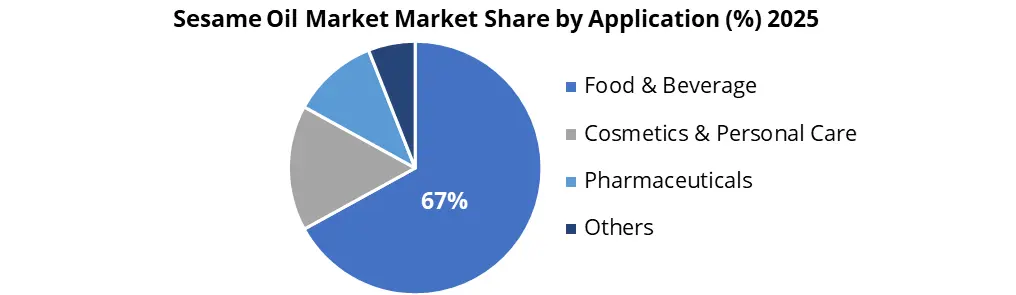
Pharmaceuticals is the highest-priced application segment, with pharmaceutical-grade sesame oil commanding 50–80% pricing premiums above food-grade equivalents. Pharmaceutical applications include injectable drug carriers, topical anti-inflammatory formulations, traditional medicine preparations (Ayurvedic, Traditional Chinese Medicine), and licensed nutraceutical supplements. The pharmaceutical and nutraceutical channel is projected to be the fastest-growing value contributor through 2032.
Global Sesame Oil Market Regional Analysis
Asia Pacific dominated the global sesame oil market in 2025, accounting for 35.6% of total revenue (USD 1,791.43 million). The region’s leadership was underpinned by strong production capabilities and deeply rooted consumption patterns across key markets such as China, Japan, South Korea, and India. Demand was supported by expanding applications in culinary, nutraceutical, and personal care segments, alongside increasing consumer preference for premium, cold-pressed, and organic variants. The region is expected to maintain the fastest growth trajectory, driven by rising health awareness, urban consumption upgrades, and expanding downstream applications.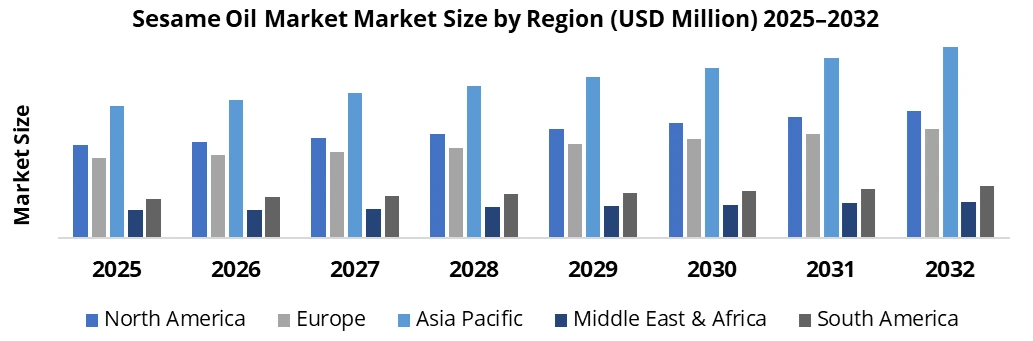
North America represented mature and premium-oriented markets, characterized by stable demand and stringent regulatory frameworks. North America, led by the United States sesame oil market, demonstrated strong demand for clean-label, organic, and cold-pressed products, supported by health-focused retail and e-commerce channels.
Europe maintained steady growth, with key markets such as Germany, France, the Netherlands, and the United Kingdom acting as processing and distribution hubs. The region’s dependence on imported sesame seeds and strict quality regulations reinforced the position of established market players.
In Middle East & Africa, sesame oil remained a staple in traditional cuisines, while countries like Saudi Arabia and the UAE showed rising demand for premium and cosmetic-grade variants. South America, led by Brazil and Mexico, benefited from localized production and traditional culinary usage, supporting consistent market expansion.
Global Sesame Oil Market Competitive Landscape
The global sesame oil market competitive landscape is fragmented at the commodity production level and increasingly brand-differentiated at the premium consumer-facing tier. Large-scale processing operators particularly in China, Japan, and the Americas command supply chain, volume, and distribution advantages, while premium branded players including Kadoya, Takemoto, and Dipasa Group lead the high-value consumer segments through brand equity, quality certifications, and established retail distribution networks. The strategic inflection of 2024–2025 is the decisive shift from volume-commodity competition to
quality-certified, traceable, and brand-differentiated competition: producers commanding cold-pressed certification, organic credentials, supply chain traceability, and premium cosmetic or pharmaceutical positioning are achieving superior per-unit pricing, stronger retailer account retention, and premium export market valuations.
Sesame Oil Market Recent Product Launches & Strategic Developments (2023–2025)
| Year | Company | Product / Initiative | Description |
| 2024 | Kadoya Sesame Mills | Premium Cold-Pressed Export Range | Launched a range of cold-pressed premium sesame oils specifically formulated and certified for export to North American and European health retail channels, featuring USDA Organic certification and premium amber-glass packaging targeting the wellness oil premium shelf position. |
| 2025 | Dipasa Group | Traceable Origin Sesame Oil (Mexico) | Introduced a blockchain-traceable sesame oil line sourced from certified Mexican farms, enabling full supply chain visibility from seed origin to bottling targeting European supermarket buyers requiring traceable, sustainable sourcing documentation under EU due diligence regulations. |
| 2024 | Spectrum Organics (USA) | Cold-Pressed Toasted Sesame Oil | Launched a USDA-certified organic cold-pressed toasted sesame oil targeting the US premium health food channel, positioned at the intersection of the culinary finishing oil and functional wellness oil categories, priced at approximately USD 12.99 per 8oz bottle. |
| 2025 | Indian Origin Producer | Chekku Wood-Pressed Sesame Oil DTC | Expanded direct-to-consumer e-commerce sales of traditional wood-cold-press sesame oil (chekku) through Amazon US and UK channels, targeting Indian diaspora and Ayurvedic wellness consumer segments with traditionally processed, unfiltered sesame oil positioning. |
| 2024 | Chinese Processor (Henan) | GMP Pharmaceutical-Grade Sesame Oil | Received GMP certification for pharmaceutical-grade sesame oil production, enabling supply to injectable pharmaceutical formulation manufacturers in Europe and North America — a segment commanding USD 9,000–14,000/MT versus ~USD 5,500/MT for food-grade equivalents. |
| 2025 | African Cooperative (ETH) | Fair Trade Certified Sesame Oil | An Ethiopian sesame producer cooperative launched Fair Trade and Rainforest Alliance dual-certified sesame oil exports to European specialty food retailers, capturing the emerging ethical sourcing premium and establishing a direct supply relationship with Scandinavian and German organic food distributors. |
Global Sesame Oil Market Report Coverage: Inquire before buying
| Global Market | |||
|---|---|---|---|
| Report Coverage | Details | ||
| Base Year: | 2025 | Forecast Period: | 2026-2032 |
| Historical Data: | 2020 to 2025 | Market Size in 2025: | USD 5,038.39 Mn. |
| Forecast Period 2026 to 2032 CAGR: | 4.76% | Market Size in 2032: | USD 6,978.82 Mn. |
| Segments Covered: | by Processing Type | Refined Unrefined / Cold-Pressed |
|
| by Product Type | Processed Sesame Oil Virgin Sesame Oil |
||
| by Oil Type | Cold-Pressed Sesame Oil Refined Sesame Oil Blended Sesame Oil |
||
| by Application | Food & Beverage Cosmetics & Personal Care Pharmaceuticals Others (Industrial, Traditional) |
||
| by Distribution Channel | Hypermarkets & Supermarkets Online / E-Commerce Convenience Stores Others (Specialty, Health Stores, HoReCa, Pharmacy) |
||
North America (United States, Canada, and Mexico)
Europe (UK, France, Germany, Italy, Spain, Sweden, Austria, and the Rest of Europe)
Asia Pacific (China, South Korea, Japan, India, Australia, ASEAN, Indonesia, Philippines, Malaysia, Vietnam, Thailand, ASEAN, Rest of Asia Pacific)
Middle East & Africa (South Africa, GCC, Nigeria, Rest of ME&A)
South America (Brazil, Argentina, Rest of South America)
Profiles Of Major Sesame Oil Companies: 25+ Key Players
| Sr. No. | Company Name | Headquarters | Core Product Offering | Primary End Markets |
| 1. | Kadoya Sesame Mills Inc. | Japan | 100% pure sesame oil; premium cold-pressed and toasted variants; global export across 50+ countries; Japan's most recognised sesame oil brand since 1907 | Japan, Asia Pacific, North America, Europe |
| 2. | Takemoto Oil & Fat Co., Ltd. | Japan | Roasted sesame oil; premium culinary and HoReCa channel focus; toasted sesame oil extract and flavouring compounds for food manufacturers | Japan, Asia Pacific, Global Food Industry |
| 3. | Dipasa Group | Mexico | Largest sesame oil company in the Americas; full product range from commodity refined to organic cold-pressed; North and South American distribution network | North America, South America, Europe |
| 4. | Wilmar International | Singapore | Diversified agri-food conglomerate; significant sesame oil volumes across Asia; integrated seed-to-oil supply chain; consumer brands in China and Southeast Asia | Asia Pacific, China, Southeast Asia |
| 5. | Lee Kum Kee | Hong Kong, China | Premium sesame oil as anchor product in broader Asian condiment portfolio; strong retail distribution across 100+ countries; premium dark sesame oil positioning | Global Retail, Asia Pacific, North America |
| 6. | Spectrum Organics (Hain Celestial) | United States | USDA-certified organic sesame oil; cold-pressed and toasted varieties; natural and health food channel distribution; premium e-commerce presence | North America, Western Europe |
| 7. | Borges International Group | Spain | Mediterranean oil portfolio including sesame oil; European retail distribution; private label and branded sesame oil for European supermarket chains | Europe, Middle East, Global |
| 8. | Henan Hongsong Food Co., Ltd. | China | Large-scale refined and cold-pressed sesame oil manufacturer; significant export volumes to Japan, South Korea, and Southeast Asia; GMP-certified pharmaceutical-grade capacity | China, Asia Pacific, Export Markets |
| 9. | Govind Oil Mills | India | Traditional cold-pressed (chekku) sesame oil; Ayurvedic wellness positioning; growing DTC e-commerce presence in India and diaspora export markets | India, Indian Diaspora, Middle East |
| 10. | CJ CheilJedang Corporation | South Korea | Premium toasted sesame oil; Korean BBQ and HoReCa channel focus; global Korean food culture expansion driving export demand; fermented food ingredient applications | South Korea, North America, Global Korean Food |
Long-Term Sesame Oil Industry Opportunities (2028–2032)
The sesame oil market long-term structural opportunity lies at the intersection of three macro trends: the global nutraceutical market projected to exceed USD 300 billion by 2030, the approximately USD 50 billion natural and organic personal care market growing at 6–8% CAGR, and the accelerating global demand for traceable, sustainably sourced, functional food ingredients from health-conscious consumers across North America, Europe, and premium Asian markets. By 2032, certified-grade sesame oil platforms operating at pharmaceutical and cosmetic specification standards will function as multi-category premium ingredient platforms commanding valuations significantly above commodity sesame oil margins.
The highest-value strategic opportunity through 2032 is the development of vertically integrated, certification-led sesame oil brands that capture value from seed origin through to premium consumer retail eliminating the current value-chain leakage whereby high-margin retail pricing in North America and Europe is captured by distributors and retailers while origin-country producers remain in low-margin commodity positions.
Global Sesame Oil Market: Research Methodology
This report employs a rigorous multi-source primary and secondary research methodology validated through triangulation across industry databases, producer financial disclosures, trade association data, pricing databases, and expert interviews. The market sizing framework uses a bottom-up demand model validated against top-down supply-side cross-checks, with regional estimates calibrated to country-level agricultural production data, trade statistics, consumer spending data, and sesame oil price benchmarks.
| Research Component | Sources & Methodology |
| Primary Research | In-depth 150+ interviews with sesame oil producers, commodity traders, food industry procurement executives, retail buyers, cosmetics formulators, pharmaceutical excipient buyers, and independent agronomists across key geographies including China, Japan, India, the United States, Germany, and Ethiopia |
| Secondary Research | UN FAO agricultural production data; UN Comtrade and ITC Trade Map import-export statistics; IMARC Group sesame oil pricing reports; company annual reports and investor presentations; EU food safety authority publications; patent databases for sesame oil processing technology; USDA agricultural statistics; industry association publications |
| Market Sizing Model | Bottom-up: production volume × extraction yield × regional distribution weighted by processing grade, validated against top-down demand-side consumption data. Value estimates derived from production volumes multiplied by grade-weighted regional average pricing benchmarks for each geography |
| Competitive Intelligence | Analysis of 100+ producer and brand websites; export licence and trade data analysis; LinkedIn hiring data; product launch databases; third-party certification registries (USDA Organic, EU Organic, Fair Trade, Rainforest Alliance) |
| Forecast Methodology | CAGR regression analysis + qualitative adjustment for cold-pressed oil premiumisation trajectory, pharmaceutical and cosmetic channel demand growth curves, Asia Pacific health consumer demographic drivers, and climate risk adjustments to production base scenarios |