
Rubber Tire Market - Industry Structure Evaluation, Demand Drivers Analysis, Regional Growth Analysis and Identification, Competitive Positioning Review & Global Market Size Forecast to 2032
Overview
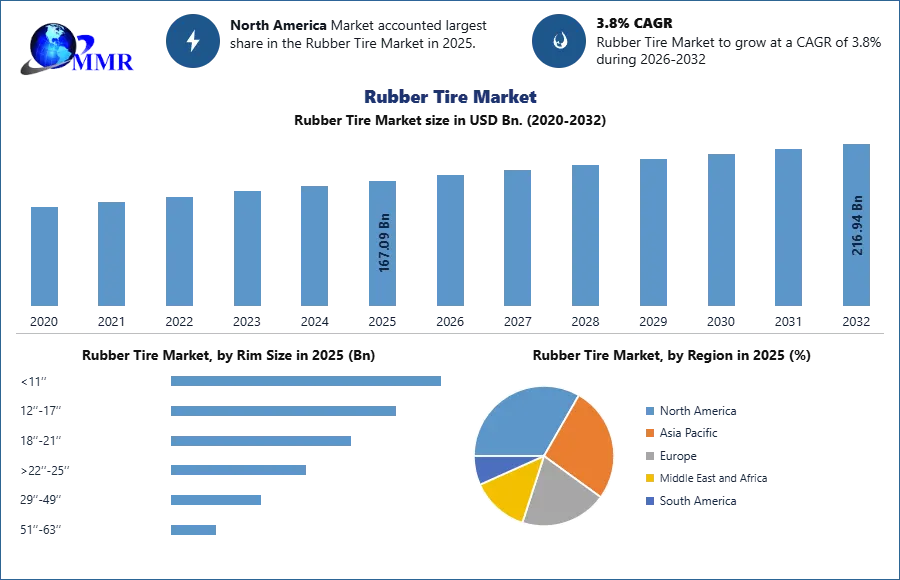
Global Rubber Tire Market size was valued at USD 167.09 Bn. in 2025 and the total Rubber Tire revenue is expected to grow by 3.8% from 2026 to 2032, reaching nearly USD 216.94 Bn.
Rubber Tire Market Overview:
A rubber tire is a component that is ring-shaped and surrounded by the axle of the wheel’s rim, to transfer the load from the rim to the ground. As more people started driving cars, and vehicles, there is a great desire for higher growth of automobiles, which led further to rising in vehicle manufacturing across the market. The automotive rubber tire market has anticipated to be driven by increasing vehicle production and high demands for passenger cars across the world over the forecast period. These aspects are expected to boost the rubber tire market. Consumers can choose different quality tires which have includes high-performance and speed-rated tires and they can also choose from different brands of rubber tires. Asia Pacific is the chief region for natural rubber production. In 2018, the region produced about 12.64 million tons of natural rubber. Moreover, Thailand is considered the world’s largest producer with 33.4% of the global natural rubber market share. The rubber tire market is getting a major boost from developing infrastructure and rising vehicle export. The government also taking diverse measures to gear up for automotive production, which create a positive impact on Thailand's tire market in the forecast year.
This report analyzes the Global Rubber Tire Market as the 2026 Middle East crisis triggers a systemic cost shock to both natural and synthetic rubber supply chains. With crude prices surging, the cost of petroleum-derived Styrene-Butadiene Rubber (SBR) has spiked, while maritime bottlenecks in the Strait of Hormuz have delayed 20% of global seaborne rubber shipments. We explore the strategic shift toward high-energy-efficiency EV tires and bio-based elastomers to mitigate volatile feedstock prices. By evaluating the rise of AI-driven smart sensors and self-healing tire technology, this study provides decision-makers with frameworks to navigate a high-inflation landscape where durability and fuel economy are the primary drivers of market resilience.
To know about the Research Methodology :- Request Free Sample Report
Rubber Tire Market Dynamics:
Market Drivers
Rising Focus on performance and consumer requirements
Rubber Tire Manufacturers have developed technology that connects a tire to its vehicle, informing drivers of routine maintenance needs via tire pressure monitoring systems. The rubber tire makers are taking this a step further, taking the technology beyond the tire, and even beyond the vehicle. As the automotive industry drives toward an autonomous future, tires-being the sole connection between the vehicle and the road-need to do more, especially if there's potentially no driver to check the tire or the hazards on the road.
High-performance and speed-rated tires have been increasing in popularity in the historical period. These premium-priced tires, which produce wider profit margins for tire companies, now account for 36 % of all original equipment passenger car tires and about 34 % of all replacement passenger car tires. Although these premium tires are of radial design, they tend to wear out much faster than conventional radials and thus increase the frequency at which tires are replaced. This change in consumers’ preferences contributes to the demand for replacement tires. Vehicle manufacturers and consumers of replacement tires have several options as to the type of tire they put on a vehicle. They can choose from different qualities of tires, including high-performance and speed-rated tires, and they can also choose from different brands.
The rubber tire market is fairly concentrated and dominated by multinational companies. This market is concentrated on the influence of brand loyalty, capital requirement required to build and modernize manufacturing facilities, and maintaining high advance research and development facilities. High demand for industrial, Agricultural vehicles increases demand for rubber tire products. Various commercial vehicles such as cars, bicycles, motorcycles, electric vehicles, and other luxurious vehicles create opportunities to boost the rubber tire market.
Increase in Awareness and Economic Expansion in the Rubber Tire Market
Increase in awareness among customers about vehicle maintenance, adoption of tire monitoring systems, and expansion of retailers and dealers network in rural areas to drive the projected rubber tire market during the forecast period. Economic growth and expansion over the globe tend to the development of roads, and infrastructures. The increase in the number of cross borders and haul freight transport is boosting the demand for the rubber tires market. The extensive spread of the pandemic across the globe promotes consumers to own their new vehicles. Which drives the sale of vehicles and subsequently boosts the demand for rubber tires across the market.
Rubber Tire Market Restraints:
High cost of the raw material hampering the market
In the manufacturing process of rubber tires, environmental concerns are fugitive air emissions, wastewater, and solid and hazardous waste. The emission is generated from chemicals, in sealed polyethylene bags. Raw material cost is usually 32 % of the entire cost of rubber tires which directly affects the cost of rubber tires. Shortage of raw materials such as synthetic rubber, and natural rubber affects the rise in the overall cost of rubber tires.
Rubber Tire Market Opportunities:
Expansion of Industrialization and urbanization helps to grow the rubber tire market
A rapid increase in industrialization and urbanization across the globe is likely to boost the rubber market, due to an increase in industrialization and construction activities demand for heavy vehicles increases. Urbanization increases the commercial vehicle and subsequently boosts the rubber tire market across the world.
A strong brand name with a reputation for high-quality products may possibly rise in prices without a negative impact on demand, the innovation in the product not only improves its quality, and life expectancy and increase security also. An increase in the number of automotive industries and increasing population also tends to increase productivity in vehicular tires for various products in industrial and domestic use. Becoming a more active participant in the EU market to which, know how to utilize as well as import and export opportunities for boosting the rate of overall GDP growth.
Rubber Tire Market Segment Analysis:
Based on vehicle type, passenger vehicle held largest market share in 2025. Rubber is used for passenger vehicle tires because it's durable, elastic, and resistant to wear and tear. Rubber tires also have a lower coefficient of friction with the road than steel tires, which means less force is required to overcome friction. Passenger vehicles and Commercial vehicles play vital anticipated roles for substantial share owing to the rising purchase power of society, which increases the high demands for vehicle.
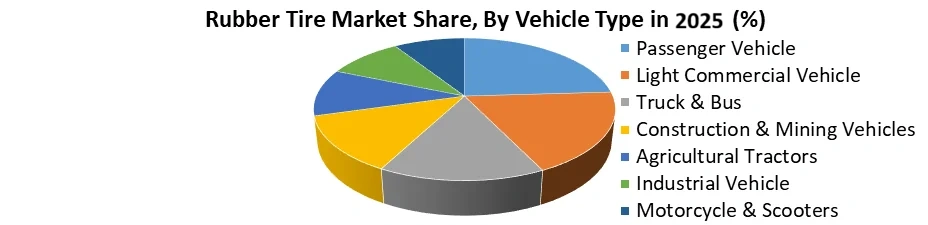
Urbanization and industrialization significantly increase advanced agricultural vehicles and their productivity and continued advancements have flourished the segment growth of the market. Commercial vehicles, motorcycles, and buses also play a major role in driving the rubber tire market. Additionally electric vehicles along with advanced and integrated technology such as passenger vehicles especially luxury and semi-luxury vehicles are expected to boost the demand for rubber tire over the forecasting period.
Rubber Tire Market Regional Insights:
In 2023, the North American Rubber Tire Market held the major share in the global market. The factors which help to attribute to the dominant country that is increasing urbanization and industrialization, increasing population, and increasing sources of incomes of populations The United States dominates the area of the North American rubber tire market, it holds about half of the total rubber tire market share. The annual share of the United States is around 10.05 million units. Which strengthens the market in this region. The combined market share of Canada and Mexico is about 15% and the rest of the North American market.
The rubber tire market in Europe stood at USD 8.2 billion in 2025. This region holds the dominant market. It owing to increasing stringency in government regulation to reduce carbon emissions, and they promote environment–friendly vehicles and other vehicular components. China is the central hub for the rubber tire market industries and one of the firmest rising economies in the world. The request for materials like coal, gold, copper, and iron ore is growing. As a result, mining trucks are growing up as well. The surge in mining production is pushing the demand for new building machinery fields by replacement of old machinery, which boosts the mining Market demand
Recent Industry Developments (2025–2026)
| Exact Date | Company | Development | Impact |
|---|---|---|---|
| 20 March 2026 | Bekaert / Bridgestone | Bekaert reached an agreement to acquire Bridgestone's tire reinforcement business in China and Thailand. | This acquisition consolidates the supply chain and strengthens Bekaert's manufacturing footprint in the high-growth Asian market. |
| 18 March 2026 | Yokohama Tire | The company officially permanently closed its manufacturing plant in Salem, Virginia. | The closure marks a strategic shift in production capacity as the company optimizes its global manufacturing network. |
| 04 February 2025 | Yokohama Rubber | Yokohama Rubber completed the USD 678 million acquisition of Goodyear's off-road tire (OTR) business. | The deal significantly expands Yokohama's portfolio in the mining and construction vehicle segments globally. |
| 07 January 2025 | Sumitomo Rubber / Goodyear | Goodyear signed a definitive agreement to sell the Dunlop brand rights in Europe and North America to Sumitomo Rubber for USD 701 million. | The transaction allows Sumitomo to unify the Dunlop brand globally while Goodyear focuses on its core portfolio. |
| 09 May 2025 | Michelin | Michelin launched the Primacy 5 energy and Pilot Sport 5 energy high-efficiency tire ranges. | These products target the electric vehicle (EV) segment, offering up to 10% increase in battery range. |
Rubber Tire Market Competitive Landscape:
The rubber tire market is fragmented, there is a high level of competition. The key players are operating the huge market. The prominent players are constantly adopting various, different strategies to grow in the market.
There is a high demand for the rubber tires. So it very scalable market having huge competition. The rubber tire market is competitive, with many global and regional manufacturers vying for market share. Various key players invest in product innovation and brand promotion to maintain a competitive edge.
Some of the leading key players dominating the rubber tire market are Bridgestone Corporation, Goodyear Tire & Rubber Company (US), Continental AG, Michelin, and other prominent players. To further enhance their market share, these companies employ various strategies such as mergers and acquisitions, partnerships, license agreements, and launching new products.
Rubber Tire Market Scope: Inquiry Before Buying
| Rubber Tire Market | |||
|---|---|---|---|
| Report Coverage | Details | ||
| Base Year: | 2025 | Forecast Period: | 2026-2032 |
| Historical Data: | 2020 to 2025 | Market Size in 2025: | 167.09 USD Bn. |
| Forecast Period 2026-2032 CAGR: | 3.8% | Market Size in 2032: | 216.94 USD Bn. |
| Segments Covered: | by Rim Size | <11’’ 12’’-17’’ 18’’-21’’ >22’’-25’’ 29’’-49’’ 51’’-63’’ |
|
| by Tire Type | Radial Bias Solid |
||
| by Vehicle Type | Passenger Vehicle Light Commercial Vehicle Truck & Bus Construction & Mining Vehicles Agricultural Tractors Industrial Vehicle Motorcycle & Scooters |
||
Rubber Tire Market, by Region
North America (United States, Canada and Mexico)
Europe (UK, France, Germany, Italy, Spain, Sweden, Austria and Rest of Europe)
Asia Pacific (China, South Korea, Japan, India, Australia, Indonesia, Malaysia, Vietnam, Taiwan, Bangladesh, Pakistan and Rest of APAC)
Middle East and Africa (South Africa, GCC, Egypt, Nigeria and Rest of ME&A)
South America (Brazil, Argentina Rest of South America)
Key Players / Competitors Profiles Covered in Brief in Global Rubber Tire Market Report in Strategic Perspective:
- Apollo Tyres Ltd
- Bridgestone Corporation
- CEAT Limited
- Continental AG
- Hankook & Company Co., Ltd.
- JK Tyre & INDUSTRIES LTD.
- Michelin
- MRF Limited
- Nokian Tyres PLC
- Pirelli & C. S.p.A.
- Sailun Group Co., Ltd.
- Salsons Impex Pvt. Ltd.
- Shandong Linglong Group Co. Ltd.
- Sumitomo Rubber Industries, Ltd.
- The Goodyear Tire & Rubber Company
- The Yokohama Rubber Co., Ltd.
- Triangle Tire Co., Ltd.
- Toyo Tire Corporation
- Wanli Tire Co., Ltd.
- Zhongce Rubber Group Co., Ltd.
- Kumho Tire Co. Inc.
- Giti Tire Pte. Ltd.
- Cheng Shin Rubber (Maxxis)
- Nexen Tire Corporation
- Cooper Tire & Rubber Company
Frequently Asked Questions
1. What is the Global Rubber Tire Market size and forecast?
Ans. The valuation reached USD 167.09 billion in 2025. With a 3.8% CAGR, total revenue will hit USD 216.94 billion by the 2032 forecast end-year.
2. Which region leads the Rubber Tire Market Share Analysis?
Ans. North America dominates consumption due to high vehicle ownership, while Thailand leads production, controlling 33.4% of the natural rubber supply essential for manufacturing tires.
3. How is technology impacting Rubber Tire Market Trends 2026?
Ans. Industry Growth Drivers include smart sensors and monitoring systems. Manufacturers are integrating AI-driven technology to support autonomous driving and improve maintenance alerts for modern vehicles.
4. What is the impact of EV adoption on Rubber Tire Market growth?
Ans. The Rubber Tire Market Trends 2026 show rising demand for high-efficiency tires. Michelin’s latest ranges increase EV battery range by 10%, optimizing electric vehicle performance.
5. How do raw material costs affect Rubber Tire Market Share Analysis?
Ans. Raw materials comprise 32% of production costs. Shortages in synthetic and natural rubber significantly inflate prices, challenging manufacturers to maintain profit margins across global markets.
6. What are the primary Industry Growth Drivers for premium tires?
Ans. Increasing demand for high-performance, speed-rated tires drives the market. These premium products offer wider profit margins but require more frequent replacement, boosting total sales volume.
7. What characterizes the Rubber Tire Market competitive landscape?
Ans. The market is highly concentrated among leaders like Bridgestone and Michelin. Recent strategic acquisitions and brand licensing deals are reshaping the global supply chain and footprint.