
Protein Expression Market Size by Expression System, Product, Application, End-User, Region – Revenue Pool Analysis, Margin Structure Assessment, Capital Flow Trends, Competitive Benchmarking & Forecast to 2034
Overview
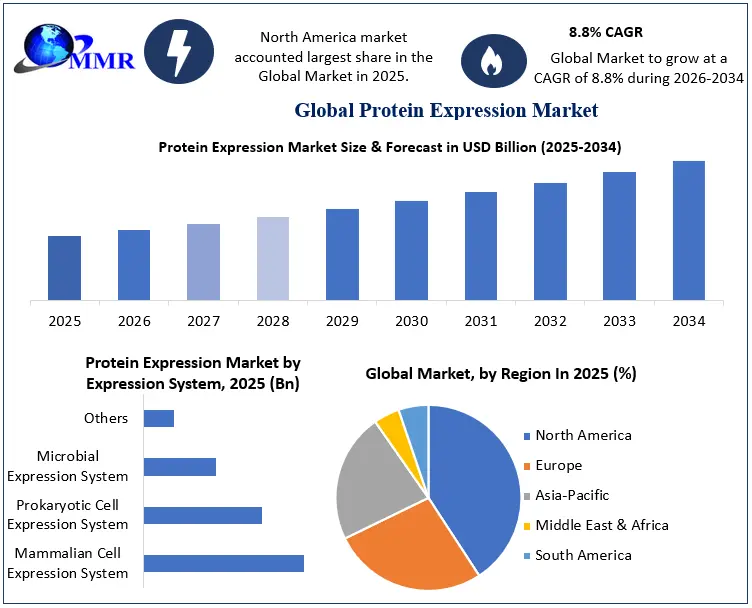
The Global Protein Expression Market was valued at USD 3.5 Bn in the year 2025 and is expected to reach USD 7.3 Bn by 2034 with a growing CAGR of 8.8% over the forecast period of 2026-2034.
Protein Expression Market Overview
Protein expression refers to the biotechnology processes, systems, and associated products used to produce recombinant and other target proteins from engineered genetic material. The market includes expression vectors, expression systems, host cells, reagents, kits, enzymes, plasmids, competent cells, and protein-expression services, supporting protein production through bacterial, yeast, insect, mammalian, and cell-free systems. These technologies are used to obtain proteins for drug discovery, recombinant therapeutics, monoclonal antibodies, vaccines, diagnostics, structural biology, proteomics, enzyme engineering, and academic research. The importance of controlled protein expression is also reflected in regulatory frameworks: the U.S. FDA’s Q5B guidance specifically addresses characterization of expression constructs used in cells for producing recombinant DNA-derived protein products.
The Protein Expression Market is expanding as pharmaceutical and biotechnology companies increase investment in biologics development, recombinant protein production, precision medicine, molecular biology, genetic engineering, proteomics, and advanced biomanufacturing. Demand is also supported by the growing use of expression technologies across therapeutic protein development, antibody discovery, vaccine research, disease modelling, and industrial biotechnology. For example, the U.S. FDA recognizes recombinant therapeutic proteins, monoclonal antibodies, cytokines, growth factors, enzymes, and other proteins within the biological-product landscape, highlighting the downstream importance of protein-expression technologies. The WHO also maintains specific guidance for recombinant-DNA-derived biotherapeutic proteins, covering their manufacturing and quality control. North America remains a major market due to its established pharmaceutical and biotechnology ecosystem, advanced research infrastructure, and concentration of protein-expression technology providers, while Europe and Asia-Pacific are supported by expanding biopharmaceutical R&D and manufacturing capabilities.
Why MMR ?
The MMR Protein Expression Market Report will provide a comprehensive assessment of the industry covering market size, growth trends, forecast analysis, market dynamics, drivers, restraints, opportunities, challenges, technological developments, regulatory environment, and competitive landscape. The report will analyse the market across key segments such as product and service, expression system, host organism, application, end user, and region, while examining developments in recombinant protein technology, mammalian and microbial expression systems, cell-free protein synthesis, protein engineering, synthetic biology, and biopharmaceutical manufacturing. It will also provide regional analysis, country-level insights, key-player profiles, strategic developments, competitive positioning, emerging opportunities, and investment perspectives, enabling pharmaceutical companies, biotechnology firms, research institutions, investors, and technology providers to evaluate market potential and identify commercially relevant growth areas.
Protein Expression Market Growth Outlook
To know about the Research Methodology :- Request Free Sample Report
Protein Expression Market Dynamics
Growing biopharmaceutical development is driving demand for protein expression technologies
The rising development of therapeutic proteins, monoclonal antibodies, vaccines, enzymes, and biosimilars is increasing demand for efficient protein expression systems across drug discovery and biomanufacturing. Advancements in genetic engineering, CRISPR, synthetic biology, and protein engineering are improving expression efficiency and enabling production of proteins with targeted characteristics. The U.S. FDA continues to maintain dedicated regulatory pathways for recombinant therapeutic proteins and biosimilars, supporting the broader application of protein-expression technologies.
High production costs and process complexity are restraining wider adoption of protein expression systems
Protein expression requires specialized vectors, host cells, reagents, purification technologies, analytical instruments, and skilled personnel, increasing development costs for smaller laboratories and biotechnology companies. Complex proteins may also require specific folding and post-translational modifications, making the selection and optimization of expression systems challenging. These factors can affect protein yield, quality, scalability, and overall production efficiency.
Cell-free synthesis and advanced protein engineering are creating new market opportunities
Advances in cell-free protein synthesis, synthetic biology, automation, and computational protein design are creating opportunities for faster and more flexible protein production. Cell-free platforms can support applications in drug discovery, diagnostics, enzyme engineering, and research, while AI-assisted protein design is expanding the development of proteins with specific functions. The FDA reported 76 approved biosimilars by October 2025, further supporting opportunities for cost-efficient protein-production technologies.
Protein folding and post-translational modification remain key challenges in scalable production
Achieving consistent protein folding, glycosylation, disulfide-bond formation, biological activity, and purity remains difficult for many complex proteins. Proteins expressed successfully at laboratory scale may require significant optimization when production is increased to commercial volumes. These technical requirements can increase process-development time, purification complexity, manufacturing costs, and batch-to-batch variability, particularly for therapeutic protein applications.
Protein Expression Market Segment Analysis:
1. By Expression System
The market is segmented into Mammalian Cell Expression System, Prokaryotic Cell Expression System, Microbial Expression System, and Others. Among these, the Mammalian Cell Expression System segment is expected to hold the leading position because mammalian hosts can produce complex proteins with appropriate folding and post-translational modifications, making them important for monoclonal antibodies, recombinant therapeutic proteins, vaccines, and other biologics. Prokaryotic systems, particularly bacterial expression platforms, remain widely used because of their relatively rapid growth, straightforward genetic manipulation, and cost-efficient production of research proteins. Microbial expression systems support enzyme production and industrial biotechnology, while Others include emerging and specialized platforms such as cell-free and alternative expression systems.
2. By Application
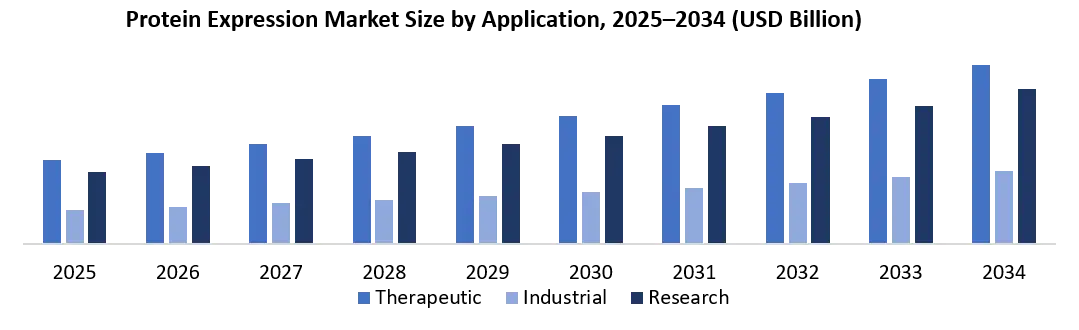
Based on application, the market is divided into Therapeutic, Industrial, and Research. The Therapeutic segment is expected to account for the largest share, supported by increasing protein production requirements for biologics, monoclonal antibodies, recombinant hormones, enzymes, vaccines, and biosimilar development. The Research segment remains significant due to extensive use of protein expression in drug discovery, structural biology, proteomics, molecular biology, biomarker research, and laboratory studies. Meanwhile, Industrial applications are supported by growing use of engineered proteins and enzymes in food processing, biofuels, biocatalysis, agriculture, and sustainable biomanufacturing.
Protein Expression Market Regional Insights:
North America is the leading region in the global protein expression market, supported by its established biopharmaceutical industry, advanced life-science research infrastructure, strong biotechnology ecosystem, and high R&D spending. The United States benefits from major biotechnology clusters across Boston, San Francisco, and San Diego, alongside the presence of pharmaceutical companies, academic research centers, and specialized protein-expression technology providers. Government support through agencies such as the U.S. FDA and NIH also strengthens research and development activities. NIH reported USD 35.3 billion in extramural biomedical research awards in FY2025, demonstrating the scale of funding supporting the broader biomedical research ecosystem.
Europe represents a significant market for protein expression technologies, driven by strong pharmaceutical and biotechnology research, academic institutions, biologics development, and advanced molecular biology capabilities. Germany, the UK, France, and Switzerland are important contributors because of their established life-science industries and research networks. The European Medicines Agency (EMA) provides a regulatory framework for biological and advanced medicinal products, supporting the development and commercialization of innovative therapies. Increasing research in recombinant proteins, monoclonal antibodies, biosimilars, proteomics, and personalized medicine is creating sustained demand for protein-expression platforms across the region.
Asia-Pacific is expected to witness strong expansion during the forecast period as China, Japan, India, South Korea, and Australia increase investment in biotechnology, pharmaceutical manufacturing, and life-science research. Growing biologics production, biosimilar development, contract research, recombinant protein manufacturing, and cost-efficient laboratory services are strengthening regional demand. Government initiatives supporting biotechnology and biopharmaceutical manufacturing are further improving the regional ecosystem. China's expanding biologics industry and India's growing pharmaceutical and biotechnology capabilities are particularly important for protein-expression applications, while Japan and South Korea continue to contribute through advanced research and biologics development.
Middle East & Africa is an emerging market for protein expression, supported by increasing investments in healthcare infrastructure, biotechnology research, pharmaceutical manufacturing, and diagnostic capabilities. Countries such as Saudi Arabia, the UAE, Israel, and South Africa are developing life-science and healthcare ecosystems, creating opportunities for recombinant protein research and biotechnology applications. Expansion of research institutions and collaborations with international pharmaceutical and biotechnology companies is expected to improve adoption of advanced protein-expression technologies.
South America is also developing gradually as pharmaceutical research, biotechnology capabilities, academic studies, and healthcare investment expand across countries such as Brazil and Argentina. Increasing interest in biosimilars, recombinant therapeutics, vaccine research, diagnostics, and agricultural biotechnology is supporting demand for protein-expression technologies. Brazil's comparatively developed pharmaceutical and research ecosystem provides a foundation for wider adoption, while collaborations between universities, research organizations, and biotechnology companies are creating opportunities for further market development.
Competitive Landscape of Protein Expression Market:
The Protein Expression Market is highly competitive, with major players focusing on expression systems, recombinant protein production, reagents, expression vectors, competent cells, protein engineering, cell-free synthesis, and protein-expression services. Key companies include Thermo Fisher Scientific, Merck KGaA, Lonza Group, GenScript Biotech Corporation, Bio-Rad Laboratories, Agilent Technologies, Danaher Corporation, Takara Bio, and Promega Corporation. Companies are strengthening their positions through new product launches, R&D investments, strategic collaborations, manufacturing expansion, acquisitions, and geographic expansion, while improving protein yield, scalability, expression efficiency, and quality.
For instance, NanoTemper Technologies introduced Andromeda X in 2024 to support recombinant protein expression screening, while Thermo Fisher Scientific expanded its bioprocessing manufacturing facility in Millersburg to support materials used in biologics and vaccine development. Merck KGaA also invested €250 million in its Biotech Development Center in Switzerland, strengthening biotechnology development and manufacturing capabilities. Competitive differentiation is increasingly centered on high-throughput expression, advanced protein engineering, cell-free technologies, automation, faster development cycles, customization, and cost-efficient protein production across therapeutic, industrial, and research applications.
Protein Expression Market Scope: Inquire before buying
| Protein Expression Market | |||
|---|---|---|---|
| Report Coverage | Details | ||
| Base Year: | 2025 | Forecast Period: | 2026-2034 |
| Historical Data: | 2020 to 2025 | Market Size in 2025: | US$ 3.5 Bn. |
| Forecast Period 2026 to 2034 CAGR: | 8.8% | Market Size in 2034: | US$ 7.3 Bn. |
| Segments Covered: | by Expression System | Mammalian cell expression system Prokaryotic cell expression system Microbial expression system Others |
|
| by product | Reagents Competent cells Expression vectors Others |
||
| by Application | Therapeutic Industrial Research |
||
| by End-User | Pharma-Biotech Companies Academic Research Institutes Contract Research Organizations (CRO) |
||
Protein Expression Market by Region
North America (United States, Canada and Mexico)
Europe (UK, France, Germany, Italy, Spain, Sweden, Austria and Rest of Europe)
Asia Pacific (China, South Korea, Japan, India, Australia, Indonesia, Malaysia, Vietnam, Taiwan, Bangladesh, Pakistan and Rest of APAC)
Middle East and Africa (South Africa, GCC, Egypt, Nigeria and Rest of ME&A)
South America (Brazil, Argentina Rest of South America)
Key Players:
1. Thermo Fisher Scientific (US)
2. GenScript (US)
3. Merck KGaA (Germany)
4. Agilent Technologies, Inc. (US)
5. Takara Bio Inc. (Japan)
6. Bio-Rad Laboratories (US)
7. Qiagen (Germany)
8. New England Biolabs (US)
9. Promega Corporation (US)
10. Oxford Expression Technologies Ltd (UK)
11. Lonza (Switzerland)
12. Synthetic Genomics Inc. (US)
13. Sigma-Aldrich Corporation (US)
14. Abcam (UK)
15. Bio- Techne Corporation (US)
16. Codexis (US)
17. Synbio Technologies (US)
18. Eurofins Genomics (US)
19. Novoprotein Scientific (China)
20. GE Healthcare (US)
Frequently Asked Questions FAQ’s
1] What segments are covered in Global Protein Expression report?
Ans. The segments covered in Global Protein Expression report are based on Product, Expression system, Application and End-User.
2] Which region held the largest Protein Expression share in 2025?
Ans. North America is expected to hold the largest Protein Expression share in 2025.
3] Who are the top players in the Global Protein Expression Market?
Ans. Thermo Fischer Scientific, Merck, GenScript, Agilent Technologies, Novoprotein Scientific are the top players in the Global Protein Expression Market.
4] What is the expected Global Protein Expression size by 2034?
Ans. The expected Global Protein Expression size is USD 7.3 Bn by 2034.
5] What was the Global Protein Expression size in 2025?
Ans. The Global Protein Expression size was worth USD 3.5 Bn in 2025.