
Non-Dairy Ice Cream Market Size by Source, Flavor, Distribution Channel, Product, Form, Region – Segment-Level Market Assessment, Growth Opportunity Analysis, Competitive Mapping & Forecast to 2032
Overview
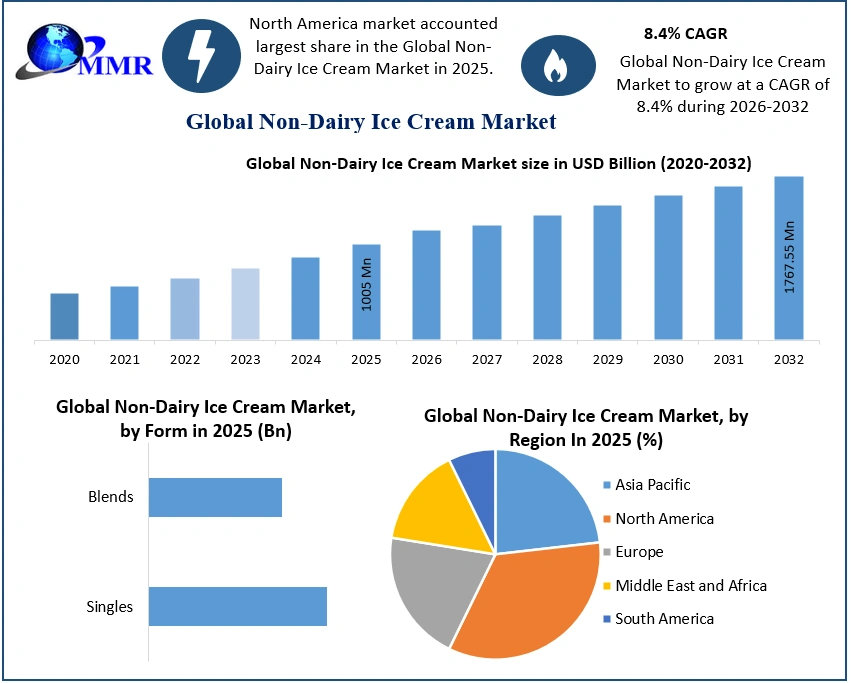
The Non-Dairy Ice Cream Market size was valued at USD 1005 Million in 2025 and the total Non-Dairy Ice Cream revenue is expected to grow at a CAGR of 8.4% from 2026 to 2032, reaching nearly USD 1767.55 Million by 2032.
Non-Dairy Ice Cream Market Overview:
The Non-Dairy Ice Cream Market is the frozen dessert market segment that focuses on the manufacturing and consumption of dairy-free ice cream alternatives. It refers to a wide range of products that have been specifically designed to emulate the flavor, texture, and enjoyment of classic dairy ice creams while employing plant-based components. Awareness of health and wellness is growing which led consumers to seek alternatives to traditional dairy products. Non-dairy ice cream often appeals to those looking for lower-calorie, lower-fat, and cholesterol-free options. Non-dairy ice cream products are now widely available in supermarkets, health food stores, and online platforms. Improved accessibility has contributed to increased consumer adoption.
North America region dominated the Non-Dairy Ice Cream market in the year 2025. Major market players from the United States are Ben & Jerry's, Eden Creamery LLC, So Delicious Dairy Free, Cosmic Bliss, Häagen-Dazs, Tofutti Brands Inc., NadaMoo!, etc. are the companies that prioritize the creation of premium non-dairy ice creams that closely same as the taste and texture of conventional dairy varieties.
To know about the Research Methodology :- Request Free Sample Report
Drivers
Adoption of plant-based diets, and rising lactose intolerance and dairy allergies to Drive Non-Dairy Ice Cream Market
The Non-Dairy Ice Cream Market is characterized by dynamic and evolving dynamics driven by various factors. Changing consumer preferences and dietary habits, including the growing adoption of plant-based diets, have a profound impact on market dynamics. Increasing health consciousness and concerns about the environmental impact of dairy products have led consumers to seek non-dairy alternatives, stimulating market growth. Technology and product innovations also influence market dynamics. Non-dairy ice cream manufacturers use dairy-like ingredients and procedures to improve taste and texture.
Innovation has increased flavor possibilities and product quality, attracting more non-dairy consumers. Marketing and promotional strategies adopted by key market players significantly influence market dynamics. Effective branding, advertising, and product positioning contribute to increased consumer awareness and acceptance of non-dairy ice cream options. The expansion of distribution channels, including online platforms and specialty stores, has also expanded market accessibility and contributed to market growth.
The Non-Dairy Ice Cream Market is driven by a confluence of significant drivers. Non-dairy ice cream is in demand due to rising lactose intolerance and dairy allergies. Plant-based diets, driven by health and environmental concerns, also boost the industry. Consumer tastes and a desire for healthier desserts also drive non-dairy ice cream sales. The availability of diverse flavors and innovative product offerings appeals to consumers seeking novel taste experiences. Additionally, the robust marketing strategies and brand recognition employed by key market players play a pivotal role in driving consumer awareness and acceptance of non-dairy ice cream. Collectively, these drivers fuel the growth of the Non-Dairy Ice Cream Market, reflecting a paradigm shift towards plant-based alternatives in the frozen dessert industry.
Restraints
Limited consumer awareness and replicating the taste and texture of traditional dairy ice cream can hamper the market
The Non-Dairy Ice Cream Market encounters a range of restraints and challenges that impact its progress. Firstly, limited consumer awareness and acceptance of non-dairy ice cream pose a hurdle to market growth. While the demand for plant-based alternatives grows, a substantial portion of the population remains unfamiliar or hesitant to try non-dairy options, affecting market reach.
Another challenge lies in replicating the taste and texture of traditional dairy ice cream using non-dairy ingredients, as achieving the same level of creaminess and indulgence can be complex. Ingredient availability and affordability also present obstacles, with certain plant-based alternatives being costlier or subject to supply chain limitations. Furthermore, navigating regulatory constraints and labeling requirements regarding allergen declarations, nutritional claims, and ingredient labeling can be intricate for manufacturers. Lastly, intensifying competition in the market calls for differentiation through unique flavors, quality ingredients, and effective marketing strategies to stand out in the crowded landscape. Addressing these challenges requires continuous innovation, consumer education, ingredient sourcing strategies, regulatory compliance, and strategic branding efforts to drive market acceptance and growth.
Opportunity
Innovation in Flavors and Ingredients and growth in the retail industry create opportunities
The Non-Dairy Ice Cream Market presents ample growth opportunities driven by the rising popularity of plant-based diets, consumer demand for unique and innovative flavors, the growth of distribution channels including online platforms, the potential for product diversification to cater to specific dietary needs, and the adoption of sustainable packaging and practices. As more individuals embrace dairy-free alternatives and seek indulgent frozen desserts, companies can capitalize on these trends to expand their market reach, attract a broader customer base, and enhance their brand reputation in the evolving landscape of non-dairy ice cream. There's room for creativity in developing new flavors and incorporating unique ingredients.
Brands can experiment with exotic fruits, spices, and other innovative components to differentiate their products in a competitive market. Increasing availability in supermarkets, convenience stores, and online platforms allows non-dairy ice cream brands to reach a wider audience. Growth retail presence can lead to increased sales and market penetration.
Non-Dairy Ice Cream Market Segment Analysis
Based on the Source,
The Non-Dairy Ice Cream Market exhibits source-based segmentation, encompassing a range of plant-based alternatives such as coconut milk, almond milk, soy milk, cashew milk, oat milk, and other options. Non-dairy ice creams derived from coconut milk delight consumers with their luxurious and creamy texture, providing a truly gratifying experience. Almond milk-based varieties present a delicately nutty flavor, appealing to those desiring a lighter taste sensation. Soy milk, a widely popular alternative, offers a smooth and creamy consistency accompanied by a neutral flavor, making it an ideal canvas for a wide array of flavor combinations.

Indulging in cashew milk-based ice creams unveils a velvety texture complemented by a slightly sweet and buttery essence. Oat milk-based alternatives provide a creamy and smooth consistency, often preferred for their neutral taste. The "others" category includes non-dairy ice creams derived from sources like rice milk, hemp milk, and pea protein, offering a diverse range of flavors and textures to cater to different dietary preferences and allergen considerations.
Based on the Product,The Non-Dairy Ice Cream Market is segmented by product into three categories such as impulse, artisanal, and take-home. Impulse non-dairy ice creams are typically single-serving products that are conveniently packaged and readily available for immediate consumption, catering to on-the-go consumers.

Artisanal non-dairy ice creams are handcrafted in small batches, often featuring unique flavors and premium ingredients, appealing to consumers seeking a gourmet experience. Take-home non-dairy ice creams come in larger containers and are intended for consumption at home, allowing individuals and families to enjoy indulgence over multiple servings. This segmentation caters to different consumer preferences, occasions, and consumption patterns within the non-dairy ice cream market.
Non-Dairy Ice Cream Market Regional Insights:
Plant-based and dairy-free options are driving demand for non-dairy ice cream in North America. Ben & Jerry's, So Delicious Dairy Free, and Häagen-Dazs use their brand recognition and distribution networks throughout the region. Flavors and new products meet varied consumer tastes in the market, especially in the United States and Canada. Both established and developing businesses can succeed in this competitive landscape because North American customers value high-quality ingredients, organic alternatives, and innovative flavor profiles. Plant-based diets and sustainability consciousness are driving non-dairy ice cream sales in Europe.
Alpro, Swedish Glace, and Oatly are meeting European demand for non-dairy alternatives. The region offers soy, almond, oat, and coconut-based non-dairy ice cream. Local and organic products, new flavors, and unusual textures appeal to European customers, grow the market, and attracting international and local businesses in various countries such as the United Kingdom, France, etc. Veganism and changing diets are driving demand for non-dairy ice cream in Asia-Pacific. Cocofrio, Non-Dairy Queen, and Yoconut Dairy Free are emerging in Australia, Japan, and India. These brands provide many non-dairy ice cream flavors and forms to satisfy consumer desires. As consumers seek healthier, more sustainable desserts, the market grows.
Consumers in MEA are slowly adopting non-dairy ice cream as a healthier alternative to dairy treats. Smoocht, Yöru, and Coconutsy are growing by offering plant-based and dairy-free solutions. The industry is rising due to health awareness, lactose sensitivity, and veganism. International and regional players can capitalize on the increased interest in locally sourced and natural products. Health and environmental consciousness is driving the non-dairy ice cream business in South America. Plant-based and dairy-free brands like Frooty, Gelato & Grano, and Los Helados meet this demand. The region's tropical fruits and native ingredients appeal to South American tastes. South America's flourishing non-dairy ice cream business benefits from the region's abundant biodiversity, which allows for novel flavor development.
Competitive Landscape:
The Non-Dairy Ice Cream Market is marked by a competitive landscape with a wide array of players offering distinct products to meet the rising demand for plant-based and dairy-free alternatives.
Key industry players like Ben & Jerry's, Häagen-Dazs, and So Delicious Dairy Free utilize their strong brand recognition and extensive distribution networks to secure a substantial market presence. These companies prioritize the creation of premium non-dairy ice creams that closely replicate the taste and texture of conventional dairy varieties. Through their commitment to quality, they cater to consumers seeking a comparable experience to traditional dairy ice creams while enjoying the benefits of a plant-based and dairy-free option. Additionally, innovative companies like Oatly and NadaMoo! specialize in creating non-dairy ice creams using unique ingredients such as oats and coconut, providing a distinct flavor profile. The competitive landscape is further enriched by smaller players offering niche flavors and focusing on organic, allergen-free, or locally sourced ingredients, catering to specific consumer preferences.
The objective of the report is to present a comprehensive analysis of the Non-Dairy Ice Cream Market including all the stakeholders of the Technology. The past and current status of the Technology with forecasted market size and trends are presented in the report with the analysis of complicated data in simple language. The report covers all the aspects of the Technology with a dedicated study of key players that includes market leaders, followers, and new entrants by region. PORTER, SVOR, and PESTEL analysis with the potential impact of micro-economic factors by region on the market have been presented in the report. External as well as internal factors that are supposed to affect the business positively or negatively have been analyzed, which will give a clear futuristic view of the Technology to the decision-makers.
The report also helps in understanding the Market dynamics, and structure by analyzing the market segments and projecting the Market size. Clear representation of competitive analysis of key players by type, price, financial position, product portfolio, growth strategies, and regional presence in the Non-Dairy Ice Cream Market makes the report an investor’s guide.
Non-Dairy Ice Cream Market Scope: Inquire before buying
| Non-Dairy Ice Cream Market | |||
|---|---|---|---|
| Report Coverage | Details | ||
| Base Year: | 2025 | Forecast Period: | 2026-2032 |
| Historical Data: | 2020 to 2025 | Market Size in 2025: | USD 1005 Mn |
| Forecast Period 2026 to 2032 CAGR: | 8.4% | Market Size in 2032: | USD 1767.55 Mn. |
| Segments Covered: | by Source | Coconut Milk Almond Milk Soy Milk Cashew Milk Oat Milk Others |
|
| by Flavor | Chocolate Caramel Coconut Vanilla Coffee Fruit Cookies & Cream Strawberry Others |
||
| by Distribution Channel | Supermarkets Hypermarkets Convenience Stores Speciality Stores Online Retail |
||
| by Product | Impulse Artisanal Take Home |
||
| by Form | Singles Blends |
||
Non-Dairy Ice Cream Market, by Region:
North America (United States, Canada, and Mexico)
Europe (UK, France, Germany, Italy, Spain, Sweden, Austria, and the Rest of Europe)
Asia Pacific (China, South Korea, Japan, India, Australia, Indonesia, Malaysia, Vietnam, Taiwan, Bangladesh, Pakistan, and the Rest of APAC)
Middle East and Africa (South Africa, GCC, Egypt, Nigeria, and the Rest of ME&A)
South America (Brazil, Argentina Rest of South America)
Non-Dairy Ice Cream Key Players
North America:
1. Ben & Jerry's (United States)
2. So Delicious Dairy Free (United States)
3. Cosmic Bliss (United States)
4. Häagen-Dazs (United States)
5. Tofutti Brands Inc. (United States)
6. NadaMoo! (United States)
7. Eden Creamery LLC (United States)
8. Dream (United States)
9. Trader Joe’s (United States)
10. Van Leeuwen Artisan Ice Cream (United States)
11. General Mills (United States)
12. Bliss Unlimited, LLC. (United States)
Europe
1. Swedish Glace (Sweden)
2. Unilever (United Kingdom/Netherlands)
3. Danone (France)
4. The Booja-Booja Co. Central Europe Ltd. (United Kingdom)
5. Happy Cow Limited (United Kingdom)
Asia Pacific
1. Over The Moo (Australia)
Frequently Asked Questions:
1] What segments are covered in the Global Non-Dairy Ice Cream Market report?
Ans. The segments covered in the Non-Dairy Ice Cream Market report are based on Source, Flavor, Distribution Channel, Product, Form, and Region.
2] Which region is expected to hold the highest share of the Global Non-Dairy Ice Cream Market?
Ans. The North American region is expected to hold the highest share of the Non-Dairy Ice Cream Market. The United States and Canada are the countries in this region where Flavors and new products meet varied consumer tastes.
3] What is the market size of the Global Non-Dairy Ice Cream Market by 2032?
Ans. The market size of the Non-Dairy Ice Cream Market by 2032 is expected to reach USD 1767.55 Mn.
4] What is the forecast period for the Global Non-Dairy Ice Cream Market?
Ans. The forecast period for the Non-Dairy Ice Cream Market is 2026-2032.
5] What was the market size of the Global Non-Dairy Ice Cream Market in 2025?
Ans. The market size of the Non-Dairy Ice Cream Market in 2025 was valued at USD 1005 Mn.