
Meat Market - Industry Structure Evaluation, Demand Drivers Analysis, Regional Growth Analysis and Identification, Competitive Positioning Review & Global Market Size Forecast to 2032
Overview
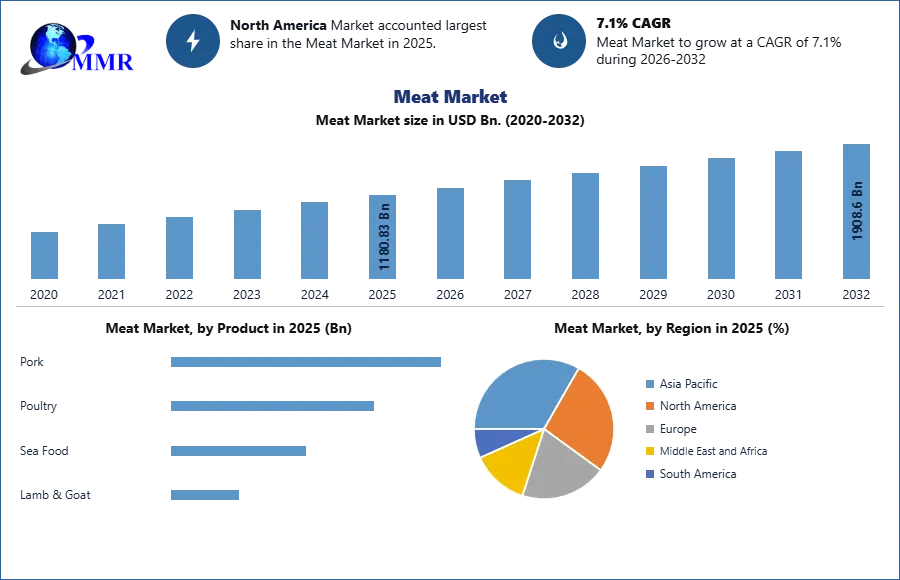
The Meat Market size was valued at USD 1180.83 Billion in 2025 and the total Meat revenue is expected to grow at a CAGR of 7.1% from 2026 to 2032, reaching nearly USD 1908.6 Billion.
Meat Market Overview:
Fresh meat is usually characterized as meat which has not undergone any special processing prior to being sold. Any meat that has been modified in some way to increase its flavor or extend its shelf life is considered processed meat. Processed food consumption leads to an increase in cholesterol and fat levels in the body, forcing the consumer to adopt an unhealthy lifestyle. Increasing obesity rates are raising awareness about the dangers of eating processed foods, putting a strain on demand for fresh processed meat products. Fresh meat is dominate the market because many consumers are trying to avoid processed meat for their disadvantages and as unhealthy meat food.
This report analyzes the Meat Market as the 2026 Middle East crisis triggers a historic surge in global food inflation and cold-chain logistics costs. With the Strait of Hormuz disruption halting 33% of global fertilizer trade and driving crude toward $120/bbl, the industry is facing a 20% spike in production and transport overheads. We explore how market leaders are leveraging AI-driven bioprocess optimization and hybrid alternative proteins to bypass volatile grain feedstocks and energy-intensive processing. By evaluating the shift toward circular "waste-to-value" processing and regionalized sourcing, this study provides stakeholders with strategic frameworks to protect margins in a high-inflation landscape where food security and operational resilience are the new market imperatives.
To know about the Research Methodology :- Request Free Sample Report
Meat Market Dynamics:
The market's growth is fueled by the availability of processed meat at reasonable prices. Market growth is being fueled by an increase in the number of women working around the world, particularly in emerging economies, as well as an increase in disposable money. Government regulations on the techniques used to prepare meat and the manufacturing of these goods, as well as increased health concerns related to red meat consumption, are restricting market growth. The market's growth has been hampered by rising demand for healthier foods and the increased acceptance of vegan and vegetarian diets. Market opportunities are created by the rising development and usage of innovative meat processing technology. Additionally, industry participants are introducing less expensive and label-friendly processed meat products on e-commerce platforms, which is creating lucrative opportunities in the market.
The rise of the fresh meat market is driven by growing meat consumption. Meat consumption in Australia has increased by 58% over the last 20 years, reaching 360 million tones, according to figures from the Australian Department of Agriculture, Water and the Environment. Spain's per capita meat consumption was 46.2 kg in, with chicken being the most popular fresh meat. According to a research published in the international journal, red meat, processed meat, and chicken consumption may increase the risk of cardiovascular disease by 3-7 %, as well as the chance of death from any cause by 3%. Customers have shifted to vegan options for better health as a result of the poor health conditions associated with meat eating, negatively impacting the fresh meat packaging sector.
Meat Market Segment Analysis:
Based on type, Global Meat Market is segmented in to the Fresh Meat and Processed Meat. The growth is likely to be fueled by rising consumption of fresh meat products such as pork and beef. Fresh meat has a shorter shelf life and requires packaging that provides for sufficient oxygen to keep its color. The Global Processed meat market was accounted at USD 563.94 Bn. in and projected to reach USD 752.15 by 2032 with increasing CAGR 4.2% during the forecast period.
Based on Products, the Global Meat Market is segmented into Poultry, Pork, Goat & Lamb and Seafood. The Poultry segment is dominated the Global Meat Market in the year 2025. Poultry segment is held the market share of 4.7% in the year , and its further expected to grow at CAGR 9.5% during the forecast period. Global Meat Market of Lamb and Goat segment, China Europe, Canada drive the 1.1% of CAGR estimated for this segment. Metric tons in the year and estimated to reach market size of 11.3 metric tons during the forecast period. Sea food held the market of 5.4% in the year and it expected to grow around 8% by the end of year.
Based on Application, Global pork market is segmented by application as Super Market Convenience Store, Independent Retailer and Others. The Super Market segment held the market share of 65% in 2025.The Independent Retailer segment dominated the Global Market in and reached for a revenue share of over 56% .The growth in the Convenience store application of Fresh and processed Meat can be directly contributed growing working population and the trend of consuming meals outside homes. During the outbreak of corona virus the demand for the pork meat has reduced because of consumption of pork meat has been impacted negatively. The Other segment is projected to witness a notable growth rate throughout the forecast period. This is attributed to the fact that the Independent Retailer market of fresh meat has increased considerably in Asia-Pacific
Meat Market Regional Insights:
Asia Pacific held the pork meat market share of 57.5% in 2025. Its expected grow up to 80% of share during the forecast period 2025-2032. The global pork meat market is growing due to changing lifestyles among people and increasing demand for meat consumption. Many countries of Asia-Pacific such as China, East Asian countries are consuming high amount of red meat which is driving the market. According to USDA foreign agriculture service, China imports account for 35% of global pork imports. In terms of pork meat production China has the highest market share, which was around 45% in . In global pork production was led by China, which produced over 40 million metric tons. In North America is expected to be the most important market for meat production. In the United States and other North American countries, Chicken remains the most popular meat product.
Nuggets are one of the most popular ways that chicken flesh is consumed in different countries. Consumers are looking for solutions that are handy to eat at any time, thanks to the increasing popularity of on-the-go lifestyles and snacking goods, notably in the United States. As a result, major corporations such as Tyson Food and Cargill are focusing their attention on making clean meat or cultured meat chicken nuggets to appeal to customers.
Recent Industry Developments (2025–2026)
| Exact Date | Company | Development | Impact |
|---|---|---|---|
| 12 February 2025 | ITC Limited | Signed a definitive agreement to acquire Prasuma, a leading frozen meat manufacturer, as part of its "ITC Next" strategy. | Strengthens frozen meat distribution and premium product portfolio in the high-growth Indian market. |
| 15 January 2026 | Eat Just (GOOD Meat) | Secured a 18.2% market share in the cultured meat segment following the expansion of its commercial bioreactor capacity. | Reinforces market leadership in alternative proteins and accelerates price parity with conventional poultry. |
| 03 March 2025 | The Business Research Company | Announced new performance standards for binders and scaffolders used in hybrid meat products to improve texture. | Facilitates wider consumer adoption of processed meat substitutes through enhanced sensory profiles. |
| 24 March 2026 | Nu Harvest Foods | Launched a new line of solar-dried beef jerky targeting the premium outdoor and fitness retail channels. | Expands sustainable processing options in the dehydrated meat sector to meet carbon-conscious consumer demand. |
| 12 February 2026 | Food Robotics Corp | Deployed automated butchery systems reaching a market value of $4 billion to address global labor shortages. | Improves operational efficiency and reduces waste in large-scale meat processing facilities. |
The objective of the report is to present a comprehensive analysis of Global Meat Market to the stakeholders in the industry. The past and current status of the industry with the forecasted Market size and trends are presented in the report with the analysis of complicated data in simple language. The report covers all the aspects of the industry with a dedicated study of key players that include Market leaders, followers, and new entrants.
PORTER, PESTEL analysis with the potential impact of micro-economic factors of the Market have been presented in the report. External as well as internal factors that are supposed to affect the business positively or negatively have been analyzed, which will give a clear futuristic view of the industry to the decision-makers.
The report also helps in understanding the Global Market dynamics, structure by analyzing the Market segments and project the Global Meat Market size. Clear representation of competitive analysis of key players by Deployment, price, financial position, Deployment portfolio, growth strategies, and regional presence in the Global Meat Market make the report investor’s guide.
Meat Market Scope: Inquire before buying
| Meat Market | |||
|---|---|---|---|
| Report Coverage | Details | ||
| Base Year: | 2025 | Forecast Period: | 2026-2032 |
| Historical Data: | 2020 to 2025 | Market Size in 2025: | 1180.83 USD Bn. |
| Forecast Period 2026-2032 CAGR: | 7.1% | Market Size in 2032: | 1908.6 USD Bn. |
| Segments Covered: | by Type | Fresh Meat Processed Meat |
|
| by Product | Pork Poultry Sea Food Lamb & Goat |
||
| by Application | Super Market Convenience Store Independent Retailers Others |
||
Meat Market, by Region
North America (United States, Canada and Mexico)
Europe (UK, France, Germany, Italy, Spain, Sweden, Austria and Rest of Europe)
Asia Pacific (China, South Korea, Japan, India, Australia, Indonesia, Malaysia, Vietnam, Taiwan, Bangladesh, Pakistan and Rest of APAC)
Middle East and Africa (South Africa, GCC, Egypt, Nigeria and Rest of ME&A)
South America (Brazil, Argentina Rest of South America)
Key Players / Competitors Profiles Covered in Brief in Global Meat Market Report in Strategic Perspective:
- JBS
- NH Foods
- Smithfield Foods
- Cargill Incorporated
- ConAgra Foods
- National Beef Packing Company
- Tyson Foods
- Cherkizovo Group PJSC
- Hormel Foods Corp.
- BRF SA
- Marfrig Global Foods SA
- WH Group Ltd.
- Danish Crown AS
- Perdue Farms Inc.
- Sysco Corp.
- Vion Food Group
- Itoham Foods Inc.
- Clemens Food Group
- Fieldale Farms Corp.
- House of Raeford Farms Inc.
- Johnsonville LLC
- KOCH FOODS INC.
- Wayne Farms LLC
- Pilgrim's Pride Corporation
- The Kraft Heinz Company
Frequently Asked Questions
1. What is the projected Global Meat Market size and growth rate?
Ans. The market reached USD 1180.83 Billion in 2025. It targets USD 1908.6 Billion by 2032, driven by a 7.1% CAGR and rising global protein demand.
2. Which region leads the Meat Market Share Analysis through 2032?
Ans. Asia Pacific dominates with a 57.5% pork market share. Rapid urbanization and high import volumes in China position the region as a primary industry growth engine.
3. How is technology impacting Meat Market Trends 2026?
Ans. Automation and Food Robotics Corp’s butchery systems optimize efficiency. Meanwhile, AI-driven processing and innovative meat processing technology are creating lucrative opportunities for high-volume manufacturers.
4. What are the primary Industry Growth Drivers for fresh meat?
Ans. Increasing disposable income and health-conscious consumers favoring minimally processed proteins boost demand. Fresh meat dominates as shoppers avoid additives found in conventional processed meat products.
5. How is the vegan movement affecting Meat Market Dynamics?
Ans. Rising acceptance of vegetarian diets and alternative proteins challenges traditional sales. Companies are responding by investing in cultured meat segments to retain health-focused consumer bases.
6. What role do e-commerce platforms play in meat distribution?
Ans. Online retail facilitates growth by offering label-friendly, affordable processed options. Industry participants utilize digital storefronts to expand reach beyond traditional supermarkets and independent retail channels.
7. Who are the leading Meat Market Trade Partners by 2026?
Ans. China remains the world's largest meat importer, while Brazil maintains its status as the top exporter, reaching record-breaking beef shipment volumes in early 2026.