
Global Noise Barrier Market by Type, Material, Distribution Channel, End-User, and Region - Global Market Size Estimation, Industry-Wide Analysis, Competitive Landscape Assessment & Long-Term Forecast to 2034
Overview
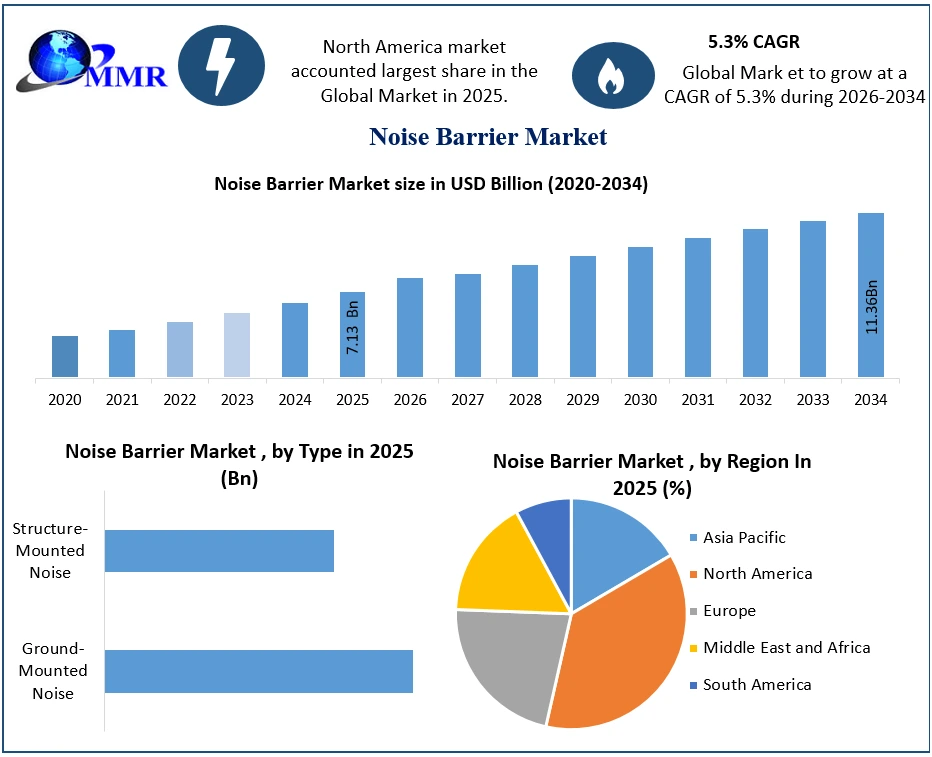
Global Noise Barrier Market size was valued at USD7.13 Bn in 2025, and the total Noise Barrier Market revenue is expected to grow at a CAGR of 5.3% from 2026 to 2034, reaching nearly USD 11.36 Bn.
Noise Barrier Market Overview
Noise barriers are physical structures, often made of materials such as concrete, steel, or composites that are strategically placed to block or absorb sound waves and minimize the transmission of noise from a noise soaurce to its surrounding environment.
The comprehensive report on the noise barrier market encompasses a wide range of essential information. The report presents key findings, providing a snapshot of the market's current state. It delves into a detailed market overview, outlining the scope and breadth of the noise barrier industry.
In terms of market analysis, the report offers valuable insights into the prevailing trends driving the noise barrier market forward. These trends include the increasing demand for noise reduction solutions across various sectors and the growing awareness of the adverse effects of noise pollution on public health and well-being. The report identifies and examines the key drivers propelling the market growth, such as infrastructure development, urbanization, and stringent noise regulations.
Additionally, the report highlights the challenges and restraints faced by the noise barrier market. Factors such as high installation costs, limited awareness in certain regions, and the need for regular maintenance are analyzed to provide a comprehensive understanding of potential obstacles.
To assist industry stakeholders in making informed decisions, the report presents an in-depth analysis of market opportunities. It explores untapped market segments, emerging application areas, and potential growth regions.
Moreover, the report incorporates a thorough segmentation analysis, categorizing the market based on product type, application, end user industry and region. This segmentation allows for a granular examination of each segment's growth potential and assists in identifying lucrative investment opportunities.
To provide a holistic view, the report includes a competitive landscape analysis, profiling major players in the industry. The profiles encompass a company overview, product portfolio, recent developments, and strategies adopted by key market participants. This information aids in understanding the competitive dynamics and helps stakeholders formulate effective strategies to gain a competitive edge.
The report on the noise barrier market is a comprehensive resource that provides a detailed overview, market trends analysis, segmentation insights, and a competitive landscape assessment. It serves as a valuable tool for businesses, investors, and decision-makers seeking to navigate the noise barrier industry and seize growth opportunities.
Noise Barrier Market Growth and Share Analysis
To know about the Research Methodology :- Request Free Sample Report
Noise Barrier Market: Research Methodology
The Noise Barrier Market research uses primary and secondary data sources for data collection. The research covers all possible factors that influence the market and evaluates them in-depth through primary research to arrive at valuable conclusions. The market size for top-level markets and sub-segments is normalized and the impact of inflation, economic downturns, regulatory & policy changes, and other variables is factored into the market forecast.
The bottom-up approach and multiple data triangulation methodologies are used to estimate the market size and forecasts. The percentage splits, market shares, and breakdowns of the segments are derived based on weights assigned to each of the segments on their utilization rate and average sale price. The country-wise analysis of the overall market and its sub-segments are based on the percentage adoption or utilization of the given market size in the respective region or country.
The major players in the market are identified through primary and secondary research based on indicators such as market revenue, price, services offered, advancements, mergers and acquisitions, and joint ventures.
Research is conducted for comprehensive market engineering and calculations for market statistics, market size estimations, market forecasts, market breakdown, and data triangulation.
External and internal factors that affect the business positively or negatively have been analyzed, which gives decision-makers a clear futuristic view of the industry. The report also helps in understanding the Noise Barrier Market's dynamic structure by analyzing the market segments and projecting the market size. Clear representation of competitive analysis of key players by price, financial position, growth strategies, and regional presence in the Noise Barrier Market makes the report an investor’s guide.
Noise Barrier Market Dynamics
In response to the global phenomena of urbanization and industrial expansion, the demand for noise reduction solutions has experienced remarkable growth. Noise barriers, recognized as sound barriers or acoustic barriers, have emerged as indispensable structures aimed at mitigating the adverse impacts of noise pollution on communities, transportation systems, and industrial facilities.
The report highlights a key driving force behind the noise barrier market: an escalating consciousness regarding the detrimental effects of noise pollution on human well-being. Stringent noise control regulations implemented by governments and regulatory bodies have triggered a widespread adoption of noise barrier solutions across residential, commercial, and transportation sectors.
Technological advancements have played an important role in shaping the dynamics of the noise barrier market. The report emphasize significant breakthroughs in materials, including transparent acoustic panels and composite barriers, which have revolutionized both the aesthetics and performance of noise barriers. Furthermore, the integration of smart technologies, such as noise monitoring systems and adaptive noise barriers, has transformed the industry by providing real-time data and customizable solutions.
Intense competition among key market players has catalyzed collaborations, partnerships, and mergers. The report underscores the focus of companies on research and development endeavors, driving the introduction of advanced products to gain a competitive edge.
Based on our comprehensive analysis, steady growth in the noise barrier market is estimated in the forecast period. Factors such as urbanization, increasing noise pollution concerns, technological advancements, and regulatory support are expected to fuel this growth. The industry's steadfast commitment to innovation, sustainability, and customization will be pivotal in shaping its future trajectory.
Noise Barrier Market Drivers
The report on the Noise Barriers Market provides an in-depth analysis of the factors driving the growth of the noise barrier market, unveiling the key dynamics that are shaping its expansion across various industries. The escalating urbanization and industrialization worldwide serve as significant catalysts, contributing to soaring demand for noise reduction solutions. Noise barriers, also known as sound barriers or acoustic barriers, have developed as crucial structures for limiting the negative effects of noise pollution on communities, transportation networks, and industrial sites. Furthermore, the growing emphasis on sustainable development has increased demand for eco-friendly and energy-efficient noise barrier materials.
Technological advancements play a pivotal role in shaping the dynamics of the noise barrier market. Our research underscores significant innovations in materials, including transparent acoustic panels and composite barriers, which enhance both the aesthetics and performance of noise barriers. Moreover, the integration of smart technologies, such as noise monitoring systems and adaptive noise barriers, revolutionizes the industry by providing real-time data and customizable solutions.
The noise barrier market is witnessing fierce competition among key players, driving collaborations, partnerships, and mergers. The report unveils the drivers fuelling the growth of the market. Increasing urbanization, the rising awareness of noise pollution's adverse effects, and technological advancements are key factors propelling market expansion. The industry's focus on innovation, sustainability, and customization will be instrumental in shaping its future trajectory.
Noise Barrier Market Opportunities
The noise barrier market presents an array of opportunities for growth and development. One significant opportunity lies in the increasing awareness and concern about noise pollution's adverse effects on human well-being.
Technological advancements offer another avenue for opportunity in the noise barrier market. Innovations in materials, such as transparent acoustic panels and composite barriers, enhance the performance and aesthetics of noise barriers, opening up possibilities for companies to offer more efficient and visually appealing solutions. The integration of smart technologies, such as noise monitoring systems and adaptive noise barriers, also presents opportunities for market players to provide customizable and data-driven noise reduction solutions.
Furthermore, the market's focus on sustainability and eco-friendly practices offers room for growth. The adoption of sustainable manufacturing processes and the utilization of recycled materials in noise barrier production can cater to the increasing demand for environmentally conscious solutions.
The noise barrier market offers opportunities for market players to capitalize on the rising awareness of noise pollution's impact and regulatory requirements. Technological advancements and sustainability considerations further provide avenues for growth and innovation in the industry.
Noise Barrier Market Restraints and Challenges
The noise barrier market encounters restraints and challenges that influence its growth. High costs associated with design, manufacturing, and installation limit widespread adoption. Complex regulatory environments and varying noise control standards across jurisdictions create hurdles and delays. Effectiveness of noise barriers can be limited by topography, wind patterns, and urban design. Additionally, size and scale of noise sources pose challenges to achieving optimal noise reduction. Balancing functional requirements with aesthetic considerations is a challenge, as stakeholders may have different preferences and concerns. Overcoming these obstacles necessitates innovative approaches, collaboration with regulatory bodies, and cost-effective, visually appealing solutions to meet diverse community and industry needs.
Noise Barrier Market Trends
The noise barrier market is witnessing significant trends that are driving its growth. The trends reflect the noise barrier industry's response to environmental concerns, the need for improved noise reduction capabilities, and the desire for more adaptable and efficient barrier systems. These trends include the increasing demand for sustainable and eco-friendly solutions, the utilisation of innovative materials and designs, the customization of noise barriers for specific applications, and the integration of smart technologies for enhanced noise management.
Noise Barrier Market Segmentation
The report covers market segmentation by product type, end-user and geography, offering a granular view of the market dynamics and growth potential in each segment.
Based on End User: The Noise Barrier market is segmented into Construction, Transportation, Industrial Sections, Airport and Others. Within the construction industry, these barriers play a crucial role in minimizing noise pollution, benefiting nearby residents and workers. Along transportation routes, including highways, railways, and subway lines, noise barriers are strategically deployed to mitigate noise levels for surrounding communities. Industries utilize these barriers to address noise emissions from factories and other industrial facilities effectively. Airports employ noise barriers to alleviate the impact of aircraft noise on nearby areas. Additionally, noise barriers serve in various other sectors, including commercial and residential areas adjacent to noisy infrastructure or entertainment venues, where noise reduction is paramount.
Noise Barrier Market Regional Insights
North America: The noise barrier market in North America, particularly the United States, is anticipated to showcase significant growth due to the well-established transportation infrastructure and urban development in the region. The presence of stringent noise regulations and a strong emphasis on environmental sustainability drives the demand for noise mitigation solutions. With a focus on improving the quality of life for residents near highways, railways, and airports, the market for noise barriers is expected to thrive in North America.
Europe: Europe stands as a prominent region in the noise barrier market, driven by countries such as Germany, France, and the United Kingdom. These nations boast well-developed transportation networks, making noise pollution management a top priority. The region's stringent regulations and growing infrastructure projects, coupled with increasing urbanization, contribute to the strong demand for noise barrier solutions. As Europe continues to prioritize noise reduction measures and enhance the acoustic environment, the market for noise barriers is poised for growth.
Asia Pacific: The rising population, increasing urbanization, extensive infrastructure development, coupled with increasing transportation demands, have heightened the need for effective noise reduction measures. This scenario presents lucrative growth opportunities for the noise barrier market in the region. With governments and local authorities recognizing the importance of noise control, the demand for noise barrier solutions is expected to witness substantial growth in the Asia Pacific region.
Middle East and Africa: UAE, Saudi Arabia, and South Africa are key contributors to the market in this region. With a focus on creating sustainable and liveable cities, governments and developers are emphasizing noise reduction measures, boosting the demand for noise barriers. The market in the Middle East and Africa presents significant opportunities for noise barrier manufacturers and suppliers.
South America: Urbanisation and infrastructure initiatives in Brazil and Mexico are increasing noise barrier demand. As population and transport networks grow, awareness of noise pollution and its effects on quality of life grows. South America's noise barrier industry is rising due to noise mitigation and acoustic improvement efforts.
Competitive Landscape
The noise barrier market features several major players who offer a wide range of noise mitigation solutions. Noise Barriers LLC stands out for their emphasis on sustainable materials and innovative designs. Armtec LP specializes in providing comprehensive noise barrier solutions for various applications. Industrial Noise Control, Inc. excels in engineering customized noise barrier systems for specific industrial needs. Paragon Noise Barriers, Inc. differentiates itself through patented technologies that optimize sound absorption and transmission loss.
The Soundcoat Company specializes in noise barrier materials and solutions for building construction projects. These industry leaders bring unique advantages to the market, including expertise in specific sectors, customized solutions, innovative designs, patented technologies, and a focus on sustainability. With their comprehensive offerings, they cater to diverse noise reduction requirements and ensure compliance with regulations in various industries and infrastructure projects.
Noise Barrier Market Recent Development
| Date | Company | Development | Impact |
|---|---|---|---|
| 25 February 2025 | Durisol Ltd. | Durisol Ltd. partnered with REBLOC to launch North America's first MASH TL-5 crash-tested integrated noise barrier system designed for highway applications. | This development addresses key transportation safety requirements by combining heavy-vehicle impact protection with high-performance acoustic mitigation in a single modular structure. |
| 02 July 2025 | Blade-Made | Blade-Made, in partnership with Rijkswaterstaat and Dura Vermeer, installed a 60-meter circular Blade Barrier made from decommissioned wind-turbine blades at the InnovA58 test site. | The innovation accelerates sustainable circular infrastructure by demonstrating acoustic mitigation performance on par with traditional concrete barriers while repurposing difficult-to-recycle materials. |
| 10 September 2025 | Kinetics Noise Control Inc. | Kinetics Noise Control Inc. unveiled NOISEBLOCK PW275, an innovative lightweight outdoor sound barrier wall and panel system. | The release enhances the company's product portfolio for industrial and transportation acoustic mitigation, offering easier installation and long-term durability. |
| 12 August 2026 | Delhi Public Works Department | The Delhi Public Works Department floated a INR 2.09 Crore civil infrastructure tender to install specialized noise barrier systems along the Barapullah flyover corridor. | The initiative highlights government-backed municipal investments to reduce urban traffic noise pollution in high-density transportation arterial roads. |
Noise Barrier Market Scope: Inquire before buying
| Noise Barrier Market | |||
|---|---|---|---|
| Report Coverage | Details | ||
| Base Year: | 2025 | Forecast Period: | 2026-2034 |
| Historical Data: | 2020 to 2025 | Market Size in 2025: | USD 7.13 Bn. |
| Forecast Period 2026 to 2034 CAGR: | 5.3% | Market Size in 2034: | USD 11.36 Bn. |
| Segments Covered: | by Type | Ground-Mounted Noise Structure-Mounted Noise |
|
| by Material Type | Concrete Metal (e.g. steel, aluminum) Wood PlasticFiber Supplements |
||
| by Distribution Channel | Offline Channel Online Channel |
||
| by End‑User | Construction Transportation Industrial Sections Airport Others |
||
Noise Barrier Market by Region:
North America (United States, Canada, and Mexico)
Europe (UK, France, Germany, Italy, Spain, Sweden, Austria, and the Rest of Europe)
Asia Pacific (China, South Korea, Japan, India, Australia, Indonesia, Malaysia, Vietnam, Taiwan, Bangladesh, Pakistan, and the Rest of APAC)
Middle East and Africa (South Africa, GCC, Egypt, Nigeria, and the Rest of ME&A)
South America (Brazil, Argentina Rest of South America)
Noise Barrier Key Players
North America:
1. Noise Barriers LLC (United States)
2. Sound Fighter Systems (United States)
3. Armtec LP (Canada)
4. Eckel Noise Control Technologies (United States)
Europe:
5. Industrial Noise Control, Inc. (United States)
6. Gramm Barriers Systems Ltd (United Kingdom)
7. Acoustiblok UK Ltd (United Kingdom)
8. IAC Acoustics (United Kingdom)
9. PAROC (Finland)
10. Noise Barriers Europe (Germany)
Asia Pacific:
11. AIL Sound Walls (Canada)
12. U-Tech Co., Ltd. (South Korea)
13. Hengdun Electronic Equipment Co., Ltd. (China)
14. Shenzhen Vinco Soundproofing Materials Co., Ltd. (China)
15. Jiangsu Shanda Environmental Protection Technology Co., Ltd. (China)
Middle East and Africa:
16. Gramco Noise Control B.V. (Netherlands)
17. Acoustic Solutions (South Africa)
18. QuietStone Ltd (United Arab Emirates)
19. Emirates Green Building Council (United Arab Emirates)
20. Al Khoory Group (United Arab Emirates)
South America:
21. Acustica Ltda. (Brazil)
22. Noise Shield (Mexico)
23. Blokfort (Brazil)
24. Vianini Pipe, Inc. (Mexico)
25. Bahia Acustica (Brazil)
FAQs:
1. What are the growth drivers for the Noise Barrier Market?
Ans. The growth drivers for the Noise Barrier Market include increasing urbanization, stringent noise regulations, expanding transportation infrastructure, rising awareness of health impacts, and technological advancements.
2. What is the major restraint for the Noise Barrier Market growth?
Ans. The major restraint for the Noise Barrier Market growth is the high cost associated with the design, manufacturing, and installation of noise barrier systems.
3. Which region is expected to lead the global Noise Barrier Market during the forecast period?
Ans. North America is expected to lead the global Noise Barrier market during the forecast period.
4. What is the projected market size & growth rate of the Noise Barrier Market?
Ans. The Noise Barrier Market size was valued at USD 7.13Billion in 2025 and the total Market revenue is expected to grow at a CAGR of 5.3% from 2026 to 2034, reaching nearly USD 11.36Billion.
5. What segments are covered in the Noise Barrier Market report?
Ans. The segments covered in the Noise Barrier Market report are End-User industry, type, Distribution Channel and Region.