
Global Circular Economy in Mining Market Size by Commodity, Mining Type and Application
Overview
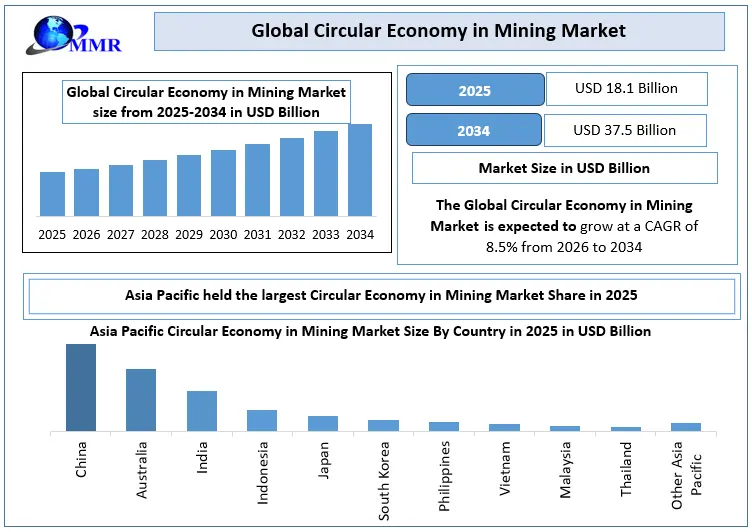
Global Circular Economy in Mining Market size was valued at USD 18.1 Billion in 2025, and the total revenue is expected to grow at a CAGR of 8.5% from 2025 to 2034, reaching USD 37.5 Billion by 2034.
Global Circular Economy in Mining Market Overview
The Global Circular Economy in Mining Market covers solutions and activities that enable mining companies to recover, reuse, recycle, and reprocess resources generated during mineral extraction and processing. It includes tailings reprocessing, metal and mineral recovery, mine-water recycling, mining-waste utilization, and secondary resource recovery. Unlike the traditional linear mining model, circular mining focuses on extracting additional value from existing resources while reducing waste, improving water efficiency, and supporting more sustainable mining operations.
The Global Circular Economy in Mining Market was valued at USD 18.1 billion in 2025 and is projected to reach around USD 37.5 billion by 2034, registering a CAGR of 8.5% during 2026–2034. Market growth is being driven by rising demand for critical minerals, resource-efficient mining, tailings recovery, mine-water recycling, and mining-waste valorization. Stricter environmental regulations and increasing pressure to reduce mining waste are encouraging companies to adopt circular mining solutions. At the same time, high capital costs, complex mineral recovery processes, variable waste composition, and regulatory requirements remain key factors influencing market adoption and project economics.
Circular Economy in Mining Market Key Highlights
|
Circular Economy in Mining Market Size, Share and Growth Analysis
To know about the Research Methodology :- Request Free Sample Report
Circular Economy in Mining Market Dynamics
Increasing Demand for Critical Mineral Security and Resource-Efficient Recovery to boost Circular Economy in Mining Market growth
As the energy transition drives unprecedented demand for critical minerals even while public opposition to new mining activity intensifies, mining companies are turning to circular strategies tailings reprocessing, waste valorization, and secondary material recovery to extract more value from existing reserves rather than expanding virgin extraction.
High Capital Intensity and Technical Complexity of Legacy Waste Reprocessing to Hamper Circular Economy in Mining Market Growth
Retrofitting brownfield operations with reprocessing infrastructure, water-recycling systems, and material-tracking technology requires significant upfront investment, and legacy tailings vary widely in mineralogy, grade, and chemical stability, making standardised, scalable recovery solutions harder to deploy uniformly across sites. As advanced hydrometallurgical and bioleaching techniques mature, certain low-value or highly variable waste streams may remain uneconomical to reprocess in the near term, limiting how quickly the addressable market can be unlocked.
Tailings Reprocessing and Urban Mining Unlocking Secondary Value
One of the strongest opportunities lies in treating legacy waste piles as a resource rather than a liability: Strategic collaborations between technology providers and miners are enabling large-scale deployment of automated recovery and digitalized material-tracking systems, creating opportunities for vendors to move beyond single-site reprocessing toward broader closed-loop resource platforms.
Fragmented Regulation and Cross-Border Trade Barriers on Recovered Materials
Circular mining involves the recovery, storage, and cross-border movement of secondary materials and metal scrap, making regulatory consistency a major consideration — policy frameworks around extended producer responsibility (EPR), decarbonization, and zero-waste operations differ sharply by geography, and trade measures such as export restrictions on metal scrap can directly prevent cross-border circular flows. Vendors and mining companies must continuously navigate evolving compliance requirements and monitoring/enforcement mechanisms to scale circular models internationally rather than only within a single jurisdiction.
Circular Economy in Mining Market Trends
Accelerating Shift from Waste Disposal to Tailings Reprocessing
The industry is moving away from treating tailings, overburden, and slag as disposal liabilities and toward extracting further value from them. Advances in processing technologies now enable additional mineral recovery from tailings, with the potential to reduce global tailings generation by around 10%. Waste-to-resource initiatives increasingly channel these residual streams into other industries, transforming mine waste such as tailings, overburden, and slag into useful materials for construction, agriculture, or road building. This is shifting reprocessing from a niche pilot activity into a core operating strategy at scale, boosting Circular Economy in Mining Market growth.
Urban Mining and Secondary Sourcing to boost Circular Economy in Mining Market Growth
Circular mining is expanding beyond the mine site itself to capture value from post-consumer and industrial waste streams. Recent modelling suggests that globally, 21% of import demand for selected critical minerals is met through recycling waste and scrap, a recovery potential that is reshaping how mining companies think about supply security. This Circular Economy in Mining Market trend is reinforced by the sheer scale of feedstock available, making it the fastest-growing waste stream, much of which contains recoverable precious and base metals.
Closed-Loop Water Management Becoming Standard Practice
Water circularity is emerging as one of the most operationally mature circular strategies in mining. Companies are reusing water and securing desalinated water supplies for mining operations, minimizing water waste, exemplified by integrated water-security projects at major copper operations. The Circular Economy in Mining sector is shifting from a linear "drain-and-discharge" model to a circular "recover-and-reuse" system, where treated mine water is redirected to dust suppression, cooling, transport, or supplied to water-scarce surrounding communities.
Digitalization and AI-Enabled Material Traceability to Boost Circular Economy in Mining Market
Circular strategies are increasingly paired with digital infrastructure rather than deployed as standalone initiatives. When combined with digital technologies such as automation, advanced data analytics and artificial intelligence, the potential of circular mining expands even further, with digital tools enabling full lifecycle tracking of materials from extraction and processing to reuse and recycling, enhancing traceability and accountability. This is turning circularity from a set of isolated projects into a measurable, auditable part of core operations.
Waste-to-Value Pilots Signal Broader Operational Adoption
Individual site-level pilots are increasingly being used to validate circular models before wider rollout. For example, Antofagasta's Los Pelambres mine recovers steel from discarded mine haulage truck tires for recycling into grinding balls used at the mine, aiming to repurpose 97 tonnes of steel from 156 haulage truck tires in its pilot project. As these pilots demonstrate commercial viability, mining companies are moving toward what industry researchers describe as fully circular business models rather than one-off sustainability initiatives.
Circular Economy in Mining Market Segment Analysis
By Application: Tailings Reprocessing & Metal Recovery dominated the application in the Circular Economy in Mining Market in 2025. Its leadership reflects the growing commercial focus on recovering residual metals from tailings and other previously processed mining materials. Mine Water Recycling & Treatment is supported by increasing pressure to reduce freshwater consumption and improve process-water reuse. Mine Waste Utilisation covers the conversion of waste rock, overburden, slag, and other mining residues into usable materials such as aggregates, backfill, and construction inputs. Other applications include emerging circular resource-management activities across mining operations.

Global Circular Economy in Mining Regional Insights
North America — Advanced Resource Recovery and Mine-Waste Management
North America dominated the Circular Economy in Mining Market in 2025. North America has a well-established mining industry and is increasingly focusing on tailings reprocessing, mine-water recycling, and recovery of valuable minerals from existing waste streams. Growing attention to critical-mineral supply, environmental performance, and mine-site rehabilitation is encouraging investment in advanced recovery and treatment technologies.
Europe — Regulation and Resource Efficiency Drive Adoption
Europe's circular mining opportunity is strongly influenced by resource efficiency, environmental regulations, waste reduction, and responsible mineral supply. Mining and processing companies are increasingly exploring ways to recover secondary resources from mining residues and improve water reuse, particularly where environmental and land-use constraints are significant.
Asia Pacific — Expansion Through Mining Scale and Resource Recovery
Asia Pacific offers significant growth potential because of its large mining and mineral-processing base, increasing mineral demand, and growing focus on reducing waste and improving resource efficiency. Australia, China, India, and Indonesia are important markets for technologies that can recover minerals from tailings, recycle mine water, and utilise mining residues, driving the Circular Economy in Mining Market growth.
Global Circular Economy in Mining Market Competitive Landscape
| Tag | Competitive Landscape Topic | Market Analysis |
| Market Structure | Market Evolution | The Global Circular Economy in Mining Market is shifting from conventional waste-management practices toward an integrated ecosystem focused on resource recovery, water reuse, waste utilization, and value generation from mining residues. |
| Key Players | Mining Companies | Major mining companies such as Vale, BHP, Rio Tinto, Glencore, and Anglo American are strengthening resource-efficiency initiatives, including tailings recovery, waste utilization, water conservation, and circular mining practices. |
| Technology | Technology Providers | Companies such as Metso, FLSmidth, Epiroc, and Weir Group support the market through mineral-processing, separation, dewatering, material-handling, and related technologies that enable more efficient resource recovery. |
| Participants | Competitive Ecosystem | The market includes mining operators, mineral-processing companies, technology providers, engineering firms, and specialized resource-recovery companies, creating competition across the mining value chain. |
| Core Focus | Tailings Reprocessing & Metal Recovery | Tailings reprocessing and metal recovery remain major competitive areas because companies can recover additional minerals from previously discarded materials while generating incremental economic value. |
| Water | Mine-Water Recycling | Mine-water treatment and recycling are gaining importance, particularly in water-stressed mining regions, encouraging companies to develop efficient treatment, recovery, and water-reuse solutions. |
| Waste Utilization | Mining Waste Reuse | Companies are increasingly focusing on the reuse of tailings, waste rock, mineral residues, and other mining by-products for backfilling, construction, infrastructure, and other productive applications. |
| Innovation | Advanced Technologies | Competitive differentiation is increasingly supported by advanced separation, hydrometallurgical processing, dewatering, automation, digital monitoring, and data-driven resource management. |
| Efficiency | Operational Performance | Companies compete on recovery efficiency, processing economics, water conservation, energy efficiency, waste reduction, and integration with existing mining infrastructure. |
| Economics | Commercial Viability | Market participants are increasingly required to demonstrate economically viable recovery rates, scalable technologies, lower operating requirements, and attractive returns from secondary-resource recovery. |
| Sustainability | Environmental Performance | Increasing pressure to improve resource productivity, reduce mining waste, conserve water, and lower environmental impacts is encouraging mining companies to integrate circular-economy practices into operations. |
| Market Direction | Future Competitive Outlook | Competition is moving beyond simply managing mining waste toward converting waste streams into economically useful secondary resources while improving the overall efficiency and sustainability of mining operations. |
Circular Economy in Mining Market Recent Developments
2025 – Vale Scales Up Iron Ore Recovery from Mining Waste: Vale made significant progress in turning mining waste into a usable source of iron ore. In 2025, the company produced 26.3 million tonnes of iron ore from reused waste materials, more than double the 12.7 million tonnes recorded in 2024. The company is targeting circular sources to contribute 10% of its annual production by 2030, showing that waste recovery is gradually becoming part of large-scale mining operations rather than remaining limited to small pilot projects.
2025 – Hindustan Zinc Moves Ahead with Large-Scale Tailings Recovery: Hindustan Zinc approved a major investment of up to ₹3,823 crore for a 10-million-tonne-per-year tailings reprocessing plant at its Rampura Agucha mine in India. The project will process previously generated tailings to recover additional mineral value. The development is particularly important for the circular mining market because it demonstrates how historical mining waste can become a new source of resources while reducing the amount of material requiring long-term storage.
29 January 2025 – India Strengthens Support for Critical-Mineral Recovery: The Indian government approved the National Critical Mineral Mission, allocating USD 1.72 billion over seven years through FY2030–31. The programme includes support for recovering critical minerals from overburden, tailings, fly ash and red mud, as well as incentives for recycling facilities. This policy is expected to encourage investment in technologies that can recover valuable minerals from existing waste streams and strengthen India's domestic supply of critical minerals.
Circular Economy in Mining Market Scope: Inquire before buying
| Circular Economy in Mining Market | |||
|---|---|---|---|
| Report Coverage | Details | ||
| Base Year: | 2025 | Forecast Period: | 2026-2032 |
| Historical Data: | 2020 to 2025 | Market Size in 2025: | USD 18.1 Bn. |
| Forecast Period 2026 to 2032 CAGR: | 8.5% | Market Size in 2032: | USD 37.5 Bn. |
| Segments Covered: | by Commodity | Base Metals Precious Metals Industrial Minerals Others |
|
| by Mining Type | Surface Mining Underground Mining |
||
| by Application | Tailings Reprocessing & Metal Recovery Mine Water Recycling & Treatment Mine Waste Utilization Others |
||
Circular Economy in Mining Market by Region:
North America: (United States, Canada, Mexico)
Europe: (United Kingdom, France, Germany, Italy, Spain, Sweden, Russia, Rest of Europe)
Asia Pacific: (China, South Korea, India, Japan, Australia, Indonesia, Philippines, Malaysia, Vietnam, Thailand, Rest of Asia Pacific)
Middle East & Africa: (Saudi Arabia, UAE, Qatar, Kuwait, Oman, Bahrain, South Africa, and Rest of ME&A)
South America: (Brazil, Argentina, Chile, Colombia, Rest of South America)
Circular Economy in Mining Key Players:
North America
1. Newmont Corporation
2. Teck Resources Limited
3. Freeport-McMoRan Inc.
4. Hecla Mining Company
5. Coeur Mining, Inc.
6. Tetra Tech, Inc.
7. Stantec Inc.
Europe
8. Anglo American plc
9. Boliden AB
10. Glencore plc
11. Umicore SA
12. Epiroc AB
13. Metso Corporation
14. FLSmidth A/S
15. The Weir Group plc
16. Fortum Oyj
17. Aurubis AG
18. Outokumpu Oyj
Asia Pacific
19. BHP Group Limited
20. Rio Tinto plc
21. South32 Limited
22. Fortescue Ltd.
23. Zijin Mining Group Co., Ltd.
24. Sumitomo Metal Mining Co., Ltd.
25. Mitsubishi Materials Corporation
26. Hindustan Zinc Limited
27. Vedanta Limited
28. Tata Steel Mining Limited
South America
29. Vale S.A.
30. Samarco Mineração S.A.
31. Antofagasta plc
32. Codelco
33. SQM S.A.
Middle East & Africa
34. DRDGOLD Limited
35. Sibanye-Stillwater Limited
36. Harmony Gold Mining Company Limited
37. Gold Fields Limited
38. AngloGold Ashanti plc
39. First Quantum Minerals Ltd.
40. Ivanhoe Mines Ltd.
Frequently Asked Questions:
1. What is the size of the Global Circular Economy in Mining Market?
The market is expanding as mining companies increase tailings recovery, mine-water recycling, and mining-waste utilization to improve resource efficiency.
2. Which segment dominates the market?
Tailings Reprocessing & Metal Recovery is expected to lead by application, while Base Metals are expected to lead by commodity.
3. Which region holds the largest market share?
Asia Pacific is expected to hold the largest share, supported by its large mining and mineral-processing base.
4. Which region is expected to grow fastest?
Asia Pacific is expected to have strong growth during the forecast period due to increasing mining activity, environmental requirements, and investment in resource-recovery technologies.
5. What are the major trends shaping the market?
Circular Economy in Mining Market trends include tailings reprocessing, critical-mineral recovery, mine-water recycling, mining-waste reuse, and advanced resource-recovery technologies.