Global Neural Processor Market by Application, End User, Region – Global Market Size Estimation, Industry-Wide Analysis, Competitive Landscape Assessment & Long-Term Forecast to 2034

18.2%
CAGR (2026-2034)
313.76 USD Mn.
Forecast Market Size
321
Report Pages
144
Market Tables

Overview

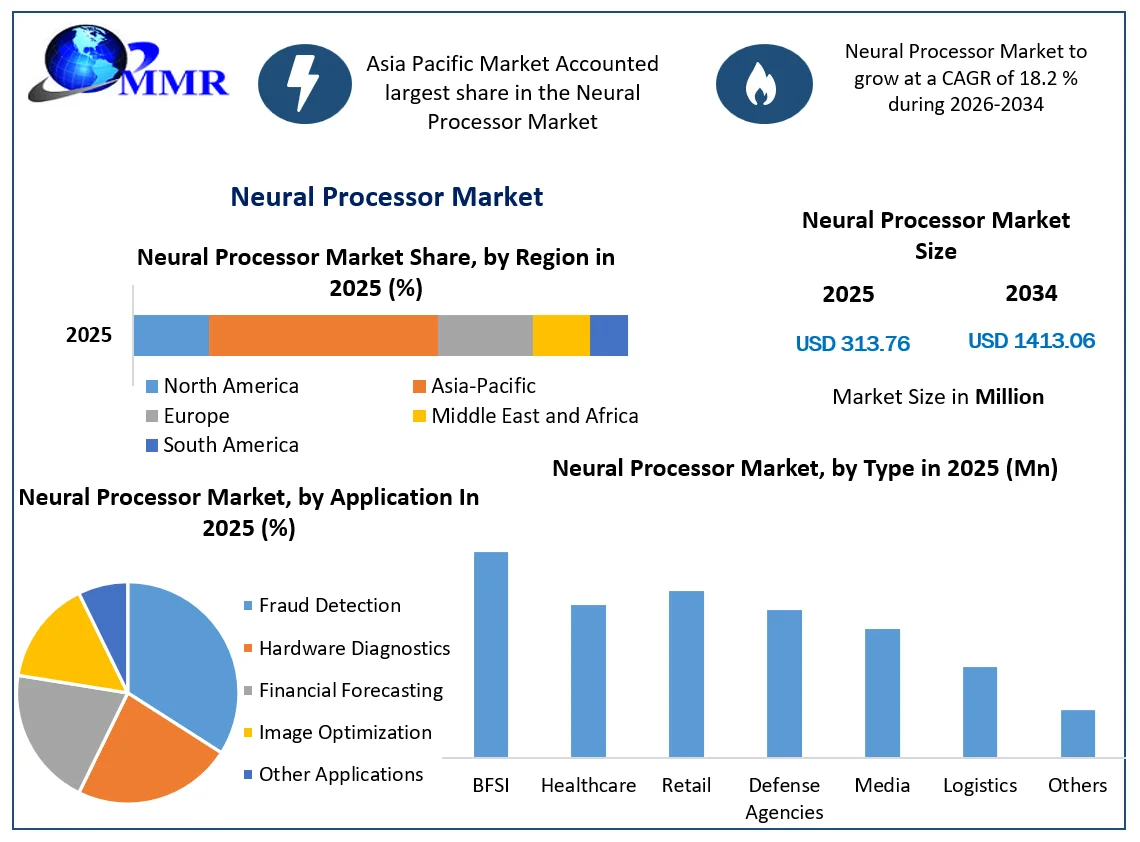
Neural Processor Market size was valued at USD 313.76 Mn. in 2025 and is expected to reach USD 1413.06 Mn. by 2030, at a CAGR of 18.2% over the forecast period (2026-2034).

Neural Processor Market Overview

A neural processor, known as a Neural Processing Unit, is a hardware component designed for accelerating artificial neural networks and deep learning tasks. The Processorare used to perform the complex operations involved in neural network, with high efficiency and speed. These processors are used in applications that depends on deep learning algorithms. By offloading the computational workload from general-purpose processors neural processors enable faster and more energy-efficient execution of neural network models parallel, which is expected to boost the Neural Processor Market growth.

Neural Processor Market Analysis from 2025 to 2034Neural Processor Market Growth
To know about the Research Methodology :- Request Free Sample Report

Neural Processor Market Dynamics

Increased demand for Artificial Intelligence to boost the Neural Processor Market growth

Artificial Intelligence applications are becoming increasingly popular across end use industries, such as healthcare, finance, automotive, and many more. These processors play an important role to accelerate the tasks generated by Artificial Intelligence such as image recognition, natural language processing, and deep learning, to meet the demand of solutions powered by AI, which is expected to boost the Neural Processor Market growth. Technological advancements in deep learning algorithms have shown remarkable performance in various complex tasks, which is significantly contributing for the growth of the market.

As the field of deep learning is becoming more advanced and popular, the demand for neural processors to handle the computational requirements of algorithms is also increasing day by day. Edge computing involves data processing closer to the source instead of depending on cloud infrastructure, and has gained traction due to its various advantages to reduce latency, data privacy, and bandwidth efficiency. Neural processors are optimized for edge computing that enables real-time processing of Artificial Intelligence tasks on devices such as smartphones, IoT devices, and autonomous vehicles, which is the factor to contribute significantly to the growth of the Neural Processor industry.

Neural networks are becoming larger and more complex, with models such as deep Convolutional Neural Networks and Recurrent Neural Networks consisting billions of parameters in it. The processor provides the computational power necessary to train and deploy these massive models efficiently. Increasing demand for energy efficiency traditional processors, such as CPUs and GPUs may not be optimized for neural network computations, which results in sub optimal performance and high energy consumption. Increasing investments in AI hardware technology companies, including Neural Processor key players like Google, Apple, and Intel, have been investing for the development of AI hardware, including neural processors.

These investments led to technological advancements in neural processor, which results in powerful and efficient hardware solutions and is expected to boost the Neural Processor Market growth. Neural processors are capable of handling real-time data, AI computations and are vital for the development and deployment of autonomous systems.

Limited compatibility and standardization to restrain the Neural Processor Market growth

Neural processors have proprietary architectures and programming interfaces, which lead to compatibility issues and limit interoperability with existing software frameworks and libraries. The lack of standardization during the development of processors makes it challenging for developers to utilize neural processors across various platforms and technologies.High development and manufacturing costs to designing and manufacture neural processors, which involves significant research and development investments is expected to restrain the Neural Processor Market growth.

The complex architecture and specialized hardware of neural processor require more efficient neural network computations and result in high production costs, limiting the affordability and widespread adoption of neural processors.Technological advancements in the field of Artificial Intelligence and neural networks is rapidly evolving, with new algorithms, and architectures, being developed regularly. The pace of innovation leads to the obsolescence of existing neural processor designs, which makes it necessary for Neural Processor companies to invest in research and development to stay competitive in the Neural Processor industry. AI applications depend on large amounts of sensitive data for training and inference.

Limited availability and accessibility pose challenges for businesses and developers seeking to integrate neural processors into their applications or infrastructure. Limited accessibility is expected to hamper the adoption of neural processors in certain regions or industries and is expected to limit market growth. Integration and scalability challenges is complex, especially when transitioning from traditional processors to specialized hardware. System-level integration, and software optimization for large-scale deployments are challenges that need to be addressed to fully leverage the capabilities of neural processors.

Trends in Neural Processor Market

Increasing demand for edge AI: Edge AI involves performing AI computations on devices, which is gaining momentum and this trend is expected to be driven by the need for real-time processing, reduced latency, and improved efficiency. Neural processors optimized for edge computing and are becoming more prevalent, enabling AI-powered applications on devices like smartphones, IoT devices, and autonomous systems.

Advancements in neural processor architectures: Neural processor architectures are evolving to improve their performance, energy efficiency, and scalability. Innovations such as systolic array architectures, for sparse neural networks, and mixed-precision computing are incorporated into neural processors to accelerate computations and handle larger and complex neural network models, which is expected to increase the Neural Processor Market share.

Hybrid computing approaches: The approaches allows flexible and efficient utilization of computing resources, where general-purpose processors handle non-neural tasks, while neural processors focus on accelerating neural network computations. These hybrid architectures offer a balance between versatility and AI performance and is also a trends in the market, which helps to boost the Neural Processor Industry growth.

Growing demand for low-power neural processors: Day by day AI applications are used in battery-powered devices and IoT systems due to, which there is a demand for low-power neural processors. These low-power neural processors are designed to deliver high performance during strict power constraints, and makes them suitable for mobile devices, wearables, and energy-efficient edge computing applications.

Increased adoption of cloud-based neural processors: Cloud-based neural processors provide access to hardware resources depending on Artificial Intelligence through the cloud, and are gaining traction in the market.  These processors enable users to leverage high-performance computing capabilities without the need for significant upfront investments in dedicated hardware.

Neural Processor Market Regional Insight

Asia Pacific region to dominate the Neural Processor Market over the forecast period

Asia Pacific region dominated the Market in 2025 and is expected to hold the largest Neural Processor Market share over the forecast period. Countries in the region are investing in research and development activities, leading to the growth of the neural processor industry. China, Japan, India and South Korea are significantly contributing for the growth of market. These countries have strong technological sectors and are home to major neural processor manufacturers, and research institutions.

China market has made significant growth in the development of Artificial Intelligence and is expected to become a leader in AI technology globally. The government in the countries have launched initiatives to support the development and deployment of AI technologies, including neural processors, and is expected to boost the regional Neural Processor market growth. Japanese companies have a strong presence in the semiconductor industry and are focusing on development of AI chips.

South Korea is known for its advanced technology ecosystem, and companies are investing in AI chip development to support their product portfolios and gain a competitive edge in the global Neural Processor market. The India has thriving IT sector and a growing AI ecosystem in the region. Research institutions in India are continuously working on developing AI chips and are supported by government initiatives such as the National AI Strategy.

North America region to boost the market over the forecast period

In North America region, the United States, is a major market for the neural processor market. The region has a robust technology sector and is home to chip manufacturers, and AI companies. The United States, is a leader in research and development activities, and investments in the field of innovation in the field. Silicon Valley in California is the biggest technology hubs where R&D activities are carried out extensively with new technological innovation. Prominent key players in the neural processor market are headquartered or have a significant presence in this region. AI startups in North America are focused on developing neural processors and are leveraging in cutting-edge technologies and innovative architectures to create more efficient and powerful AI chips.

Neural Processor Market Segment Analysis

Based on Type of Neural Processor, the market is segmented Central Processing Units (CPUs), Graphics Processing Units (GPUs), Field-Programmable Gate Arrays (FPGAs), Application-Specific Integrated Circuits (ASICs), and Neural Processing Units (NPUs). The Graphics Processing Units segment dominated the market in 2025 and is expected to continue the dominance over the forecast period. Graphics Processing Units are adopted for AI and machine learning tasks due to parallel processing capabilities and high computational power, which is expected to boost segment growth over the forecast period. Other segments in the market, such as ASICs and FPGAs, have gained opportunity for AI applications, offering performance and energy efficiency advantages.Neural Processor Market1Based on technology, the market is segmented into Digital Neural Processors, Analog Neural Processors, and Hybrid Neural Processors. The Digital Neural Processors segment held the largest market share in 2023 and is expected to dominate the market over the forecast period. Digital Neural Processors are flexible, which can be easily reconfigured or reprogrammed and allows for versatility and adaptability. Also, the processors are having high precision, and Scalability.The requirement of digital, analog and hybrid neural processors depends on the specific application, with factors such as performance, power consumption, and the nature of the neural network model being deployed.Neural Processor MarketBased on Application, the Neural Processor market is segmented based on Edge Devices, Cloud/Server, Automotive, Healthcare, Robotics, and Gaming. Cloud/Server segment dominated the market in 2025 and is expected to hold the largest Neural Processor Market share over the forecast period. The segment dominated the market due to the scalability and processing power required to handle large-scale AI workloads in data centers and cloud environments. In the automotive industry neural processor are used for neural processors for real-time AI computations in automotive applications.

Based on End Users, the market is segmented into Consumer Electronics, Automotive Manufacturers, Data Centers, Healthcare Providers, and Research Institutions. The Data Centers segment held the largest Neural processor market share in 2025 and is expected to dominate the market over the forecast period. Data centers plays an important role in providing the infrastructure and computing resources required to meet this demand.

Neural Processor Market Competitive Landscape

The company profiles and competitive analysis of the major players is provided in the Neural Processor Market report. The regions covered in the report are North America, Europe, Asia-Pacific, and LAMEA. The strategies adopted by the Neural Processor key player, such as product portfolio expansion, mergers & acquisitions, agreements, geographical expansion, and collaborations, to enhance the Neural Processor industry penetration. The competitive environment in the market with technological innovation, product extensions, and different strategies are adopted by the Neural Processor key vendors.The industry is growing significantly as its facing huge demand because of the increase in research and development projects with technological development in the Neural Processor industry across the globe.

In November 2022, Renesas Electronics developed neuromorphic devices for TinyML. It is the latest generation of neural networks called spike neural networks, their operation, and the hardware necessary to run those algorithms. There are many advantages SNNs over conventional artificial neural networks.

Neural Processor Market Recent Development:

Date Company Development Impact
18 March 2025 NVIDIA Corporation NVIDIA launched its next-generation Blackwell Ultra AI neural processors featuring enhanced high-bandwidth memory. Significantly accelerates large-scale model training and improves energy efficiency for data centers.
10 June 2025 Advanced Micro Devices (AMD) AMD announced the commercial shipment of its Instinct MI325X neural processing accelerators. Enhances enterprise AI computing scale and provides robust competition in the high-performance accelerator market.
14 September 2025 Qualcomm Technologies, Inc. Qualcomm unveiled its latest Snapdragon X Elite neural processing unit architecture for edge AI devices. Drives on-device generative AI efficiency, reducing latency and power consumption for next-generation laptops.
22 January 2026 Intel Corporation Intel expanded its client computing portfolio with the rollout of Gaudi 3 neural processors optimized for enterprise servers. Broadens cost-effective deep learning deployment options for enterprise customers worldwide.
05 February 2026 Cerebras Systems Cerebras deployed its newest wafer-scale CS-3 neural processing engine for ultra-fast frontier model inference. Delivers unprecedented processing speeds and drastically reduces time-to-insight for complex neural networks.

Neural Processor Market Scope: Inquire before buying

Global Neural Processor Market
Report Coverage Details
Base Year: 2025 Forecast Period: 2026-2034
Historical Data: 2020 to 2025 Market Size in 2025: US $ 313.76 Mn.
Forecast Period 2026 to 2034 CAGR: 18.2 % Market Size in 2034: US $ 1413.06 Mn.
Segments Covered: by Application Fraud Detection
Hardware Diagnostics
Financial Forecasting
Image Optimization
Other Applications
by End User BFSI
Healthcare
Retail
Defense Agencies
Media
Logistics
Others

Neural Processor Market, by Region

North America (United States, Canada and Mexico)
Europe (UK, France, Germany, Italy, Spain, Sweden, Austria and Rest of Europe)
Asia Pacific (China, South Korea, Japan, India, Australia, Indonesia, Malaysia, Vietnam, Taiwan, Bangladesh, Pakistan and Rest of APAC)
Middle East and Africa (South Africa, GCC, Egypt, Nigeria and Rest of ME&A)
South America (Brazil, Argentina Rest of South America)

Neural Processor Key Players Include

  1. NVIDIA Corporation
  2. Advanced Micro Devices (AMD)
  3. Intel Corporation
  4. Google LLC
  5. Apple Inc.
  6. Qualcomm Technologies, Inc.
  7. MediaTek Inc.
  8. Huawei Technologies Co., Ltd.
  9. IBM Corporation
  10. Amazon Web Services (AWS)
  11. Microsoft Corporation
  12. ARM Limited
  13. Cisco Systems, Inc.
  14. Broadcom Inc.
  15. Samsung Electronics Co., Ltd.
  16. TSMC (Taiwan Semiconductor Manufacturing Company)
  17. Graphcore
  18. Habana Labs (Intel)
  19. Cerebras Systems
  20. SambaNova Systems
  21. Groq, Inc.
  22. Tenstorrent
  23. Mythic, Inc.
  24. Kneron
  25. Hailo
  26. Esperanto Technologies
  27. SiFive, Inc.
  28. Blaize
  29. Syntiant Corporation
  30. Horizon Robotics
  31. Baidu, Inc.
  32. Alibaba Group (T-Head)
  33. Meta Platforms, Inc.
  34. Tesla, Inc.
  35. EdgeCortix
  36. Armis
  37. Untether AI
  38. Flex Logix Technologies
  39. GSI Technology, Inc.
  40. GreenWaves Technologies

Frequently Asked Questions:

1] What is the growth rate of the Global Neural Processor Market?
Ans. The Global Neural Processor Market is growing at a significant rate of 18.2% over the forecast period.

2] Which region is expected to dominate the Global Neural Processor Market during the forecast period?
Ans. Asia Pacific region is expected to dominate the Neural Processor Market over the forecast period.

3] What is the expected Global Neural Processor Market size by 2034?
Ans. The market size of the Neural Processor Market is expected to reach USD 1413.06 Mn. by 2034.

4] Who are the top players in the Global Neural Processor Industry?
Ans. The major key players in the Global Neural Processor Market are Google, Intel, Qualcomm, Apple, and General Vision Inc.

5] Which factors are expected to drive the Global Neural Processor Market growth by 2034?
Ans.Increased demand for Artificial Intelligence is expected to drive the Neural Processor Market growth over the forecast period (2026-2034).

Table of Contents

1. Neural Processor Market Introduction 1.1. Study Assumption and Market Definition 1.2. Scope of the Study 1.3. Executive Summary 2. Global Neural Processor Market: Competitive Landscape 2.1. MMR Competition Matrix 2.2. Competitive Landscape 2.3. Key Players Benchmarking 2.3.1. Company Name 2.3.2. Business Segment 2.3.3. End-user Segment 2.3.4. Revenue (2025) 2.3.5. Company Locations 2.4. Leading Neural Processor Market Companies, by market capitalization 2.5. Market Structure 2.5.1. Market Leaders 2.5.2. Market Followers 2.5.3. Emerging Players 2.6. Mergers and Acquisitions Details 3. Neural Processor Market: Dynamics 3.1. Neural Processor Market Trends by Region 3.1.1. North America Neural Processor Market Trends 3.1.2. Europe Neural Processor Market Trends 3.1.3. Asia Pacific Neural Processor Market Trends 3.1.4. Middle East and Africa Neural Processor Market Trends 3.1.5. South America Neural Processor Market Trends 3.2. Neural Processor Market Dynamics by Region 3.2.1. North America 3.2.1.1. North America Neural Processor Market Drivers 3.2.1.2. North America Neural Processor Market Restraints 3.2.1.3. North America Neural Processor Market Opportunities 3.2.1.4. North America Neural Processor Market Challenges 3.2.2. Europe 3.2.2.1. Europe Neural Processor Market Drivers 3.2.2.2. Europe Neural Processor Market Restraints 3.2.2.3. Europe Neural Processor Market Opportunities 3.2.2.4. Europe Neural Processor Market Challenges 3.2.3. Asia Pacific 3.2.3.1. Asia Pacific Neural Processor Market Drivers 3.2.3.2. Asia Pacific Neural Processor Market Restraints 3.2.3.3. Asia Pacific Neural Processor Market Opportunities 3.2.3.4. Asia Pacific Neural Processor Market Challenges 3.2.4. Middle East and Africa 3.2.4.1. Middle East and Africa Neural Processor Market Drivers 3.2.4.2. Middle East and Africa Neural Processor Market Restraints 3.2.4.3. Middle East and Africa Neural Processor Market Opportunities 3.2.4.4. Middle East and Africa Neural Processor Market Challenges 3.2.5. South America 3.2.5.1. South America Neural Processor Market Drivers 3.2.5.2. South America Neural Processor Market Restraints 3.2.5.3. South America Neural Processor Market Opportunities 3.2.5.4. South America Neural Processor Market Challenges 3.3. PORTER's Five Forces Analysis 3.4. PESTLE Analysis 3.5. Technology Roadmap 3.6. Regulatory Landscape by Region 3.6.1. North America 3.6.2. Europe 3.6.3. Asia Pacific 3.6.4. Middle East and Africa 3.6.5. South America 3.7. Key Opinion Leader Analysis in the Neural Processor Market 3.8. Analysis of Government Schemes and Initiatives For Global Industry 3.9. Neural Processor Market Trade Analysis 3.10. The Global Pandemic Impact on Neural Processor Market 4. Neural Processor Market: Global Market Size and Forecast by Segmentation (in USD Million) 2025-2034 4.1. Neural Processor Market Size and Forecast, by Application (2025-2034) 4.1.1. Fraud Detection 4.1.2. Hardware Diagnostics 4.1.3. Financial Forecasting 4.1.4. Image Optimization 4.1.5. Other Applications 4.2. Neural Processor Market Size and Forecast, by End User (2025-2034) 4.2.1. BFSI 4.2.2. Healthcare 4.2.3. Retail 4.2.4. Defense Agencies 4.2.5. Media 4.2.6. Logistics 4.2.7. Others 4.3. Neural Processor Market Size and Forecast, by Region (2025-2034) 4.3.1. North America 4.3.2. Europe 4.3.3. Asia Pacific 4.3.4. Middle East and Africa 4.3.5. South America 5. North America Neural Processor Market Size and Forecast by Segmentation (in USD Million) 2025-2034 5.1. North America Neural Processor Market Size and Forecast, by Application (2025-2034) 5.1.1. Fraud Detection 5.1.2. Hardware Diagnostics 5.1.3. Financial Forecasting 5.1.4. Image Optimization 5.1.5. Other Applications 5.2. North America Neural Processor Market Size and Forecast, by End User (2025-2034) 5.2.1. BFSI 5.2.2. Healthcare 5.2.3. Retail 5.2.4. Defense Agencies 5.2.5. Media 5.2.6. Logistics 5.2.7. Others 5.3. North America Neural Processor Market Size and Forecast, by Country (2025-2034) 5.3.1. United States 5.3.1.1. United States Neural Processor Market Size and Forecast, by Application (2025-2034) 5.3.1.1.1. Fraud Detection 5.3.1.1.2. Hardware Diagnostics 5.3.1.1.3. Financial Forecasting 5.3.1.1.4. Image Optimization 5.3.1.1.5. Other Applications 5.3.1.2. United States Neural Processor Market Size and Forecast, by End User (2025-2034) 5.3.1.2.1. BFSI 5.3.1.2.2. Healthcare 5.3.1.2.3. Retail 5.3.1.2.4. Defense Agencies 5.3.1.2.5. Media 5.3.1.2.6. Logistics 5.3.1.2.7. Others 5.3.2. Canada 5.3.2.1. Canada Neural Processor Market Size and Forecast, by Application (2025-2034) 5.3.2.1.1. Fraud Detection 5.3.2.1.2. Hardware Diagnostics 5.3.2.1.3. Financial Forecasting 5.3.2.1.4. Image Optimization 5.3.2.1.5. Other Applications 5.3.2.2. Canada Neural Processor Market Size and Forecast, by End User (2025-2034) 5.3.2.2.1. BFSI 5.3.2.2.2. Healthcare 5.3.2.2.3. Retail 5.3.2.2.4. Defense Agencies 5.3.2.2.5. Media 5.3.2.2.6. Logistics 5.3.2.2.7. Others 5.3.3. Mexico 5.3.3.1. Mexico Neural Processor Market Size and Forecast, by Application (2025-2034) 5.3.3.1.1. Fraud Detection 5.3.3.1.2. Hardware Diagnostics 5.3.3.1.3. Financial Forecasting 5.3.3.1.4. Image Optimization 5.3.3.1.5. Other Applications 5.3.3.2. Mexico Neural Processor Market Size and Forecast, by End User (2025-2034) 5.3.3.2.1. BFSI 5.3.3.2.2. Healthcare 5.3.3.2.3. Retail 5.3.3.2.4. Defense Agencies 5.3.3.2.5. Media 5.3.3.2.6. Logistics 5.3.3.2.7. Others 6. Europe Neural Processor Market Size and Forecast by Segmentation (in USD Million) 2025-2034 6.1. Europe Neural Processor Market Size and Forecast, by Application (2025-2034) 6.1.1. Fraud Detection 6.1.2. Hardware Diagnostics 6.1.3. Financial Forecasting 6.1.4. Image Optimization 6.1.5. Other Applications 6.2. Europe Neural Processor Market Size and Forecast, by End User (2025-2034) 6.2.1. BFSI 6.2.2. Healthcare 6.2.3. Retail 6.2.4. Defense Agencies 6.2.5. Media 6.2.6. Logistics 6.2.7. Others 6.3. Europe Neural Processor Market Size and Forecast, by Country (2025-2034) 6.3.1. United Kingdom 6.3.1.1. United Kingdom Neural Processor Market Size and Forecast, by Application (2025-2034) 6.3.1.1.1. Fraud Detection 6.3.1.1.2. Hardware Diagnostics 6.3.1.1.3. Financial Forecasting 6.3.1.1.4. Image Optimization 6.3.1.1.5. Other Applications 6.3.1.2. United Kingdom Neural Processor Market Size and Forecast, by End User (2025-2034) 6.3.1.2.1. BFSI 6.3.1.2.2. Healthcare 6.3.1.2.3. Retail 6.3.1.2.4. Defense Agencies 6.3.1.2.5. Media 6.3.1.2.6. Logistics 6.3.1.2.7. Others 6.3.2. France 6.3.2.1. France Neural Processor Market Size and Forecast, by Application (2025-2034) 6.3.2.1.1. Fraud Detection 6.3.2.1.2. Hardware Diagnostics 6.3.2.1.3. Financial Forecasting 6.3.2.1.4. Image Optimization 6.3.2.1.5. Other Applications 6.3.2.2. France Neural Processor Market Size and Forecast, by End User (2025-2034) 6.3.2.2.1. BFSI 6.3.2.2.2. Healthcare 6.3.2.2.3. Retail 6.3.2.2.4. Defense Agencies 6.3.2.2.5. Media 6.3.2.2.6. Logistics 6.3.2.2.7. Others 6.3.3. Germany 6.3.3.1. Germany Neural Processor Market Size and Forecast, by Application (2025-2034) 6.3.3.1.1. Fraud Detection 6.3.3.1.2. Hardware Diagnostics 6.3.3.1.3. Financial Forecasting 6.3.3.1.4. Image Optimization 6.3.3.1.5. Other Applications 6.3.3.2. Germany Neural Processor Market Size and Forecast, by End User (2025-2034) 6.3.3.2.1. BFSI 6.3.3.2.2. Healthcare 6.3.3.2.3. Retail 6.3.3.2.4. Defense Agencies 6.3.3.2.5. Media 6.3.3.2.6. Logistics 6.3.3.2.7. Others 6.3.4. Italy 6.3.4.1. Italy Neural Processor Market Size and Forecast, by Application (2025-2034) 6.3.4.1.1. Fraud Detection 6.3.4.1.2. Hardware Diagnostics 6.3.4.1.3. Financial Forecasting 6.3.4.1.4. Image Optimization 6.3.4.1.5. Other Applications 6.3.4.2. Italy Neural Processor Market Size and Forecast, by End User (2025-2034) 6.3.4.2.1. BFSI 6.3.4.2.2. Healthcare 6.3.4.2.3. Retail 6.3.4.2.4. Defense Agencies 6.3.4.2.5. Media 6.3.4.2.6. Logistics 6.3.4.2.7. Others 6.3.5. Spain 6.3.5.1. Spain Neural Processor Market Size and Forecast, by Application (2025-2034) 6.3.5.1.1. Fraud Detection 6.3.5.1.2. Hardware Diagnostics 6.3.5.1.3. Financial Forecasting 6.3.5.1.4. Image Optimization 6.3.5.1.5. Other Applications 6.3.5.2. Spain Neural Processor Market Size and Forecast, by End User (2025-2034) 6.3.5.2.1. BFSI 6.3.5.2.2. Healthcare 6.3.5.2.3. Retail 6.3.5.2.4. Defense Agencies 6.3.5.2.5. Media 6.3.5.2.6. Logistics 6.3.5.2.7. Others 6.3.6. Sweden 6.3.6.1. Sweden Neural Processor Market Size and Forecast, by Application (2025-2034) 6.3.6.1.1. Fraud Detection 6.3.6.1.2. Hardware Diagnostics 6.3.6.1.3. Financial Forecasting 6.3.6.1.4. Image Optimization 6.3.6.1.5. Other Applications 6.3.6.2. Sweden Neural Processor Market Size and Forecast, by End User (2025-2034) 6.3.6.2.1. BFSI 6.3.6.2.2. Healthcare 6.3.6.2.3. Retail 6.3.6.2.4. Defense Agencies 6.3.6.2.5. Media 6.3.6.2.6. Logistics 6.3.6.2.7. Others 6.3.7. Austria 6.3.7.1. Austria Neural Processor Market Size and Forecast, by Application (2025-2034) 6.3.7.1.1. Fraud Detection 6.3.7.1.2. Hardware Diagnostics 6.3.7.1.3. Financial Forecasting 6.3.7.1.4. Image Optimization 6.3.7.1.5. Other Applications 6.3.7.2. Austria Neural Processor Market Size and Forecast, by End User (2025-2034) 6.3.7.2.1. BFSI 6.3.7.2.2. Healthcare 6.3.7.2.3. Retail 6.3.7.2.4. Defense Agencies 6.3.7.2.5. Media 6.3.7.2.6. Logistics 6.3.7.2.7. Others 6.3.8. Rest of Europe 6.3.8.1. Rest of Europe Neural Processor Market Size and Forecast, by Application (2025-2034) 6.3.8.1.1. Fraud Detection 6.3.8.1.2. Hardware Diagnostics 6.3.8.1.3. Financial Forecasting 6.3.8.1.4. Image Optimization 6.3.8.1.5. Other Applications 6.3.8.2. Rest of Europe Neural Processor Market Size and Forecast, by End User (2025-2034) 6.3.8.2.1. BFSI 6.3.8.2.2. Healthcare 6.3.8.2.3. Retail 6.3.8.2.4. Defense Agencies 6.3.8.2.5. Media 6.3.8.2.6. Logistics 6.3.8.2.7. Others 7. Asia Pacific Neural Processor Market Size and Forecast by Segmentation (in USD Million) 2025-2034 7.1. Asia Pacific Neural Processor Market Size and Forecast, by Application (2025-2034) 7.1.1. Fraud Detection 7.1.2. Hardware Diagnostics 7.1.3. Financial Forecasting 7.1.4. Image Optimization 7.1.5. Other Applications 7.2. Asia Pacific Neural Processor Market Size and Forecast, by End User (2025-2034) 7.2.1. BFSI 7.2.2. Healthcare 7.2.3. Retail 7.2.4. Defense Agencies 7.2.5. Media 7.2.6. Logistics 7.2.7. Others 7.3. Asia Pacific Neural Processor Market Size and Forecast, by Country (2025-2034) 7.3.1. China 7.3.1.1. China Neural Processor Market Size and Forecast, by Application (2025-2034) 7.3.1.1.1. Fraud Detection 7.3.1.1.2. Hardware Diagnostics 7.3.1.1.3. Financial Forecasting 7.3.1.1.4. Image Optimization 7.3.1.1.5. Other Applications 7.3.1.2. China Neural Processor Market Size and Forecast, by End User (2025-2034) 7.3.1.2.1. BFSI 7.3.1.2.2. Healthcare 7.3.1.2.3. Retail 7.3.1.2.4. Defense Agencies 7.3.1.2.5. Media 7.3.1.2.6. Logistics 7.3.1.2.7. Others 7.3.2. S Korea 7.3.2.1. S Korea Neural Processor Market Size and Forecast, by Application (2025-2034) 7.3.2.1.1. Fraud Detection 7.3.2.1.2. Hardware Diagnostics 7.3.2.1.3. Financial Forecasting 7.3.2.1.4. Image Optimization 7.3.2.1.5. Other Applications 7.3.2.2. S Korea Neural Processor Market Size and Forecast, by End User (2025-2034) 7.3.2.2.1. BFSI 7.3.2.2.2. Healthcare 7.3.2.2.3. Retail 7.3.2.2.4. Defense Agencies 7.3.2.2.5. Media 7.3.2.2.6. Logistics 7.3.2.2.7. Others 7.3.3. Japan 7.3.3.1. Japan Neural Processor Market Size and Forecast, by Application (2025-2034) 7.3.3.1.1. Fraud Detection 7.3.3.1.2. Hardware Diagnostics 7.3.3.1.3. Financial Forecasting 7.3.3.1.4. Image Optimization 7.3.3.1.5. Other Applications 7.3.3.2. Japan Neural Processor Market Size and Forecast, by End User (2025-2034) 7.3.3.2.1. BFSI 7.3.3.2.2. Healthcare 7.3.3.2.3. Retail 7.3.3.2.4. Defense Agencies 7.3.3.2.5. Media 7.3.3.2.6. Logistics 7.3.3.2.7. Others 7.3.4. India 7.3.4.1. India Neural Processor Market Size and Forecast, by Application (2025-2034) 7.3.4.1.1. Fraud Detection 7.3.4.1.2. Hardware Diagnostics 7.3.4.1.3. Financial Forecasting 7.3.4.1.4. Image Optimization 7.3.4.1.5. Other Applications 7.3.4.2. India Neural Processor Market Size and Forecast, by End User (2025-2034) 7.3.4.2.1. BFSI 7.3.4.2.2. Healthcare 7.3.4.2.3. Retail 7.3.4.2.4. Defense Agencies 7.3.4.2.5. Media 7.3.4.2.6. Logistics 7.3.4.2.7. Others 7.3.5. Australia 7.3.5.1. Australia Neural Processor Market Size and Forecast, by Application (2025-2034) 7.3.5.1.1. Fraud Detection 7.3.5.1.2. Hardware Diagnostics 7.3.5.1.3. Financial Forecasting 7.3.5.1.4. Image Optimization 7.3.5.1.5. Other Applications 7.3.5.2. Australia Neural Processor Market Size and Forecast, by End User (2025-2034) 7.3.5.2.1. BFSI 7.3.5.2.2. Healthcare 7.3.5.2.3. Retail 7.3.5.2.4. Defense Agencies 7.3.5.2.5. Media 7.3.5.2.6. Logistics 7.3.5.2.7. Others 7.3.6. Indonesia 7.3.6.1. Indonesia Neural Processor Market Size and Forecast, by Application (2025-2034) 7.3.6.1.1. Fraud Detection 7.3.6.1.2. Hardware Diagnostics 7.3.6.1.3. Financial Forecasting 7.3.6.1.4. Image Optimization 7.3.6.1.5. Other Applications 7.3.6.2. Indonesia Neural Processor Market Size and Forecast, by End User (2025-2034) 7.3.6.2.1. BFSI 7.3.6.2.2. Healthcare 7.3.6.2.3. Retail 7.3.6.2.4. Defense Agencies 7.3.6.2.5. Media 7.3.6.2.6. Logistics 7.3.6.2.7. Others 7.3.7. Malaysia 7.3.7.1. Malaysia Neural Processor Market Size and Forecast, by Application (2025-2034) 7.3.7.1.1. Fraud Detection 7.3.7.1.2. Hardware Diagnostics 7.3.7.1.3. Financial Forecasting 7.3.7.1.4. Image Optimization 7.3.7.1.5. Other Applications 7.3.7.2. Malaysia Neural Processor Market Size and Forecast, by End User (2025-2034) 7.3.7.2.1. BFSI 7.3.7.2.2. Healthcare 7.3.7.2.3. Retail 7.3.7.2.4. Defense Agencies 7.3.7.2.5. Media 7.3.7.2.6. Logistics 7.3.7.2.7. Others 7.3.8. Vietnam 7.3.8.1. Vietnam Neural Processor Market Size and Forecast, by Application (2025-2034) 7.3.8.1.1. Fraud Detection 7.3.8.1.2. Hardware Diagnostics 7.3.8.1.3. Financial Forecasting 7.3.8.1.4. Image Optimization 7.3.8.1.5. Other Applications 7.3.8.2. Vietnam Neural Processor Market Size and Forecast, by End User (2025-2034) 7.3.8.2.1. BFSI 7.3.8.2.2. Healthcare 7.3.8.2.3. Retail 7.3.8.2.4. Defense Agencies 7.3.8.2.5. Media 7.3.8.2.6. Logistics 7.3.8.2.7. Others 7.3.9. Taiwan 7.3.9.1. Taiwan Neural Processor Market Size and Forecast, by Application (2025-2034) 7.3.9.1.1. Fraud Detection 7.3.9.1.2. Hardware Diagnostics 7.3.9.1.3. Financial Forecasting 7.3.9.1.4. Image Optimization 7.3.9.1.5. Other Applications 7.3.9.2. Taiwan Neural Processor Market Size and Forecast, by End User (2025-2034) 7.3.9.2.1. BFSI 7.3.9.2.2. Healthcare 7.3.9.2.3. Retail 7.3.9.2.4. Defense Agencies 7.3.9.2.5. Media 7.3.9.2.6. Logistics 7.3.9.2.7. Others 7.3.10. Rest of Asia Pacific 7.3.10.1. Rest of Asia Pacific Neural Processor Market Size and Forecast, by Application (2025-2034) 7.3.10.1.1. Fraud Detection 7.3.10.1.2. Hardware Diagnostics 7.3.10.1.3. Financial Forecasting 7.3.10.1.4. Image Optimization 7.3.10.1.5. Other Applications 7.3.10.2. Rest of Asia Pacific Neural Processor Market Size and Forecast, by End User (2025-2034) 7.3.10.2.1. BFSI 7.3.10.2.2. Healthcare 7.3.10.2.3. Retail 7.3.10.2.4. Defense Agencies 7.3.10.2.5. Media 7.3.10.2.6. Logistics 7.3.10.2.7. Others 8. Middle East and Africa Neural Processor Market Size and Forecast by Segmentation (in USD Million) 2025-2034 8.1. Middle East and Africa Neural Processor Market Size and Forecast, by Application (2025-2034) 8.1.1. Fraud Detection 8.1.2. Hardware Diagnostics 8.1.3. Financial Forecasting 8.1.4. Image Optimization 8.1.5. Other Applications 8.2. Middle East and Africa Neural Processor Market Size and Forecast, by End User (2025-2034) 8.2.1. BFSI 8.2.2. Healthcare 8.2.3. Retail 8.2.4. Defense Agencies 8.2.5. Media 8.2.6. Logistics 8.2.7. Others 8.3. Middle East and Africa Neural Processor Market Size and Forecast, by Country (2025-2034) 8.3.1. South Africa 8.3.1.1. South Africa Neural Processor Market Size and Forecast, by Application (2025-2034) 8.3.1.1.1. Fraud Detection 8.3.1.1.2. Hardware Diagnostics 8.3.1.1.3. Financial Forecasting 8.3.1.1.4. Image Optimization 8.3.1.1.5. Other Applications 8.3.1.2. South Africa Neural Processor Market Size and Forecast, by End User (2025-2034) 8.3.1.2.1. BFSI 8.3.1.2.2. Healthcare 8.3.1.2.3. Retail 8.3.1.2.4. Defense Agencies 8.3.1.2.5. Media 8.3.1.2.6. Logistics 8.3.1.2.7. Others 8.3.2. GCC 8.3.2.1. GCC Neural Processor Market Size and Forecast, by Application (2025-2034) 8.3.2.1.1. Fraud Detection 8.3.2.1.2. Hardware Diagnostics 8.3.2.1.3. Financial Forecasting 8.3.2.1.4. Image Optimization 8.3.2.1.5. Other Applications 8.3.2.2. GCC Neural Processor Market Size and Forecast, by End User (2025-2034) 8.3.2.2.1. BFSI 8.3.2.2.2. Healthcare 8.3.2.2.3. Retail 8.3.2.2.4. Defense Agencies 8.3.2.2.5. Media 8.3.2.2.6. Logistics 8.3.2.2.7. Others 8.3.3. Nigeria 8.3.3.1. Nigeria Neural Processor Market Size and Forecast, by Application (2025-2034) 8.3.3.1.1. Fraud Detection 8.3.3.1.2. Hardware Diagnostics 8.3.3.1.3. Financial Forecasting 8.3.3.1.4. Image Optimization 8.3.3.1.5. Other Applications 8.3.3.2. Nigeria Neural Processor Market Size and Forecast, by End User (2025-2034) 8.3.3.2.1. BFSI 8.3.3.2.2. Healthcare 8.3.3.2.3. Retail 8.3.3.2.4. Defense Agencies 8.3.3.2.5. Media 8.3.3.2.6. Logistics 8.3.3.2.7. Others 8.3.4. Rest of ME&A 8.3.4.1. Rest of ME&A Neural Processor Market Size and Forecast, by Application (2025-2034) 8.3.4.1.1. Fraud Detection 8.3.4.1.2. Hardware Diagnostics 8.3.4.1.3. Financial Forecasting 8.3.4.1.4. Image Optimization 8.3.4.1.5. Other Applications 8.3.4.2. Rest of ME&A Neural Processor Market Size and Forecast, by End User (2025-2034) 8.3.4.2.1. BFSI 8.3.4.2.2. Healthcare 8.3.4.2.3. Retail 8.3.4.2.4. Defense Agencies 8.3.4.2.5. Media 8.3.4.2.6. Logistics 8.3.4.2.7. Others 9. South America Neural Processor Market Size and Forecast by Segmentation (in USD Million) 2025-2034 9.1. South America Neural Processor Market Size and Forecast, by Application (2025-2034) 9.1.1. Fraud Detection 9.1.2. Hardware Diagnostics 9.1.3. Financial Forecasting 9.1.4. Image Optimization 9.1.5. Other Applications 9.2. South America Neural Processor Market Size and Forecast, by End User (2025-2034) 9.2.1. BFSI 9.2.2. Healthcare 9.2.3. Retail 9.2.4. Defense Agencies 9.2.5. Media 9.2.6. Logistics 9.2.7. Others 9.3. South America Neural Processor Market Size and Forecast, by Country (2025-2034) 9.3.1. Brazil 9.3.1.1. Brazil Neural Processor Market Size and Forecast, by Application (2025-2034) 9.3.1.1.1. Fraud Detection 9.3.1.1.2. Hardware Diagnostics 9.3.1.1.3. Financial Forecasting 9.3.1.1.4. Image Optimization 9.3.1.1.5. Other Applications 9.3.1.2. Brazil Neural Processor Market Size and Forecast, by End User (2025-2034) 9.3.1.2.1. BFSI 9.3.1.2.2. Healthcare 9.3.1.2.3. Retail 9.3.1.2.4. Defense Agencies 9.3.1.2.5. Media 9.3.1.2.6. Logistics 9.3.1.2.7. Others 9.3.2. Argentina 9.3.2.1. Argentina Neural Processor Market Size and Forecast, by Application (2025-2034) 9.3.2.1.1. Fraud Detection 9.3.2.1.2. Hardware Diagnostics 9.3.2.1.3. Financial Forecasting 9.3.2.1.4. Image Optimization 9.3.2.1.5. Other Applications 9.3.2.2. Argentina Neural Processor Market Size and Forecast, by End User (2025-2034) 9.3.2.2.1. BFSI 9.3.2.2.2. Healthcare 9.3.2.2.3. Retail 9.3.2.2.4. Defense Agencies 9.3.2.2.5. Media 9.3.2.2.6. Logistics 9.3.2.2.7. Others 9.3.3. Rest Of South America 9.3.3.1. Rest Of South America Neural Processor Market Size and Forecast, by Application (2025-2034) 9.3.3.1.1. Fraud Detection 9.3.3.1.2. Hardware Diagnostics 9.3.3.1.3. Financial Forecasting 9.3.3.1.4. Image Optimization 9.3.3.1.5. Other Applications 9.3.3.2. Rest Of South America Neural Processor Market Size and Forecast, by End User (2025-2034) 9.3.3.2.1. BFSI 9.3.3.2.2. Healthcare 9.3.3.2.3. Retail 9.3.3.2.4. Defense Agencies 9.3.3.2.5. Media 9.3.3.2.6. Logistics 9.3.3.2.7. Others 10. Company Profile: Key Players 10.1. NVIDIA Corporation 10.1.1. Company Overview 10.1.2. Business Portfolio 10.1.3. Financial Overview 10.1.4. SWOT Analysis 10.1.5. Strategic Analysis 10.1.6. Scale of Operation (small, medium, and large) 10.1.7. Details on Partnership 10.1.8. Regulatory Accreditations and Certifications Received by Them 10.1.9. Awards Received by the Firm 10.1.10. Recent Developments 10.2. Advanced Micro Devices (AMD) 10.3. Intel Corporation 10.4. Google LLC 10.5. Apple Inc. 10.6. Qualcomm Technologies, Inc. 10.7. MediaTek Inc. 10.8. Huawei Technologies Co., Ltd. 10.9. IBM Corporation 10.10. Amazon Web Services (AWS) 10.11. Microsoft Corporation 10.12. ARM Limited 10.13. Cisco Systems, Inc. 10.14. Broadcom Inc. 10.15. Samsung Electronics Co., Ltd. 10.16. TSMC (Taiwan Semiconductor Manufacturing Company) 10.17. Graphcore 10.18. Habana Labs (Intel) 10.19. Cerebras Systems 10.20. SambaNova Systems 10.21. Groq, Inc. 10.22. Tenstorrent 10.23. Mythic, Inc. 10.24. Kneron 10.25. Hailo 10.26. Esperanto Technologies 10.27. SiFive, Inc. 10.28. Blaize 10.29. Syntiant Corporation 10.30. Horizon Robotics 10.31. Baidu, Inc. 10.32. Alibaba Group (T-Head) 10.33. Meta Platforms, Inc. 10.34. Tesla, Inc. 10.35. EdgeCortix 10.36. Armis 10.37. Untether AI 10.38. Flex Logix Technologies 10.39. GSI Technology, Inc. 10.40. GreenWaves Technologies 11. Key Findings 12. Industry Recommendations 13. Neural Processor Market: Research Methodology 14. Terms and Glossary

Custom Market Research Services

We Will Customise The Research For You, In Case The Report Listed Above Does Not Meet With Your Requirements