
Global Moisturizing Cream Market by Product, by Category, by Consumer Group, by Distribution Channel, by Region and Forecast 2034
Overview
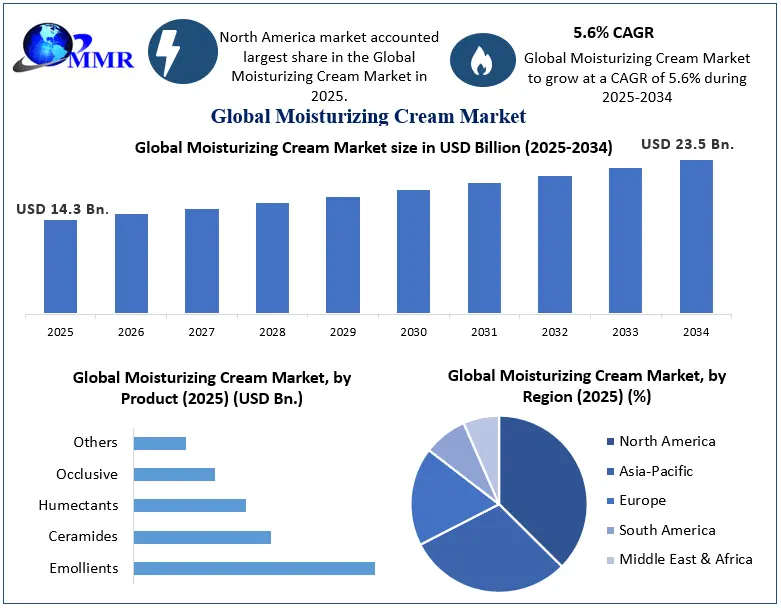
The Global Moisturizing Cream Market size was valued at USD 14.3 Billion in 2025 and the total Moisturizing Cream revenue is expected to grow at a CAGR of 5.6% from 2026 to 2034, reaching USD 23.5 Billion by 2034.
Moisturizing Cream Market Overview:
A moisturiser is a personal care product that is applied to the skin to moisturise it and give it a healthy appearance and sheen. This personal care product comes in two varieties: creams and lotions. Ceramides, humectants, emollients, and occlusives are known to be found in moisturising creams and lotions, and they tend to seal water in the skin's outer layer. Also, moisturising creams offer a wide range of uses, including skin care, tissue repair, anti-aging, and more.
The market includes facial and body moisturizing creams designed for daily hydration as well as products formulated for specific skin concerns such as dry, sensitive, rough, and mature skin. Products include mass-market, premium, natural, organic, and dermatologically positioned moisturizing creams sold through offline and online retail channels.
In 2025, 74% of global consumers used moisturizers daily, citing skin hydration, anti-aging, and barrier protection as top motivations.
Global Moisturizing Cream Market – Key Highlights
• Market Size: The global moisturizing cream market size is USD 14.3 billion in 2025.
• Market Forecast: Market revenue is projected to reach approximately USD 23.5 billion by 2034.
• Market Growth: The market registers a 5.6% CAGR during 2025–2034.
• Regional Demand: North America and Europe have strong demand for premium and specialized skincare, while Asia-Pacific represents a major growth market due to rising disposable income, expanding beauty markets, and increasing consumer awareness of skincare.
• Product Type: Emollients represent the largest product-type segment.
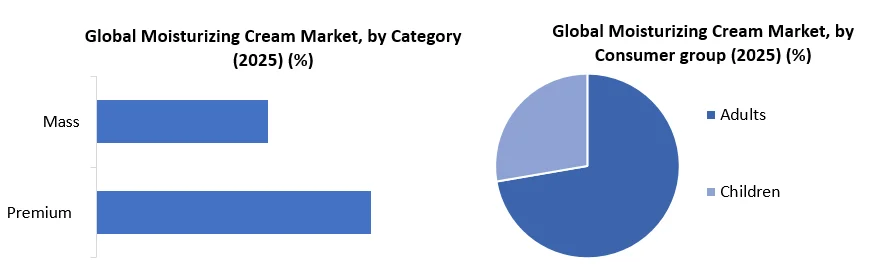
• Category: Premium moisturizing creams lead the category, while mass-market products continue to benefit from affordability and broad distribution.
Global Moisturizing Cream Market Size, Growth and Share Analysis
To know about the Research Methodology :- Request Free Sample Report
Moisturizing Cream Market Dynamics:
The global market for moisturising cream as a possible skin care product is being driven by rising skin concerns among consumers and the developing beauty and personal care industry. Various brands in the industry are concentrating their research and development efforts in order to launch new and creative moisturisers for a variety of skin issues. This encourages more people to invest in items that assist them maintain their skin's health. Growth in demand for creative products is also being driven by changing trends in the burgeoning beauty industry. As a result of these reasons, the moisturising cream market is likely to rise at a faster rate over the forecast period.
Moisturizing Cream Market Drivers
• Increasing Consumer Awareness and Anti-Aging Demand: Growing awareness of skin hydration, barrier protection, and overall skin health increases demand for moisturizing creams. Rising interest in youthful-looking skin also supports multifunctional products containing ingredients such as hyaluronic acid, peptides, ceramides, retinol, and antioxidants.
• E-commerce, Formulation Innovation, and Social Media: The expansion of e-commerce improves product accessibility and allows consumers to compare products, prices, ingredients, and reviews. At the same time, advances in formulation technology and the influence of social media and beauty influencers support product innovation, brand visibility, and consumer adoption.
Moisturizing Cream Market Restraints
• Market Saturation and Price Competition: High competition from established brands, local manufacturers, and low-cost alternatives creates pricing pressure and limits profit margins. Market saturation in developed regions also makes customer acquisition and new brand entry more challenging.
• Consumer Concerns and Ingredient Sensitivity: Growing concerns about synthetic ingredients, allergens, and potential skin reactions can reduce consumer trust in certain formulations. This encourages some consumers to shift toward natural, organic, and minimalist skincare products, creating challenges for conventional moisturizing cream brands.
Moisturizing Cream Market Opportunities
• Expansion in Emerging Markets: Rising disposable income, urbanization, and growing skincare awareness create opportunities for premium and specialized moisturizing creams in emerging markets. Asia-Pacific and Latin America offer strong potential as consumers increasingly adopt advanced skincare routines and explore natural and premium formulations.
Moisturizing Cream Market Challenges
• Regulatory Compliance and Rising Production Costs: Varying international regulations on cosmetic ingredients, safety testing, and labeling increase compliance costs and extend product development timelines. Smaller brands face greater difficulty absorbing testing, reformulation, and certification expenses, which limits innovation and market entry.
• Product Development Complexity and Competitive Pressure: Developing moisturizing creams for different skin types, climates, and specific skin concerns requires extensive formulation expertise and testing. Strong competition from serums, lotions, facial oils, and multifunctional skincare products increases pricing pressure and makes product differentiation more challenging.
Moisturizing Cream Market Trend
Several moisturizing cream market trends influence product development, consumer behavior, and competitive strategies.
• Growing Demand for Skin Barrier Repair: Increasing awareness of the skin barrier encourages consumers to seek moisturizers containing ceramides, hyaluronic acid, niacinamide, peptides, emollients, and other skin barrier ingredients. An increased focus on overall skin health is driving a high demand for dermatologist-recommended, fragrance-free moisturizers tailored for sensitive skin and barrier repair.
• Natural and Clean Beauty Products: The growing preference for natural moisturizing cream, organic moisturiser, plant-based moisturizer, vegan moisturizer, and clean-label moisturizer influences product innovation. Consumers increasingly examine ingredients, product sourcing, environmental impact, packaging, and ethical practices when purchasing skincare products.
• Premium and Multifunctional Skincare: Premium consumers increasingly seek advanced moisturizing cream formulations that provide multiple benefits, including hydration, anti-aging, brightening, skin protection, and barrier support. This trend supports demand for premium moisturizing cream, clinical skincare products, science-backed moisturizers, and multifunctional skincare products.
• E-Commerce and Online Skincare Sales: The expansion of e-commerce is transforming the online moisturizing cream market. Consumers compare ingredients, prices, product reviews, claims, and formulations across multiple platforms. The growth of online skincare, skincare e-commerce, direct-to-consumer moisturizer brands, and online beauty retail creates additional market opportunities.
• Personalized and AI-Powered Skincare: Technology plays an increasingly important role in skincare. Brands explore AI skincare personalization, AI skincare diagnostics, personalized moisturizer recommendations, and customized skincare solutions.
These technologies enable companies to provide more targeted product recommendations based on skin type, environmental conditions, and consumer preferences.
Moisturizing Cream Market Segmentation:
The Moisturizing Cream market is segmented into Product Type, Category, Consumer Group.
Based on the Product Type segment: The Moisturizing Cream market is further sub-segmented into Emollients, ceramides, occlusive, humectants, and others. Among these, the emollients section has the largest revenue share in the global market than other segments, and it is expected to grow at the fastest rate throughout the forecast period (2026-2034). Thanks to the increase in the demand for Emollients from soap and other personal care industries. Also, Emollient manufacturers are developing integrated solutions that use emollients for multifunctional qualities, which are expected to drive significant growth in the emollient industry.
In terms of the Consumer Group segment: The Moisturizing Cream market is further sub-segmented into adults and children. Based on the Category segment: The premium category leads the moisturizing cream market, supported by strong demand for branded, dermatologically tested, and anti-aging formulations. Consumers in developed regions prefer premium creams offering superior efficacy, innovative textures, and clean ingredients. However, the mass segment is rapidly growing, driven by affordability and expanding distribution across supermarkets and e-commerce channels.
Based on the Consumer Group segment: Adults hold the largest market share, supported by regular demand for hydration, skin protection, and anti-aging care. Meanwhile, the children’s segment is expanding rapidly due to heightened parental awareness of skin sensitivity and safety. Manufacturers expand child-focused product ranges to meet growing demand for mild and dermatologist-tested moisturizers.
Global Moisturizing Cream Market Regional Insights:
North America Moisturizing Cream Market: North America holds the largest share of the global moisturizing cream market, accounting for XX% of revenue in 2025. The region benefits from strong consumer awareness of skincare, widespread use of premium and dermatologist-recommended products, and increasing demand for moisturizers that address dryness, signs of aging, and sensitive skin. Well-established daily skincare habits, high disposable incomes, and the strong presence of leading skincare brands continue to reinforce North America’s market position.
Asia-Pacific Moisturizing Cream Market: Asia-Pacific represents the fastest-growing regional market. Rapid urbanization, rising disposable incomes, an expanding middle-class population, and growing awareness of structured skincare routines are driving demand across China, Japan, India, South Korea, and Southeast Asia.
Consumers increasingly seek products that provide hydration, skin brightening, sun protection, and anti-aging benefits. The global popularity of K-beauty and J-beauty continues to influence consumer preferences and product innovation. At the same time, expanding e-commerce platforms, increasing local production, and the availability of affordable skincare products are making moisturizing creams more accessible across both metropolitan and emerging markets.
Europe Moisturizing Cream Market Insights: In 2025, Europe’s moisturizing cream market benefits from a long-standing skincare culture and the dominance of established cosmetic houses. Consumers emphasize product safety, efficacy, and clean ingredient lists. Growing adoption of vegan, cruelty-free, and dermatologically tested products supports demand. Regulatory consistency across the EU ensures high product quality. Innovation in anti-aging and sensitive-skin formulations propels further growth.
South America Moisturizing Cream Market: The South American market benefits from increasing skincare awareness, expanding beauty retail, rising disposable incomes, and growing e-commerce adoption. Brazil represents a particularly important market for skincare and personal care products, supported by a large consumer base and established beauty culture.
Middle East and Africa Moisturizing Cream Market: The Middle East and Africa moisturizing cream market benefits from rising personal care expenditure, increasing premium skincare demand, expanding modern retail, and growing online beauty sales. The UAE, Saudi Arabia, South Africa, Egypt, and GCC countries represent important opportunities for manufacturers.
The objective of the report is to present a comprehensive analysis of the global Moisturizing Cream to the stakeholders in the industry. The past and current status of the industry with the forecasted market size and trends are presented in the report with the analysis of complicated data in simple language. The report covers all the aspects of the industry with a dedicated study of key players that include market leaders, followers, and new entrants.
PORTER, PESTEL analysis with the potential impact of micro-economic factors of the market has been presented in the report. External as well as internal factors that are supposed to affect the business positively or negatively have been analyzed, which will give a clear futuristic view of the industry to the decision-makers.
The report also helps in understanding the Moisturizing Cream dynamics, structure by analyzing the market segments and project the Moisturizing Cream size. Clear representation of competitive analysis of key players by product, price, financial position, product portfolio, growth strategies, and regional presence in the global Moisturizing Cream make the report investor’s guide.
Moisturizing Cream Market Competitive Landscape:
| Company | Key Brands | Competitive Position & Key Strategies |
|---|---|---|
| L’Oréal | L’Oréal Paris, Vichy, CeraVe |
Maintains a leading position through a broad portfolio of science-backed and dermatologically tested moisturizing products. The company focuses on formulations for diverse skin types and environmental conditions while investing in sustainable packaging, personalized skincare, and AI-enabled diagnostics. |
| Unilever | Dove, Vaseline, Pond’s | Holds a strong market position through extensive global distribution and a focus on affordable, inclusive, and sustainable skincare. The company increasingly incorporates natural ingredients and sustainability-focused practices to strengthen consumer appeal across developed and emerging markets. |
| Procter & Gamble (P&G) | Olay, SK-II |
Remains a major competitor through advanced hydration and anti-aging technologies backed by extensive research and innovation. The company strengthens its position through premium skincare expansion, digital marketing, and personalized consumer experiences. |
| Beiersdorf AG | Nivea, Eucerin, La Prairie | Maintains a significant presence across mass-market and premium skincare segments. The company emphasizes skin health, clinical validation, scientific innovation, sustainability, and dermatologically tested formulations to build customer loyalty and support global expansion. |
Moisturizing Cream Market Recent Development
• June 25, 2026, CeraVe launches Hydrating HA Water Gel: CeraVe introduces a lightweight facial moisturizer combining hyaluronic acid, three essential ceramides, and its new patent-pending Ceramide Booster Technology. The launch highlights demand for lightweight hydration and skin-barrier support.
• September 1, 2026, SkinMedica introduces Barrier Calming Cream : SkinMedica expands its regenerative skincare portfolio with a cream designed to soothe skin and strengthen the skin barrier. Clinical testing reports a 30% reduction in skin dryness after two weeks, highlighting the growing focus on targeted hydration.
• September 15, 2026: Dot & Key launches Dragon Fruit Bounce Jelly Moisturiser : Indian skincare brand Dot & Key introduces a lightweight jelly moisturizer designed for oily and combination skin. The product emphasizes non-sticky hydration, a fresh finish, and suitability for hot and humid conditions.
• March 17, 2026: Vanicream launches Enhanced Moisturizer : Vanicream expands its product range with a lightweight, full-body moisturizer containing hyaluronic acid, five key ceramides, and glycerin. The launch reflects demand for gentle, long-lasting hydration for sensitive skin.
• January 7, 2026, Olay upgrades Regenerist Micro-Sculpting Cream : Olay updates its anti-aging moisturizer with Triple Collagen Peptide technology, alongside niacinamide and pro-vitamin B5. The reformulation emphasizes skin firmness, elasticity, hydration, and visible improvements in skin texture.
Moisturizing Cream Market Scope: Inquire before buying
| Moisturizing Cream Market | |||
|---|---|---|---|
| Report Coverage | Details | ||
| Base Year: | 2025 | Forecast Period: | 2026-2034 |
| Historical Data: | 2020 to 2025 | Market Size in 2025: | 14.3 USD Billion |
| Forecast Period 2026-2034 CAGR: | 5.6% | Market Size in 2034: | 23.5 USD Billion |
| Segments Covered: | by Product | Emollients Ceramides Occlusive Humectants Others |
|
| by Category | Premium Mass |
||
| by Consumer Group | Adults Children |
||
| by Distribution Channel | Store-Based Non-Store Based |
||
Moisturizing Cream Market, by Region
North America (United States, Canada and Mexico)
Europe (UK, France, Germany, Italy, Spain, Sweden, Austria and Rest of Europe)
Asia Pacific (China, South Korea, Japan, India, Australia, Indonesia, Malaysia, Vietnam, Taiwan, Bangladesh, Pakistan and Rest of APAC)
Middle East and Africa (South Africa, GCC, Egypt, Nigeria and Rest of ME&A)
South America (Brazil, Argentina Rest of South America)
Moisturizing Cream Market, Key Players:
1. Procter & Gamble
2. Shiseido Company, Limited
3. LVMH
4. L'Oréal
5. Coty Inc.
6. Unilever
7. Estée Lauder Companies
8. New Avon Company
9. CHANEL
10. Revlon
11. Giorgio Armani S.p.A.
12. Amway Corp.
13. Johnson & Johnson Services, Inc.
14. Kao Corporation
15. Henkel AG & Co. KGaA
16. L Brands
17. Natura
18. Oriflame Cosmetics AG
19. Babor
20. Lotus Herbals
21. Mary Kay Inc.
22. Nature Republic USA,
23. Clarins
24. Beiersdorf AG
25. Galderma Group AG
26. Colgate-Palmolive Company
27. Reckitt
28. Bioderma
29. CeraVe
30. Cetaphil
31. Eucerin
32. Neutrogena
33. Aveeno
34. La Roche-Posay
35. NIVEA
36. Vaseline
38. Kiehl's
39. First Aid Beauty
40. Weleda
41. Burt's Bees
42. The Body Shop
43. Palmer's
44. Mustela
Frequently Asked Questions:
1. Which region has the largest share in Moisturizing Cream Market?
Ans: North America held the largest share in 2025.
2. What was the Global Moisturizing Cream Market size in 2025?
Ans: The Global Moisturizing Cream Market size was USD 14.3 Billion in 2025.
3. What segments are covered in Moisturizing Cream market?
Ans: Moisturizing Cream Market is segmented into Product Type, Category , Consumer Group, Distribution Channel, and Region.
4. Who are the key players in Moisturizing Cream market?
Ans: The important key players in the Moisturizing Cream Market are - Procter & Gamble, Shiseido Company, Limited, LVMH, L'Oréal, Coty Inc., Unilever, Estée Lauder Companies, New Avon Company, CHANEL, Revlon.
5. What is the study period of this market?
Ans: The Moisturizing Cream Market is studied from 2020 to 2034.