Mine-Site Technology Adoption Market by Component, by Deployment Mode, by Mining Type, by Technology, by Application and Regional Insights 2034

14.5%
CAGR (2026-2034)
16.37 USD Bn.
Forecast Market Size
302
Report Pages
120
Market Tables

Overview

Mine-Site Technology Adoption Market size was valued at USD 16.37 Billion in 2025 and the total Mine-Site Technology Adoption Market is expected to grow at a CAGR of 14.5 % from 2026 to 2034, reaching nearly USD 55.38 Billion.

Mine-Site Technology Adoption Market Overview:

The Mine-site Technology Adoption markets include mining, quarrying, and oil and gas extraction companies. Companies in this sector extract naturally occurring mineral solids, such as coal and metal; liquid minerals, such as crude petroleum; and gases, such as natural gas. The term Mining is used in the broad sense to include quarrying, well operations, beneficiating like crushing, screening, washing, and flotation, and other work performed at a mine site.The sector distinguishes between mine operation and mining support activities.

Mine operation includes operating mines, quarries, or oil and gas wells. Mining support activities include performing exploration or other mining services.Mine-site technology Adoption Markets in the Mining sector are classified according to the natural resource mined or to be mined. Industries include companies that develop the mine site, extract the natural resources and those that prepare the mineral mined. Mining is the second-most important and ancient effort of humanity after agriculture.

The two industries are ranked as the primary industries of early civilization. Mining is the foremost source of mineral commodities, and all countries find it essential for maintaining and improving their standard of living. In recent years, automated mining has gained importance due to better awareness of the application of advanced technology. Previously, mining activities involved a lot of manual work that posed a risk to personnel who were working in a dangerous environment.

A proportion of human resources are required for achieving higher productivity, which involves providing safety equipment and high remuneration that increases the overall production cost. To avoid such high costs and risks to personnel, many companies are implementing automation in their mining processes.The demand for more efficient and economical mining operations is the key driver propelling the growth of the industry.

Mining software solutions are being adopted by governments and mining firms to boost productivity, increase safety and lessen environmental impact. Mining software shines in the optimization of mine design, planning, processing of minerals, safety management, and environmental management for mining firms. To enhancemining operations, these solutions are progressively utilizing cutting-edge technologies like automation, artificial intelligence, and blockchain. By enabling the creation of smart nines the integration of these technologies is anticipated to transform the mining sector.

Mine-Site Technology Adoption Market Size, Growth and Share Analysis
Mine-Site Technology Adoption Market size

To know about the Research Methodology :- Request Free Sample Report

Mine-Site Technology Adoption Market Dynamics:

Mine-Site Technology Adoption Market Drivers:              

Rising Focus on Reducing Operating Cost

Constantly fluctuating commodity prices in recent years have put additional pressure on the profit margins of mining companies. Increasing expenses on exploration activities and the need to carry out non-stop production to meet global energy demands have encouraged mining companies to embrace innovative technologies. To maximize productivity gains, companies are directing their investment towards advanced automation technologies, such as AHS for driverless trucks, automated drilling systems (ADS), and real-time monitoring of assets. By using advanced automation technologies for mining, companies are witnessing a significant fall in their operating costs. Thus, mining companies are focusing on deploying automation to reduce operating costs, which will accelerate market growth over the course of the forecast period.

Reducing Risks to the Health and Safety of Workers       

Some mining operations can take place in extreme environments and distant locations McKinsey and Company. Moving operators to the mine face whether by flying them in, moving them underground, or from shaft to face is time-consuming, expensive, and can be dangerous for workers’ health and safety. Therefore, any technology that can minimize the presence of workers at complex and deep mining operations or remote locations will contribute to improving their safety conditions and hence reduce risks of accidents and lossesa critical concern for mining companies and workers alike.

Mine-Site Technology Adoption Market Restraint:     

High Initial and Maintenance Costs

The high expenses of purchasing and maintaining automated equipment and solutions can hinder market growth. Aside from the high cost, the necessity for more experienced employees to handle automated systems and sufficient training for automotive engineers can increase the overall cost. Furthermore, even after buying automated equipment, many machines require extensive maintenance. Such factors can adversely impact market expansion, which is projected to impede the fog computing market's growth.

Mine-Site Technology Adoption Market Market Opportunity:

Evolution of smart connected mines

Connected mining refers to the application of technology to achieve better productivity and safety as well as reduce operational costs for a mine site. Thus, connected mining, a combination of IT, automation, and instrumentation technologies, is a result of the advancements in the existing technologies present in the mining Deployment. This integrated operations technology makes the process of mine surveying, planning, exploration, extraction, and analysis faster and easier with software providing real-time information, thereby providing a realistic image of the mine environment and the availability of resources.

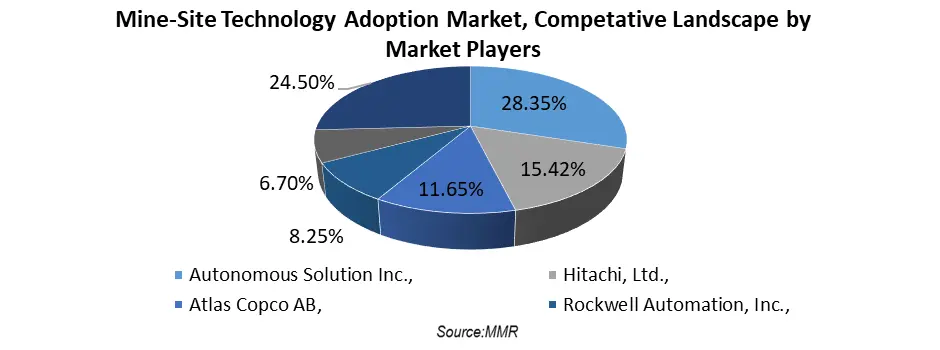
Mine-Site Technology Adoption Market Competitive Landscape:

Smart mining technologies market players are focused on expanding their product portfolios by adding new and advanced services and technologies. Retailers in the market are also focusing on mergers, acquisitions, and collaborations to gain a competitive edge in the market. The Mine-Site Technology Adoption Market included key players  Atlas Copco AB, Autonomous Solution Inc., Caterpillar, Epiroc AB, Hexagon AB, Hitachi, Ltd., Komatsu Ltd., Liebherr Group, MST (Mine Site Technologies), Rio Tinto, Rockwell Automation, Inc., RPM Global Holdings Ltd., Sandvik AB, SANY Group, Siemens and Trimble Inc.

May 23, 2023: Atlas Copco has acquired Maziak Compressor Services Ltd., a UK distributor of air compressors, nitrogen generators, and process cooling equipment as well as related services and support.

May 17, 2023 – Hitachi Astemo, Ltd. ("Hitachi Astemo") has developed an autonomous driving technology that helps to safely and smoothly pass by oncoming vehicles on narrow roads and other situations by utilizing 3D sensing results of the surrounding vehicle environment. Hitachi Astemo aims to strengthen its cost competitiveness through the use of 3D sensing data obtained from new stereo cameras with improved cost benefits.
Mine-Site Technology Adoption Market

Mine-Site Technology Adoption Market Segment Analysis:

By Mining Type, the Surface mining holds the largest market share in the Global Mine-Site Technology Adoption Market. According to MMR analysis, the segment is further expected to grow at a CAGR of 14.6 % during the forecast period. This dominance is primarily driven by the operational accessibility and scalability that surface mining offers, allowing for smoother integration of advanced equipment such as autonomous haul trucks, excavators, and drilling systems. The open environment of surface mines enhances visibility and safety, making it ideal for deploying GPS tracking Device systems, drone-based mapping, and real-time monitoring technologies. In contrast, underground mining operations often face complex conditions such as limited space, higher safety risks, and ventilation requirements, which slow down technology adoption and increase deployment costs.

The market impact of this trend is significant. The high adoption rate of digital and automated technologies in surface mining is accelerating operational efficiency, productivity, and cost reduction for major mining companies. This has also attracted investments in digital mining infrastructure, especially in regions like Australia, South America, and Africa, where large-scale open-pit operations are prevalent. Surface mining is not only shaping the direction of technological innovation but also influencing the strategic decisions of equipment manufacturers, software providers, and mining operators seeking to remain competitive in an increasingly automated mining landscape.

Mine-Site Technology Adoption Market Recent Development

Date Company Development Impact
21 April 2026 Komatsu The company commissioned its 1,000th ultra-class autonomous haul truck, a 930E-5AT electric drive model, deployed at Barrick’s Nevada Gold Mines operation in the United States. This milestone extends the Front Runner Autonomous Haulage System (AHS) footprint into large-scale gold mining, verifying a cumulative volume of over 11.5 billion metric tons moved autonomously worldwide.
28 May 2026 Epiroc The company expanded its Deep Automation portfolio to integrate new dedicated digital solutions for underground drilling and bolting alongside its existing material handling systems. The expansion enables up to 30% faster mine development rates and up to 70% shorter stoping cycles while eliminating dangerous manual interventions at extreme mining depths.
10 June 2026 Caterpillar The company secured a Master Development Agreement with Micro Vision to integrate advanced 3D digital LiDAR and perception technologies into its next-generation autonomous heavy machinery platforms. This collaboration directly safeguards the Cat Command for hauling technology ecosystem following recent asset acquisitions of previous vendor hardware, facilitating obstacle rerouting across mixed-fleet surface mines.
15 June 2026 Sandvik The company secured a major SEK 350 million digitalized equipment order from mining contractor Barminco for deployment at the Bellevue Gold Project in Western Australia. The deployment includes high-grade underground loaders, trucks, and drill rigs designed to ramp up mine production via OEM-agnostic digital mine connectivity and fleet monitoring systems.
03 March 2026 Komatsu The company introduced its Smart Quarry Autonomous system package in North America via a commercial tech partnership with Silicon Valley autonomy pioneer Pronto. The solution provides site managers an affordable retrofittable AI sensor stack that circumvents the need for massive dedicated site infrastructure or localized network control centers.

Mine-Site Technology Adoption Market Regional Analysis:

North America has dominated the Mine site technology Adoption Market segment during the forecast period 2026-2034. North America has been a prominent Application in the mining automation market, exhibiting significant growth and adoption of automation technologies in the mining Deployment. The Application is known for its strong technological capabilities and innovation. The Application is home to several leading automation technology providers, research institutions, and mining companies focused on developing and implementing cutting-edge automation solutions in mining operations.

Moreover, North America has a substantial mining Deployment, encompassing various minerals, including coal, gold, copper, and iron ore. The Application's rich mineral resources and the demand for these minerals drive the need for efficient and productive mining operations, making it an ideal market for automation technologies, and are also expected to fuel market growth in North America over the forecast period.

Mine-Site Technology Adoption Market Scope: Inquire before buying

Mine-Site Technology Adoption Market
Report Coverage Details
Base Year: 2025 Forecast Period: 2026-2034
Historical Data: 2020 to 2025 Market Size in 2025: USD 16.37 Billion
Forecast Period 2026 to 2034 CAGR: 14.5 % Market Size in 2034: USD 55.38 Billion
Segments Covered: by Component Solution
Services
by Deployment Mode Cloud
On-premise
by Mining Type Surface mining
Underground mining
by Technology Mine Management Software
Predictive Maintenance
Drones
Autonomous Vehicles
Collision Avoidance
Others
by Application Exploration
Processing and Refining
Transportation
Others
by End-Use Industry Metal Mining
Coal Mining
Non-Metallic Mineral Mining
Quarrying and Construction Materials
Others

Mine-Site Technology Adoption Market, by Region

North America (United States, Canada and Mexico)
Europe (UK, France, Germany, Italy, Spain, Sweden, Austria and Rest of Europe)
Asia Pacific (China, South Korea, Japan, India, Australia, Indonesia, Malaysia, Vietnam, Taiwan, Bangladesh, Pakistan and Rest of APAC)
Middle East and Africa (South Africa, GCC, Egypt, Nigeria and Rest of ME&A)• South America (Brazil, Argentina Rest of South America)

Mine-Site Technology Adoption Market Key Players:

Key players in the mine-site technology adoption market are major mining technology and equipment providers. These companies are focusing on integrating advanced technologies like automation, real-time analytics, and remote monitoring. Strategies include expanding their technological portfolios, forming strategic partnerships, and pursuing acquisitions to enhance operational safety and efficiency in mining operations.

North America

1. Caterpillar Inc.
2. Autonomous Solutions, Inc. (ASI Mining)
3. Pronto.ai
4. Rockwell Automation, Inc.
5. Trimble Inc.
6. Emerson Electric Co.
7. Honeywell International Inc.
8. Aspen Technology, Inc.
9. Wabtec Corporation (Wabtec Digital Mine)
10. Cisco Systems, Inc.
11. IBM Corporation
12. NVIDIA Corporation
13. Modular Mining Systems (Komatsu Ltd.)
14. Wenco International Mining Systems (Hitachi Construction Machinery Co., Ltd.)
15. MineSense Technologies (Hexagon AB, acquired 2025)
16. Newmont Corporation
17. Freeport-McMoRan Inc.
18. Barrick Mining Corporation (formerly Barrick Gold)

Europe

19. Sandvik AB
20. Epiroc AB
21. AB Volvo (Volvo Group)
22. Scania (TRATON SE)
23. Liebherr Group
24. Hexagon AB
25. ABB Ltd
26. Siemens AG
27. Innomotics (KKR, divested from Siemens AG)
28. Schneider Electric SE
29. SAP SE
30. Dassault Systèmes SE
31. Metso Corporation
32. FLSmidth & Co. A/S
33. Weir Group plc
34. Normet Group Oy
35. Nokia Corporation
36. Telefonaktiebolaget LM Ericsson
37. Glencore plc
38. Anglo American plc
39. Rio Tinto Group

Asia Pacific

40. Komatsu Ltd. (Komatsu Mining Corp.)
41. Hitachi Construction Machinery Co., Ltd. (Hitachi, Ltd.)
42. Remote Control Technologies Pty Ltd (Epiroc AB)
43. Micromine Pty Ltd (Aspen Technology, Inc.)
44. Maptek Pty Ltd
45. Mine Site Technologies (MST)
46. RPM Global Holdings Ltd.
47. Orica Limited
48. Deswik (Sandvik AB)
49. Seequent Limited (Bentley Systems, Incorporated)
50. EACON Mining Technology
51. Huawei Technologies Co., Ltd.
52. XCMG Group
53. SANY Heavy Industry Co., Ltd.
54. BHP Group Limited
55. Fortescue Ltd.
56. Guanghui Energy Co., Ltd.
57. China Shenhua Energy Company Limited (CHN Energy)

Middle East & Africa

58. Gold Fields Limited
59. Sibanye-Stillwater Limited
60. Maaden (Saudi Arabian Mining Company)

South America

61. Codelco (Corporación Nacional del Cobre de Chile)
62. Vale S.A.
Others

Frequently Asked Questions:

1] What segments are covered in the Market report?
Ans. The segments covered in the Mine-Site Technology Adoption Market report are based on Components, Deployment Modes, Mining Types, Technology and Applications.

2] Which Application is expected to hold the highest share in the Market?
Ans. The North America Application is expected to hold the highest share of the Mine-Site Technology Adoption Market.

3] What is the market size of the Market by 2034?
Ans. The market size of the Mine-Site Technology Adoption Market by 2034 is expected to reach USD 55.38 Bn.

4] What is the forecast period for the Market?
Ans. The forecast period for the Mine-Site Technology Adoption Market is 2026-2034.

5] What was the market size of the Market in 2025?
Ans. The market size of the Mine-Site Technology Adoption Market in 2025 was valued at USD 16.37 Bn.

Table of Contents

1. Executive Market Landscape and Industry Overview 1.1. Global Mine-Site Technology Adoption Market Size (Value USD Million), 2025–2034 1.2. Global mine-site technology adoption market structure, ecosystem, stakeholders and value chain 1.3. Evolution of mining technologies across surface and underground mining operations 1.4. Major mining technology providers, equipment manufacturers and digital solution developers 1.5. Integration of automation, connectivity, analytics and intelligent mining systems 1.6. Key industry trends shaping mine-site technology adoption worldwide 1.7. Emerging opportunities driven by productivity, safety and operational modernization 1.8. CAGR Analysis of Global Mine-Site Technology Adoption Market During 2025–2034 2. Mine-Site Technology Adoption Market Dynamics 2.1. Mine-Site Technology Adoption Market Trends 2.2. Mine-Site Technology Adoption Market Dynamics 2.3. Drivers 2.4. Restraints 2.5. Opportunities 2.6. Challenges 2.7. PORTER’s Five Forces Analysis 2.8. PESTLE Analysis 3. Mine-Site Technology Adoption Market Macroeconomic Factors 3.1. Global GDP growth and industrial activity influencing mineral demand and mining investments 3.2. Commodity price fluctuations affecting mining company capital expenditure and technology budgets 3.3. Inflation, interest rates and financing costs influencing mine-site technology investment decisions 3.4. Foreign exchange movements and equipment import costs affecting technology affordability 3.5. Government infrastructure spending, mining policies and resource development investments 3.6. Energy prices, labor costs and supply chain conditions influencing technology adoption 4. Mine-Site Technology Industry Trends & Emerging Adoption Patterns 4.1. Adoption of autonomous and digitally connected mining operations worldwide 4.2. Growing use of AI, predictive analytics and digital twins 4.3. Expansion of remote operations and intelligent mining equipment 4.4. Increasing focus on worker safety and operational productivity 4.5. Electrification, decarbonization and sustainable mining technology adoption 4.6. Emerging technologies, adoption maturity and future investment priorities 5. Mine-Site Technology Categories & Solution Landscape 5.1. Autonomous haulage, drilling and loading technologies across mining operations 5.2. Fleet management, dispatch and equipment monitoring systems 5.3. Industrial Internet of Things, sensors and connected mining equipment 5.4. Artificial intelligence, machine learning and advanced analytics solutions 5.5. Robotics, remote operation and automated inspection technologies 5.6. Integrated mine-site platforms combining operational data and technology systems 6. Mining Automation & Autonomous Equipment Adoption 6.1. Autonomous haul trucks and driverless transportation systems across mining sites 6.2. Automated drilling rigs and precision drilling technology deployment 6.3. Autonomous loading, excavation and material handling equipment adoption 6.4. Remote-controlled machinery for hazardous and difficult operating environments 6.5. Human-operated, semi-autonomous and fully autonomous equipment deployment models 6.6. Automation readiness, implementation barriers and mine-site scaling opportunities 7. Mine-Site Digitalization, Connectivity & Industrial IoT 7.1. Connected mining equipment and real-time operational data collection technologies 7.2. Private wireless networks, Wi-Fi and cellular connectivity across mine sites 7.3. Industrial IoT sensors for equipment, environmental and process monitoring 7.4. Edge computing and cloud platforms supporting mining operations 7.5. Digital integration between equipment, control rooms and enterprise systems 7.6. Connectivity challenges across remote, underground and geographically dispersed operations 8. Artificial Intelligence, Analytics & Intelligent Mining 8.1. Artificial intelligence applications across mining operations and equipment management 8.2. Predictive analytics for equipment failure and maintenance planning 8.3. Machine learning applications in drilling, haulage and production optimization 8.4. Computer vision for safety monitoring and operational inspections 8.5. Ore characterization, grade control and processing decision-support technologies 8.6. Generative AI and emerging intelligent mining application opportunities 9. Mine Planning, Digital Twins & Operational Optimization 9.1. Digital mine planning and integrated operational scheduling technologies 9.2. Three-dimensional mine models and digital twin implementation 9.3. Production planning, resource allocation and equipment utilization optimization 9.4. Real-time operational simulation and scenario-based decision support 9.5. Integration of geological, engineering and production information systems 9.6. Digital planning adoption challenges and operational value realization 10. Fleet Management, Dispatch & Equipment Performance Technologies 10.1. Fleet management systems for mining trucks, loaders and support equipment 10.2. Real-time dispatch optimization and haulage route management technologies 10.3. Equipment utilization, availability and productivity monitoring solutions 10.4. Fuel consumption, idle-time and operating cost optimization systems 10.5. Fleet tracking, geofencing and equipment location monitoring technologies 10.6. Integrated fleet performance benchmarking and operational reporting platforms 11. Mine-Site Robotics, Remote Operations & Teleoperation 11.1. Remote-controlled mining equipment for hazardous operating environments 11.2. Robotic inspection systems for machinery, tunnels and mine infrastructure 11.3. Teleoperation technologies for underground and surface mining equipment 11.4. Automated sampling, surveying and repetitive operational task technologies 11.5. Remote operating centers and centralized mining control room models 11.6. Deployment economics, operational limitations and emerging robotics applications 12. Mine-Site Safety, Worker Monitoring & Risk Management Technologies 12.1. Proximity detection and collision avoidance systems for mining equipment 12.2. Wearable devices and connected worker safety monitoring technologies 12.3. Personnel tracking and underground worker localization systems 12.4. Computer vision and automated hazard detection applications 12.5. Environmental monitoring for gas, dust, ventilation and hazardous conditions 12.6. Emergency response, incident prevention and digital safety management platforms 13. Mine Surveying, Geospatial & Geological Technologies 13.1. Drone-based surveying and aerial mine-site mapping technologies 13.2. LiDAR, GPS and high-precision positioning solutions for mining operations 13.3. Geological modeling and digital exploration data integration 13.4. Photogrammetry and three-dimensional terrain measurement applications 13.5. Real-time geospatial monitoring of pits, slopes and mine infrastructure 13.6. Surveying automation, data accuracy and deployment trends 14. Underground Mining Technology Adoption 14.1. Underground communication and personnel tracking technology deployment 14.2. Automated drilling, loading and material transportation equipment adoption 14.3. Ventilation monitoring and intelligent underground environmental control systems 14.4. Remote operation technologies for confined and hazardous mining areas 14.5. Underground equipment electrification and battery-powered machinery adoption 14.6. Digital integration challenges across underground mining environments 15. Surface Mining Technology Adoption 15.1. Autonomous haulage and large-scale surface fleet automation technologies 15.2. Precision drilling, blasting and excavation optimization systems 15.3. Drone surveying, terrain mapping and pit monitoring applications 15.4. Real-time dispatch and material movement tracking technologies 15.5. Slope stability monitoring and surface mine safety systems 15.6. Integrated surface mining platforms and productivity improvement opportunities 16. Mine-Site Technology Costs, Economics & Return on Investment 16.1. Mine-site technology pricing trends across major solution categories 16.2. Hardware, software, connectivity and implementation cost structures 16.3. Integration, training, maintenance and change-management expenditure requirements 16.4. Productivity improvements, downtime reduction and operating cost savings 16.5. Return on investment, payback periods and total cost of ownership 16.6. Technology affordability and investment prioritization across mine operators 17. Mine-Site Technology Integration & Implementation 17.1. Technology deployment models across new and operating mine sites 17.2. Integration of legacy equipment with modern digital mining platforms 17.3. Implementation timelines, commissioning requirements and operational transition planning 17.4. Interoperability across equipment manufacturers, software and communication systems 17.5. Workforce training, organizational readiness and technology adoption management 17.6. Deployment risks, scalability considerations and implementation best practices 18. Mine-Site Equipment Maintenance & Asset Lifecycle Management 18.1. Predictive and condition-based maintenance technology adoption across mining equipment 18.2. Remote diagnostics and real-time equipment health monitoring solutions 18.3. Digital maintenance planning, work orders and spare parts management 18.4. Asset reliability, equipment availability and lifecycle performance optimization 18.5. Maintenance automation and service delivery model developments 18.6. Retrofit, upgrade and technology replacement opportunities across installed equipment 19. Mine-Site Energy Management & Electrification Technologies 19.1. Energy monitoring and optimization across mining operations and equipment 19.2. Battery-electric mining vehicles and electrified equipment adoption trends 19.3. Charging infrastructure and energy management requirements for electric fleets 19.4. Renewable energy integration and mine-site power management technologies 19.5. Fuel efficiency, emissions monitoring and energy consumption optimization 19.6. Electrification economics, infrastructure challenges and future deployment opportunities 20. Mine-Site Environmental Monitoring & Sustainability Technologies 20.1. Real-time air quality, dust and emissions monitoring technologies 20.2. Water usage, wastewater and mine-site environmental monitoring systems 20.3. Tailings, waste management and environmental risk monitoring solutions 20.4. Energy efficiency and greenhouse gas reduction technology applications 20.5. Biodiversity, land rehabilitation and environmental compliance monitoring technologies 20.6. Digital sustainability reporting and responsible mining technology adoption 21. Mine-Site Cybersecurity & Operational Technology Resilience 21.1. Cybersecurity risks across connected mining equipment and digital platforms 21.2. Operational technology and information technology integration security requirements 21.3. Industrial control systems and remote operations protection technologies 21.4. Data privacy, access control and network security management 21.5. Cybersecurity standards, incident response and business continuity planning 21.6. Secure deployment of autonomous and connected mining technologies 22. Mine-Site Technology Adoption Barriers & Change Management 22.1. Capital expenditure constraints and investment prioritization across mining companies 22.2. Legacy infrastructure, interoperability and technology standardization challenges 22.3. Skills shortages and digital capability gaps among mining workforces 22.4. Workforce acceptance, training requirements and organizational change management 22.5. Connectivity limitations and implementation challenges at remote mine sites 22.6. Adoption maturity, scaling strategies and long-term technology integration requirements 23. Mine-Site Technology Adoption by Mining Commodity 23.1. Technology adoption across copper, iron ore and other base metal mines 23.2. Gold, silver and precious metal mining technology requirements 23.3. Coal mining automation, safety and operational monitoring technologies 23.4. Lithium, nickel, cobalt and battery mineral mining technologies 23.5. Uranium, phosphate and industrial mineral mining applications 23.6. Commodity-specific operational requirements influencing technology selection and investment 24. Mine-Site Technology Adoption by Mining Company & Site Type 24.1. Large diversified mining companies and enterprise-wide technology deployment strategies 24.2. Mid-sized mining operators and targeted digital modernization investments 24.3. Junior mining companies and technology adoption under capital constraints 24.4. Greenfield mine developments and digitally enabled site design 24.5. Brownfield mines and technology retrofits across existing operations 24.6. Contract miners and technology adoption across outsourced mining services 25. Mine-Site Technology Adoption Regional & Country-Level Landscape 25.1. North American mining technology adoption trends and investment opportunities 25.2. European mining innovation, automation and environmental technology developments 25.3. Asia-Pacific mining digitalization and equipment modernization requirements 25.4. Latin American adoption across copper, lithium and iron ore operations 25.5. African mine-site technology investments and operational connectivity challenges 25.6. Australia, Chile, Canada, the United States and major mining markets 26. Mine-Site Technology Adoption Investment Trends 26.1. Historical and forecast mine-site technology investment trends worldwide 26.2. Adoption of autonomous, connected and AI-enabled mining solutions 26.3. Emerging technologies attracting mining company investment and strategic partnerships 26.4. Greenfield deployment, brownfield upgrades and mine modernization opportunities 27. Mine-Site Technology Adoption Market: Market Size and Forecast by Segmentation (Value USD Million) (2025–2034) 27.1. Mine-Site Technology Adoption Market Size and Forecast, By Component 27.1.1. Solution 27.1.2. Services 27.2. Mine-Site Technology Adoption Market Size and Forecast, By Deployment Mode 27.2.1. On-Premise 27.2.2. Cloud 27.3. Mine-Site Technology Adoption Market Size and Forecast, By Mining Type 27.3.1. Surface Mining 27.3.2. Underground Mining 27.4. Mine-Site Technology Adoption Market Size and Forecast, By Technology 27.4.1. Mine Management Software 27.4.2. Predictive Maintenance 27.4.3. Drones 27.4.4. Autonomous Vehicles 27.4.5. Collision Avoidance 27.4.6. Others 27.5. Mine-Site Technology Adoption Market Size and Forecast, By Application 27.5.1. Exploration 27.5.2. Processing and Refining 27.5.3. Transportation 27.5.4. Others 27.6. Mine-Site Technology Adoption Market Size and Forecast, By End-Use Industry 27.6.1. Metal Mining 27.6.2. Coal Mining 27.6.3. Non-Metallic Mineral Mining 27.6.4. Quarrying and Construction Materials 27.6.5. Others 27.7. Mine-Site Technology Adoption Market Size and Forecast, By Region 27.7.1. North America 27.7.1.1. United States 27.7.1.2. Canada 27.7.1.3. Mexico 27.7.2. Europe 27.7.2.1. Germany 27.7.2.2. Italy 27.7.2.3. United Kingdom 27.7.2.4. France 27.7.2.5. Netherlands 27.7.2.6. Norway 27.7.2.7. Denmark 27.7.2.8. Sweden 27.7.2.9. Finland 27.7.2.10. Spain 27.7.2.11. Poland 27.7.2.12. Switzerland 27.7.2.13. Russia 27.7.2.14. Rest of Europe 27.7.3. Asia Pacific 27.7.3.1. China 27.7.3.2. Japan 27.7.3.3. South Korea 27.7.3.4. India 27.7.3.5. Australia 27.7.3.6. Singapore 27.7.3.7. Indonesia 27.7.3.8. Malaysia 27.7.3.9. Thailand 27.7.3.10. Vietnam 27.7.3.11. Taiwan 27.7.3.12. Philippines 27.7.3.13. Rest of Asia Pacific 27.7.4. Middle East and Africa 27.7.4.1. Saudi Arabia 27.7.4.2. UAE 27.7.4.3. Turkey 27.7.4.4. South Africa 27.7.4.5. Qatar 27.7.4.6. Egypt 27.7.4.7. Oman 27.7.4.8. Rest of Middle East & Africa 27.7.5. South America 27.7.5.1. Brazil 27.7.5.2. Argentina 27.7.5.3. Chile 27.7.5.4. Colombia 27.7.5.5. Rest of South America 27.8. Note: Segment-wise market size estimates for all regions and countries will follow the same structure throughout the final report. 28. Competitive Landscape 28.1. MMR Competition Matrix 28.2. Competitive Positioning of Leading Key Players [Revenue and Market Share (%)] 28.3. Key Players Benchmarking 28.3.1. Company Name 28.3.2. Headquarter 28.3.3. Product Portfolio 28.3.4. Technology Integration 28.3.5. Supply Chain Strength 28.3.6. Customer Base 28.3.7. Total Company Revenue (2025) 28.3.8. Mine-Site Technology Adoption Revenue (2025) 28.3.9. Certifications 28.3.10. Geographic Presence 28.4. Market Structure 28.4.1. Market Leaders 28.4.2. Market Followers 28.4.3. Emerging Players 28.5. Growth Rate/Y-o-Y (%) of Companies 28.6. Profit Margin (%) of Companies 28.7. R&D Investments (%) of Companies 28.8. Revenue Vs Net Earnings – Financial Health Benchmarking (2025) 28.9. Revenue Performance and Financial Analysis (2025) 28.10. Mergers and Acquisitions Details 28.11. Recent Key Developments 29. Mining Equipment & Automation Technology Competitive Landscape 29.1. Autonomous haulage and mining equipment technology provider comparison 29.2. Automated drilling, loading and material handling solution providers 29.3. Fleet management, dispatch and equipment monitoring platform comparison 29.4. Robotics, teleoperation and remote operation technology providers 29.5. Mining sensors, connectivity and industrial IoT solution providers 29.6. Integrated mining technology ecosystems and interoperability capabilities 30. Mining Software, Analytics & Digital Platform Landscape 30.1. Mine planning, scheduling and digital twin software providers 30.2. Fleet management, dispatch and operational optimization platforms 30.3. Artificial intelligence, analytics and predictive maintenance solution providers 30.4. Worker safety, tracking and environmental monitoring software platforms 30.5. Cloud, edge computing and connected mine-site platform offerings 30.6. Integrated digital mining ecosystems and platform differentiation assessment 31. Mine-Site Technology Provider Strategies & Expansion Plans 31.1. Product portfolio expansion strategies among leading technology providers 31.2. Geographic expansion and localization across major mining markets 31.3. Partnerships with mining operators and equipment manufacturers 31.4. Artificial intelligence, automation and digital platform investment strategies 31.5. Acquisition strategies and technology capability expansion initiatives 31.6. Service-led business models and recurring software revenue opportunities 32. Mine-Site Technology Industry Competitive SWOT Assessment 32.1. Competitive strengths of established mining technology providers 32.2. Technology limitations and deployment capability gaps across competitors 32.3. Emerging market opportunities for automation and digital mining solutions 32.4. Competitive threats from new entrants and alternative technologies 32.5. Pricing pressures, interoperability challenges and customer switching barriers 32.6. Long-term competitive resilience and technology leadership assessment 33. Mining Technology Investments, Partnerships & Product Developments 33.1. Research and development investments in autonomous mining technologies 33.2. New mining software, analytics and connected equipment product launches 33.3. Strategic partnerships between mining operators and technology providers 33.4. Acquisitions supporting digitalization, automation and artificial intelligence capabilities 33.5. Major technology deployment contracts and mine modernization projects 33.6. Emerging collaborations addressing safety, productivity and sustainability priorities 34. Mine-Site Technology Adoption Competitive Outlook 34.1. Emerging competitive trends across mining technology categories 34.2. Technology leadership shifts among established and emerging providers 34.3. Convergence of equipment, software, automation and analytics platforms 34.4. Growth of integrated technology ecosystems and service-based business models 34.5. Competitive opportunities arising from mine electrification and digitalization 34.6. Future positioning of leading mine-site technology providers 35. Company Profiles: 40+ Key Players 35.1. Detailed Company Profile Parameters 35.1.1. Overview 35.1.2. Business Portfolio 35.1.3. Financial Overview 35.1.4. SWOT Analysis 35.1.5. Strategic Analysis 35.1.6. Recent Developments 35.2. North America 35.2.1. Caterpillar Inc. 35.2.2. Autonomous Solutions, Inc. (ASI Mining) 35.2.3. Pronto.ai 35.2.4. Rockwell Automation, Inc. 35.2.5. Trimble Inc. 35.2.6. Emerson Electric Co. 35.2.7. Honeywell International Inc. 35.2.8. Aspen Technology, Inc. 35.2.9. Wabtec Corporation (Wabtec Digital Mine) 35.2.10. Cisco Systems, Inc. 35.2.11. IBM Corporation 35.2.12. NVIDIA Corporation 35.2.13. Modular Mining Systems (Komatsu Ltd.) 35.2.14. Wenco International Mining Systems (Hitachi Construction Machinery Co., Ltd.) 35.2.15. MineSense Technologies (Hexagon AB, acquired 2025) 35.2.16. Newmont Corporation 35.2.17. Freeport-McMoRan Inc. 35.2.18. Barrick Mining Corporation (formerly Barrick Gold) 35.3. Europe 35.3.1. Sandvik AB 35.3.2. Epiroc AB 35.3.3. AB Volvo (Volvo Group) 35.3.4. Scania (TRATON SE) 35.3.5. Liebherr Group 35.3.6. Hexagon AB 35.3.7. ABB Ltd 35.3.8. Siemens AG 35.3.9. Innomotics (KKR, divested from Siemens AG) 35.3.10. Schneider Electric SE 35.3.11. SAP SE 35.3.12. Dassault Systèmes SE 35.3.13. Metso Corporation 35.3.14. FLSmidth & Co. A/S 35.3.15. Weir Group plc 35.3.16. Normet Group Oy 35.3.17. Nokia Corporation 35.3.18. Telefonaktiebolaget LM Ericsson 35.3.19. Glencore plc 35.3.20. Anglo American plc 35.3.21. Rio Tinto Group 35.4. Asia Pacific 35.4.1. Komatsu Ltd. (Komatsu Mining Corp.) 35.4.2. Hitachi Construction Machinery Co., Ltd. (Hitachi, Ltd.) 35.4.3. Remote Control Technologies Pty Ltd (Epiroc AB) 35.4.4. Micromine Pty Ltd (Aspen Technology, Inc.) 35.4.5. Maptek Pty Ltd 35.4.6. Mine Site Technologies (MST) 35.4.7. RPM Global Holdings Ltd. 35.4.8. Orica Limited 35.4.9. Deswik (Sandvik AB) 35.4.10. Seequent Limited (Bentley Systems, Incorporated) 35.4.11. EACON Mining Technology 35.4.12. Huawei Technologies Co., Ltd. 35.4.13. XCMG Group 35.4.14. SANY Heavy Industry Co., Ltd. 35.4.15. BHP Group Limited 35.4.16. Fortescue Ltd. 35.4.17. Guanghui Energy Co., Ltd. 35.4.18. China Shenhua Energy Company Limited (CHN Energy) 35.5. Middle East & Africa 35.5.1. Gold Fields Limited 35.5.2. Sibanye-Stillwater Limited 35.5.3. Maaden (Saudi Arabian Mining Company) 35.6. South America 35.6.1. Codelco (Corporación Nacional del Cobre de Chile) 35.6.2. Vale S.A. 35.7. Others 36. Key Findings 37. Strategic Moves & Industry Outlook 38. Research Methodology

Custom Market Research Services

We Will Customise The Research For You, In Case The Report Listed Above Does Not Meet With Your Requirements