
Global Military Parachute Market by Product Type, by Application, by Components, by End User, by Region, and Forecast 2034
Overview
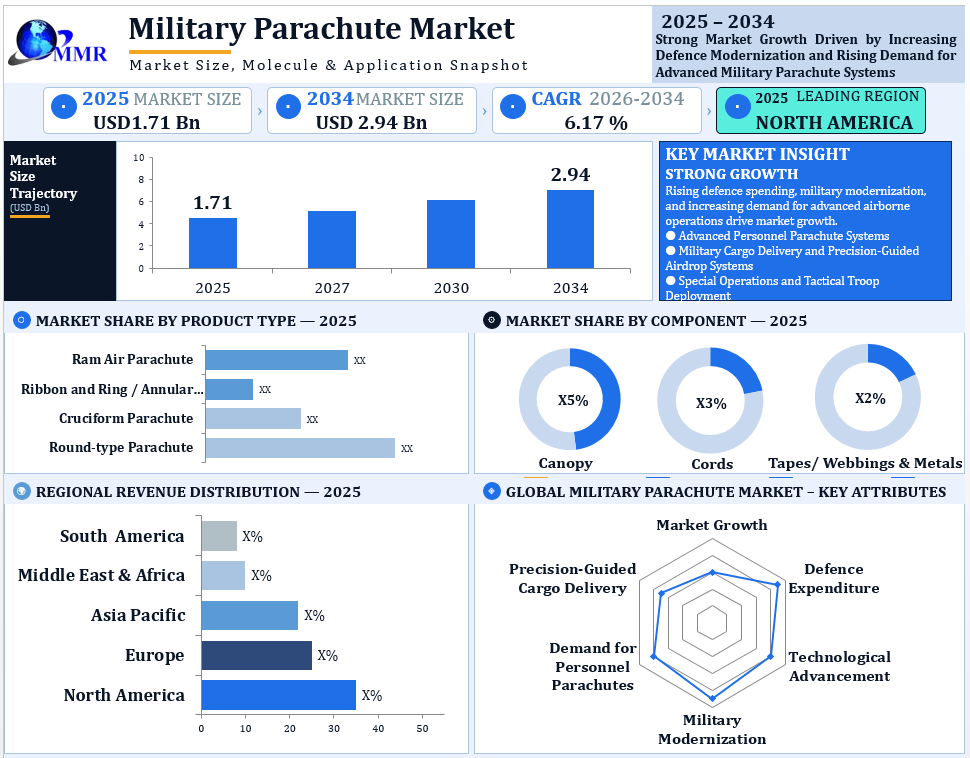
The Global Military Parachute Market is projected to grow at a CAGR of 6.17% from 2026 to 2034, increasing from USD 1.71 billion in 2025 to USD 2.94 billion by 2034.
A parachute is a tool that uses drag to slow down an object's speed as it falls through the air. It comprises of a canopy made of fabric from which the subject or object is hung. The parachute pilot can fly under a structured "wing" made by the parachute as it overcomes air resistance by shoving air in front of it. Militaries have employed military parachutes to transport troops and supplies into battle. Large military planes frequently use parachutes to drop supplies and cargo over distant military locations. In general, the military uses a variety of parachutes, including square parachutes, ram-air parachutes, and round parachutes.
With the defense industry being the primary end-use industry in the market, it is expected that the majority of the sales of military parachutes would be driven by their use in a range of military activities. Additionally, there has been an increase in the use of UAVs for ISR operations, which has been made possible by the growing use of parachutes in processes like recreation. Future growth in military parachute sales is also expected to be fueled by an increase in international conflicts. Technical innovations like the use of lightweight material, followed by the incorporation of GPS systems, drogue chutes, and recovery parachutes, are expected to assist the military parachute market growth across the globe.
Military Parachute Market Growth and Share Analysis
To know about the Research Methodology :- Request Free Sample Report
Key Highlights of the Military Parachute Market
- Steady Market Growth: The global Military Parachute Market is projected to grow at a CAGR of 6.17% from 2025 to 2034, increasing from USD 1.71 billion in 2025 to USD 2.94 billion by 2034.
- Defence Modernization Drives Demand: Increasing military applications, geopolitical tensions, and investments in airborne capabilities support demand for advanced personnel parachutes, cargo delivery systems, and specialized military parachute technologies.
- North America Leads the Market: North America is the leading region due to high defence expenditure, established military parachute manufacturers, and continuous investments in airborne operations and military modernization.
- Technological Advancements Create Opportunities: Lightweight materials, GPS-enabled guidance, steerable parachutes, and precision-guided airdrop technologies create opportunities to improve delivery accuracy, operational reliability, and UAV recovery capabilities.
- Product Innovation Shapes Competition: Leading companies, including Airborne Systems, Safran SA, Mills Manufacturing Corporation, BAE Systems plc, and IrvinGQ, focus on product reliability, advanced canopy designs, manufacturing capabilities, and defence procurement partnerships to strengthen their market positions.
Military Parachute Market Dynamics:
Military Parachute Market Drivers
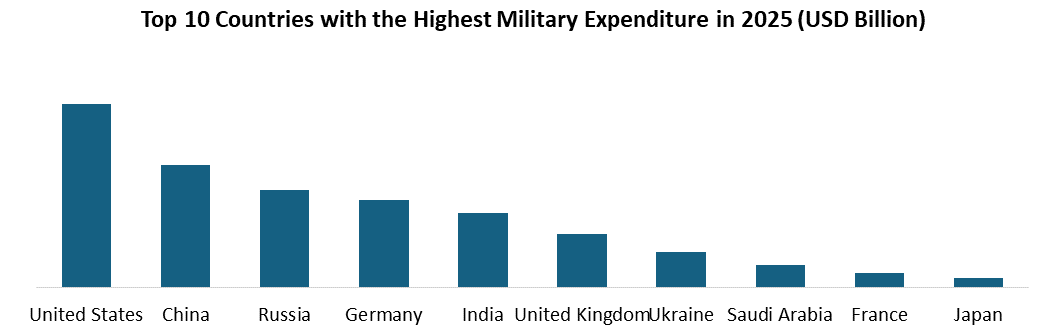
Increasing Military Applications and Defence Modernization to Drive Market Growth: Military parachutes play a crucial role in troop deployment, special operations, emergency evacuation, and the delivery of military equipment and supplies to remote or inaccessible locations. Rising geopolitical tensions, territorial conflicts, and security concerns encourage governments to strengthen airborne capabilities and modernize existing parachute systems. Military forces increasingly require reliable personnel and cargo parachutes that provide improved deployment accuracy, load-bearing capacity, and operational safety. For example, in March 2025, the U.S. Army awarded Airborne Systems North America a contract valued at USD 11.38 million for the production of T-11 personnel parachutes. Furthermore, advancements in lightweight materials, canopy design, and deployment mechanisms improve system reliability and performance. These factors support the adoption of advanced parachute systems and contribute to market growth.
Military Parachute Market Restraints
High Manufacturing Costs and Maintenance Requirements to Restrain Market Growth: Military parachutes require specialized fabrics, durable suspension lines, advanced harnesses, and reliable deployment mechanisms to meet military performance and safety requirements. The costs associated with research, development, manufacturing, and testing can increase the overall price of advanced parachute systems. Additionally, regular inspection, repacking, maintenance, repair, and certification increase lifecycle expenses. These financial requirements can limit procurement among countries with restricted defence budgets and delay the replacement of ageing equipment. Smaller manufacturers may also face difficulties entering the market because of the investment required to develop and qualify military-grade parachutes.
Military Parachute Market Challenges
Stringent Safety Standards and Lengthy Procurement Procedures to Challenge Market Growth: Military parachutes must comply with strict performance, durability, and reliability requirements before being approved for operational use. Manufacturers conduct extensive testing to evaluate canopy strength, deployment reliability, load-bearing capacity, and performance under different environmental conditions. These procedures increase development costs and may extend product qualification timelines. In addition, military procurement processes often involve technical evaluations, competitive bidding, and multiple approval stages. Delays in contract awards and product certification can affect manufacturing schedules and the introduction of new technologies, creating challenges for market participants.
Military Parachute Market Opportunities
Growing Demand for Precision-Guided Parachutes and UAV Recovery Systems to Create Opportunities: The increasing demand for precision-guided cargo delivery and unmanned aerial vehicle (UAV) technologies creates opportunities for military parachute manufacturers. Steerable parachutes and GPS-enabled guidance systems improve the accuracy of personnel and equipment delivery to remote or difficult-to-access locations. These technologies can help reduce delivery errors and improve the efficiency of airborne logistics. Furthermore, parachute recovery systems support the controlled recovery of selected UAV platforms, reducing the risk of damage during landing. Continued development of lightweight, compact, and reliable parachute systems for unmanned platforms and specialized military operations creates additional opportunities for manufacturers.
Military Parachute Market Segment Analysis:
By Product Type, The Military Parachute Market is segmented into round-type parachutes, cruciform parachutes, ribbon and ring/annular parachutes, and ram-air parachutes. Round-type parachutes are widely used for military personnel deployment and cargo delivery due to their reliable descent characteristics and simple design. Cruciform parachutes offer stable descent and controlled deployment, making them suitable for personnel and specialized military applications. Ribbon and ring/annular parachutes support high-speed deployment and specialized aerial applications through their distinctive canopy designs. Ram-air parachutes provide improved steering and maneuverability, making them suitable for precision landing, special operations, and guided military cargo delivery. Increasing demand for reliable airborne systems, accurate airdrop capabilities, and advanced parachute technologies supports development across these product segments.
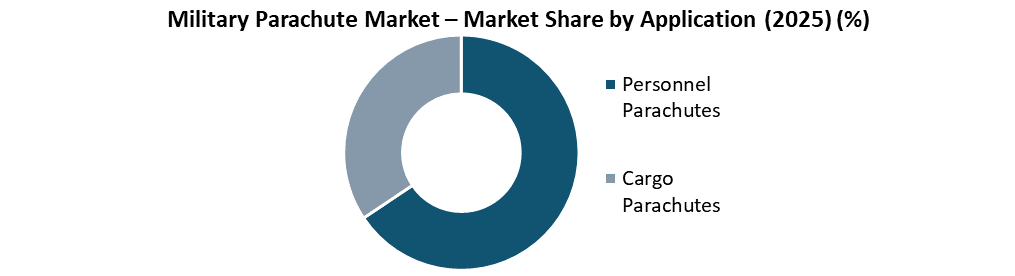
By Application, The Military Parachute Market is segmented by application into personnel parachutes and cargo parachutes. Personnel parachutes account for a significant share of the market due to their extensive use in troop deployment, airborne training, and special military operations. Cargo parachutes support the controlled delivery of military equipment, ammunition, food, and other essential supplies to remote or inaccessible locations. Increasing investments in airborne capabilities, military modernization, and efficient aerial delivery systems support demand across both application segments.
Military Parachute Market Regional Insights:
North America is the leading region of the global military parachute market due to high defence expenditure, advanced military infrastructure, and the presence of established military parachute manufacturers. The United States represents a major contributor to regional demand through continuous investments in airborne forces, special operations, tactical deployment, and military logistics. The increasing need for reliable personnel parachutes and military cargo parachutes supports the adoption of advanced parachute systems across defence operations. Furthermore, ongoing military modernization programs and government procurement initiatives encourage manufacturers to develop lightweight, durable, and high-performance parachute systems. Technological advancements in canopy design, deployment mechanisms, and precision-guided airdrop systems improve operational efficiency and delivery accuracy. The strong focus on troop readiness, specialized military training, and rapid equipment deployment continues to strengthen North America's position in the global military parachute market.
Europe holds a significant share of the military parachute market, supported by increasing defence expenditure, military modernization initiatives, and cooperation among NATO member countries. Countries such as Germany, France, and the United Kingdom invest in advanced airborne systems, personnel parachutes, and military cargo delivery solutions to strengthen their defence capabilities. The growing emphasis on operational readiness and the replacement of ageing military equipment supports demand for modern parachute systems.
European defence forces require reliable military parachutes for troop deployment, special operations, airborne training, and the transportation of essential supplies. Manufacturers focus on improving parachute durability, load-bearing capacity, deployment reliability, and landing precision to meet evolving military requirements. In addition, investments in advanced materials and precision-guided airdrop technologies support product innovation. These factors contribute to the continued development of the European military parachute market.
Asia Pacific represents a rapidly growing region in the military parachute market, driven by rising defence expenditure, geopolitical tensions, and ongoing military modernization programs. Countries such as China, India, Japan, and South Korea strengthen their airborne capabilities through investments in military personnel parachutes, cargo delivery systems, and specialized airborne equipment. The need to improve troop mobility, tactical deployment, and military logistics supports regional demand for advanced parachute technologies. Furthermore, expanding military training programs and investments in defence infrastructure encourage the procurement of modern parachute systems. Military forces increasingly require parachutes that provide improved reliability, controlled descent, and efficient transportation of personnel and equipment to remote locations. Developments in lightweight fabrics, steerable parachutes, and precision-guided airdrop systems also create opportunities for manufacturers. Increasing attention to defence preparedness and advanced airborne operations supports the growth of the Asia Pacific military parachute market.
The Middle East & Africa military parachute market benefits from defence modernization initiatives, regional security requirements, and investments in military aviation and airborne capabilities. Countries in the Middle East strengthen special operations forces and tactical deployment capabilities to address evolving defence requirements. These activities support demand for military personnel parachutes, tactical parachute systems, and cargo parachutes used to transport essential equipment and supplies. In addition, investments in military training, airborne operations, and specialized defence equipment contribute to the adoption of reliable parachute systems. Military forces require durable parachutes capable of supporting personnel deployment and cargo delivery under different operational and environmental conditions. In Africa, military training programs and gradual improvements in defence infrastructure contribute to regional demand. However, differences in defence budgets, manufacturing capabilities, and procurement priorities influence the pace of market development across the Middle East and Africa.
South America experiences gradual growth in the military parachute market, supported by defence modernization initiatives, airborne training programs, and investments in military aviation capabilities. Countries such as Brazil, Colombia, and Chile focus on strengthening military readiness, improving personnel deployment, and enhancing logistical support for defence operations. These requirements generate demand for military personnel parachutes, cargo parachutes, and specialized systems used in airborne training and tactical missions. Military parachutes support troop mobility, equipment transportation, and the delivery of supplies to remote locations with limited ground access. Defence organizations also require reliable parachute systems for routine training exercises, emergency deployment, and specialized military operations. Manufacturers offering durable, cost-effective, and easy-to-maintain parachute systems can address the requirements of regional defence forces. However, budget constraints, dependence on imported defence equipment, and competing military expenditure priorities influence procurement decisions. Continued investment in military modernization and airborne training supports the long-term development of the South American military parachute market.
Military Parachute Market – Competitive Landscape
The Military Parachute Market features a competitive environment in which manufacturers focus on product innovation, technological advancements, product quality, and strategic defence partnerships to strengthen their market positions. Key players develop advanced military parachute systems for personnel deployment, special operations, military cargo delivery, and precision-guided airdrop applications. The market includes established defence suppliers and specialized manufacturers that compete through product performance, reliability, safety standards, and the ability to meet military procurement requirements. The United States, France, the United Kingdom, Germany, and China represent important countries in the broader military parachute and defence equipment industry, supported by defence modernization, domestic manufacturing capabilities, and investments in airborne operations.
Leading companies, including Airborne Systems, Safran SA, Mills Manufacturing Corporation, BAE Systems plc, and IrvinGQ, focus on developing reliable personnel parachutes, tactical parachute systems, and military cargo delivery solutions. Manufacturers invest in lightweight materials, improved canopy designs, steerable parachutes, and precision-guided airdrop technologies to enhance operational performance. These developments support military requirements for accurate equipment delivery, effective troop deployment, and improved airborne capabilities. The United States supports market demand through substantial defence procurement and advanced airborne operations, while France maintains a strong aerospace and defence industry through companies such as Safran SA.
Furthermore, companies such as SPEKON Company, Butler Parachute Systems Group, Aerodyne Research LLC, FXC Corporation, and Atair Aerospace contribute to market competition through specialized parachute products and customized solutions for different operational requirements. Germany and the United Kingdom support the European military parachute market through established defence industries and military modernization initiatives. Meanwhile, China strengthens its domestic defence manufacturing capabilities through investments in military equipment and airborne technologies. Market participants emphasize research and development, manufacturing efficiency, product durability, and compliance with stringent military safety standards. Government contracts, defence procurement programs, international collaborations, and long-term supply agreements also influence competitive positioning.
The growing demand for advanced military equipment encourages manufacturers to expand their product portfolios and improve parachute system capabilities. In India, defence modernization and domestic manufacturing initiatives support the development of indigenous defence equipment and create opportunities for advanced military parachute systems. Similarly, the United States and European countries maintain demand through investments in airborne forces, specialized military operations, and military logistics. Precision-guided cargo delivery, lightweight parachute materials, enhanced deployment mechanisms, and specialized personnel recovery systems remain important areas of technological development.
Overall, product innovation, operational reliability, technological advancement, and defence procurement partnerships shape competition in the global military parachute market. Manufacturers focus on improving parachute performance, deployment accuracy, load-bearing capacity, and system durability to meet the evolving requirements of armed forces. North America benefits from established defence manufacturers and substantial military investment, while Europe maintains a strong position through its aerospace and defence industry. Asia Pacific, particularly China and India, offers growth opportunities through increasing defence expenditure, domestic manufacturing initiatives, and military modernization programs.
| Competitive Factor | Strategic Importance | Market Impact |
| Product Reliability and Safety | Ensures dependable parachute deployment and operational performance | Influences military procurement and supplier selection |
| Technological Innovation | Supports the development of lightweight, steerable, and precision-guided parachute systems | Encourages product differentiation and modernization |
| Manufacturing Capabilities | Enables consistent production and delivery of military-grade parachutes | Supports large-scale procurement requirements |
| Research and Development | Improves canopy design, deployment mechanisms, and material performance | Strengthens long-term competitiveness |
| Government Contracts | Provides access to military procurement programs | Influences revenue opportunities and supplier relationships |
| Product Customization | Addresses different personnel deployment and cargo delivery requirements | Helps manufacturers serve specialized military applications |
| International Partnerships | Supports technology development and access to new markets | Expands business opportunities and market reach |
| After-Sales Support | Provides maintenance, repair, inspection, and technical assistance | Supports long-term customer relationships |
Military Parachute Market Scope: Inquiry Before Buying
| Military Parachute Market | |||
|---|---|---|---|
| Report Coverage | Details | ||
| Base Year: | 2025 | Forecast Period: | 2026-2034 |
| Historical Data: | 2020 to 2025 | Market Size in 2025: | USD $ 1.71 Bn. |
| Forecast Period 2026 to 2034 CAGR: | 6.17% | Market Size in 2034: | USD $ 2.94 Bn. |
| Segments Covered: | by Product Type | Round-type Parachute Cruciform Parachute Ribbon and ring/ Annular Ram air parachute |
|
| by Application | Personnel Parachutes Cargo Parachutes |
||
| by Components | Canopy Cords Tapes/ Webbings Metal |
||
| by End User | Military Sports Rescue Recovery Break Chutes |
||
Military Parachute Market, by Region
North America (United States, Canada and Mexico)
Europe (UK, France, Germany, Italy, Spain, Sweden, Austria and Rest of Europe)
Asia Pacific (China, South Korea, Japan, India, Australia, Indonesia, Malaysia, Vietnam, Taiwan, Bangladesh, Pakistan and Rest of APAC)
Middle East and Africa (South Africa, GCC, Egypt, Nigeria and Rest of ME&A)
South America (Brazil, Argentina Rest of South America)
Military Parachute Market, Key Players are
1. CIMSA Ingeniería de Sistemas S.A.
2. Cirrus Aircraft
3. Global SDN BHD
4. Mills Manufacturing Corporation
5. Safran SA
6. SPEKON Company
7. VITAL Parachute Inc.
8. Aerodyne Research LLC
9. Airborne Systems Inc.
10. Atair Aerospace Inc.
11. AVIC Hongguang Airborne Equipment Co. Ltd.
12. BAE Systems plc
13. Ballenger International LLC
14. Butler Parachute Systems Group
15. FXC Corporation
16. Magam Safety Ltd.
17. Complete Parachute Solutions
18. Fujikura Parachute Co. Ltd.
19. Parachute Systems
20. TransDigm Group Inc.
21. Precision Aerodynamics Inc.
22. Aerial Delivery Solutions LLC
23. NH Global Sdn. Bhd.
24. Tactical Parachute Delivery Systems Inc.
25. Ozone Paragliders Ltd.
26. IrvinGQ
27. Performance Designs Inc.
28. Saxon Specialty Manufacturing GmbH
29. MarS a.s.
30. Bourdon Forge Co. Inc.
31. Paradigm Parachute & Defense Inc.
32. Kohli Enterprises Pvt. Ltd.
33. YILTEX SKY USA LLC
34. Oriental Weaving & Processing Mill Pvt. Ltd.
35. North American Aerodynamics Inc.
36. SSK Military Industries
37. Pioneer Aerospace
38. Para-Flite
39. National Parachute Industries
40. Strong Enterprises
Frequently Asked Questions:
1. What is the projected size of the global Military Parachute Market in 2025?
Ans. The global Military Parachute Market is projected to reach USD 1.71 billion in 2025.
2. Which region leads the global Military Parachute Market?
Ans. North America leads the global Military Parachute Market, driven by high defence expenditure, advanced military infrastructure, and continuous investments in military modernization and airborne capabilities.
3. What is the growth rate of the Military Parachute Market?
Ans. The Military Parachute Market is projected to grow at a CAGR of 6.17% during the forecast period from 2025 to 2034.
4. Who are the major key players in the global Military Parachute Market?
Ans. The major key players in the global Military Parachute Market include CIMSA Ingeniería, Cirrus Aircraft, Global SDN BHD, Mills Manufacturing, Safran SA, SPEKON Company, AVIC Hongguang Airborne Equipment, BAE Systems plc, Airborne Systems Inc., Atair Aerospace Inc., and Butler Parachute Systems Group.
5. What is the forecast period for the Military Parachute Market?
Ans. The forecast period for the Military Parachute Market is 2025–2034, during which the market is projected to grow at a CAGR of 6.17%, reaching USD 2.94 million by 2034.