
Mexico Processed Snacks Market Size by Product Type, Ingredient Type, Nature and Distribution Channel
Overview
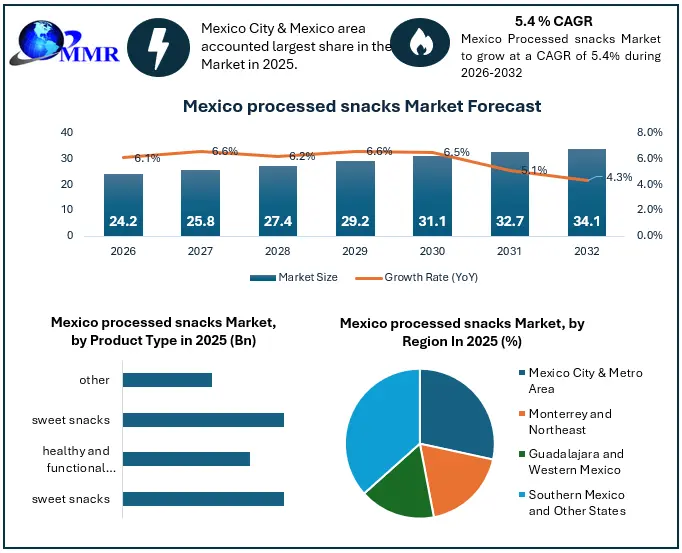
Mexico Processed Snacks Market valued at USD 3.4 Bn in 2025, forecast to reach USD 4.9 Bn by 2032 at 5.4% CAGR. Explore key growth drivers, segments, and investment opportunities.
Mexico processed snacks market Definition
The Mexico Processed Snacks Market comprises packaged, ready-to-eat snack products manufactured through processes such as frying, baking, extrusion, drying, and seasoning. It includes potato chips, corn and tortilla chips, popcorn, extruded snacks, savory biscuits, rice snacks, and vegetable- or pulse-based snacks. Market growth is supported by increasing demand for convenient, portable, and flavourful food products suited to busy lifestyles. Expanding retail availability and product innovation are further improving consumer access to processed snacks. In addition, growing interest in healthier eating is encouraging the development of baked, reduced-fat, lower-sodium, and more natural snack alternatives.
| Parameter | Value |
| Market Size (Base Year 2025) | USD 3.4 Billion |
| Forecast Market Size (2032) | USD 4.9 Billion |
| CAGR (2026–2032) | 5.4% |
| Base Year | 2025 |
| Forecast Period | 2026–2032 |
| Historical Period | 2020–2025 |
| Key Growth Opportunity | Better-for-You & Functional Snack Innovation |
Mexico Processed Snacks Market Growth Outlook
To know about the Research Methodology :- Request Free Sample Report
Mexico Processed Snacks Market Overview
The market was valued at USD 3.4 Billion in 2025 and is projected to reach USD 4.9 Billion by 2032, growing at a CAGR of 5.4% during the forecast period. Key demand drivers include evolving snacking occasions, health-oriented reformulation trends, expanding e-commerce and convenience retail channels, and growing consumer interest in functional and fortified snack formats. Manufacturers are focusing on healthier formulations, reduced sodium and sugar, natural ingredients, portion-controlled packaging, baked products, and plant-based alternatives while maintaining taste and affordability. At the same time, premiumization, sustainable packaging, private-label products, digital retail, and innovative Flavor profiles are creating new growth opportunities. The evolving landscape highlights differences across product categories, consumer preferences, distribution channels, income groups, and regional markets, influencing competition and investment opportunities.
Mexico Processed Snacks Market Historical Size (2020–2025)
| Year | Market Size | Growth Rate (YoY) |
| 2020 | USD 2.4 Bn | 2.8% |
| 2021 | USD 2.6 Bn | 7.4% |
| 2022 | USD 2.8 Bn | 8.0% |
| 2023 | USD 3.0 Bn | 6.9% |
| 2024 | USD 3.2 Bn | 7.0% |
| 2025 | USD 3.4 Bn | 6.0% |
Mexico Processed Snacks Market Key Highlights
| Market Parameter | Value / Insight | Trend |
| Market Size (2025) | USD 3.4 Billion | ↑ Strong Growth |
| Projected Market Size (2032) | USD 4.9 Billion | ↑ Accelerating Expansion |
| CAGR (2026–2032) | 5.4% | ↑ Sustained Growth |
| Dominant Type Segment | Tortilla Chips & Corn-Based Snacks | ↑ 46.2% Share |
| Fastest-Growing Type | Better-for-You & Functional Snacks | ↑ Rapid Adoption |
| Dominant Application | Retail & OXXO Convenience | ↑ 57.8% Share |
| Leading Distribution Channel | Informal & Tianguis Retail | ↑ 34.6% Share |
Mexico Processed Snacks Market Consumer Insights & Demand Analysis
| Consumer Dimension | Key Insights | Market Implication |
| Health Awareness | Growing urban middle-class awareness of obesity and diabetes driving demand for healthier snack options amid Mexico's public health challenges | Nutritional reformulation and better-for-you positioning gaining traction |
| Price Sensitivity | Highly price-conscious mass market with strong demand for affordable and value-format snack products | Single-serve and small-format packaging essential for mass market penetration |
| Demand Patterns | Deeply rooted corn-based snacking culture with tortilla chips, chicharrón, and spicy | Spicy and lime flavors command premium loyalty across all income segments |
Mexico Processed Snacks Market Dynamics
Mexico Processed Snacks Market Drivers
• World's per-capita corn snack consumption leader, supported by deep cultural and culinary integration of corn-based snacks in Mexican diet
• Young demographic pyramid (median age 29) driving strong long-term snack consumption growth momentum
• OXXO convenience store network (22,000+ stores) providing unparalleled single-serve snack distribution across Mexico
Mexico Processed Snacks Market Restraints
• Front-of-Pack (FOP) black warning label regulations (NOM-051) creating significant marketing restrictions and reformulation costs for traditional high-calorie snacks
• High obesity and diabetes prevalence (Mexico ranks globally for obesity rates) driving regulatory scrutiny of processed snack categories
• Currency volatility (MXN) and imported ingredient dependency creating cost and margin pressures
• Informal economy and snack counterfeiting reducing addressable market for formal sector manufacturers
Mexico Processed Snacks Market Opportunities
• Export of authentic Mexican snack formats (tortilla chips, chili-spiced snacks) to the global Hispanic diaspora market (50+ million in USA alone)
• Better-for-you innovation leveraging Mexico's rich traditional ingredient portfolio (chia, amaranth, nopal cactus, pepitas)
• Expansion of premium artisan snack segment in Mexico City and Guadalajara targeting growing affluent consumers
Mexico Processed Snacks Market Challenges
• NOM-051 FOP black warning label requirements restricting marketing and promotional activities for HFSS snack categories
• COFEPRIS (Federal Commission for Protection against Sanitary Risks) advertising restrictions for unhealthy snack marketing targeting children
• Rising domestic security challenges and logistics costs in certain regions affecting distribution efficiency
Mexico Processed Snacks Market Segment Analysis
Mexico Processed Snacks Market by Ingredient Type
The Mexico processed snacks market is segmented into grain-based, fruit-based, protein-based, vegetable-based, dairy-based, and mixed-ingredient snacks. Grain-based snacks, particularly corn and tortilla-based products, hold a strong position due to their cultural relevance and widespread consumption. Fruit- and vegetable-based snacks are gaining popularity as consumers increasingly seek healthier and more natural alternatives. Protein-based snacks benefit from rising interest in nutritious and convenient foods, while dairy-based and mixed-ingredient snacks are expanding through innovative, portable, and value-added product formats.
Mexico Processed Snacks Market by Product Type
The market is divided into savory snacks, sweet snacks, healthy and functional snacks, and other processed snack types. Savory snacks represent the leading category, supported by strong consumer preference for salty, spicy, and intensely flavored products. Healthy and better-for-you snacks are gaining momentum as consumers increasingly seek baked, reduced-fat, natural, and nutritionally enhanced alternatives without compromising taste.
Mexico Processed Snacks Market Regional Analysis
| Region | Market Share | Key Demand Drivers & Trends |
| Mexico City (CDMX) & Metro Area | 28.4% | Largest market, premium and mass consumption hub |
| Monterrey & Northeast | 18.6% | Industrial hub, strong premium snack market |
| Guadalajara & Western Mexico | 16.4% | Growing premium artisan and health snack market |
| Southern Mexico & Other States | 36.6% | Mass market, traditional and value snack dominant |
Mexico Processed Snacks Market Competitive Landscape
The Mexico Processed Snacks Market is highly competitive, with established manufacturers, regional producers, and emerging brands competing through affordability, product variety, Flavor innovation, and extensive distribution. Companies are increasingly adapting products to local taste preferences, particularly through spicy, chili, lime, and other culturally relevant Flavors. Competition is also being shaped by value-focused packaging, private-label offerings, and the expansion of modern retail and e-commerce channels. Health-oriented formulations, sustainable packaging, and new snack formats are creating additional opportunities for differentiation. Leading participants benefit from strong brand recognition and broad distribution networks, while smaller players are competing through niche products, localized Flavors, and flexible pricing. Overall, product innovation, affordability, cultural relevance, distribution strength, and changing consumer preferences remain the major factors influencing competitive positioning in Mexico's processed snacks market.
Mexico Processed Snacks Market Key Players & Benchmarking
| Company | Headquarters | Snack Type | Market Position | Revenue (Est.) |
| Sabritas (PepsiCo Mexico) | Mexico City | Tortilla Chips, Savory | Market Leader | Part of PepsiCo |
| Gamesa (PepsiCo Mexico) | Monterrey | Biscuits, Sweet Snacks | Major Player | Part of PepsiCo |
| Barcel (Grupo Bimbo) | Mexico City | Chips, Corn Snacks, Spicy | Major Player | Part of Grupo Bimbo |
| Grupo Bimbo | Mexico City | Bread Snacks, Sweet | Dominant Local Conglomerate | BMV-listed (~USD 16 Bn) |
| Marinela (Grupo Bimbo) | Mexico City | Sweet Snacks, Cakes | Major Player | Part of Grupo Bimbo |
| Rancheritos (Barcel) | Guadalajara | Corn Snacks, Spicy | Popular Mass Brand | Part of Grupo Bimbo |
| De La Rosa | Mexico City | Traditional Candy, Snacks | Heritage Brand | Private |
| Mafer (Herdez Group) | Mexico City | Nuts, Seeds, Traditional | Growing Player | Part of Herdez Group |
Mexico Processed Snacks Market Technology & Innovation Trends
| Innovation Area | Current Trend | Market Impact |
| NOM-051 Reformulation | Salt, fat, and sugar reduction technologies enabling compliance with FOP black warning label avoidance thresholds | Required for marketing compliance and retail shelf retention |
| Traditional Ingredient Innovation | R&D platforms integrating ancient Mexican superfoods (chia, amaranth, nopal, pepitas) into modern snack formats | Strong global export positioning potential for premium health-adjacent markets |
| Flavor Complexity Engineering | Multi-layer chili-lime-tajín flavor profile engineering for authentic Mexican taste at scale | Core competency for global Mexican snack export and authentic positioning |
Mexico Processed Snacks Market Regulatory Framework
Mexico's processed snacks market is regulated by the Secretariat de Salud (Ministry of Health) through COFEPRIS (Federal Commission for Protection against Sanitary Risks). The landmark NOM-051-SCFI/SSA1-2010 (amended 2020) mandates front-of-pack black octagonal warning labels on foods exceeding established thresholds for calories, sodium, sugars, saturated fat, or trans-fat, representing one of the most stringent FOP labelling regimes globally. COFEPRIS also enforces restrictions on HFSS food advertising targeting children (under 12) in broadcast and digital media. PROFECO (Federal Consumer Protection Agency) governs consumer protection and advertising. The Secretariat de Economía oversees trade regulations including USMCA provisions affecting snack ingredient trade.
Mexico Processed Snacks Market Investor Takeaway
The Mexico processed snacks market offers a compelling investment thesis: a market growing at 5.4% CAGR through 2032, with significant untapped opportunities in health-oriented, functional, and culturally relevant snack innovation. The combination of established distribution infrastructure, evolving consumer preferences toward better-for-you formats, and expanding e-commerce channels creates multiple value creation levers for investors and operators.
Mexico Processed Snacks Market Scope: Inquire before buying
| Mexico Processed Snacks Market | |
| Base Year | 2025 |
| Forecast Period | 2026–2032 |
| Historical Period | 2020–2025 |
| Market Size (Base Year) | USD 3.4 Billion |
| Forecast Market Size (2032) | USD 4.9 Billion |
| CAGR | 5.4% |
| Segment: By Product Type | Chips & Crisps | Extruded Snacks | Nuts & Seeds Snacks | Popcorn Products | Meat Snacks | Snack Bars | Biscuits & Crackers | Dried Fruit Snacks | Bakery Snacks | Other Processed Snacks |
| Segment: By Ingredient Type | Grain-Based Snacks | Fruit-Based Snacks | Protein-Based Snacks | Vegetable-Based Snacks | Dairy-Based Snacks | Mixed Ingredient Snacks |
| Segment: By Nature | Conventional | Organic |
| Segment: By Distribution Channel | Supermarkets & Hypermarkets | Convenience Stores | Specialty Stores | Online Retail/E-commerce | Department Stores | Others |
| Segment: By Consumer Group | Children | Teenagers | Adults | Senior Consumers |
| Segment: By Packaging Type | Pouches | Boxes | Cans | Flexible Packaging | Others |
| Regional Analysis | Mexico City | Jalisco | Nuevo León | Estado de México | Rest of Mexico |
| Key Companies | PepsiCo Mexico | Grupo Bimbo | Barcel | Mondelez Mexico | Nestlé Mexico | Grupo Lala | Others |
Mexico Processed Snacks Market FAQs
1. What is the size of Mexico's processed snacks market?
The Mexican processed snacks market was valued at USD 3.4 billion in 2025 and is projected to reach USD 4.9 billion by 2032, growing at a CAGR of 5.4%.
2. How do Mexico's FOP black warning label regulations affect the snack industry?
NOM-051 mandates black octagonal warning labels on snacks exceeding calorie, sodium, sugar, saturated fat, or trans-fat thresholds, significantly restricting marketing and driving reformulation investment across traditional snack categories.
3. What is the role of OXXO in Mexico's snack distribution?
OXXO operates 22,000+ convenience stores across Mexico, representing an unparalleled single-serve and impulse snack distribution network. It is a critical channel for both multinational and domestic snack brands.
4. Which companies dominate the Mexican processed snacks market?
PepsiCo Mexico (Sabritas, Gamesa) and Grupo Bimbo (Barcel, Marinela) dominate the market, controlling the majority of formal retail snack shelf space. Both are deeply embedded in Mexican snacking culture.
5. What are the unique export opportunities for Mexican snack brands?
Authentic Mexican snack formats tortilla chips, chili-spiced snacks, chicharrón have significant export potential to the global Hispanic diaspora (50+ million in the USA) and rapidly growing international demand for authentic Mexican Flavors.