
Dehydrated Onions Market Size, Share, Growth Trends and Forecast to 2034 – Analysis by Product, Nature, Onion Variety, Processing Technology, Packaging, Distribution Channel and End User, Competitive Landscape and Investment Opportunities
Overview
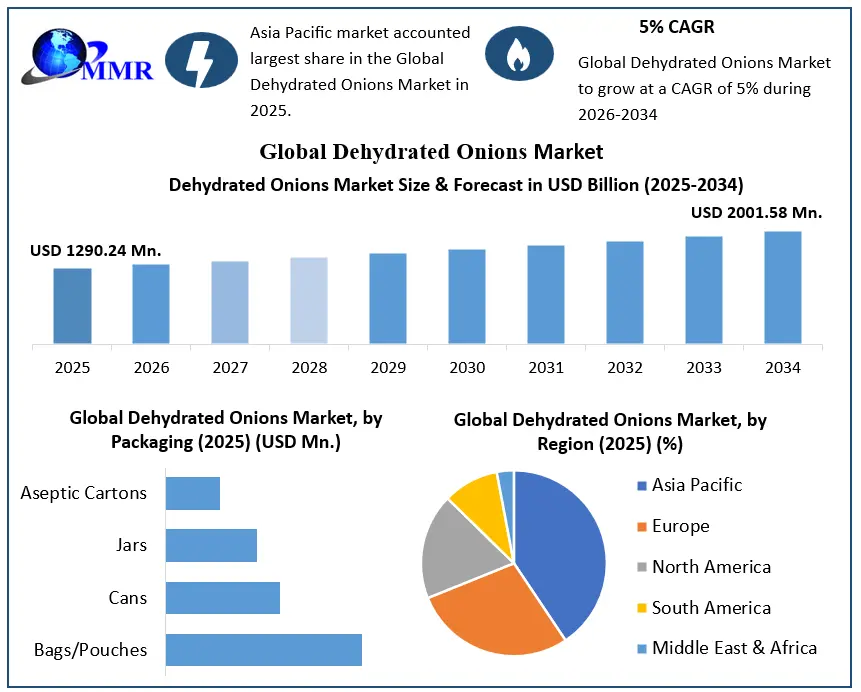
The Dehydrated Onions Market size was valued at USD 1290.24 Million in 2025 and the total Dehydrated Onions revenue is expected to grow at a CAGR of 5% from 2026 to 2034, reaching nearly USD 12001.58 Million by 2034.
Dehydrated Onions Market Overview
The Dehydrated Onions Market includes dried onion products such as onion flakes, onion powder, onion granules, and minced onions, which undergo moisture removal to enhance shelf life, flavor concentration, and storage convenience. The global Dehydrated Onions Market plays a significant role in the food processing industry due to increasing demand for convenient, ready-to-use, and shelf-stable food ingredients. Food manufacturers widely use dehydrated onions in instant noodles, soups, sauces, snacks, seasoning blends, and ready-to-eat meals to maintain consistent flavor, reduce food preparation time, and improve supply chain efficiency.
The Dehydrated Onions Market growth is driven by rising consumption of processed foods, increasing adoption of natural food ingredients, and expanding applications across household, food processing, food services, and industrial sectors. Changing consumer preferences toward clean-label ingredients, convenient cooking solutions, and sustainable food processing influence dehydrated onion market trends. Food manufacturers, quick-service restaurants, catering companies, and seasoning producers represent major buyers. Growing demand for organic dehydrated onions, advanced dehydration technologies, and value-added onion products creates significant dehydrated onion market opportunities across emerging economies.
Asia Pacific dominates the Dehydrated Onions Market, supported by strong onion production, expanding food processing infrastructure, and growing export activities, particularly in India and China. Key industry participants include Jain Farm Fresh Foods Ltd., Olam Food Ingredients (ofi), and Sensient Technologies Corporation, which operate across dehydrated vegetable ingredients, food processing, and seasoning solutions. Maximize Market Research (MMR) analysis examines dehydrated onions market size, market share, growth drivers, competitive landscape, regional demand patterns, and industry opportunities through 2034, highlighting the importance of food processing applications, product innovation, distribution networks, and evolving consumer preferences in shaping the global Dehydrated Onions Market forecast.
Dehydrated Onions Market Growth and Analysis
To know about the Research Methodology :- Request Free Sample Report
Dehydrated Onions Market Dynamics
Rising Demand for Processed Foods and Convenient Food Ingredients
The Dehydrated Onions Market growth is driven by increasing consumption of ready-to-eat meals, instant noodles, packaged soups, sauces, snacks, and seasoning products. Food manufacturers prefer dehydrated onion powder, flakes, and granules because these ingredients provide consistent flavor, reduce preparation time, and simplify storage and transportation. Fresh onions contain approximately 89% water, while properly dried onion products typically contain less than 7% moisture, depending on the product specification. This reduction in moisture improves storage stability and decreases transportation weight. Expanding quick-service restaurant operations, packaged food manufacturing, and industrial seasoning production strengthen global dehydrated onions market demand.
High Processing Costs and Dependence on Raw Onion Availability
The Dehydrated Onions Market faces restraints from fluctuating fresh onion prices, energy-intensive drying processes, and seasonal variations in raw material availability. Industrial onion dehydration requires washing, peeling, slicing, drying, grading, and packaging, which increase production costs and operational complexity. Conventional hot-air drying commonly operates at temperatures around 50–70°C, depending on equipment design and product requirements, making electricity and thermal energy important cost components. In addition, dehydration reduces onion weight substantially, requiring approximately 8–10 kg of fresh onions to produce 1 kg of dried onions under typical processing conditions. These factors influence dehydrated onion production costs, product pricing, and profitability across the food ingredient supply chain.
Expansion of Organic Ingredients and Value-Added Onion Products
The Dehydrated Onions Market opportunities increase with growing demand for organic dehydrated onions, clean-label seasonings, customized onion powders, and specialty food ingredients. Food ingredient suppliers develop products with controlled particle sizes, standardized moisture levels, and customized flavor profiles to meet the requirements of snack manufacturers, sauce producers, and premium packaged food brands. Onion powder with particle sizes commonly specified through 60–100 mesh grades supports fine seasoning blends and uniform ingredient distribution, while larger onion granules and flakes serve soups, dressings, and prepared meals. Expanding food exports, private-label food manufacturing, and business-to-business ingredient supply networks create opportunities for dehydrated onion manufacturers and suppliers to introduce higher-value products and strengthen international distribution.
Maintaining Product Quality and Food Safety Across Supply Chains
The Dehydrated Onions Market faces challenges in maintaining consistent product quality, microbial safety, flavor retention, and moisture control throughout processing and distribution. Dehydrated onion manufacturers must control drying temperatures, prevent contamination, and maintain appropriate packaging conditions to preserve product freshness. Improper storage increases the risk of moisture absorption, discoloration, flavor deterioration, and microbial contamination. Food processing companies require consistent particle size, controlled moisture content, and compliance with food safety standards such as HACCP and ISO 22000. International suppliers also face challenges related to batch traceability, pesticide residue limits, and varying import regulations. These requirements increase the importance of dehydrated onion quality control, advanced testing systems, and reliable food ingredient supply chains.
Adoption of Advanced Drying Technologies and Sustainable Food Processing
The Dehydrated Onions Market trends reflect increasing adoption of energy-efficient drying technologies, automated processing equipment, and sustainable food ingredient manufacturing practices. Dehydrated onion producers increasingly explore heat-pump drying, vacuum drying, freeze-drying, and controlled hot-air dehydration to improve product consistency and preserve desirable flavor characteristics. Freeze-drying operates under reduced pressure and uses sublimation to remove frozen moisture, supporting premium dehydrated onion products with improved structural retention. Automated optical sorting, moisture monitoring, and precision packaging systems also enhance manufacturing efficiency and product standardization. Growing interest in recyclable packaging, reduced food waste, and energy-efficient operations supports innovation across the global dehydrated onions industry, particularly in premium food ingredients and export-oriented processing.
Dehydrated Onions Market Segment Analysis
Dehydrated Onions Market, by Onion Variety
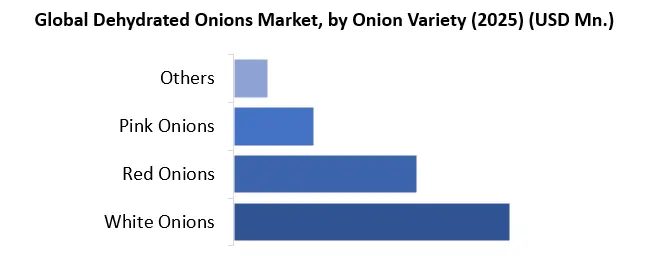
The Dehydrated Onions Market by Onion Variety is segmented into White Onions, Red Onions, Pink Onions, and Others. The White Onions segment holds a leading position due to its widespread application in dehydrated onion powder, onion flakes, seasoning blends, instant soups, and processed food products. The Red Onions segment benefits from growing demand for natural food ingredients, distinctive flavor profiles, and convenient cooking solutions across the food processing and food service industries. The Pink Onions segment supports demand for dehydrated onion ingredients in packaged foods, spice mixes, and culinary preparations. The Others segment includes additional onion varieties used in specialized food formulations. Increasing consumption of convenience foods, rising demand for shelf-stable ingredients, and expansion of the global food processing industry support Dehydrated Onions Market growth.
Dehydrated Onions Market, by End User
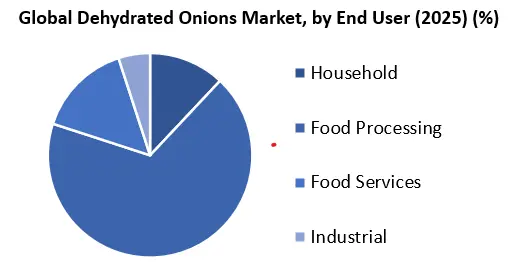
The Dehydrated Onions Market is segmented into Household, Food Processing, Food Services, and Industrial. The Food Processing segment dominates the market, driven by increasing demand for dehydrated onion powder, onion flakes, seasoning blends, ready-to-eat meals, instant noodles, and packaged food products. The Food Services segment experiences growing demand from restaurants, hotels, catering services, and quick-service restaurant chains due to convenient storage, consistent flavor, and reduced preparation time. The Household segment benefits from increasing consumer preference for convenient cooking ingredients and long-shelf-life food products. The Industrial segment supports dehydrated onion consumption in specialized food ingredient formulations and industrial processing applications. Growing demand for processed foods, expansion of food manufacturing, and advancements in onion dehydration technology support global dehydrated onions market growth.
Dehydrated Onions Market Regional Insights
Asia Pacific
Asia Pacific dominates the global Dehydrated Onions Market, supported by extensive onion cultivation, expanding food processing industries, and increasing demand for dehydrated onion powder, flakes, and granules. India and China serve as major production and export hubs, while Japan and South Korea generate demand for convenient food ingredients, instant noodles, and seasoning products. Rising consumption of packaged foods and investments in food dehydration technologies strengthen Asia Pacific Dehydrated Onions Market growth.
North America
The North America Dehydrated Onions Market experiences steady demand from packaged food manufacturers, quick-service restaurants, and industrial seasoning producers. The United States represents a major consumption market, with dehydrated onion flakes, powder, and granules widely used in snack seasonings, frozen meals, sauces, and processed meat products. Increasing demand for consistent flavor, convenient food preparation, and shelf-stable ingredients supports North America Dehydrated Onions Market growth.
Europe
The Europe Dehydrated Onions Market benefits from increasing demand for natural food ingredients, clean-label seasonings, and convenient food products. Germany, France, the United Kingdom, and Italy represent important consumption markets, supported by established food manufacturing industries and growing applications in soups, sauces, snacks, and ready-to-eat meals. Stringent food safety regulations and consumer preference for traceable ingredients encourage product quality improvements and sustainable processing practices, supporting Europe Dehydrated Onions Market growth.
Middle East & Africa
The Middle East & Africa Dehydrated Onions Market benefits from expanding hospitality operations, increasing packaged food consumption, and growing demand for long-shelf-life food ingredients. Saudi Arabia, the UAE, and South Africa generate demand for dehydrated onion powder and flakes across restaurants, catering services, and food processing facilities. Dependence on imported food ingredients and expanding retail distribution networks create Dehydrated Onions Market opportunities for international manufacturers and suppliers.
South America
The South America Dehydrated Onions Market experiences increasing demand from processed food manufacturers, seasoning companies, and foodservice operators. Brazil and Argentina represent important markets, supported by expanding applications of dehydrated onion ingredients in snacks, sauces, soups, and convenience foods. Growing food processing activities, demand for affordable shelf-stable ingredients, and improvements in ingredient distribution networks support South America Dehydrated Onions Market growth.
Dehydrated Onions Market Scope : Inquire before buying
| Dehydrated Onions Market | |||
|---|---|---|---|
| Report Coverage | Details | ||
| Base Year: | 2025 | Forecast Period: | 2026-2034 |
| Historical Data: | 2020 to 2025 | Market Size in 2025: | USD 1290.24 Mn. |
| Forecast Period 2026 to 2034 CAGR: | 5% | Market Size in 2034: | USD 2001.58 Mn. |
| Segments Covered: | by Product | Nylon Zippers Chopped Minced Granules Powder Flakes Kibble Others |
|
| by Nature | Organic Conventional |
||
| by Onion Variety | White Onions Red Onions Pink Onions Others |
||
| by Processing Technology | Air Drying Freeze Drying Vacuum Drying Spray Drying Others |
||
| by Packaging | OBags/Pouches Cans Aseptic Cartons Jars |
||
| by Distribution Channel | B2B B2C Hyper/Super Markets Convenience Stores Specialty Stores Traditional Grocery Retailers Online Retailers |
||
| by End User | Household Food Processing Food Services Industrial |
||
Dehydrated Onions Market, by Region
North America (United States, Canada and Mexico)
Europe (UK, France, Germany, Italy, Spain, Sweden, Austria, Turkey, Russia and Rest of Europe)
Asia Pacific (China, India, Japan, South Korea, Australia, ASEAN and Rest of APAC)
Middle East and Africa (South Africa, GCC, Egypt, Nigeria and Rest of ME&A)
South America (Brazil, Argentina, Columbia and Rest of South America)
Dehydrated Onions Market, Key players:
North America
- Harmony House Foods, Inc.
- Silva International, Inc.
- Van Drunen Farms
- Rocky Mountain Spice Company
- BC Foods Inc.
- Sensient Technologies Corporation
- McCormick & Company, Inc.
- Dehydrated Onion Co.
- Sunrise Natural Foods
- The Spice Hunter
Europe
- Döhler Group
- Diana Food
- Kanegrade Ltd.
- Aust & Hachmann
- Suszarnia Warzyw Jaworski Sp. J.
- Freeze-Dry Foods
- German Foods
- Sodeleg UK
Asia Pacific
- Olam Group
- ofi (Olam Food Ingredients)
- Jain Farm Fresh Foods Ltd.
- Jain Irrigation Systems Ltd.
- Daksh Foods Pvt. Ltd.
- Jiyan Food Ingredients
- Natural Dehydrated Vegetables Pvt. Ltd.
- Natural Dehydration
- Earth Expo Company
- Green Rootz
- Real Dehydrates Pvt. Ltd.
- B.K. Dehy Foods
- Viji Foods
- Murtuza Foods Pvt. Ltd.
- Kisan Foods
- Darshan Foods Pvt. Ltd.
- Garon Dehydrates Private Limited
- V.T. Foods Pvt. Ltd.
- AGRIN EXPORT
- Mevive International Food Ingredients
- Universal Dehydration Pvt. Ltd.
- Balaji Dehydration
- Garlico Industries Ltd.
- Vakil Foods
- Rama Foods Ltd.
- Oceanic Foods Ltd.
- The Dehydrated Garlic and Onion Company
- A&F Dehydration Foods
- Sambavanam Group
- Qingdao UnisonEco Food Technology Co., Ltd.
- BCFoods Gansu Co. Ltd.
- Hua Guang Group
South America
- Adegermex
Middle East & Africa
- Cape Dried Foods
Frequently Asked Questions:
1. Which region has the largest share in Global Dehydrated Onions Market?
Ans: Asia Pacific region holds the highest share in 2025.
2. What is the growth rate of Global Dehydrated Onions Market?
Ans: The Global Dehydrated Onions Market is growing at a CAGR of 5% during forecasting period 2026-2034
3. What is scope of the Global Dehydrated Onions market report?
Ans: Global Dehydrated Onions Market report helps with the PESTEL, PORTER, COVID-19 Impact analysis, Recommendations for Investors & Leaders, and market estimation of the forecast period.
4. Who are the key players in Global Dehydrated Onions market?
Ans: The important key players in the Global Dehydrated Onions Market are
Jain Irrigation Systems Ltd., Garlico Industries Ltd., The Dehydrated Garlic and Onion Company, Internationa, Van Drunen Farms, Sensient Natural Ingredients, Goldwood Moulton, Rocky Mountain Spice Company, Daksh Foods Pvt. Ltd., Natural Dehydrated Vegetables Pvt. Ltd., B.K. Dehy Foods, Darshan Foods Pvt. Ltd., Pardes Dehydration Company, Murtuza Foods Pvt. Ltd., Earth Expo Company, Kisan Foods, Jiyan Food Ingredients., Oceanic Foods Ltd., Onion Company, Classic Dehydration, Olam International.
5. What is the study period of this market?
Ans: The Global Dehydrated Onions Market is studied from 2020 to 2034