
Global Metaverse in Healthcare Market - Industry Structure Evaluation, Demand Drivers Analysis, Regional Growth Analysis and Identification, Competitive Positioning / Landscape Review & Global Market Size Forecast to 2032
Overview
The Metaverse in Healthcare Market size was valued at USD 16.14 Billion in 2025 and the total Metaverse in Healthcare revenue is expected to grow at a CAGR of 49% from 2026 to 2032, reaching nearly USD 263.15 Billion by 2032.
Metaverse in Healthcare Market Overview-
Metaverse is a digital universe where users can live and interact with each other. metaverse works by allowing an infinite number of people to synchronously connect in real-time in a virtual environment that’s immersive, three-dimensional, and seamlessly connects to our physical world. Metaverse has various elements, including blockchain, technology, augmented reality, virtual reality, and game theory. The growth in metaverse in healthcare market is due to the increasing adoption of extended reality technology in the healthcare sector, improved patient-centric care, improved patient outcome, reduction in healthcare cost, accuracy of diagnosis and minimized errors, and increasing the use of AR platforms to perform complex surgical procedures with higher precision and flexibility.
1. Johns Hopkins and Mayo Clinic are using AR to assist in medical procedures, including spine surgeries and catheter placement. The evolving landscape of telemedicine is expanding immersive virtual clinic experiences, catalyzing the exponential growth of the metaverse in healthcare. The utilization of virtual labs for drug discovery and VR therapy for mental health treatments is driving innovation, efficiency, and market expansion of metaverse in healthcare.
2. Osso VR is a company that provides doctors and hospital staff with a training platform. Osso VR platform provides realistic virtual simulations for surgical training.
3. Surgeons and medical professionals can perform procedures in a virtual operating room, complete with 3D models, tools, and realistic haptic feedback. This is how the Metaverse is reshaping medical training.
To know about the Research Methodology :- Request Free Sample Report
Metaverse in Healthcare Market Dynamics-
Application in medical training and increase in patient engagement
Artificial intelligence, augmented reality, and robots are now used in the healthcare industry to enhance patient experience and outcomes, decrease the errors of medical equipment, and improve communication between healthcare providers and patients. In 2022 the Emirates Health Service (EHS) launched the world's first Healthcare Metaverse platform – MetaHealth, while the Thumbay group launched a Metaverse hospital that works in a way that the patients can visit using their avatars Metaverse in healthcare is an excellent tool in the healthcare industry for teaching, empowering, and giving patients and providers better experiences. Medical training became more effective with virtual medical simulations provided by the Metaverse which increases the use of Metaverse in healthcare. Drug discovery and research are known for their huge time and cost investments. The Metaverse helps to revolutionize of healthcare industry by providing virtual laboratories where scientists are able to collaborate and test potential drug compounds more efficiently, this drives metaverse in healthcare market growth.
1. Microsoft’s HoloLens is a mixed-reality device, that has huge applications in medical education. For example, at Case Western Reserve University, medical students use the HoloLens device to visualize and interact with detailed 3D anatomical models.
2. EchoPixel Inc. is a company that focuses on advancing human healthcare by providing innovative solutions for medical imaging and diagnosis. They provide true 3D technology that converts 2D medical images, such as CT scans and MRIs, into detailed 3D reconstructions which reduces the error in diagnosis.
Telemedicine is more than video calls; it is an immersive virtual clinic experience. As healthcare regulations adapt to accommodate virtual care, which is two-way communication between the patient and healthcare provider, due increased adoption of telemedicine metaverse in the healthcare market is growing exponentially. Collaboration in the Metaverse has the potential to accelerate drug discovery. Virtual labs help remote cooperation among researchers from any part of the world, which helps to reduce the time that is required to bring new medicines to the market. metaverse in healthcare is not only popular for the diagnosis of physical disorders but metaverse helping in mental health treatment. VR therapy is gaining recognition as an effective tool for managing conditions like anxiety, phobias, and PTSD, increased application In multiple ways boosts the metaverse in healthcare market growth.
AppliedVR is a company that provides virtual reality-based treatments, they use virtual reality to manage pain and anxiety. And offer a library of immersive experiences that patients can access through VR headsets. These experiences range from calming beach scenes to virtual mindfulness programs.
High implementation costs and user complexity hinder market growth.
Taking informed agreement from patients in virtual healthcare environments is an important ethical consideration that have a negative impact on the use of metaverse which hinders the metaverse in healthcare market growth. Patients are not able to easily understand the nature of virtual healthcare, its limitations, and the potential risks, which makes it less user-friendly in some cases. This process is more complex in the Metaverse, as patients must be informed about how their data will be used and secured this creates hesitation, which eventually hinders the metaverse in the healthcare market. Determining responsible persons for errors in virtual reality is a challenge. When medical errors occur in virtual settings, it may not always be easy to identify the responsible party. High implementation costs make it difficult for all healthcare institutions to be equipped to seamlessly adopt Metaverse technologies. Smaller or underfunded healthcare facilities struggle to invest in the necessary technology for Metaverse integration which creates challenges related to infrastructure and technology integration which slow down the growth of Metaverse in healthcare market.
The need for data security and a complete regulatory framework slows down the metaverse in healthcare market growth
As the Metaverse continues to evolve and expand its presence in healthcare, the need for complete regulatory frameworks becomes important. Governments and healthcare institutions must develop guidelines and standards to ensure that the Metaverse works within provided ethical boundaries. These regulations will address issues such as data privacy, cybersecurity, and patient rights. The French Data Protection Authority (‘CNIL’), through its Digital Innovation Laboratory (LINC), has pointed out the risks associated with the exponential increase in data collection implied by the metaverse, which hinders the metaverse in healthcare market growth. The licensing of medical practitioners is another challenge in the metaverse. Licensing and enforcement can also take place at the state level. It I important to see how the license is imposed or constructed. To keep patients safe from data breaches and to regulate licensing, every model of technology must update its HIPAA rules. As the metaverse applications increase, it is critical to remember that it is a collection of platforms, each with its own set of rules and regulations., which is time-consuming to comply with and has a negative impact on the growth of metaverse in healthcare market.
Metaverse in Healthcare Market Segment Analysis –
By Device-
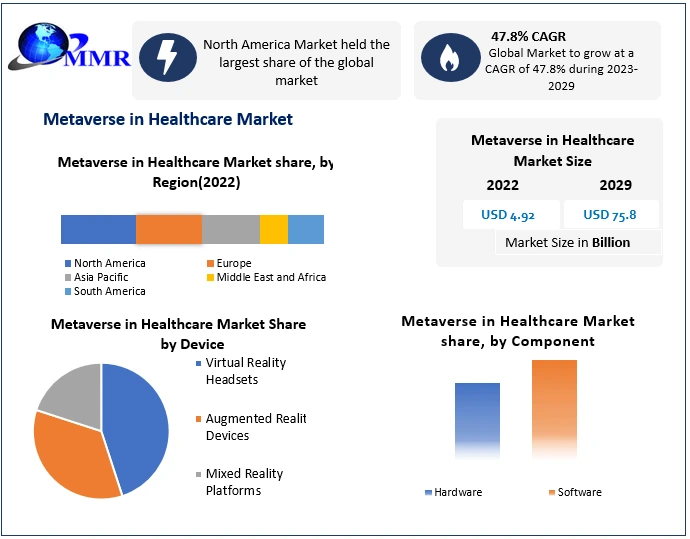
Metaverse in Healthcare Market segment dominates the device segment in 2025. Augmented reality devices are frequently used in the medical industry and patients require continuous monitoring. These gadgets have an interactive virtual user interface that uses new approaches to improve the quality of healthcare and medical services. Virtual reality can be used to reproduce real-world medical operations. Augmented reality 3D annotations are useful in patient diagnosis and care. It helps the healthcare staff to gather patient details, reports, and statistics. Doctors and specialists utilize it to train other doctors and members of their medical teams which drives the metaverse in healthcare market.
1. Medtech startup AccuVein is using AR technology, they use this technology to that help nurses find veins more accurately. By using a handheld scanner that projects over the skin and shows nurses and doctors where veins are in the patients’ bodies.
2. SyncAR developed a software program that gives surgeons “X-ray vision” by fusing digitally enhanced images directly into the microscope of a surgical device.

By Application-
The medical training and education modules segment is expected to dominate the market during the forecast period as a result of the extensive usage of metaverse extensions in medical and surgical training for a 3D learning experience. These instruments help in improving patient understanding of surgical procedures, which enhances medical treatments. Medical students can engage in realistic simulations of surgical procedures or patient diagnoses, which will allow them to practice and improve their techniques without putting real patients at risk. It is a safe learning experience that makes sure that healthcare professionals are well-prepared and capable in the fields they are working which helps to grow metaverse in healthcare market at a good pace, these virtual environments provide a unique opportunity for hands-on training that was earlier only available in the physical world.
Metaverse in Healthcare Market Regional Insights-
North America region dominates the metaverse in healthcare market in 2025. The United States spends more on healthcare than any other country. The growth is due to the rapid expansion of the healthcare infrastructure and the use of digital technology in the treatment and diagnosis of disease. The huge number of companies with a metaverse-focused business model in the region, the rapid infrastructure development of the healthcare sector, the integration of AR and VR platforms, and the growth of investments in Augmented reality goods and services, drive the metaverse in healthcare market growth. Annual health expenditures of the United States were at over 4.4 trillion U.S. dollars in 2022, and personal health care expenditure equaled 10,805 U.S. dollars per resident which is more than average amount spent than any other country, a huge amount of government funding well-developed infrastructure helps North America to dominate the metaverse in healthcare market.

Global Metaverse in Healthcare Market Scope: Inquire before buying
| Global Metaverse in Healthcare Market | |||
|---|---|---|---|
| Report Coverage | Details | ||
| Base Year: | 2025 | Forecast Period: | 2026-2032 |
| Historical Data: | 2020 to 2025 | Market Size in 2025: | USD 16.14 Bn. |
| Forecast Period 2026 to 2032 CAGR: | 49% | Market Size in 2032: | USD 263.15 Bn. |
| Segments Covered: | by Technology | Virtual Reality Augmented Reality Mixed Reality Artificial Intelligence Blockchain IoT |
|
| by Device | Virtual Reality Headsets Augmented Reality Devices Mixed Reality Platforms |
||
| by Application | Medical Training and Educational Modules Diagnosis Treatment Designing ORs Surgical Training Remote Monitoring Others |
||
| by Component | Hardware Software |
||
| by End-User Industry | Medtech Healthcare Providers Biopharma Patients Others |
||
Metaverse in Healthcare Market, by Region
North America (United States, Canada and Mexico)
Europe (UK, France, Germany, Italy, Spain, Sweden, Austria and Rest of Europe)
Asia Pacific (China, South Korea, Japan, India, Australia, Indonesia, Malaysia, Vietnam, Taiwan, Bangladesh, Pakistan and Rest of APAC)
Middle East and Africa (South Africa, GCC, Egypt, Nigeria and Rest of ME&A)
South America (Brazil, Argentina Rest of South America)
Metaverse In Healthcare Key Players
1. Brainlab (Germany)
2. Intuitive Surgical Inc (US)
3. Veyond Metaverse (US)
4. GE Healthcare (US)
5. Medtronic PLC (Ireland)
6. BioFlight VR (US)
7. Siemens Healthineers (Germany)
8. Novarad Corporation (US)
9. Nvidia Corporation (US)
10. gameChange VR (UK)
11. Aimedis B.V. (Belgium)
12. ARBREA LABSv (Switzerland)
13. Medical Realities Ltd. (UK)
14. Augmedics (US)
15. Cedars-Sinai Medical Center (US)
16. XR Health (US)
17. ImmersiveTouch, Incv. (US)
18. EON Reality(US)
Frequently Asked Questions:
1] What segments are covered in the Global Metaverse in Healthcare Market report?
Ans. The segments covered in the Metaverse in Healthcare Market report are based on Technology Type, Component, Application, device and End-Use Industry.
2] Which region held the largest Metaverse in Healthcare Market share in 2025?
Ans. The North America region held the largest Metaverse in Healthcare Market share in 2025 in which the United States was the leading country.
3] What is the expected Metaverse in Healthcare Market size by 2032?
Ans. The Metaverse in Healthcare Market size is expected to reach USD 263.15 Bn by 2032.
4] What would be the forecast period in market report?
Ans. The forecast period in the report is from 2026 to 2032.
5] What is the expected CAGR of the Global Metaverse in Healthcare Market during the forecast period?
Ans. The expected CAGR of the Metaverse in Healthcare Market is 49% during the forecast period.