Medical clothing Market - Industry Structure Evaluation, Demand Drivers Analysis, Regional Growth Analysis and Identification, Competitive Positioning / Landscape Review & Global Market Size Forecast to 2034

6.5%
CAGR (2026-2034)
105.94 USD Bn.
Forecast Market Size
307
Report Pages
159
Market Tables

Overview

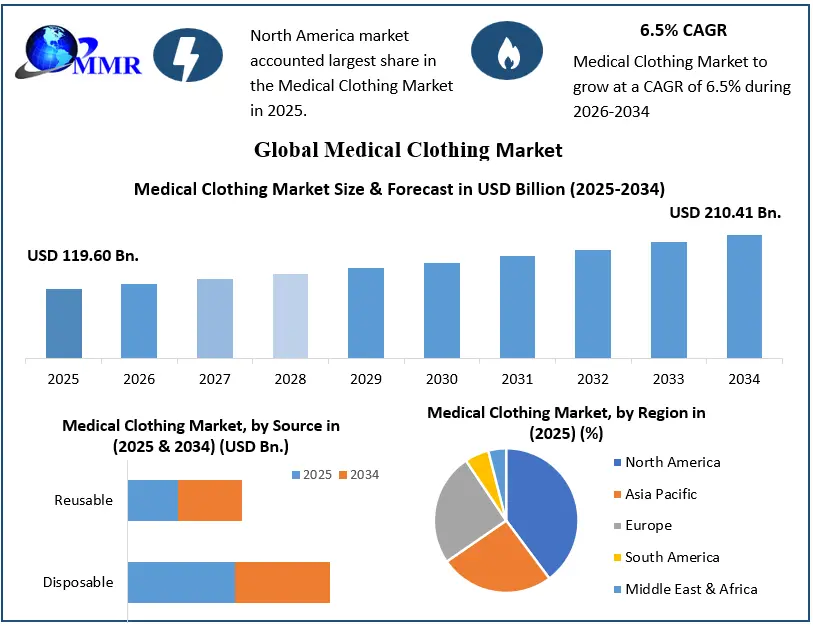
The Global Medical Clothing Market was valued at USD 119.60 Billion in 2025 and is projected to reach USD 210.41 Billion by 2034, growing at a CAGR of 6.5% during the forecast period 2026–2034.

Medical Clothing Market Overview:

Rising healthcare needs, work safety, prevention, and industrial use are the key factors influencing the market in question. The Medical Clothing Market consists of protective and professional wear for doctors, nurses, surgeons, laboratory staff, patients, and other workers. In this market, such products as gowns, scrubs, lab coats, coveralls, patient gowns, caps, shoe covers, and other medical apparel are produced. The relevance of the market is reflected in the role of medical clothing: decreasing the risk of contamination, facilitating hygienic practices, ensuring protection, and contributing to the overall safety of patients and medical workers. Thus, medical clothing is used in all healthcare facilities, which determines its significant market value.

At present, the market is changing as customers want garments that would be comfortable, breathable, resistant to fluid penetration, reusable, and made from eco-friendly materials. The market is segmented into hospitals, clinics, diagnostic centers, laboratories, ambulatory surgical centers, manufacturers, and nursing care facilities. The market growth forecast for the Medical Clothing Market is positive as healthcare services develop, and medical institutions need to ensure the safety of their clients and employees. However, there is a market gap in providing affordable and high-quality garments in small hospitals and emerging countries. Therefore, the market opportunities are in the production of medical clothing for hospitals in need, reusable and affordable medical apparel, wearables, and garments requiring fewer materials.

North America is the largest region for medical clothing market due to the high level of healthcare services and the focus on work safety. The competitive landscape of the North American market is moderate as several key suppliers develop the offering in terms of products, quality, comfort, and distribution. Cardinal Health, Medline Industries, 3M, Owens & Minor, Mölnlycke Health Care, and Ansell are key suppliers that provide a wide range of gowns, scrubs, and other medical apparel. According to MMR’s research, the main opportunities for market participants are connected to the expected growth in hospitals, the need to maintain safety and prevent infection, and the tendency toward disposable and reusable garments. However, the market threats are related to the competition in the equipment and apparel sector, and market participants will gain advantages by emphasizing price, comfort, and quality of services and products.

Medical Clothing Market Growth and Share Analysis
Medical Clothing Market Growth

To know about the Research Methodology :- Request Free Sample Report

Medical Clothing Market Dynamics:

Rising healthcare activities and infection prevention measures propel the growth of the medical clothing market.

Hospitals, clinics, labs, surgical centers, and diagnostic facilities utilize gowns, scrubs, lab coats, coveralls, caps, and other apparel on a daily basis. The increasing patient admissions, surgeries, and diagnostic tests conducted, as well as the rising healthcare workforce, positively contribute to the demand for medical clothing and, by extension, the overall market growth. Additionally, the healthcare industry allocates a considerable amount of money to staff protection and infection control measures, whereby medical clothing constitutes a significant portion of the expenditure. As such, the consistent need for apparel among healthcare facilities sustains the growth of the market as well as the leading manufacturers’ market share.

The high production and procurement costs impede the utilization of advanced apparel.

Medical clothing with enhanced protection, fluid resistance, breathability, and comfort features is generally expensive, whereas facilities have to deal with recurrent spending on replacements, laundry services, sterilization, storage, and disposal. Small-scale healthcare facilities with limited budgets are more likely to embrace lower quality, affordable products or postpone the adoption of higher-end apparel. Such a scenario limits the overall market growth as well as the penetration rate of select manufacturers.

The rising healthcare industry and the growing preference for reusable products create opportunities for market expansion.

The opening of new facilities, including hospitals, clinics, labs, nursing care centers, and pharmaceutical manufacturing units, spurs the demand for medical clothing as the apparel is necessary from day one of operation. In addition, several healthcare organizations are promoting the use of reusable medical gowns, scrubs, and other apparel with better quality and lower environmental impact. The need for such products is more apparent in emerging countries with a young population and a rising middle class but limited local production of medical supplies. As such, the opportunity to supply these products opens up new markets and enhances the overall demand for the manufacturers’ products.

Ensuring the reliability, comfort, and quality of medical apparel is a major limitation for the market.

As the use of protective clothing is often mandatory in healthcare settings, manufacturers must ensure its comfort and reliability under constant use. Although some facilities may prefer lighter apparel, others require higher-quality clothes to ensure adequate protection. The former is more likely to result in apparel damage, whereas the latter generates higher production costs and quality control issues. Overall, it is challenging to satisfy the diverse demands of facilities, thereby limiting the overall growth of the market, as well as the participating manufacturers’ market share.

Global Medical Clothing Market Trends

Women’s Medical Clothing Creates Strong Product Innovation Potential

Women’s medical clothing is increasingly being shaped as a growing category in the Medical Clothing Market due to the dominance of female healthcare professionals in the industry. The lack of properly fitting unisex scrubs creates a niche for scrubs designed for women, maternity clothing, stretch fabrics, breathable material, adjustable waistbands, pockets placement, and other features.

It drives the demand for medical clothing and predicts the market size due to a number of healthcare workers who want to replace standard uniforms with more comfortable and functional apparel. The market expects an increase in the production of luxury scrubs and clothing with advanced technologies, such as moisture-wicking fabrics, softness, flexibility, and sportswear-inspired designs.

The healthcare market’s demand for medical scrubs is driven by the importance of the health service sector. Nurses, surgeons, dentists, doctors, and other specialists devote their lives to treating patients with a strong focus on comfort and safety. Thus, the market for healthcare clothing is growing rapidly due to the expected increase in demand for medical scrubs that fits most female healthcare professionals’ preferences.

The most attractive market segments for companies are a focus on a specific size, maternity scrubs, petite and tall sizes, plus-size scrubs, and mid-range luxury medical clothing. Therefore, a company that intends to compete in this market should be mindful of the potential to fill the niche by providing clothes that are more comfortable, made from high-quality materials, and include more style options.
Medical Clothing Market By Trends

Medical Clothing Market Segment Analysis:

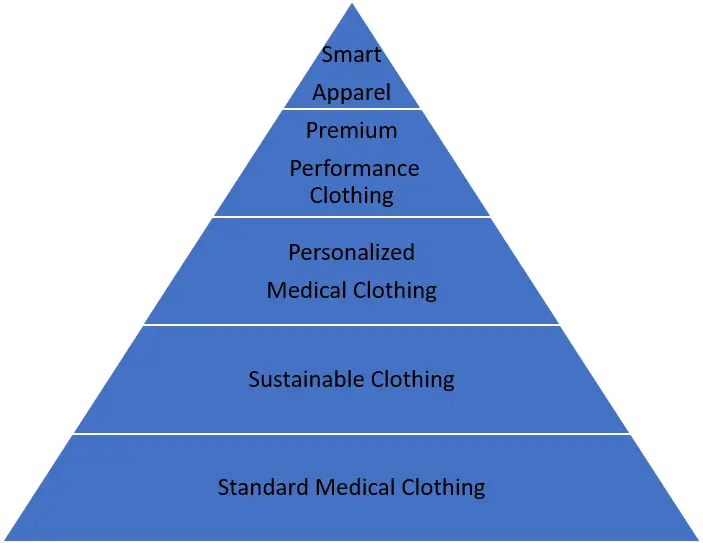
The pyramid shows how women’s medical clothing moves from basic to complex, comfort to technology. On the left side, the biggest portion is occupied by the most widespread medical clothing products with the most considerable market share. With the movement to the top of the pyramid, the products can be found in narrower markets. The higher the products are in the pyramid, the more significant is their value, potential, and market share. The market gap is also reflected in the spectrum of sizes, comfort, functionality, and technical features of the clothing. The levels of the pyramid include standard, sustainable, personalized, performance, and smart clothing.

Standard Medical Clothing: Includes the basic types of scrubs, gowns, coats, and uniforms worn by women in hospitals, clinics, and labs. These are the most common types of medical clothing with the most considerable market share.

Sustainable Clothing: Includes sustainable, reusable, recyclable, low-waste, and eco-friendly clothing that has become increasingly in demand in recent years.

Personalized Medical Clothing: Represents the personalized clothing, including women-specific cuts, maternity clothes, petite and plus size, custom colors and logos, and department- or position-specific apparel. This type of clothing is in great demand due to the market gap.

Performance Clothing: Includes clothing with enhanced performance features such as stretchy fabric, breathability, moisture-wicking, flexibility, and comfort for extended wear. This segment has the highest market value and considerable potential for development.

Smart Apparel: Includes smart clothing with built-in sensors, wearable technology, and connected devices, and it is the newest and the most promising segment. It still has unmet demand, and the early adopters are the target audience for now.

Global Medical Clothing Market Segment Analysis

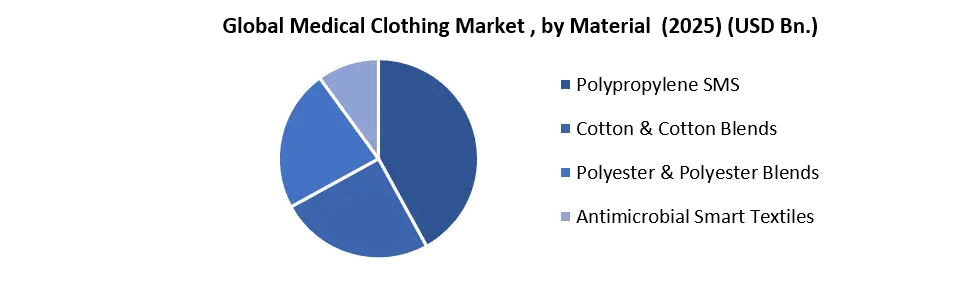
By Material, The Medical Clothing Market is segmented by material into Polypropylene SMS, Cotton & Cotton Blends, Polyester & Polyester Blends, and Antimicrobial Smart Textiles. In terms of demand, Polypropylene SMS leads the market due to its absorption resistance, reduced weight, practicality, and cost-effectiveness, being used for disposable gowns, surgeon clothing, caps, and protective apparel. Cotton & Cotton Blends occupy a notable market value due to their utilization for comfort scrubs and uniforms. Polyester & Polyester Blends are in demand due to their abrasion resistance, resilience, reduced ironing, and quicker drying. The growth rate of the segment is moderate due to the use of blends for scrubs and uniforms. Antimicrobial Smart Textiles record the highest projected value due to the rising demand for infection prevention materials and the inclusion of sensors, temperature regulation, and other components. Overall, the market gap is the lack of materials combining protection, comfort, and sustainability with affordability. The market forecast is positive due to the utilization of both high-performance disposable clothing and advanced reusable textiles.
Medical Clothing Market by Material

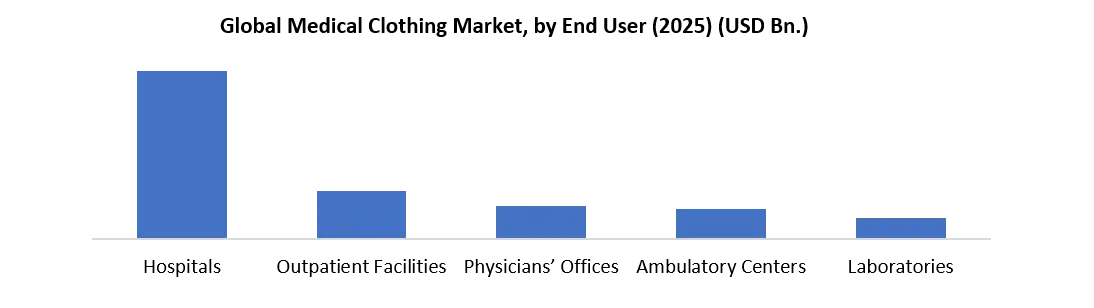
By End User, The Medical Clothing Market is divided into end user into Hospitals, Outpatient Facilities, Physicians’ Offices, Ambulatory Centers, and Laboratories. Hospitals command the largest market share due to the concentration of the healthcare industry there, providing the highest demand for scrubs, gowns, protective apparel, coats, and other forms of medical clothing. The expansion of the healthcare industry into the outpatient and ambulatory segments contributes to the growing market value. Physicians’ Offices cater to another consistent demand for medical clothing, including scrubs and other apparel. As far as Laboratories are concerned, the need for protective clothing is higher due to the specific safety regulations. The market gap is the inconsistent quality of medical apparel, particularly in regions with a shortage of healthcare professionals. The market forecast is positive due to the overall rise in medical facilities and professionals.
Medical Clothing Market, by End User

Medical Clothing Market Regional Insights:

Asia Pacific shows strong market potential in the Medical Clothing Market potential due to the presence of the largest number of healthcare professionals in the world and a substantial need for medical clothing due to the proliferation of hospitals. Such market gaps as the lack of premium clothing for medical professionals and the need for infection prevention apparel dominate the segment. The market size is consistent with the demand in countries like China, India, Japan, and South Korea. The market forecast is positive due to the rising need for quality and comfort in medical apparel and the rising importance of healthcare in the economies of these countries.

Europe is a region with a consistent market size due to the high level of healthcare development, advanced safety regulations, and sustainability criteria. The market gap is the demand for comfort and sustainability, with healthcare workers tending to prioritize these factors. The market forecast is positive due to the rising middle class, aging population, and the corresponding need for medical services and professionals.

North America is the largest market in terms of demand and revenue, driven by the high level of healthcare development and the corresponding need for medical clothing. The market gap is the demand for affordable yet premium medical apparel. The market forecast is positive due to the consistent need for apparel and accessories for healthcare professionals and the focus on comfort and performance.

South America is a growing market due to the increase in the number of hospitals and healthcare professionals. The market gap is the lack of affordable yet high-quality medical clothing. The market forecast is positive as healthcare becomes more developed in the region, with a growing number of physicians’ offices and outpatient facilities.

Middle East and Africa are a region with a rising need for healthcare services and facilities, which increases the demand for medical clothing. The market gap is the lack of affordable apparel that would be available in a variety of sizes and designs. The market forecast is positive due to the expected increase in the number of hospitals and the corresponding need for protective clothing.

Global Medical Clothing Market Key Competitive Strategies

• Product Innovation: The companies develop advanced fabrics, antimicrobial materials, breathable technologies, stretch features, and design improvements to upgrade medical apparel.

• Premiumization: The brands such as FIGS and Jaanuu offer medical clothing as part of the professional wardrobe for surgeons, nursing professionals, and other clinicians.

• Hospital Contracts: The leading suppliers of medical apparel build their presence through significant value contracts with major hospital networks and healthcare systems.

• Sustainability: The emphasis on reusable, recyclable, low-waste, and eco-friendly apparel provides an opportunity for the companies to enter the market space.

• Digital Selling: The direct sales model via e-commerce websites enables manufacturers to sell their products to individual healthcare professionals and reduce their reliance on traditional distribution channels.

• Customization: The provision of logos, color codes, and size variations for different departments and healthcare units allows manufacturers to differentiate their products and gain competitive advantages.

Overall, the main gap in the market is the offering of affordable products with the balance between the functionality and premium feel. In other words, a company that manages to offer medical apparel with infection control features, comfort, sustainability, personalization, and relatively low cost has a significant opportunity to acquire a meaningful share of the market during the forecast period.

Medical Clothing Market Scope: Inquire before buying

Medical Clothing Market
Report Coverage Details
Base Year: 2025 Forecast Period: 2026-2034
Historical Data: 2020 to 2025 Market Size in 2025: 105.94 USD Billion
Forecast Period 2026-2034 CAGR: 6.5% Market Size in 2034: 159.30 USD Billion
Segments Covered: by Product Gloves
Facial Protection
Sterilization Wraps
Protective Apparel
Surgical Drapes
Scrubs & Gowns
by Material Polypropylene SMS
Cotton & Cotton Blends
Polyester & Polyester Blends
Antimicrobial Smart Textiles
by Usage Disposable
Reusable
by End User Hospitals
Outpatient Facilities
Physicians’ Offices
Ambulatory centers
Laboratories
by Distribution Channel Direct Institutional Procurement
Distributors & Wholesalers
E-Commerce Platforms

Medical clothing Market, by Region

Asia Pacific (China, South Korea, Japan, India, Australia, Indonesia, Malaysia, Vietnam, Taiwan, Bangladesh, Pakistan and Rest of APAC)
Europe (UK, France, Germany, Italy, Spain, Sweden, Austria and Rest of Europe)
North America (United States, Canada and Mexico)
Middle East and Africa (South Africa, GCC, Egypt, Nigeria and Rest of ME&A)
South America (Brazil, Argentina Rest of South America)

Key Players

1. Cardinal Health, Inc.
2. Medline Industries, LP
3. 3M Company
4. DuPont de Nemours, Inc.
5. Ansell Limited
6. Kimberly-Clark Corporation
7. Owens & Minor, Inc. / Halyard
8. FIGS, Inc.
9. Careismatic Brands, Inc.
10. Barco Uniforms
11. Superior Group of Companies, Inc.
12. Cintas Corporation
13. Vestis Corporation
14. Kindthread
15. Jaanuu, Inc.
16. Adar Medical Uniforms
17. Maevn Uniforms
18. KOI Design LLC
19. Healing Hands Scrubs
20. Med Couture
21. IguanaMed
22. Landau Uniforms
23. WonderWink
24. Cherokee Uniforms
25. Dickies Medical
26. Knya Enterprise Private Limited
27. Standard Textile Co., Inc.
28. Mölnlycke Health Care AB
29. Paul Hartmann AG
30. Lohmann & Rauscher GmbH & Co. KG
31. B. Braun Melsungen AG
32. Winner Medical Co., Ltd.
33. TIDI Products, LLC
34. Medicom Group
35. Alpha Pro Tech, Ltd.
36. Honeywell International Inc.
37. Henry Schein, Inc.
38. Grahame Gardner Ltd.
39. Alexandra Workwear
40. Mafatlal Industries Limited

Frequently Asked Questions:

1. What is the current size of the Global Medical Clothing Market?
The Global Medical Clothing Market was valued at USD 119.60 Billion in 2025 and is projected to reach USD 210.41 Billion by 2034, growing at a CAGR of 6.5% during the forecast period 2026–2034.

2. What are the key factors driving the Global Medical Clothing Market?
Growing healthcare workforce, rising infection-control needs, hospital expansion, and demand for comfortable, protective medical clothing.

3. Which application segment holds the largest share of the Global Medical Clothing Market?
Hospital application holds the largest share of the Global Medical Clothing Market?

4. Which region dominates the Global Medical Clothing Market?
North America dominated the Global Medical Clothing Market?

5. Who are the major players operating in the Global Medical Clothing Market?
Key Players are, Adar Medical Uniforms, Maevn Uniforms, KOI Design LLC, Healing Hands Scrubs, Med Couture, IguanaMed, Landau Uniforms, WonderWink, Cherokee Uniforms, Dickies Medical and others.

Table of Contents

1. Medical Clothing Market Introduction 1.1. Study Assumption and Market Definition 1.2. Scope of the Study 1.3. Executive Summary 2. Global Medical Clothing Market: Competitive Landscape 2.1. MMR Competition Matrix 2.2. Competitive Landscape 2.3. Key Players Benchmarking 2.3.1. Company Name 2.3.2. Business Segment 2.3.3. End-user Segment 2.3.4. Revenue (2025) 2.3.5. Company Locations 2.4. Leading Medical Clothing Market Companies, by market capitalization 2.5. Market Structure 2.5.1. Market Leaders 2.5.2. Market Followers 2.5.3. Emerging Players 2.6. Mergers and Acquisitions Details 3. Medical Clothing Market: Dynamics 3.1. Medical Clothing Market Trends by Region 3.1.1. North America Medical Clothing Market Trends 3.1.2. Europe Medical Clothing Market Trends 3.1.3. Asia Pacific Medical Clothing Market Trends 3.1.4. Middle East and Africa Medical Clothing Market Trends 3.1.5. South America Medical Clothing Market Trends 3.2. Medical Clothing Market Dynamics by Region 3.2.1. North America 3.2.1.1. North America Medical Clothing Market Drivers 3.2.1.2. North America Medical Clothing Market Restraints 3.2.1.3. North America Medical Clothing Market Opportunities 3.2.1.4. North America Medical Clothing Market Challenges 3.2.2. Europe 3.2.2.1. Europe Medical Clothing Market Drivers 3.2.2.2. Europe Medical Clothing Market Restraints 3.2.2.3. Europe Medical Clothing Market Opportunities 3.2.2.4. Europe Medical Clothing Market Challenges 3.2.3. Asia Pacific 3.2.3.1. Asia Pacific Medical Clothing Market Drivers 3.2.3.2. Asia Pacific Medical Clothing Market Restraints 3.2.3.3. Asia Pacific Medical Clothing Market Opportunities 3.2.3.4. Asia Pacific Medical Clothing Market Challenges 3.2.4. Middle East and Africa 3.2.4.1. Middle East and Africa Medical Clothing Market Drivers 3.2.4.2. Middle East and Africa Medical Clothing Market Restraints 3.2.4.3. Middle East and Africa Medical Clothing Market Opportunities 3.2.4.4. Middle East and Africa Medical Clothing Market Challenges 3.2.5. South America 3.2.5.1. South America Medical Clothing Market Drivers 3.2.5.2. South America Medical Clothing Market Restraints 3.2.5.3. South America Medical Clothing Market Opportunities 3.2.5.4. South America Medical Clothing Market Challenges 3.3. PORTER's Five Forces Analysis 3.4. PESTLE Analysis 3.5. Technology Roadmap 3.6. Regulatory Landscape by Region 3.6.1. North America 3.6.2. Europe 3.6.3. Asia Pacific 3.6.4. Middle East and Africa 3.6.5. South America 3.7. Key Opinion Leader Analysis For Medical Clothing Industry 3.8. Analysis of Government Schemes and Initiatives For Medical Clothing Industry 3.9. Medical Clothing Market Trade Analysis 3.10. The Global Pandemic Impact on Medical Clothing Market 4. Medical Clothing Market: Global Market Size and Forecast by Segmentation (in USD Billion) 2025-2034 4.1. Medical Clothing Market Size and Forecast, by Product (2025-2034) 4.1.1. Gloves 4.1.2. Facial Protection 4.1.3. Sterilization Wraps 4.1.4. Protective Apparel 4.1.5. Surgical Drapes 4.1.6. Scrubs & Gowns 4.2. Medical Clothing Market Size and Forecast, by Material (2025-2034) 4.2.1. Polypropylene SMS 4.2.2. Cotton & Cotton Blends 4.2.3. Polyester & Polyester Blends 4.2.4. Antimicrobial Smart Textiles 4.3. Medical Clothing Market Size and Forecast, by Usage (2025-2034) 4.3.1. Disposable 4.3.2. Reusable 4.4. Medical Clothing Market Size and Forecast, by End User (2025-2034) 4.4.1. Hospitals 4.4.2. Outpatient Facilities 4.4.3. Physicians’ Offices 4.4.4. Ambulatory centers 4.4.5. Laboratories 4.5. Medical Clothing Market Size and Forecast, by Distribution Channel (2025-2034) 4.5.1. Direct Institutional Procurement 4.5.2. Distributors & Wholesalers 4.5.3. E-Commerce Platforms 4.6. Medical Clothing Market Size and Forecast, by Region (2025-2034) 4.6.1. North America 4.6.2. Europe 4.6.3. Asia Pacific 4.6.4. Middle East and Africa 4.6.5. South America 5. North America Medical Clothing Market Size and Forecast by Segmentation (in USD Billion) 2025-2034 5.1. North America Medical Clothing Market Size and Forecast, by Product (2025-2034) 5.1.1. Gloves 5.1.2. Facial Protection 5.1.3. Sterilization Wraps 5.1.4. Protective Apparel 5.1.5. Surgical Drapes 5.1.6. Scrubs & Gowns 5.2. North America Medical Clothing Market Size and Forecast, by Material (2025-2034) 5.2.1. Polypropylene SMS 5.2.2. Cotton & Cotton Blends 5.2.3. Polyester & Polyester Blends 5.2.4. Antimicrobial Smart Textiles 5.3. North America Medical Clothing Market Size and Forecast, by Usage (2025-2034) 5.3.1. Disposable 5.3.2. Reusable 5.4. North America Medical Clothing Market Size and Forecast, by End User (2025-2034) 5.4.1. Hospitals 5.4.2. Outpatient Facilities 5.4.3. Physicians’ Offices 5.4.4. Ambulatory centers 5.4.5. Laboratories 5.5. North America Medical Clothing Market Size and Forecast, by Distribution Channel (2025-2034) 5.5.1. Direct Institutional Procurement 5.5.2. Distributors & Wholesalers 5.5.3. E-Commerce Platforms 5.6. North America Medical Clothing Market Size and Forecast, by Country (2025-2034) 5.6.1. United States 5.6.1.1. United States Medical Clothing Market Size and Forecast, by Product (2025-2034) 5.6.1.1.1. Gloves 5.6.1.1.2. Facial Protection 5.6.1.1.3. Sterilization Wraps 5.6.1.1.4. Protective Apparel 5.6.1.1.5. Surgical Drapes 5.6.1.1.6. Scrubs & Gowns 5.6.1.2. United States Medical Clothing Market Size and Forecast, by Material (2025-2034) 5.6.1.2.1. Polypropylene SMS 5.6.1.2.2. Cotton & Cotton Blends 5.6.1.2.3. Polyester & Polyester Blends 5.6.1.2.4. Antimicrobial Smart Textiles 5.6.1.3. United States Medical Clothing Market Size and Forecast, by Usage (2025-2034) 5.6.1.3.1. Disposable 5.6.1.3.2. Reusable 5.6.1.4. United States Medical Clothing Market Size and Forecast, by End User (2025-2034) 5.6.1.4.1. Hospitals 5.6.1.4.2. Outpatient Facilities 5.6.1.4.3. Physicians’ Offices 5.6.1.4.4. Ambulatory centers 5.6.1.4.5. Laboratories 5.6.1.5. United States Medical Clothing Market Size and Forecast, by Distribution Channel (2025-2034) 5.6.1.5.1. Direct Institutional Procurement 5.6.1.5.2. Distributors & Wholesalers 5.6.1.5.3. E-Commerce Platforms 5.6.2. Canada 5.6.2.1. Canada Medical Clothing Market Size and Forecast, by Product (2025-2034) 5.6.2.1.1. Gloves 5.6.2.1.2. Facial Protection 5.6.2.1.3. Sterilization Wraps 5.6.2.1.4. Protective Apparel 5.6.2.1.5. Surgical Drapes 5.6.2.1.6. Scrubs & Gowns 5.6.2.2. Canada Medical Clothing Market Size and Forecast, by Material (2025-2034) 5.6.2.2.1. Polypropylene SMS 5.6.2.2.2. Cotton & Cotton Blends 5.6.2.2.3. Polyester & Polyester Blends 5.6.2.2.4. Antimicrobial Smart Textiles 5.6.2.3. Canada Medical Clothing Market Size and Forecast, by Usage (2025-2034) 5.6.2.3.1. Disposable 5.6.2.3.2. Reusable 5.6.2.4. Canada Medical Clothing Market Size and Forecast, by End User (2025-2034) 5.6.2.4.1. Hospitals 5.6.2.4.2. Outpatient Facilities 5.6.2.4.3. Physicians’ Offices 5.6.2.4.4. Ambulatory centers 5.6.2.4.5. Laboratories 5.6.2.5. Canada Medical Clothing Market Size and Forecast, by Distribution Channel (2025-2034) 5.6.2.5.1. Direct Institutional Procurement 5.6.2.5.2. Distributors & Wholesalers 5.6.2.5.3. E-Commerce Platforms 5.6.3. Mexico 5.6.3.1. Mexico Medical Clothing Market Size and Forecast, by Product (2025-2034) 5.6.3.1.1. Gloves 5.6.3.1.2. Facial Protection 5.6.3.1.3. Sterilization Wraps 5.6.3.1.4. Protective Apparel 5.6.3.1.5. Surgical Drapes 5.6.3.1.6. Scrubs & Gowns 5.6.3.2. Mexico Medical Clothing Market Size and Forecast, by Material (2025-2034) 5.6.3.2.1. Polypropylene SMS 5.6.3.2.2. Cotton & Cotton Blends 5.6.3.2.3. Polyester & Polyester Blends 5.6.3.2.4. Antimicrobial Smart Textiles 5.6.3.3. Mexico Medical Clothing Market Size and Forecast, by Usage (2025-2034) 5.6.3.3.1. Disposable 5.6.3.3.2. Reusable 5.6.3.4. Mexico Medical Clothing Market Size and Forecast, by End User (2025-2034) 5.6.3.4.1. Hospitals 5.6.3.4.2. Outpatient Facilities 5.6.3.4.3. Physicians’ Offices 5.6.3.4.4. Ambulatory centers 5.6.3.4.5. Laboratories 5.6.3.5. Mexico Medical Clothing Market Size and Forecast, by Distribution Channel (2025-2034) 5.6.3.5.1. Direct Institutional Procurement 5.6.3.5.2. Distributors & Wholesalers 5.6.3.5.3. E-Commerce Platforms 6. Europe Medical Clothing Market Size and Forecast by Segmentation (in USD Billion) 2025-2034 6.1. Europe Medical Clothing Market Size and Forecast, by Product (2025-2034) 6.2. Europe Medical Clothing Market Size and Forecast, by Material (2025-2034) 6.3. Europe Medical Clothing Market Size and Forecast, by Usage (2025-2034) 6.4. Europe Medical Clothing Market Size and Forecast, by End User (2025-2034) 6.5. Europe Medical Clothing Market Size and Forecast, by Distribution Channel (2025-2034) 6.6. Europe Medical Clothing Market Size and Forecast, by Country (2025-2034) 6.6.1. United Kingdom 6.6.1.1. United Kingdom Medical Clothing Market Size and Forecast, by Product (2025-2034) 6.6.1.2. United Kingdom Medical Clothing Market Size and Forecast, by Material (2025-2034) 6.6.1.3. United Kingdom Medical Clothing Market Size and Forecast, by Usage (2025-2034) 6.6.1.4. United Kingdom Medical Clothing Market Size and Forecast, by End User (2025-2034) 6.6.1.5. United Kingdom Medical Clothing Market Size and Forecast, by Distribution Channel (2025-2034) 6.6.2. France 6.6.2.1. France Medical Clothing Market Size and Forecast, by Product (2025-2034) 6.6.2.2. France Medical Clothing Market Size and Forecast, by Material (2025-2034) 6.6.2.3. France Medical Clothing Market Size and Forecast, by Usage (2025-2034) 6.6.2.4. France Medical Clothing Market Size and Forecast, by End User (2025-2034) 6.6.2.5. France Medical Clothing Market Size and Forecast, by Distribution Channel (2025-2034) 6.6.3. Germany 6.6.3.1. Germany Medical Clothing Market Size and Forecast, by Product (2025-2034) 6.6.3.2. Germany Medical Clothing Market Size and Forecast, by Material (2025-2034) 6.6.3.3. Germany Medical Clothing Market Size and Forecast, by Usage (2025-2034) 6.6.3.4. Germany Medical Clothing Market Size and Forecast, by End User (2025-2034) 6.6.3.5. Germany Medical Clothing Market Size and Forecast, by Distribution Channel (2025-2034) 6.6.4. Italy 6.6.4.1. Italy Medical Clothing Market Size and Forecast, by Product (2025-2034) 6.6.4.2. Italy Medical Clothing Market Size and Forecast, by Material (2025-2034) 6.6.4.3. Italy Medical Clothing Market Size and Forecast, by Usage (2025-2034) 6.6.4.4. Italy Medical Clothing Market Size and Forecast, by End User (2025-2034) 6.6.4.5. Italy Medical Clothing Market Size and Forecast, by Distribution Channel (2025-2034) 6.6.5. Spain 6.6.5.1. Spain Medical Clothing Market Size and Forecast, by Product (2025-2034) 6.6.5.2. Spain Medical Clothing Market Size and Forecast, by Material (2025-2034) 6.6.5.3. Spain Medical Clothing Market Size and Forecast, by Usage (2025-2034) 6.6.5.4. Spain Medical Clothing Market Size and Forecast, by End User (2025-2034) 6.6.5.5. Spain Medical Clothing Market Size and Forecast, by Distribution Channel (2025-2034) 6.6.6. Sweden 6.6.6.1. Sweden Medical Clothing Market Size and Forecast, by Product (2025-2034) 6.6.6.2. Sweden Medical Clothing Market Size and Forecast, by Material (2025-2034) 6.6.6.3. Sweden Medical Clothing Market Size and Forecast, by Usage (2025-2034) 6.6.6.4. Sweden Medical Clothing Market Size and Forecast, by End User (2025-2034) 6.6.6.5. Sweden Medical Clothing Market Size and Forecast, by Distribution Channel (2025-2034) 6.6.7. Austria 6.6.7.1. Austria Medical Clothing Market Size and Forecast, by Product (2025-2034) 6.6.7.2. Austria Medical Clothing Market Size and Forecast, by Material (2025-2034) 6.6.7.3. Austria Medical Clothing Market Size and Forecast, by Usage (2025-2034) 6.6.7.4. Austria Medical Clothing Market Size and Forecast, by End User (2025-2034) 6.6.7.5. Austria Medical Clothing Market Size and Forecast, by Distribution Channel (2025-2034) 6.6.8. Rest of Europe 6.6.8.1. Rest of Europe Medical Clothing Market Size and Forecast, by Product (2025-2034) 6.6.8.2. Rest of Europe Medical Clothing Market Size and Forecast, by Material (2025-2034) 6.6.8.3. Rest of Europe Medical Clothing Market Size and Forecast, by Usage (2025-2034) 6.6.8.4. Rest of Europe Medical Clothing Market Size and Forecast, by End User (2025-2034) 6.6.8.5. Rest of Europe Medical Clothing Market Size and Forecast, by Distribution Channel (2025-2034) 7. Asia Pacific Medical Clothing Market Size and Forecast by Segmentation (in USD Billion) 2025-2034 7.1. Asia Pacific Medical Clothing Market Size and Forecast, by Product (2025-2034) 7.2. Asia Pacific Medical Clothing Market Size and Forecast, by Material (2025-2034) 7.3. Asia Pacific Medical Clothing Market Size and Forecast, by Usage (2025-2034) 7.4. Asia Pacific Medical Clothing Market Size and Forecast, by End User (2025-2034) 7.5. Asia Pacific Medical Clothing Market Size and Forecast, by Distribution Channel (2025-2034) 7.6. Asia Pacific Medical Clothing Market Size and Forecast, by Country (2025-2034) 7.6.1. China 7.6.1.1. China Medical Clothing Market Size and Forecast, by Product (2025-2034) 7.6.1.2. China Medical Clothing Market Size and Forecast, by Material (2025-2034) 7.6.1.3. China Medical Clothing Market Size and Forecast, by Usage (2025-2034) 7.6.1.4. China Medical Clothing Market Size and Forecast, by End User (2025-2034) 7.6.1.5. China Medical Clothing Market Size and Forecast, by Distribution Channel (2025-2034) 7.6.2. S Korea 7.6.2.1. S Korea Medical Clothing Market Size and Forecast, by Product (2025-2034) 7.6.2.2. S Korea Medical Clothing Market Size and Forecast, by Material (2025-2034) 7.6.2.3. S Korea Medical Clothing Market Size and Forecast, by Usage (2025-2034) 7.6.2.4. S Korea Medical Clothing Market Size and Forecast, by End User (2025-2034) 7.6.2.5. S Korea Medical Clothing Market Size and Forecast, by Distribution Channel (2025-2034) 7.6.3. Japan 7.6.3.1. Japan Medical Clothing Market Size and Forecast, by Product (2025-2034) 7.6.3.2. Japan Medical Clothing Market Size and Forecast, by Material (2025-2034) 7.6.3.3. Japan Medical Clothing Market Size and Forecast, by Usage (2025-2034) 7.6.3.4. Japan Medical Clothing Market Size and Forecast, by End User (2025-2034) 7.6.3.5. Japan Medical Clothing Market Size and Forecast, by Distribution Channel (2025-2034) 7.6.4. India 7.6.4.1. India Medical Clothing Market Size and Forecast, by Product (2025-2034) 7.6.4.2. India Medical Clothing Market Size and Forecast, by Material (2025-2034) 7.6.4.3. India Medical Clothing Market Size and Forecast, by Usage (2025-2034) 7.6.4.4. India Medical Clothing Market Size and Forecast, by End User (2025-2034) 7.6.4.5. India Medical Clothing Market Size and Forecast, by Distribution Channel (2025-2034) 7.6.5. Australia 7.6.5.1. Australia Medical Clothing Market Size and Forecast, by Product (2025-2034) 7.6.5.2. Australia Medical Clothing Market Size and Forecast, by Material (2025-2034) 7.6.5.3. Australia Medical Clothing Market Size and Forecast, by Usage (2025-2034) 7.6.5.4. Australia Medical Clothing Market Size and Forecast, by End User (2025-2034) 7.6.5.5. Australia Medical Clothing Market Size and Forecast, by Distribution Channel (2025-2034) 7.6.6. Indonesia 7.6.6.1. Indonesia Medical Clothing Market Size and Forecast, by Product (2025-2034) 7.6.6.2. Indonesia Medical Clothing Market Size and Forecast, by Material (2025-2034) 7.6.6.3. Indonesia Medical Clothing Market Size and Forecast, by Usage (2025-2034) 7.6.6.4. Indonesia Medical Clothing Market Size and Forecast, by End User (2025-2034) 7.6.6.5. Indonesia Medical Clothing Market Size and Forecast, by Distribution Channel (2025-2034) 7.6.7. Malaysia 7.6.7.1. Malaysia Medical Clothing Market Size and Forecast, by Product (2025-2034) 7.6.7.2. Malaysia Medical Clothing Market Size and Forecast, by Material (2025-2034) 7.6.7.3. Malaysia Medical Clothing Market Size and Forecast, by Usage (2025-2034) 7.6.7.4. Malaysia Medical Clothing Market Size and Forecast, by End User (2025-2034) 7.6.7.5. Malaysia Medical Clothing Market Size and Forecast, by Distribution Channel (2025-2034) 7.6.8. Vietnam 7.6.8.1. Vietnam Medical Clothing Market Size and Forecast, by Product (2025-2034) 7.6.8.2. Vietnam Medical Clothing Market Size and Forecast, by Material (2025-2034) 7.6.8.3. Vietnam Medical Clothing Market Size and Forecast, by Usage (2025-2034) 7.6.8.4. Vietnam Medical Clothing Market Size and Forecast, by End User (2025-2034) 7.6.8.5. Vietnam Medical Clothing Market Size and Forecast, by Distribution Channel (2025-2034) 7.6.9. Taiwan 7.6.9.1. Taiwan Medical Clothing Market Size and Forecast, by Product (2025-2034) 7.6.9.2. Taiwan Medical Clothing Market Size and Forecast, by Material (2025-2034) 7.6.9.3. Taiwan Medical Clothing Market Size and Forecast, by Usage (2025-2034) 7.6.9.4. Taiwan Medical Clothing Market Size and Forecast, by End User (2025-2034) 7.6.9.5. Taiwan Medical Clothing Market Size and Forecast, by Distribution Channel (2025-2034) 7.6.10. Rest of Asia Pacific 7.6.10.1. Rest of Asia Pacific Medical Clothing Market Size and Forecast, by Product (2025-2034) 7.6.10.2. Rest of Asia Pacific Medical Clothing Market Size and Forecast, by Material (2025-2034) 7.6.10.3. Rest of Asia Pacific Medical Clothing Market Size and Forecast, by Usage (2025-2034) 7.6.10.4. Rest of Asia Pacific Medical Clothing Market Size and Forecast, by End User (2025-2034) 7.6.10.5. Rest of Asia Pacific Medical Clothing Market Size and Forecast, by Distribution Channel (2025-2034) 8. Middle East and Africa Medical Clothing Market Size and Forecast by Segmentation (in USD Billion) 2025-2034 8.1. Middle East and Africa Medical Clothing Market Size and Forecast, by Product (2025-2034) 8.2. Middle East and Africa Medical Clothing Market Size and Forecast, by Material (2025-2034) 8.3. Middle East and Africa Medical Clothing Market Size and Forecast, by Usage (2025-2034) 8.4. Middle East and Africa Medical Clothing Market Size and Forecast, by End User (2025-2034) 8.5. Middle East and Africa Medical Clothing Market Size and Forecast, by Distribution Channel (2025-2034) 8.6. Middle East and Africa Medical Clothing Market Size and Forecast, by Country (2025-2034) 8.6.1. South Africa 8.6.1.1. South Africa Medical Clothing Market Size and Forecast, by Product (2025-2034) 8.6.1.2. South Africa Medical Clothing Market Size and Forecast, by Material (2025-2034) 8.6.1.3. South Africa Medical Clothing Market Size and Forecast, by Usage (2025-2034) 8.6.1.4. South Africa Medical Clothing Market Size and Forecast, by End User (2025-2034) 8.6.1.5. South Africa Medical Clothing Market Size and Forecast, by Distribution Channel (2025-2034) 8.6.2. GCC 8.6.2.1. GCC Medical Clothing Market Size and Forecast, by Product (2025-2034) 8.6.2.2. GCC Medical Clothing Market Size and Forecast, by Material (2025-2034) 8.6.2.3. GCC Medical Clothing Market Size and Forecast, by Usage (2025-2034) 8.6.2.4. GCC Medical Clothing Market Size and Forecast, by End User (2025-2034) 8.6.2.5. GCC Medical Clothing Market Size and Forecast, by Distribution Channel (2025-2034) 8.6.3. Nigeria 8.6.3.1. Nigeria Medical Clothing Market Size and Forecast, by Product (2025-2034) 8.6.3.2. Nigeria Medical Clothing Market Size and Forecast, by Material (2025-2034) 8.6.3.3. Nigeria Medical Clothing Market Size and Forecast, by Usage (2025-2034) 8.6.3.4. Nigeria Medical Clothing Market Size and Forecast, by End User (2025-2034) 8.6.3.5. Nigeria Medical Clothing Market Size and Forecast, by Distribution Channel (2025-2034) 8.6.4. Rest of ME&A 8.6.4.1. Rest of ME&A Medical Clothing Market Size and Forecast, by Product (2025-2034) 8.6.4.2. Rest of ME&A Medical Clothing Market Size and Forecast, by Material (2025-2034) 8.6.4.3. Rest of ME&A Medical Clothing Market Size and Forecast, by Usage (2025-2034) 8.6.4.4. Rest of ME&A Medical Clothing Market Size and Forecast, by End User (2025-2034) 8.6.4.5. Rest of ME&A Medical Clothing Market Size and Forecast, by Distribution Channel (2025-2034) 9. South America Medical Clothing Market Size and Forecast by Segmentation (in USD Billion) 2025-2034 9.1. South America Medical Clothing Market Size and Forecast, by Product (2025-2034) 9.2. South America Medical Clothing Market Size and Forecast, by Material (2025-2034) 9.3. South America Medical Clothing Market Size and Forecast, by Usage (2025-2034) 9.4. South America Medical Clothing Market Size and Forecast, by End User (2025-2034) 9.5. South America Medical Clothing Market Size and Forecast, by Distribution Channel (2025-2034) 9.6. South America Medical Clothing Market Size and Forecast, by Country (2025-2034) 9.6.1. Brazil 9.6.1.1. Brazil Medical Clothing Market Size and Forecast, by Product (2025-2034) 9.6.1.2. Brazil Medical Clothing Market Size and Forecast, by Material (2025-2034) 9.6.1.3. Brazil Medical Clothing Market Size and Forecast, by Usage (2025-2034) 9.6.1.4. Brazil Medical Clothing Market Size and Forecast, by End User (2025-2034) 9.6.1.5. Brazil Medical Clothing Market Size and Forecast, by Distribution Channel (2025-2034) 9.6.2. Argentina 9.6.2.1. Argentina Medical Clothing Market Size and Forecast, by Product (2025-2034) 9.6.2.2. Argentina Medical Clothing Market Size and Forecast, by Material (2025-2034) 9.6.2.3. Argentina Medical Clothing Market Size and Forecast, by Usage (2025-2034) 9.6.2.4. Argentina Medical Clothing Market Size and Forecast, by End User (2025-2034) 9.6.2.5. Argentina Medical Clothing Market Size and Forecast, by Distribution Channel (2025-2034) 9.6.3. Rest Of South America 9.6.3.1. Rest Of South America Medical Clothing Market Size and Forecast, by Product (2025-2034) 9.6.3.2. Rest Of South America Medical Clothing Market Size and Forecast, by Material (2025-2034) 9.6.3.3. Rest Of South America Medical Clothing Market Size and Forecast, by Usage (2025-2034) 9.6.3.4. Rest Of South America Medical Clothing Market Size and Forecast, by End User (2025-2034) 9.6.3.5. Rest Of South America Medical Clothing Market Size and Forecast, by Distribution Channel (2025-2034) 10. Company Profile: Key Players 10.1. Cardinal Health, Inc. 10.1.1. Company Overview 10.1.2. Business Portfolio 10.1.3. Financial Overview 10.1.4. SWOT Analysis 10.1.5. Strategic Analysis 10.1.6. Scale of Operation (small, medium, and large) 10.1.7. Details on Partnership 10.1.8. Regulatory Accreditations and Certifications Received by Them 10.1.9. Awards Received by the Firm 10.1.10. Recent Developments 10.2. Medline Industries, LP 10.3. 3M Company 10.4. DuPont de Nemours, Inc. 10.5. Ansell Limited 10.6. Kimberly-Clark Corporation 10.7. Owens & Minor, Inc. / Halyard 10.8. FIGS, Inc. 10.9. Careismatic Brands, Inc. 10.10. Barco Uniforms 10.11. Superior Group of Companies, Inc. 10.12. Cintas Corporation 10.13. Vestis Corporation 10.14. Kindthread 10.15. Jaanuu, Inc. 10.16. Adar Medical Uniforms 10.17. Maevn Uniforms 10.18. KOI Design LLC 10.19. Healing Hands Scrubs 10.20. Med Couture 10.21. IguanaMed 10.22. Landau Uniforms 10.23. WonderWink 10.24. Cherokee Uniforms 10.25. Dickies Medical 10.26. Knya Enterprise Private Limited 10.27. Standard Textile Co., Inc. 10.28. Mölnlycke Health Care AB 10.29. Paul Hartmann AG 10.30. Lohmann & Rauscher GmbH & Co. KG 10.31. B. Braun Melsungen AG 10.32. Winner Medical Co., Ltd. 10.33. TIDI Products, LLC 10.34. Medicom Group 10.35. Alpha Pro Tech, Ltd. 10.36. Honeywell International Inc. 10.37. Henry Schein, Inc. 10.38. Grahame Gardner Ltd. 10.39. Alexandra Workwear 10.40. Mafatlal Industries Limited 11. Key Findings 12. Industry Recommendations 13. Medical Clothing Market: Research Methodology 14. Terms and Glossary

Custom Market Research Services

We Will Customise The Research For You, In Case The Report Listed Above Does Not Meet With Your Requirements