Marine Mining Market Size by Resource Type, Mining Technology, Mining Stage, Depth of Operation, Target Mineral, End-Use Industry and Region – Market Share Analysis, Competitive Benchmarking, Investment Trends and Global Forecast to 2034

34.2%
CAGR (2026-2034)
1.06 USD Bn.
Forecast Market Size
319
Report Pages
158
Market Tables

Overview

The Global Marine Mining Market was valued at USD 1.06 Billion in 2025 and is projected to reach USD 15 Billion by 2034, growing at a CAGR of 34.2% during the forecast period 2026–2034.

Marine Mining Market Overview

The Marine Mining Market involves the exploration, extraction, and processing of mineral resources from the ocean floor, including polymetallic nodules, seafloor massive sulfide deposits, and cobalt-rich crusts. Marine mining supports the supply of critical minerals such as nickel, cobalt, copper, and manganese for electric vehicles, batteries, electronics, renewable energy, and industrial manufacturing. Rising demand for critical minerals and resource diversification supports Marine Mining Market growth.

The global Marine Mining Market experiences technological advancements in deep-sea mining equipment, underwater robotics, autonomous vehicles, and seabed exploration systems. Governments, mining companies, offshore engineering firms, and equipment manufacturers drive demand for marine mineral exploration technologies. Opportunities emerge in critical mineral extraction, subsea equipment development, and offshore investment. Asia Pacific holds a prominent position in marine mining exploration, supported by technological development and mineral resource initiatives in China, Japan, and India.

The Marine Mining Market includes leading players such as The Metals Company, Allseas, Impossible Metals, Kongsberg Maritime, Royal IHC, and China Minmetals Corporation. These companies focus on seabed exploration, mineral recovery, and advanced underwater mining technologies. The Marine Mining Market Report by Maximize Market Research (MMR) provides insights into market size, share, growth opportunities, segmentation, regional analysis, competitive positioning, technological developments, and forecasts for 2025–2034, supporting strategic investment and business decisions.

Marine Mining Market Share and Analysis
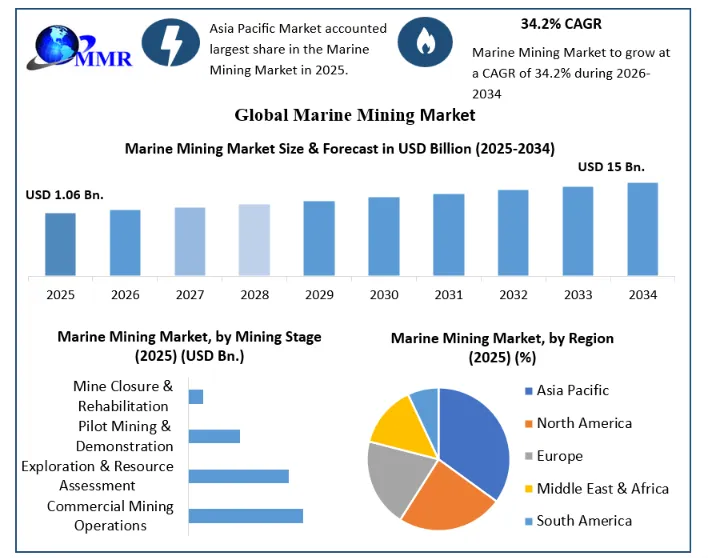
Marine Mining Market Growth Outlook

To know about the Research Methodology:-Request Free Sample Report

Marine Mining Market Dynamics

Increasing Critical Mineral Demand Across Battery and Industrial Manufacturing

The Marine Mining Market experiences growing demand due to the increasing need for nickel, cobalt, copper, and manganese in electric vehicle batteries, energy storage systems, electronics, and industrial equipment. Polymetallic nodules contain valuable metals that support battery cathode production, electrical conductivity, and advanced manufacturing applications. Growing interest in diversifying critical mineral supply chains encourages investment in marine mineral exploration and seabed resource assessment. The development of offshore mineral resources supports Marine Mining Market growth, particularly as manufacturers seek long-term access to essential raw materials.

High Capital Investment and Complex Extraction Economics Limit Commercial Development

The Marine Mining Market faces financial limitations due to the high cost of deep-sea exploration, specialized mining vessels, subsea collection equipment, and mineral lifting infrastructure. Commercial marine mining projects require substantial expenditure on underwater robotics, hydraulic lifting systems, mineral processing facilities, and offshore logistics. Operations at depths of 4,000–6,000 meters, particularly for polymetallic nodule collection, require pressure-resistant equipment and advanced engineering capabilities. High initial investment, uncertain mineral recovery economics, and lengthy project development cycles restrict participation by smaller companies and influence the Marine Mining Market investment outlook.

Advanced Underwater Mining Technologies Create New Commercial Opportunities

The Marine Mining Market presents growth opportunities through the development of autonomous underwater vehicles (AUVs), remotely operated vehicles (ROVs), hydraulic dredging systems, and subsea mineral collection equipment. Advanced sonar mapping systems support high-resolution seabed surveys, while underwater robotics improve mineral deposit identification and reduce dependence on manual operations. Marine exploration services, equipment leasing, environmental monitoring, and offshore engineering contracts create additional revenue opportunities for technology providers. Increasing investment in deep-sea mining technology strengthens opportunities for equipment manufacturers, marine survey companies, and mineral recovery specialists.

Marine Ecosystem Protection and Regulatory Uncertainty Complicate Project Execution

The Marine Mining Market encounters significant challenges related to seabed ecosystem disturbance, sediment plume generation, biodiversity protection, and environmental monitoring requirements. Deep-sea mineral extraction activities create concerns about habitat disruption, underwater noise, and long-term ecological effects. Mining companies require environmental baseline studies, sediment monitoring systems, biodiversity assessments, and regulatory approvals before advancing commercial projects. Uncertainty surrounding international seabed mining regulations and environmental standards complicates project scheduling and investment decisions. These factors increase compliance expenditure and influence the Marine Mining Market forecast 2025–2034.

Autonomous Seabed Collection and Digital Monitoring Transform Mining Operations

The Marine Mining Market demonstrates increasing adoption of artificial intelligence, underwater automation, digital twins, and real-time seabed monitoring technologies. Autonomous underwater vehicles equipped with sonar, cameras, and environmental sensors improve exploration accuracy and support continuous collection of geological data. Predictive maintenance systems support equipment reliability, while digital mapping technologies improve mineral deposit assessment and extraction planning. Energy-efficient lifting systems, remotely controlled seabed collectors, and integrated environmental monitoring platforms influence Marine Mining Market trends, supporting greater operational efficiency and technological differentiation among marine mining equipment manufacturers.

Marine Mining Market Segment Analysis

By Mining Technology

The Hydraulic Dredging & Suction Collection segment holds a significant position in the Marine Mining Market, supported by its application in seabed sediment extraction, marine aggregate recovery, and mineral collection. Hydraulic systems use suction pumps and pipelines to transport mineral-bearing materials from the seabed to processing facilities. Mechanical Dredging & Excavation supports shallow-water mineral extraction, while Seabed Robotic Collection Systems improve precision in deep-sea mining operations. Continuous Line Bucket Systems represent an alternative extraction technology for collecting seabed mineral deposits. Increasing demand for automated underwater mining equipment, efficient mineral recovery systems, and advanced subsea technologies supports Marine Mining Market growth.
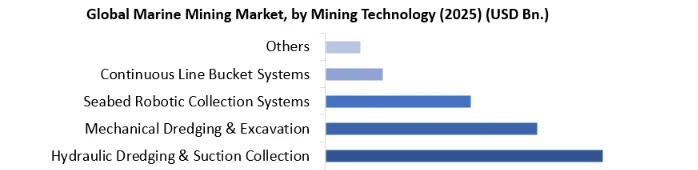
Marine Mining by Mining Technology

By End-Use Industry

The Battery & Energy Storage Manufacturing segment represents an important demand area in the Marine Mining Market, driven by the need for nickel, cobalt, manganese, and copper in lithium-ion batteries and energy storage applications. Electronics & Electrical Equipment Manufacturing uses copper and specialty minerals for electronic components and electrical infrastructure, while Automotive & Transportation Manufacturing requires critical metals for electric vehicles and advanced mobility systems. Construction & Infrastructure utilizes marine sand and gravel, whereas Industrial Manufacturing & Metal Processing uses recovered minerals for alloys and industrial products. Agriculture & Fertilizer Manufacturing benefits from marine phosphate resources, while Jewelry & Precious Metal Products uses recovered gold and silver. Expanding industrial applications and critical mineral requirements support the global Marine Mining Market outlook for 2025–2034.
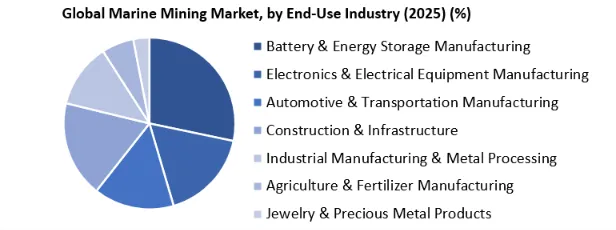
Marine Mining by End Users

Marine Mining Market Regional Insights

Asia Pacific holds a prominent position in the Marine Mining Market, supported by extensive offshore mineral exploration programs, advanced subsea technologies, and growing demand for critical minerals. China, Japan, India, and South Korea invest in polymetallic nodule exploration, seabed mapping, and underwater mining equipment development. The region benefits from strong battery manufacturing, electronics production, and marine engineering capabilities. Government-supported research initiatives and technological innovation strengthen Asia Pacific Marine Mining Market growth, particularly in deep-sea mineral resource assessment and extraction technology development.

North America represents an important region in the Marine Mining Market, driven by critical mineral supply security, private investment, and advanced offshore engineering capabilities. The United States and Canada support marine mineral exploration, autonomous underwater vehicle development, and subsea mineral collection technologies. Companies such as The Metals Company and Impossible Metals contribute to resource development and technology innovation. Demand for nickel, cobalt, copper, and manganese supports North America Marine Mining Market opportunities across battery manufacturing, industrial processing, and energy storage applications.

Europe maintains a significant position in the Marine Mining Market through advanced offshore engineering, underwater robotics, and marine mineral exploration technologies. Germany, France, the Netherlands, and the United Kingdom contribute to subsea equipment manufacturing, marine geological surveys, and offshore extraction system development. Companies such as Allseas, Royal IHC, and Fugro strengthen regional technological capabilities. Environmental regulations and sustainability requirements influence project development, creating opportunities for Europe Marine Mining Market growth in monitoring systems, marine engineering services, and responsible resource exploration.

The Middle East & Africa Marine Mining Market benefits from established offshore diamond extraction activities, mineral-rich coastal areas, and marine resource exploration. Namibia plays an important role through marine diamond recovery operations, with companies such as Debmarine Namibia contributing to offshore mineral production. Demand for specialized mining vessels, seabed collection equipment, and mineral recovery technologies supports regional industry development. Investments in offshore infrastructure and exploration services create Marine Mining Market opportunities across marine mineral extraction and processing activities.

South America represents an emerging region in the Marine Mining Market, supported by offshore mineral resource potential, coastal geological exploration, and demand for industrial minerals. Brazil, Chile, and Argentina present opportunities for marine geological surveys, seabed mineral assessment, and offshore mining equipment services. Marine sand, gravel, and heavy mineral deposits support construction and industrial applications. Increasing interest in underwater exploration technologies and resource mapping strengthens the South America Marine Mining Market outlook, while environmental requirements and project financing influence commercial development.

Marine Mining Market Competitive Landscape

The Marine Mining Market features a developing competitive landscape comprising mineral exploration companies, subsea equipment manufacturers, offshore engineering firms, and marine technology providers. Competition focuses on mineral resource access, exploration licenses, extraction efficiency, technological innovation, and commercial project readiness. Leading participants such as The Metals Company, Allseas, Impossible Metals, Royal IHC, Kongsberg Maritime, and Global Sea Mineral Resources (DEME Group) strengthen their market positions through specialized technologies, strategic partnerships, and marine resource development activities. Companies compete in polymetallic nodule exploration, seabed collection systems, underwater robotics, and mineral recovery technologies. Regulatory compliance, capital availability, and environmental performance influence competitive positioning across the global Marine Mining Market.

A significant competitive development in the Marine Mining Market is the partnership between The Metals Company and Allseas, which focuses on developing an integrated polymetallic nodule collection system with a planned production capacity of 3 million wet metric tons annually, subject to regulatory approvals. The collaboration strengthens competition in deep-sea mineral recovery, offshore infrastructure, and critical mineral supply chain development. Meanwhile, companies such as Impossible Metals focus on autonomous seabed collection technology, while Kongsberg Maritime and Royal IHC compete through specialized subsea engineering and equipment solutions. Across the Marine Mining Market forecast 2025–2034, technology reliability, environmental compliance, project financing, and successful commercialization remain important factors shaping competitive advantage.

Marine Mining Market Scope: Inquire before buying

Marine Mining Market
Report Coverage Details
Base Year: 2025 Forecast Period: 2026-2034
Historical Data: 2020to 2025 Market Size in 2025: USD 1.06 Bn.
Forecast Period 2026 to 2036 CAGR: 34.2% Market Size in 2034: USD 15 Bn.
Segments Covered: by Resource Type Polymetallic Nodules
Seafloor Massive Sulfide Deposits
Cobalt-Rich Ferromanganese Crusts
Marine Placer Deposits
Heavy Mineral Sands
Marine Gold & Precious Metal Placers
Other Marine Placer Deposits
Marine Aggregates
Marine Sand
Marine Gravel
Marine Phosphorite Deposits
Others
by Mining Technology Hydraulic Dredging & Suction Collection
Mechanical Dredging & Excavation
Seabed Robotic Collection Systems
Continuous Line Bucket Systems
Others
by Mining Stage Exploration & Resource Assessment
Pilot Mining & Demonstration
Commercial Mining Operations
Mine Closure & Rehabilitation
Others
by Depth of Operation Shallow-Water Mining
Deep-Sea Mining
by Target Mineral Manganese
Nickel
Copper
Cobalt
Zinc
Gold & Silver
Titanium & Zirconium Minerals
Phosphate Minerals
Construction Aggregates
Other Minerals
by End-Use Industry Battery & Energy Storage Manufacturing
Electronics & Electrical Equipment Manufacturing
Automotive & Transportation Manufacturing
Construction & Infrastructure
Industrial Manufacturing & Metal Processing
Agriculture & Fertilizer Manufacturing
Jewelry & Precious Metal Products
Other End-Use Industries

Marine Mining Market, by Region

North America (United States, Canada and Mexico)
Europe (UK, France, Germany, Italy, Spain, Sweden, Austria, Turkey, Russia and Rest of Europe)
Asia Pacific (China, India, Japan, South Korea, Australia, ASEAN and Rest of APAC)
Middle East and Africa (South Africa, GCC, Egypt, Nigeria and Rest of ME&A)
South America (Brazil, Argentina, Columbia and Rest of South America)

Marine Mining Market Key Players

1. The Metals Company
2. Ocean Minerals LLC
3. Impossible Metals
4. Odyssey Marine Exploration
5. Deep Ocean Engineering
6. RJE International
7. Teledyne Marine
8. Diamond Fields Resources
9. Neptune Minerals
10. Greensea IQ
11. Oceaneering International
12. VideoRay
13. Global Sea Mineral Resources (DEME Group)
14. Loke Marine Minerals
15. Soil Machine Dynamics
16. Royal IHC
17. Allseas
18. Kongsberg Maritime
19. Acteon Group
20. Adepth Minerals
21. Scandinavian Ocean Minerals
22. Fugro
23. Boskalis
24. TechnipFMC
25. DeepOcean
26. UK Seabed Resources
27. China Minmetals Corporation
28. China Ocean Mineral Resources Research and Development Association (COMRA)
29. Japan Organization for Metals and Energy Security (JOGMEC)
30. Deep Ocean Resources Development Co. (DORD)
31. Keppel
32. Japan Agency for Marine-Earth Science and Technology (JAMSTEC)
33. National Institute of Ocean Technology (NIOT)
34. Geological Survey of India (GSI)
35. Korea Institute of Ocean Science and Technology (KIOST)
36. Mariscope
37. Marine Mining Corp.
38. Interoceanmetal Joint Organization
39. Tonga Offshore Mining Limited
40. Nauru Ocean Resources Inc. (NORI)
41. Debmarine Namibia
42. De Beers Marine
43. Trans Hex Group
44. Marawa Research and Exploration Ltd.

Frequently Asked Questions:

1. What is the Marine Mining Market size in 2025?
The Marine Mining Market is valued at USD 1.06 Billion in 2025 and is projected to reach USD 15 Billion by 2034, at a CAGR of 34.2%.

2. What factors drive the Marine Mining Market growth?
Increasing demand for critical minerals, battery manufacturing, renewable energy technologies, and offshore mineral exploration supports market growth.

3. Which region leads the Marine Mining Market?
Asia Pacific holds a prominent position, supported by marine mineral exploration and technological advancements in China, Japan, and India.

4. What are the major segments of the Marine Mining Market?
The market is segmented by resource type, mining technology, mining stage, depth of operation, target mineral, end-use industry, and region.

5. Who are the key players in the Marine Mining Market?
Key players include The Metals Company, Allseas, Impossible Metals, Royal IHC, Kongsberg Maritime, and China Minmetals Corporation.

Table of Contents

1. Executive Market Landscape and Industry Overview 1.1. Global Marine Mining Market Size (Value USD Billion and Volume MT), 2025–2034 1.2. Market Definition, Scope, Resource Classification and Product Framework 1.3. Global Marine Mining Value Chain and Industry Ecosystem Assessment 1.4. Market Attractiveness Analysis by Resource Type, Technology and Geography 1.5. Marine Mineral Resource Availability and Commercial Development Potential Assessment 2. Global Marine Mining Market Dynamics 2.1. Global Marine Mining Market Trends 2.2. Global Marine Mining Market Dynamics 2.2.1. Drivers 2.2.2. Restraints 2.2.3. Opportunities 2.2.4. Challenges 2.3. PORTER’s Five Forces Analysis 2.4. PESTLE Analysis 3. Marine Mineral Resource Base and Deposit Distribution Analysis 3.1. Global Distribution of Polymetallic Nodules Across Major Ocean Basins 3.2. Seafloor Massive Sulfide Deposit Locations and Resource Potential Assessment 3.3. Cobalt-Rich Ferromanganese Crust Distribution Across Underwater Seamounts 3.4. Regional Marine Mineral Resource Availability and Geological Characteristics 3.5. Resource Grade, Mineral Composition and Estimated Deposit Size Assessment 3.6. Exploration Status and Commercial Readiness of Identified Marine Deposits 4. Regulatory Framework and Environmental Compliance Requirements 4.1. International Seabed Authority Regulations and Deep-Sea Mining Governance Framework 4.2. United Nations Convention on the Law of the Sea Requirements 4.3. National Licensing Frameworks and Offshore Mineral Exploration Permitting Requirements 4.4. Environmental Impact Assessment and Marine Biodiversity Protection Requirements 4.5. Seabed Mining Compliance, Monitoring and Environmental Management Standards 4.6. Regulatory Uncertainty, Moratoriums and Commercial Mining Approval Considerations 5. Marine Mining Technology and Extraction Systems Analysis 5.1. Continuous Line Bucket Systems and Seabed Collection Technology Assessment 5.2. Hydraulic Suction Systems and Mineral Lifting Technology Performance Evaluation 5.3. Remotely Operated Vehicles and Underwater Mining Equipment Deployment Analysis 5.4. Sonar Mapping and Marine Seismic Survey Technology Assessment 5.5. Subsea Collection Machines, Risers and Surface Support System Integration 5.6. Emerging Autonomous Extraction Technologies and Equipment Innovation Outlook 6. Marine Mining Pricing and Cost Structure Analysis 6.1. Marine Mining Equipment Pricing and Technology-Wise Cost Benchmarking 6.2. Exploration, Surveying and Marine Resource Assessment Expenditure Analysis 6.3. Seabed Collection, Lifting and Mineral Recovery Cost Structure Evaluation 6.4. Offshore Vessel, Support Infrastructure and Logistics Cost Assessment 6.5. Environmental Monitoring, Compliance and Marine Restoration Cost Considerations 6.6. Project Capital Expenditure, Operating Costs and Economic Feasibility Assessment 7. Marine Mining Project Pipeline and Development Lifecycle Analysis 7.1. Global Marine Mineral Exploration Projects and Development Pipeline Assessment 7.2. Exploration License Distribution and Contract Holder Portfolio Analysis 7.3. Pilot Mining Programs and Technology Demonstration Project Assessment 7.4. Project Development Timelines and Commercial Readiness Benchmarking 7.5. Project-Level Capital Requirements and Investment Commitment Assessment 7.6. Delays, Project Cancellations and Development Risk Evaluation 8. Environmental Impact and Sustainability Assessment 8.1. Seabed Disturbance and Marine Habitat Disruption Impact Assessment 8.2. Sediment Plume Generation and Ocean Ecosystem Exposure Analysis 8.3. Biodiversity Risks Across Deep-Sea Mining Locations and Resource Zones 8.4. Noise, Light and Underwater Pollution Impact Assessment 8.5. Environmental Baseline Studies and Long-Term Monitoring Requirements 8.6. Sustainability Standards, Mitigation Measures and Marine Restoration Outlook 9. Marine Mining Exploration and Survey Technology Adoption Analysis 9.1. Remotely Operated Vehicle Deployment Across Marine Exploration Projects 9.2. Autonomous Underwater Vehicle Adoption and Survey Capability Assessment 9.3. Sonar Systems for Seabed Mapping and Deposit Identification 9.4. Marine Seismic Methods for Sub-Seafloor Geological Resource Assessment 9.5. Exploration Technology Investment and Equipment Procurement Trend Analysis 9.6. Digital Mapping, Artificial Intelligence and Data Analytics Integration Outlook 10. Global Marine Mining Equipment Trade Flow and Manufacturing Landscape 10.1. Global Marine Mining Equipment Trade Flow and Import Dependency Assessment 10.2. Equipment Imports and Exports by Major Technology Category 10.3. Major Equipment Manufacturing Countries and International Supplier Assessment 10.4. Regional Equipment Manufacturing Capabilities and Export Opportunities 10.5. International Supplier Networks and Cross-Border Equipment Procurement Analysis 10.6. Trade Barriers, Equipment Availability and Import Dependency Risks 11. Marine Mining Equipment Supply Chain and Procurement Risk Analysis 11.1. Offshore Vessel Availability and Specialized Equipment Supply Constraints 11.2. Critical Components, Subsea Systems and Raw Material Sourcing Analysis 11.3. Equipment Procurement Lead Times and Supplier Delivery Performance Assessment 11.4. Supply Chain Vulnerability and Dependence on Specialized Suppliers 11.5. Offshore Equipment Transportation, Mobilization and Logistics Cost Assessment 11.6. Equipment Maintenance, Spare Parts Availability and Technical Support Requirements 12. Target Mineral and Critical Metals Demand Analysis 12.1. Global Marine Mining Resource Potential by Target Mineral Category 12.2. Manganese Resource Availability and Industrial Demand Outlook Assessment 12.3. Nickel and Cobalt Resource Potential for Battery Manufacturing Applications 12.4. Copper and Zinc Resource Availability for Industrial Applications 12.5. Gold, Silver and Other Marine Mineral Recovery Potential Assessment 12.6. Critical Mineral Demand Trends and Terrestrial Supply Diversification Opportunities 13. Marine Mining Project Investment and Expansion Analysis 13.1. Global Marine Mining Greenfield Project Pipeline and Investment Assessment 13.2. Existing Exploration Contract Expansion and Project Development Opportunities 13.3. Project-Wise Equipment Requirements and Procurement Investment Forecasting 13.4. Public Funding, Private Capital and Strategic Investment Activity Analysis 13.5. Project Commissioning Timelines and Commercial Extraction Readiness Assessment 13.6. Investment Risks, Financing Constraints and Long-Term Project Viability Analysis 14. Offshore Support Infrastructure and Mineral Transportation Analysis 14.1. Offshore Vessel Requirements for Marine Mining Operations and Exploration 14.2. Subsea Lifting Systems and Mineral Transportation Infrastructure Assessment 14.3. Surface Support Vessels and Offshore Processing System Requirements 14.4. Port Facilities, Mineral Handling and Storage Infrastructure Evaluation 14.5. Offshore Logistics Networks and Remote Operating Location Accessibility Assessment 14.6. Infrastructure Investment Requirements for Commercial Marine Mining Development 15. Market Outlook by Resource Type and Revenue Contribution 15.1. Polymetallic Nodules Market Size, Share and Growth Forecast Analysis 15.2. Polymetallic Sulfide Deposits Market Outlook and Revenue Contribution Assessment 15.3. Cobalt-Rich Ferromanganese Crusts Market Outlook and Development Potential 15.4. Other Marine Mineral Deposits Market Opportunity and Growth Assessment 15.5. Resource Type-Wise Project Pipeline and Commercialization Readiness Comparison 15.6. Resource Type-Wise Market Share and Forecast Growth Analysis (2025–2034) 16. Market Outlook by Mining Technology and Extraction Systems 16.1. Continuous Line Bucket Systems Market Outlook and Adoption Forecast 16.2. Hydraulic Suction Systems Market Outlook and Deployment Potential Assessment 16.3. Alternative Seabed Extraction Systems Market Opportunity and Technology Development 16.4. Extraction Technology-Wise Equipment Investment and Project Deployment Analysis 16.5. Technology Performance, Recovery Efficiency and Operating Cost Benchmarking 16.6. Technology-Wise Market Share and Forecast Growth Analysis (2025–2034) 17. Market Outlook by Mining Activity and Development Stage 17.1. Marine Mineral Exploration Activity and Revenue Opportunity Assessment 17.2. Environmental Studies and Monitoring Activity Outlook and Expenditure Analysis 17.3. Mining Equipment Development Activity and Investment Trend Assessment 17.4. Pilot Mining Programs and Testing Activity Development Outlook 17.5. Commercial Extraction Readiness and Project Advancement Assessment 17.6. Mining Activity-Wise Investment Outlook and Development Pipeline Forecasting 18. Investment, Funding and Strategic Partnership Analysis 18.1. Global Marine Mining Investment Trends and Capital Allocation Assessment 18.2. Public Sector Funding and Government-Backed Research Program Analysis 18.3. Private Equity, Institutional Capital and Strategic Investor Participation 18.4. Technology Development Funding and Equipment Innovation Investment Analysis 18.5. Joint Ventures, Strategic Alliances and International Partnership Assessment 18.6. Mergers, Acquisitions and Emerging Marine Mining Investment Opportunities 19. Innovation Shaping Future Marine Mining Technology Development 19.1. Autonomous Underwater Mining Systems and Intelligent Equipment Innovation 19.2. Advanced Seabed Collection Machines and Mineral Recovery Technology Development 19.3. Artificial Intelligence Applications in Marine Exploration and Resource Mapping 19.4. Digital Twins, Predictive Maintenance and Remote Operations Integration 19.5. Energy Efficiency Improvements in Offshore Mining and Lifting Systems 19.6. Emerging Technologies Supporting Safer and More Efficient Marine Mining 20. Marine Mining Value Chain and Distribution Network Assessment 20.1. Marine Mining Value Chain Structure and Stakeholder Ecosystem Assessment 20.2. Exploration Contractors, Equipment Suppliers and Technology Developer Relationships 20.3. Offshore Vessel Operators and Specialized Marine Service Provider Assessment 20.4. Mineral Recovery, Transportation and Downstream Processing Network Analysis 20.5. Procurement Contracts, Supplier Relationships and Equipment Service Arrangements 20.6. Value Chain Bottlenecks, Operational Dependencies and Supply Resilience Assessment 21. Comparative Analysis by Marine Mining Resource Type 21.1. Polymetallic Nodules versus Sulfide Deposits Resource Characteristics Comparison 21.2. Cobalt-Rich Crusts versus Other Deposits Commercial Potential Comparison 21.3. Resource Grade, Mineral Composition and Recovery Complexity Benchmarking 21.4. Deposit Depth, Geological Conditions and Accessibility Requirements Comparison 21.5. Environmental Exposure and Resource-Specific Development Challenges Assessment 21.6. Resource Type-Wise Investment Attractiveness and Commercial Readiness Comparison 22. Comparative Analysis of Marine Mining Extraction Technologies 22.1. Continuous Line Bucket versus Hydraulic Suction System Performance Comparison 22.2. Mineral Collection Efficiency and Recovery Rate Benchmarking Across Technologies 22.3. Capital Investment and Operating Cost Comparison by Extraction System 22.4. Deployment Depth, Equipment Reliability and Operational Flexibility Assessment 22.5. Environmental Disturbance and Sediment Plume Generation Technology Comparison 22.6. Technology Selection Criteria and Project-Specific Extraction System Evaluation 23. Long-Term Market Evolution and Structural Shifts 23.1. Evolution of Marine Mineral Exploration Toward Commercial Extraction Operations 23.2. Critical Mineral Security and Terrestrial Resource Diversification Impact Analysis 23.3. Technological Advancements Reshaping Deep-Sea Mining Project Economics 23.4. Environmental Governance and Regulatory Changes Influencing Industry Development 23.5. Commercial Investment Trends and Emerging Marine Mining Business Models 23.6. Long-Term Market Opportunities and Structural Transformation Outlook Through 2034 24. Competitive Landscape and Key Participant Positioning Analysis 24.1. Global Marine Mining Industry Structure and Competitive Positioning Assessment 24.2. Marine Mineral Exploration Contractors and License Holder Portfolio Analysis 24.3. Marine Mining Equipment Manufacturers and Technology Provider Benchmarking 24.4. Strategic Partnerships, Joint Ventures and Consortium Development Analysis 24.5. Competitive Strengths, Technology Differentiation and Project Capability Assessment 24.6. Market Entry Barriers and Long-Term Competitive Advantage Evaluation 25. Global Marine Mining Market: Market Size and Forecast by Segmentation(By Value in USD Billion Volume in MT) 2025–2034 25.1. Global Marine Mining Market Size and Forecast, By Resource Type 25.1.1. Polymetallic Nodules 25.1.2. Seafloor Massive Sulfide Deposits 25.1.3. Cobalt-Rich Ferromanganese Crusts 25.1.4. Marine Placer Deposits 25.1.4.1. Heavy Mineral Sands 25.1.4.2. Marine Gold & Precious Metal Placers 25.1.5. Marine Aggregates 25.1.5.1. Marine Sand 25.1.5.2. Marine Gravel 25.1.6. Marine Phosphorite Deposits 25.2. Global Marine Mining Market Size and Forecast, By Mining Technology 25.2.1. Hydraulic Dredging & Suction Collection 25.2.2. Mechanical Dredging & Excavation 25.2.3. Seabed Robotic Collection Systems 25.2.4. Continuous Line Bucket Systems 25.3. Global Marine Mining Market Size and Forecast, By Mining Stage 25.3.1. Exploration & Resource Assessment 25.3.2. Pilot Mining & Demonstration 25.3.3. Commercial Mining Operations 25.3.4. Mine Closure & Rehabilitation 25.4. Global Marine Mining Market Size and Forecast, By Depth of Operation 25.4.1. Shallow-Water Mining 25.4.2. Deep-Sea Mining 25.5. Global Marine Mining Market Size and Forecast, By Target Mineral 25.5.1. Manganese 25.5.2. Nickel 25.5.3. Copper 25.5.4. Cobalt 25.5.5. Zinc 25.5.6. Gold & Silver 25.5.7. Titanium & Zirconium Minerals 25.5.8. Phosphate Minerals 25.5.9. Construction Aggregates 25.6. Global Marine Mining Market Size and Forecast, By End-Use Industry 25.6.1. Battery & Energy Storage Manufacturing 25.6.2. Electronics & Electrical Equipment Manufacturing 25.6.3. Automotive & Transportation Manufacturing 25.6.4. Construction & Infrastructure 25.6.5. Industrial Manufacturing & Metal Processing 25.6.6. Agriculture & Fertilizer Manufacturing 25.6.7. Jewelry & Precious Metal Products 25.7. Global Marine Mining Market Size and Forecast, By Region 26. Competitive Landscape 26.1. MMR Competition Matrix 26.2. Competitive Positioning of Leading Marine Mining Companies [Revenue and Market Share (%)] 26.3. Key Players Benchmarking 26.3.1. Company Name 26.3.2. Headquarters 26.3.3. Marine Mining Technology and Resource Portfolio 26.3.4. Exploration Projects and Extraction Capabilities 26.3.5. Market Share (%) (2025) 26.3.6. R&D Investment 26.3.7. Revenue, (2025) 26.3.8. Revenue Growth Rate (Y-O-Y) 26.3.9. Profit Margin (%) 26.3.10. Certifications and Classification Approvals 26.3.11. Customer and OEM Relationships 26.3.12. Geographical Presence 26.4. Market Structure 26.4.1. Market Leaders 26.4.2. Market Followers 26.4.3. Emerging Players 26.5. Recent Key Developments 26.5.1. Sustainability & ESG Positioning 27. Competitive Landscape and Industry Structure Analysis 27.1. Market Concentration Across the Global Marine Mining Industry 27.2. Competitive Positioning Across Nodules, Sulfides and Cobalt-Rich Crusts 27.3. Comparison of Marine Mining Technologies and Extraction System Capabilities 27.4. Resource Exploration, Geological Assessment and Mineral Recovery Differentiation 27.5. Project Portfolio Breadth and Marine Resource Development Coverage Comparison 27.6. Environmental Performance, Sustainability Practices and Regulatory Compliance Benchmarking 27.7. Technology Differentiation Across Exploration, Collection and Mineral Lifting Systems 27.8. Strategic Positioning Across Commercial Readiness and Development Stages 28. Company Market Share and Positioning Analysis (2025) 28.1. Market Share and Competitive Positioning of Leading Marine Mining Participants 28.2. Global Positioning Across Marine Mining Contractors and Technology Developers 28.3. Polymetallic Nodule Exploration and Development Project Positioning 28.4. Seafloor Massive Sulfide Exploration and Development Positioning 28.5. Cobalt-Rich Ferromanganese Crust Project Portfolio Positioning 29. Strategic Initiatives and Expansion Strategy Analysis 29.1. Marine Mineral Exploration and Project Development Expansion Strategies 29.2. Expansion of Seabed Collection and Mineral Extraction Technology Capabilities 29.3. Development of Advanced Underwater Mining Equipment and Systems 29.4. Expansion of Exploration Licenses and Contracted Marine Resource Areas 29.5. Strategic Partnerships, Joint Ventures and Consortium Development Activities 29.6. Regional Expansion and International Market Entry Strategies 30. Financial Performance and Profitability Benchmarking 30.1. Revenue Growth Trends Across Marine Mining Industry Participants 30.2. Profitability and Financial Performance of Leading Marine Mining Companies 30.3. Exploration Expenditure and Project Development Investment Analysis 30.4. Research and Development Spending Across Marine Mining Technology Providers 30.5. Capital Expenditure and Equipment Investment Benchmarking 30.6. Funding Sources, Financing Structures and Capital Availability Assessment 30.7. Impact of Commodity Prices and Regulatory Uncertainty on Financial Performance 31. Innovation Leadership and R&D Investment Analysis 31.1. Research and Development Investment Across Marine Mining Participants 31.2. Advanced Seabed Collection and Mineral Recovery Technology Innovation 31.3. Autonomous Underwater Vehicles and Remote Operations Technology Development 31.4. Subsea Mineral Lifting, Pumping and Transportation System Innovation 31.5. Artificial Intelligence and Digital Mapping Applications in Marine Exploration 31.6. Environmental Monitoring, Sediment Control and Ecosystem Protection Technologies 31.7. Automation, Robotics and Equipment Reliability Improvement Initiatives 31.8. Future Technology Pipelines and Emerging Marine Mining Opportunities 32. Marine Mining Ecosystem, Technology Partnerships and Strategic Collaboration Analysis 32.1. Marine Mining Company and Technology Developer Partnerships 32.2. Exploration Contractors and Marine Survey Provider Relationships 32.3. Marine Mining Equipment Manufacturer and Operator Collaboration 32.4. Offshore Vessel Operators and Subsea Engineering Partner Relationships 32.5. Mineral Processing Companies and Downstream Customer Partnerships 32.6. Research Institutions, Universities and Government Collaboration Initiatives 32.7. Environmental Organizations and Marine Science Research Partnerships 32.8. Future Strategic Collaboration Opportunities Across the Marine Mining Ecosystem 33. End-Use Industry Demand and Mineral Offtake Analysis 33.1. Battery Technologies and Energy Storage Mineral Demand Outlook Assessment 33.2. Electronics and Electrical Equipment Industry Mineral Consumption Analysis 33.3. Automotive and Electric Vehicle Industry Critical Mineral Demand Assessment 33.4. Construction and Industrial Manufacturing Mineral Demand Forecast Analysis 33.5. Precious Metals Refining and Industrial Processing Demand Evaluation 33.6. Mineral Offtake Agreements and Downstream Customer Procurement Strategy Assessment 34. Company and Organization Profiles 40+ 34.1. Overview 34.2. Business Portfolio 34.3. Financial Overview 34.4. SWOT Analysis 34.5. Strategic Analysis 34.6. Recent Developments 34.7. The Metals Company 34.8. Ocean Minerals LLC 34.9. Impossible Metals 34.10. Odyssey Marine Exploration 34.11. Deep Ocean Engineering 34.12. RJE International 34.13. Teledyne Marine 34.14. Diamond Fields Resources 34.15. Neptune Minerals 34.16. Greensea IQ 34.17. Oceaneering International 34.18. VideoRay 34.19. Global Sea Mineral Resources (DEME Group) 34.20. Loke Marine Minerals 34.21. Soil Machine Dynamics 34.22. Royal IHC 34.23. Allseas 34.24. Kongsberg Maritime 34.25. Acteon Group 34.26. Adepth Minerals 34.27. Scandinavian Ocean Minerals 34.28. Fugro 34.29. Boskalis 34.30. TechnipFMC 34.31. DeepOcean 34.32. UK Seabed Resources 34.33. China Minmetals Corporation 34.34. China Ocean Mineral Resources Research and Development Association (COMRA) 34.35. Japan Organization for Metals and Energy Security (JOGMEC) 34.36. Deep Ocean Resources Development Co. (DORD) 34.37. Keppel 34.38. Japan Agency for Marine-Earth Science and Technology (JAMSTEC) 34.39. National Institute of Ocean Technology (NIOT) 34.40. Geological Survey of India (GSI) 34.41. Korea Institute of Ocean Science and Technology (KIOST) 34.42. Mariscope 34.43. Marine Mining Corp. 34.44. Interoceanmetal Joint Organization 34.45. Tonga Offshore Mining Limited 34.46. Nauru Ocean Resources Inc. (NORI) 34.47. Debmarine Namibia 34.48. De Beers Marine 34.49. Trans Hex Group 34.50. Marawa Research and Exploration Ltd. 35. Key Findings 36. Strategic Moves & Industry Outlook 37. Research Methodology

Custom Market Research Services

We Will Customise The Research For You, In Case The Report Listed Above Does Not Meet With Your Requirements