
Low Temperature Coatings Market by Resin Type, by Technology, by Substrate, by End-Use Industry and Regional Insights 2034
Overview
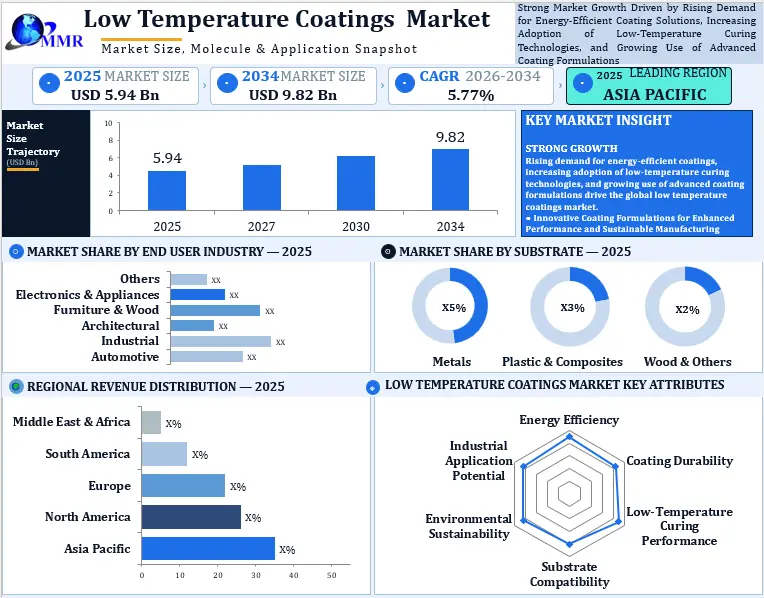
The Global Low Temperature Coatings Market size was valued at USD 5.94 billion in 2025 and is expected to grow at a CAGR of 5.77% from 2026 to 2034, reaching USD 9.82 billion by 2034.
Global Low Temperature Coatings Market Overview:
Low temperature coatings are specialized coatings designed to cure and perform effectively under low-temperature conditions, including applications where conventional coatings require higher curing temperatures. These coatings offer the ability to cure at temperatures as low as 0°C, depending on their formulation, making them suitable for cold environments and temperature-sensitive applications. They maintain essential properties such as flexibility, adhesion, durability, and impact resistance on metal surfaces exposed to low temperatures. Their use supports protective coating applications in industries such as automotive, construction, industrial equipment, and infrastructure, where reliable surface protection and reduced curing requirements improve operational efficiency. Growing demand for durable protective coatings, maintenance solutions in cold climates, and energy-efficient coating processes supports the adoption of low temperature coatings across diverse industrial applications.
The Global Low Temperature Coatings Market report provides a comprehensive analysis of the industry, including market dynamics, growth drivers, challenges, emerging trends, and key players. The report evaluates the market from both demand- and supply-side perspectives across major segments, highlighting developments in coating technologies, material innovations, investment opportunities, and competitive strategies. It also examines market segmentation, regional performance, and the factors influencing product adoption across various end-use industries, providing insights into the industry's growth prospects and competitive landscape.
Low Temperature Coatings Market Growth and Share Analysis
To know about the Research Methodology :- Request Free Sample Report
Global Low Temperature Coatings Market Key Highlights
• Market Size and Growth: The global low temperature coatings market reaches USD 5.94 billion in 2025 and grows at a CAGR of 5.77% from 2026 to 2034, reaching USD 9.82 billion by 2034.
• Energy-Efficient Curing: Increasing demand for energy-efficient manufacturing processes drives the adoption of low temperature coatings, reducing curing energy requirements while maintaining coating durability and performance.
• Technology Leadership: Powder coatings hold a prominent position due to their durable finishes, resistance to corrosion and chemicals, and suitability for diverse industrial applications.
• Resin Type Opportunities: Polyester resins support demand across protective coating applications, while acrylic resins offer growth opportunities through their versatile performance characteristics and applications in automotive and heavy-duty equipment coatings.
• Regional Leadership: Asia Pacific leads the global low temperature coatings market, supported by expanding automotive manufacturing, rapid industrialization, infrastructure development, and increasing demand for protective coatings.
• Competitive Landscape: Major players, including PPG Industries, Akzo Nobel, The Sherwin-Williams Company, BASF, and Axalta Coating Systems, focus on advanced coating formulations, low-temperature curing technologies, product innovation, and energy-efficient solutions to strengthen their market positions.
Low Temperature Coatings Market Dynamics:
Global Low Temperature Coatings Market Drivers
The global low temperature coatings market benefits from increasing demand for energy-efficient coating technologies across automotive, construction, electronics, and industrial manufacturing. These coatings cure at lower temperatures than conventional coatings, reducing energy consumption and supporting cost-effective manufacturing. Lower curing temperatures also enable manufacturers to coat heat-sensitive substrates, including plastics, composites, and medium-density fibreboard (MDF), without compromising material integrity. Industrial coating processes that reduce curing temperatures from 180°C to approximately 100°C can achieve energy savings of 40%–60% under suitable operating conditions, strengthening the economic benefits of low-temperature curing technologies.
Global Low Temperature Coatings Market Restraints
The global low temperature coatings market faces challenges related to formulation costs, substrate compatibility, and performance consistency. Specialized resins, curing agents, and additives increase production costs, particularly for coatings that require enhanced corrosion resistance, chemical stability, and durability at reduced curing temperatures. Manufacturers also encounter technical limitations when developing formulations that deliver consistent adhesion and surface hardness under different application conditions. In addition, replacing conventional coating systems requires adjustments to application equipment, curing processes, and quality-control procedures. These requirements increase initial investment costs for small and medium-sized manufacturers and slow adoption among price-sensitive industrial customers.
Global Low Temperature Coatings Market Opportunities
The market presents significant opportunities through the expansion of electric vehicle manufacturing, lightweight automotive components, electronics production, and energy-efficient industrial processes. Increasing use of plastics and composite materials creates demand for coatings that cure at lower temperatures without damaging sensitive substrates. UV-curable and low-bake powder coating technologies also offer opportunities to improve production efficiency and reduce curing energy requirements. Under suitable operating conditions, reducing curing temperatures from 180°C to 100°C can lower energy consumption by 40%–60%, creating opportunities for manufacturers to reduce operating costs and improve production sustainability. Growing investments in automated coating lines and advanced resin technologies further support product innovation and market expansion through 2034.
Global Low Temperature Coatings Market Challenges
The global low temperature coatings market encounters challenges in maintaining consistent coating performance across diverse substrates, environmental conditions, and industrial applications. Achieving strong adhesion, corrosion protection, impact resistance, and long-term durability at reduced curing temperatures requires continuous formulation improvements and application testing. Variations in humidity, surface preparation, film thickness, and curing conditions also influence final coating quality. Furthermore, fluctuations in raw material prices, including resin, pigments, curing agents, and specialty additives, affect manufacturing costs and pricing strategies. Manufacturers must balance lower curing requirements with product durability, regulatory compliance, and cost efficiency to strengthen adoption across automotive, construction, furniture, and industrial applications.
Low Temperature Coatings Market Segment Analysis:
By Technology, The powder-based coatings segment held the largest market share in 2025. Powder-based coating provides a more durable finish than liquid coating can offer, while still providing an attractive finish. Powder-coated products are more resistant to diminished coating quality as a result of the impact, moisture, chemicals, ultraviolet light, and other extreme weather conditions. This in turn has a directly and positively impact on the global low-temperature coatings market growth.
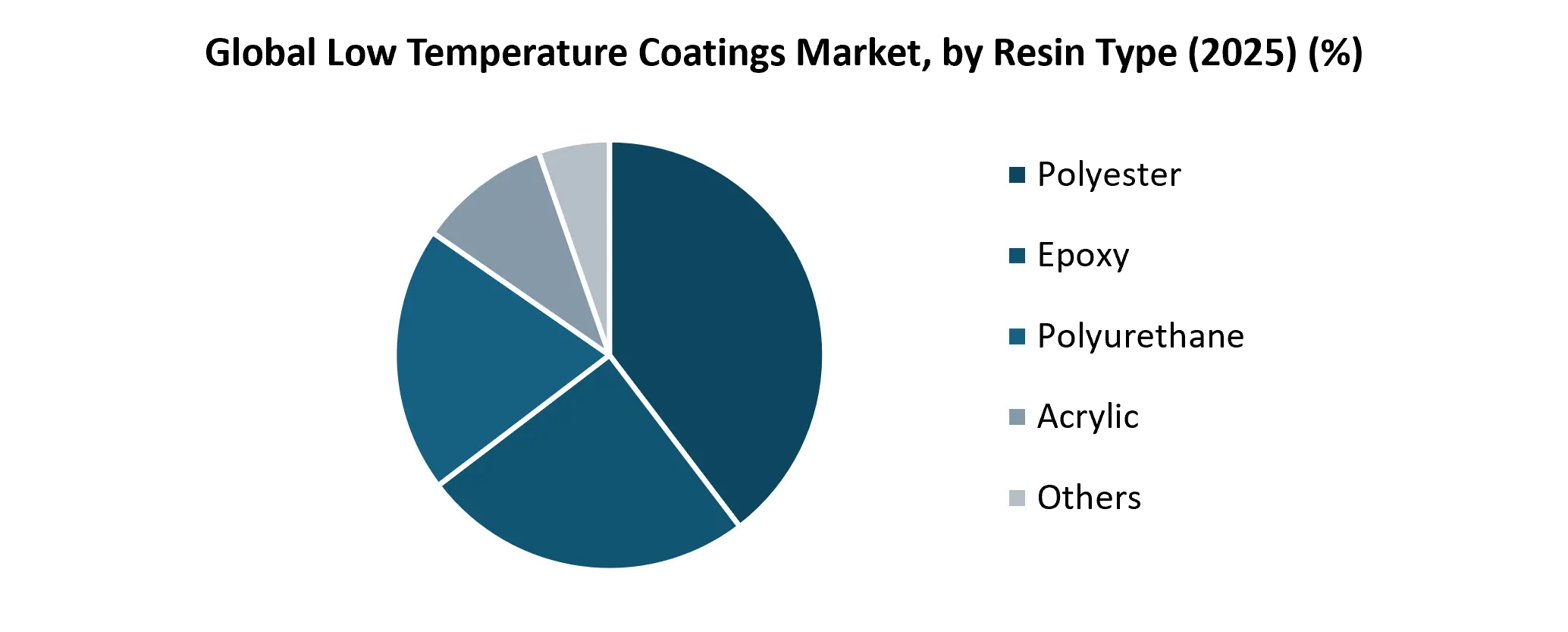
By Resin Type, the market is segmented into polyester, epoxy, polyurethane, and acrylic. The acrylic resin is expected to be the fastest-growing segment during the forecast period thanks to the demand for acrylic resins primarily comes from the automotive, and paints & coatings, industries. They have low-cost and a broad performance range, from ultra-removable to ultra-high durability depending on the formulation. Due to this benefit, the application of low-temperature coatings based on acrylics is increasing greatly in heavy-duty equipment.
 Low Temperature Coatings Market Regional Insights:
Asia Pacific holds a leading position in the global low temperature coatings market, driven by rapid industrialization, expanding automotive production, infrastructure development, and rising demand for energy-efficient coating technologies. China, India, Japan, and South Korea contribute to regional growth through established manufacturing industries and increasing investments in industrial coatings. Expanding automotive manufacturing, construction activities, and industrial equipment production support the adoption of low temperature coatings that offer strong adhesion, corrosion resistance, and durability while reducing curing energy requirements.
North America maintains a significant position in the global low temperature coatings market, supported by advanced manufacturing capabilities, automotive production, infrastructure maintenance, and growing demand for sustainable coating solutions. The United States drives regional demand through investments in industrial automation, protective coatings, and energy-efficient manufacturing processes. The increasing use of low-bake coatings, advanced powder coatings, and specialized formulations across automotive, aerospace, construction, and industrial equipment applications strengthens regional market growth.
Europe demonstrates strong demand in the global low temperature coatings market due to stringent environmental regulations, established automotive manufacturing, and increasing adoption of energy-efficient industrial processes. Germany, France, Italy, and the United Kingdom support regional demand through automotive production, machinery manufacturing, and infrastructure renovation. The shift toward lower-emission manufacturing processes and durable coating technologies encourages the use of low temperature coatings that reduce curing energy requirements while maintaining surface protection and coating performance.
South America experiences increasing demand for low temperature coatings through construction, automotive manufacturing, industrial maintenance, and infrastructure development. Brazil and Argentina contribute to regional market growth through investments in manufacturing facilities, commercial infrastructure, and protective coating applications. The need for durable surface protection in industrial equipment and metal structures supports the adoption of coatings that deliver reliable performance under varied environmental conditions.
Middle East & Africa presents emerging opportunities in the low temperature coatings market, supported by infrastructure investment, industrial diversification, construction projects, and energy-sector development. Saudi Arabia, the United Arab Emirates, and South Africa contribute to regional demand for protective coatings used in industrial facilities, transportation infrastructure, and construction applications. Increasing emphasis on corrosion protection, operational efficiency, and durable coating systems supports the adoption of low temperature coatings across regional end-use industries.
Global Low Temperature Coatings Market Competitive Landscape
The Global Low Temperature Coatings Market features competition among established coating manufacturers and specialized powder coating suppliers. Key players focus on product innovation, advanced resin formulations, low-temperature curing technologies, energy efficiency, and coating durability to strengthen their market positions. Companies develop specialized coating solutions that cure at reduced temperatures while maintaining adhesion, corrosion resistance, surface finish, and mechanical performance. The competitive environment also emphasizes research and development, product portfolio expansion, strategic partnerships, and distribution network development across automotive, construction, industrial equipment, and infrastructure applications.
Leading companies, including Akzo Nobel N.V., PPG Industries, Inc., The Sherwin-Williams Company, Axalta Coating Systems, and Jotun, compete through advanced coating technologies and application-specific product portfolios. For example, AkzoNobel offers Interpon D Low-E powder coatings that cure at temperatures as low as 150°C, while PPG provides low-temperature-curing protective coatings for demanding industrial environments. Sherwin-Williams also offers low-temperature application and curing solutions for protective coatings and powder coating applications. These product developments demonstrate the industry's focus on energy-efficient curing, enhanced coating performance, and improved manufacturing productivity.
Market participants strengthen their competitive positions by expanding specialized coating portfolios, improving formulation performance, and addressing demand from heat-sensitive substrates and industrial applications. Growing emphasis on reduced curing temperatures, lower energy consumption, corrosion protection, and sustainable manufacturing supports continued product development. Companies that combine technical expertise, reliable product performance, broad distribution networks, and cost-effective coating solutions maintain strong competitive opportunities throughout the forecast period.
Low Temperature Coatings Market Recent Developments:
| Date | Company | Development | Impact |
| March 2, 2026 | PPG Industries, IPG Photonics, and Whirlpool Corporation | The companies collaborate to accelerate the commercialization of laser-based powder coating curing systems, with pilot trials evaluating coating formulations for appliance components. | The collaboration supports faster curing, improved production efficiency, reduced energy requirements, and lower operating costs in industrial coating processes. |
| March 16, 2026 | WEG | WEG expands its product portfolio with low-temperature-curing powder coatings designed for curing at 110–140°C, compared with conventional curing temperatures of 160–200°C. | The technology improves energy efficiency and expands powder coating applications across heat-sensitive materials, including plastics and composites. |
| April 23, 2026 | Evonik | Evonik introduces Ancamine® 2873, an ultra-low-emission epoxy curing agent designed for protective and marine coatings, with curing performance at temperatures as low as 5°C. | The product supports cold-weather maintenance, improves corrosion protection, and enables high-solids formulations with reduced volatile organic compound emissions. |
| May 5, 2026 | NOF Metal Coatings Europe | The company launches its GEOMET® LT low-temperature-curing coating range, featuring a water-based, chrome-free, PFAS-free, and nonylphenol-free formulation. | The launch strengthens sustainable coating options by reducing curing energy requirements while maintaining corrosion resistance and supporting industrial applications involving metal components. |
| June 15, 2026 | The Sherwin-Williams Company | Sherwin-Williams introduces its OneCure™ powder coating portfolio, which allows primer and topcoat layers to cure together in a single bake. | The technology reduces curing cycles, improves production throughput, lowers energy consumption, and simplifies industrial finishing operations. |
| September 23, 2026 | PPG Industries | PPG showcases its Low Temperature Cure automotive coating technology at SURCAR Asia 2026. The technology supports curing at 110°C for a standalone basecoat and 90°C for a three-layer system. | The technology supports more integrated painting processes for metal vehicle bodies and plastic components, improves production flexibility, and reduces reliance on higher-temperature curing processes. |
| October 19, 2026 | IGP Pulvertechnik AG | IGP expands its low-temperature powder coating portfolio with IGP-HWFsmart 59 for façade applications. The product cures at an object temperature as low as 160°C for 15 minutes and includes a biosource variant. | The development supports lower energy consumption or higher production productivity while maintaining weather resistance, color retention, gloss, and scratch resistance. |
The objective of the report is to present a comprehensive analysis of the global Low Temperature Coatings market to the stakeholders in the industry. The past and current status of the industry with the forecasted market size and trends are presented in the report with the analysis of complicated data in simple language. The report covers all the aspects of the industry with a dedicated study of key players that include market leaders, followers, and new entrants.
PORTER, SVOR, PESTEL analysis with the potential impact of micro-economic factors of the market have been presented in the report. External as well as internal factors that are supposed to affect the business positively or negatively have been analysed, which will give a clear futuristic view of the industry to the decision-makers.
The report also helps in understanding the global Low Temperature Coatings market dynamics, structure by analyzing the market segments and project the global Low Temperature Coatings market size. Clear representation of competitive analysis of key players by product, price, financial position, product portfolio, growth strategies, and regional presence in the global Low Temperature Coatings market make the report investor’s guide.
Low Temperature Coatings Market Scope: Inquire before buying
| Low Temperature Coatings Market | |||
|---|---|---|---|
| Report Coverage | Details | ||
| Base Year: | 2025 | Forecast Period: | 2026-2034 |
| Historical Data: | 2020 to 2025 | Market Size in 2025: | 5.94 USD Billion |
| Forecast Period 2026-2034 CAGR: | 5.77% | Market Size in 2034: | 9.82 USD Billion |
| Segments Covered: | by Resin Type | Polyester Epoxy Polyurethane Acrylic Others |
|
| by Technology | Powder Coatings Liquid – Solvent-borne Liquid – Water-borne UV / EB-cured |
||
| by Substrate | Metals Plastics & Composites Wood Others |
||
| by End-Use Industry | Automotive Industrial Architectural Furniture & Wood Electronics & Appliances Others |
||
Low Temperature Coatings Marke, by Region
North America (United States, Canada and Mexico)
Europe (UK, France, Germany, Italy, Spain, Sweden, Austria and Rest of Europe)
Asia Pacific (China, South Korea, Japan, India, Australia, Indonesia, Malaysia, Vietnam, Taiwan, Bangladesh, Pakistan and Rest of APAC)
Middle East and Africa (South Africa, GCC, Egypt, Nigeria and Rest of ME&A)
South America (Brazil, Argentina Rest of South America)
Low Temperature Coatings Market Key Players
1. PPG Industries Inc.
2. Akzo Nobel N.V.
3. The Sherwin-Williams Company
4. BASF SE
5. Axalta Coating Systems Ltd.
6. Jotun A/S
7. Hempel A/S
8. Nippon Paint Holdings Co. Ltd.
9. Kansai Paint Co. Ltd.
10.RPM International Inc.
11.Covestro AG
12.Allnex GmbH
13.Arkema S.A.
14.Dow Inc.
15.DSM (Royal DSM)
16.Solvay Group
17.Eastman Chemical Company
18.Teknos Group
19.Tiger Coatings GmbH & Co. KG
20.IGP Pulvertechnik AG
21.Beckers Group
22.TCI Powder Coatings
23.Vitracoat America Inc.
24.APV Engineered Coatings
25.Asian Paints Limited
26.Berger Paints India Ltd.
27.KISCO Limited
28.Bowers Industrial
29.Specialty Polymer Coatings Inc.
30.Phygen Coatings Inc.
31.Axalta Powder Coatings
32.Protech Group
33.Forrest Technical Coatings
34.IFS Coatings
35.Prismatic Powders
36.PPG Industrial Coatings
37.Hentzen Coatings, Inc.
38.Tnemec Company, Inc.
39.Carpoly Chemical Group Co., Ltd.
40.SKSHU Paint Co., Ltd.
41.Others
Global Low Temperature Coatings Market FAQs
1. What is the global low temperature coatings market size in 2025?
Ans. The global low temperature coatings market reaches USD 5.94 billion in 2025.
2. What is the projected CAGR of the global low temperature coatings market?
Ans. The global low temperature coatings market grows at a CAGR of 5.77% from 2026 to 2034.
3. What is the projected market size of low temperature coatings by 2034?
Ans. The global low temperature coatings market reaches USD 9.82 billion by 2034, driven by increasing demand for energy-efficient coating technologies and durable protective finishes.
4. Which region leads the global low temperature coatings market?
Ans. Asia Pacific leads the global low temperature coatings market, supported by expanding manufacturing activities, automotive production, infrastructure development, and increasing demand for industrial coatings.
5. What are the key factors driving the global low temperature coatings market?
Ans. Key growth drivers include rising demand for energy-efficient manufacturing, increasing adoption of environmentally friendly coating technologies, expansion of automotive and construction industries, and growing demand for coatings suitable for heat-sensitive substrates.