
Lobster Market - Industry Structure Evaluation, Demand Drivers Analysis, Regional Growth Analysis and Identification, Competitive Positioning Review & Global Market Size Forecast to 2032
Overview
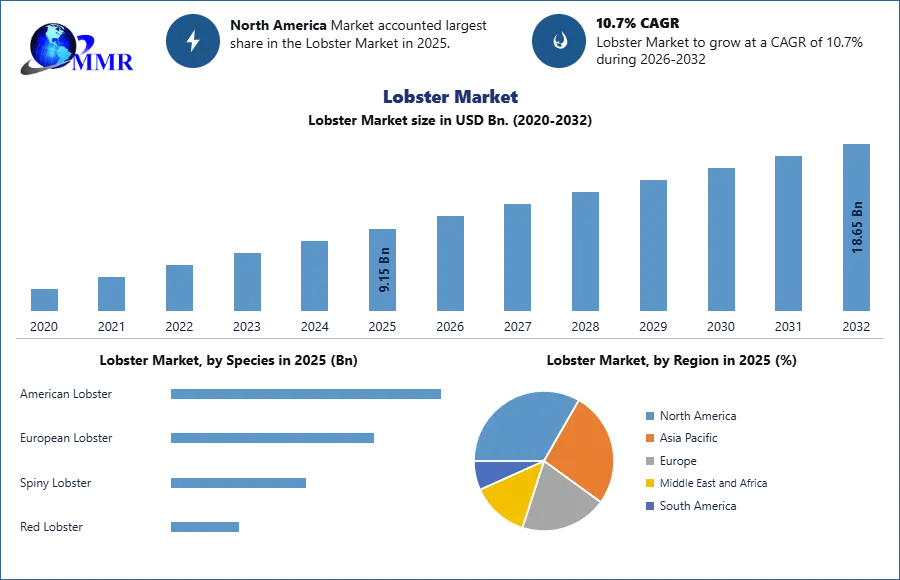
The Lobster Market size was valued at USD 9.15 Billion in 2025 and the total Lobster revenue is expected to grow at a CAGR of 10.7% from 2026 to 2032, reaching nearly USD 16.85 Billion.
Lobsters are marine animals with cylindrical muscular tails, arms and jointed legs that can be boiled or steamed. Rather than main meal, that can be used as a filling for variety of dishes such as Sandwiches, Pasta, Potatoes and egg breakfasts. Lobster provides important nutrients such as copper, Phosphorous, Zinc and omega-3 fats. In addition, it is a source of magnesium, vitamin E and vitamin B12, which can help reduce the risk of thyroid disease, anemia and kidney dysfunction.
The lobster market is composed of up of the lobster industry, which is in responsible for the production, marketing, and consumption of lobsters. The demand for lobster has continuously expanded both domestically and internationally the years. Lobster market is driven by many factors such as increased health awareness, preference for high protein diet and expansion of restaurant industry.
Lobster market is highly competitive seafood market. There are many major players in the market, from seafood processors to distributors and retailers. They focuses on expansion of product line, enhancement of supply chain, and strengthening their distribution channel. Some of the major players are Boston Lobster Company, Clearwater Seafood, East Coast Seafood Group, Geraldton Fishermen's Co-operative, High Liner Foods Incorporated, Pescanova España, SL, Supreme Lobster & Seafood Company, Tangier Lobster Company Limited, and Thai Union Manufacturing Company Ltd.
To know about the Research Methodology :- Request Free Sample Report
Lobster Market Scope & Research Methodology
The report highlights the competitive market view, segment analysis based on the type, species, Distribution channel and Region. First, the market overview describes the market trends, key market drivers, market restraints, opportunities, and challenges for the Lobster Market.
The Market is segmented by Type includes Whole Lobster, Lobster Tail and Lobster Meat. Market is segmented by Species into American Lobster, European Lobster, Spiny Lobster, Red Lobster. Market also segmented by Distribution Channel includes Food Service and retail. The market size and trends for the Lobster Market were analysed by using both primary and secondary data. Top down approach is used to estimate market size of the Lobster Market.
Market projections were based on historical data, present sector developments, and future market opportunities and challenges. The SWOT analysis of the major market players, which included their strengths, weaknesses, opportunities, and threats, was also included in the research to provide a thorough knowledge of the market dynamics. By employing the PESTLE analysis, the operating environment of an organization can be assessed. Porter's analysis were used to identify crucial factors that directly affect market profitability.
Lobster Market Key Dynamics
Market Drivers
Increasing Consumption of Sea Food
People are consuming more seafood, therefore there is a higher demand for lobster. Lobsters are considered as delicious meal, so people are more likely to eat them. Another reason is that people are looking for healthier protein alternatives to red meat and processed foods. Health-conscious consumers are looking for nutritional alternatives. As global tastes change, so does the demand for different lobster dishes, such as lobster rolls and lobster pasta. Demand for lobster is also growing in Asian markets, where seafood consumption is increasing. This will continue to increase the lobster market worldwide.
Growing Demand for Ready to Eat products
The lobster market is expected to expand because of the convenience and accessibility of pre- packed foods (Ready to eat food products). Products such as ready to eat lobster tails and lobster salad are made to meet the needs of busy lifestyles, allowing consumers to enjoy lobster without cooking it. This convenience can appeal to a wider customers, even those who initially did not dare to cook lobster at home. Because lobster products are easier to package and distribute, they can be distributed to new markets and areas where fresh lobster may not be available, which increases the consumer base and can increase demand for lobster products.
Increase in Income
With higher disposable income, consumers spends more on premium and specialty food products like Lobsters. Lobster is associated with high-end dining and special occasions, making it a popular choice among people who can afford to splurge. When people have more disposable income, they are more likely to splurge on eating or buying seafood, which in turn increases the demand for lobster in restaurants, seafood and supermarkets.
Market Trends
A hеalthy diеt is bеcoming incrеasingly important as pеoplе around thе world strugglе with obеsity and othеr hеalth problеms. Pеoplе arе starting to rеcognizе fish and shеllfish as part of a healthier diеt, еspеcially whеn it comеs to omеga-3 fatty acids. But it is not easy to get everyone to eat healthily, because different countries and people have different access and understanding of the nutritional benefits of seafood and different levels of personal health care. Food safety is also a major concern, so consumers want to know more about seafood and how it moves through the food chain.
Ready to eat lobster products is one of the important trend in growth of lobsters market. Now a days Ready to eat lobster products are become increasingly popular because consumer prefers convenient and easy to prepare sea food. Ready to eat lobsters are available in many forms such as lobster meat, lobster tails and lobsters rolls.
Sustainable lobster products are another rising trend. People are more aware of the environmental impact of seafood and are looking for sustainable seafood. As a result, lobster processors and harvesters are taking steps to become more sustainable.
One of the most important trends shaping the lobster market is the growing popularity of lobster in developing markets. As the middle class continues to grow in emerging markets, people are spending more on luxury foods like lobster. This has led to an increase in demand for lobster in emerging markets such as China and India.
Market Opportunities
Consumers in emerging economies, where the middle class is quickly expanding, are increasingly spending on pricey luxury foods such as lobster. New enterprises can export lobster items to emerging markets such as China and India.
The demand for personalized lobster-based products for special occasions is increasing. For example, lobster gift baskets and wedding cakes are increasingly popular. Entrepreneurship in the lobster industry could be a great option for those who want to create unique lobster products for unique situations.
Online market for lobsters is growing rapidly. So there is an opportunity to develop online sales channels to reach wide range of consumers who are increasingly prefers online channel rather than offline.
In addition of these opportunities, there is number of opportunities for an entrepreneur who are new in Lobster Market. For example Entrepreneur can start lobster restaurant, lobster processing plant or lobster delivery services.
Market Challenges
Price of the lobsters fluctuates with variety of factors such as seasonal variation in supply, weather conditions that affect fishing and change in consumer preferences. This can make it challenging for lobsters business owners to plan ahead and set consistent prices.
The quality of the lobster is depending on geographical area, the method of harvesting and employed processing technique. This can make it challenging for consumers to find high quality lobster products.
The global lobster market faces major challenges due to government regulations related to use of large quantity of products and preservatives which are harmful to human health. The price of fish and shellfish increases due to increase in import duties that may further increase the growth of the market in coming years.
As the number of vegetarians and vegans grows in Europe and America, so does the pressure to grow a global industry. The fear of losing species, which can lead to an imbalance in nature, has led to strict laws on harvesting and hunting for food, which can have a negative impact on the food chain. This can hinder global industrial growth.
Lobster Market Segment Analysis
Based on Product Type, Lobster market is classified as Whole Lobster, Lobster Tail, Lobster Meat, Lobster claw.
Whole lobster segment has the largest market share due to its relatively lower prices than tail and meat lobsters. In 2025, the whole lobster segment accounted for 65% of the global lobster market. The market share is expected to increase to 40% by 2032. This is due to the growing demand of whole lobster in the restaurant and dining. Whole lobsters are more versatile than lobster tails and meat, so they can be cooked whole or cut into smaller portions and added to a variety of dishes. A whole lobster is a more sustainable choice than lobster tails or meat because it creates less waste. Overall, whole lobster is an attractive choice for those looking for versatile and environmentally friendly seafood.
Based on species, Lobster market is classified as American Lobster, European Lobster, Spiny Lobster and Red Lobster. The American lobster is one of the most popular lobster in the world. It is found in north-eastern coast of North America (from Canada to Maine). The European lobster is found in North Atlantic Ocean. Spiny Lobsters are found in warm, tropical and tempered water worldwide. And Red lobsters are found in Pacific Ocean.
In 2025 American Lobster segment dominated the global lobster market and it is expected to maintain its dominance during the forecasted period. This is due to strong demand for lobster in Canada and in the United States as well as Consumer preference towards the quality, taste and structure of American Lobster.

Based on the distribution channel, Lobster Market is segmented into Food Service and Retail. The Food Service segment is expected to have the largest market share. This is due to the fact that lobsters are primarily ordered and prepared by high-end and fancy restaurants. Certain retail establishments have begun to sell lobsters as well, but the proportion is still small.
This development of food service segment is driven by consumer demand for high-quality seafood, especially lobster, in restaurants and other food services. As the popularity of seafood grows, many restaurants are adding lobster dishes to their menu, as well as the need for unique and high-quality ingredients. The demand for lobster in restaurant service is driven by menu diversity.
Lobster market Regional Insights
The global Lobster Market segmented into North America, Europe, Asia-Pacific, Middle East and Africa and South America.
North-America is one of the largest Lobster segments in the world. More than 55% of the market revenue came from this region in 2024, and it is projected to grow at a CAGR of more than 9%. This Region holds the largest market share mainly due to growth in lobster production and consumption in countries such as Canada and the United States. A thriving seafood business and harvesting of fish and shellfish will drive market expansion globally.
The top lobster exporters in North America are the United States, Canada, the United Arab Emirates, the United Kingdom, Ireland and Denmark with over 500 million pounds. The growth of lobsters market in these region is mainly due to region’s role as a seafood exporter which will prove variety of options and growing demand for the Lobster Products in the coming year.
During the forecast period, Europe is expected to grow at the fastest CAGR. Europeans eat a lot of lobster, especially in countries with coastal regions like France, Spain, and Italy. Spiny lobster 15 is a typical component in European dishes like as spaghetti and paella. This has a huge impact on market demand. As Europeans become more health conscious, the demand for quality seafood such as lobster is increasing. Growing seafood imports from North America, Canada and Australia led to an expansion of the European lobster market. The entire cost of imported fish entering Europe in 2020 was $54.8 billion. Imports of seafood have surged since 2015, hitting a peak of $58.0 billion in 2018. The growing demand for lobster in Europe is likely to increase imports and contribute to market growth.

Competitive Landscape
The lobster market is highly competitive, with multiple companies on a worldwide and regional base. Seafood processors, distributors, and exporters are important players in the market. The major key players of the lobsters market are Clearwater Seafoods, East Coast Seafood Group, High Liner Foods Incorporated, Boston Lobster Company, and Red Lobster. These companies prioritize quality assurance, innovative packaging and sustainable sourcing to gain competitive advantage.
The lobster Market is a widely expanding market with lots of opportunities for new players. Emerging companies can take advantage of these opportunities by offering unique products and services that fulfil consumers' needs. Some of the emerging players are Lobster Love, Lobster Buddy, Lobster Chef etc These are just a few of the emerging companies in lobster industry. A number of other companies are developing new products and services to fulfil consumer demands.
Scope of Lobster Market: Inquire Before Buying
| Lobster Market | |||
|---|---|---|---|
| Report Coverage | Details | ||
| Base Year: | 2025 | Forecast Period: | 2026-2032 |
| Historical Data: | 2020 to 2025 | Market Size in 2025: | 9.15 USD Bn. |
| Forecast Period 2026-2032 CAGR: | 10.7% | Market Size in 2032: | 18.65 USD Bn. |
| Segments Covered: | by Type | Whole Lobster Lobster Tail Lobster Meat |
|
| by Species | American Lobster European Lobster Spiny Lobster Red Lobster |
||
| by Distribution Channel | Food Service Retail |
||
Lobster Market, by Region
North America (United States, Canada and Mexico)
Europe (UK, France, Germany, Italy, Spain, Sweden, Austria and Rest of Europe)
Asia Pacific (China, South Korea, Japan, India, Australia, Indonesia, Malaysia, Vietnam, Taiwan, Bangladesh, Pakistan and Rest of APAC)
Middle East and Africa (South Africa, GCC, Egypt, Nigeria and Rest of ME&A)
South America (Brazil, Argentina Rest of South America)
Key Players / Competitors Profiles Covered in Brief in Global Lobster Market Report in Strategic Perspective:
- Boston Lobster Company
- Clearwater Seafoods
- East Coast Seafood Group
- Geraldton Fishermen's Co-operative
- High Liner Foods Incorporated
- PESCANOVA ESPAÑA
- Supreme Lobster
- Tangier Lobster
- Thai Union Manufacturing Company
- Douty Brothers
- Island Seafood
- World Link Food Distributors
- Bayley's Lobster Pound
- Cap Morrill's
- A S Francis Lobster
- Philbrick Lobster Company
- Cousins Maine Lobster
- Cozy Harbor Seafood
- AquaChile
- Mowi
- Lerøy Seafood Group
- Maruha Nichiro Corporation
- Nippon Suisan Kaisha (Nissui)
- Pacific Seafood
- Lobster Lovin' Co.