
Global LiFSI for Lithium Battery Electrolytes Market by Grade (Battery Grade, Industrial Grade), by Application (Lithium-ion Batteries, Lithium Metal Batteries, Solid-State Batteries, Sodium-ion Batteries, Others)
Overview
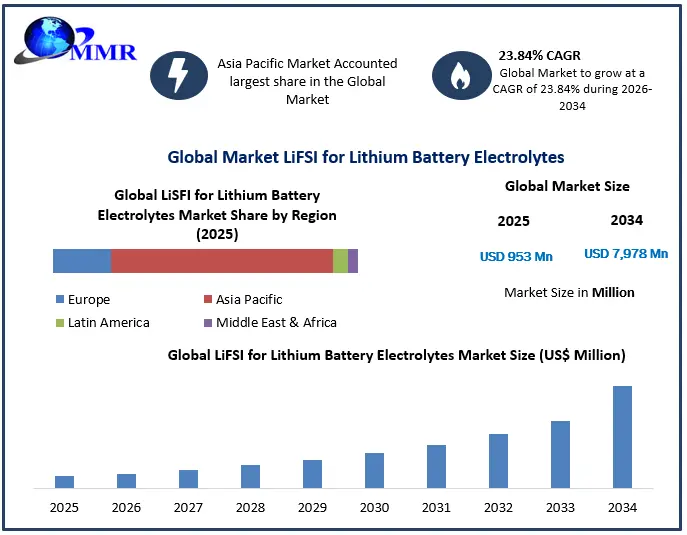
The Global LiFSI for Lithium Battery Electrolytes Market was valued at US$ 953 Million in 2025 and is projected to reach approximately US$ 1,207 Million in 2026. The market is further expected to expand at a CAGR of 26.63% during the forecast period, reaching US$ 7,978 Million by 2034.
Global LiFSI for Lithium Battery Electrolytes Market Overview:
The global LiFSI (Lithium Bis(fluorosulfonyl)imide) for Lithium Battery Electrolytes Market is witnessing robust growth as battery manufacturers increasingly adopt advanced electrolyte chemistries to improve the performance, safety, and lifespan of lithium-ion batteries. LiFSI has emerged as a high-performance alternative and complementary electrolyte salt to conventional lithium hexafluorophosphate (LiPF₆), owing to its superior ionic conductivity, excellent thermal stability, wider electrochemical stability window, and enhanced moisture resistance. These properties enable lithium-ion batteries to achieve faster charging, higher energy density, improved cycle life, and reliable operation under extreme temperatures. The LiFSI market complements electric vehicles (EVs), battery energy storage systems (BESS), consumer electronics, and the emerging lithium-metal battery market. The material is used as an electrolyte additive and is gradually being evaluated as a primary lithium salt in next-generation battery chemistries.
Therefore, LiFSI for lithium battery electrolytes market is driven by the rapid expansion of the global electric vehicle industry, increasing investments in renewable energy storage, and growing demand for high-performance batteries capable of ultra-fast charging. According to the International Energy Agency, global electric car sales exceeded 17 million units in 2024, accounting for more than one in five new cars sold worldwide, significantly increasing demand for advanced electrolyte materials. In addition to this, the U.S. Department of Energy continues to support research into fast-charging batteries capable of achieving an 80% charge in under 10 minutes. This is also reflected in growing interest in high-conductivity electrolyte salts such as LiFSI. At the same time, battery manufacturers are investing heavily in high-voltage cathodes, silicon-anode batteries, and lithium-metal battery technologies, all of which benefit from LiFSI-based electrolyte formulations.
Technological advancements are also reshaping the market including the development of localized high-concentration electrolytes (LHCEs), high-voltage electrolyte systems, fluorinated electrolyte additives, and solid-state battery research. Asia Pacific currently dominates the market due to its extensive lithium-ion battery manufacturing ecosystem led by China, Japan, and South Korea. North America is expected to register the fastest growth, supported by expanding domestic battery manufacturing, government incentives, and increasing investments in electric mobility and grid-scale energy storage.
Global LiFSI for Lithium Battery Electrolytes Market Size, Share and Segment Analysis
To know about the Research Methodology :- Request Free Sample Report
LiFSI for Lithium Battery Electrolytes Market Dynamics:
Rapid Expansion of Electric Vehicles and Energy Storage Systems Drives the Market
The rapid growth of electric vehicles (EVs) and battery energy storage systems (BESS) is a key driver of the LiFSI for lithium battery electrolytes market. As manufacturers focus on developing high-energy-density, fast-charging, and long-life lithium-ion batteries, demand for advanced electrolyte salts such as LiFSI continues to increase. Compared with conventional LiPF₆, LiFSI offers higher ionic conductivity, superior thermal stability, improved low-temperature performance, and enhanced cycle life, making it well suited for high-voltage and next-generation battery chemistries. Global electric car sales exceeded 17 million units in 2024, with battery demand surpassing 1 TWh for the first time. The growing deployment of renewable energy storage and investments in advanced battery technologies are accelerating the adoption of LiFSI-based electrolytes, supporting the development of safer, faster-charging, and higher-performance lithium-ion batteries.
High Production Cost and Manufacturing Complexity Restrains to the Market
Producing battery-grade LiFSI requires advanced synthesis technologies and stringent purification processes to achieve ultra-high purity, as impurities can significantly affect battery safety and electrochemical performance. This results in high production costs, which represent a key restraint to the market.
LiFSI manufacturing is still limited to a smaller number of specialized producers, compared with the well-established production and supply chain of LiPF₆, resulting in higher production costs and supply constraints. These factors discourage widespread adoption, particularly in cost-sensitive applications such as consumer electronics and entry-level electric vehicles. Although manufacturers are expanding production capacity and improving manufacturing efficiency, LiFSI remains more expensive than conventional electrolyte salts, slowing its commercialization despite its superior technical performance.
Advancements in High-Voltage and Next-Generation Battery Technologies Create Significant Growth Opportunities
The growing commercialization of high-voltage lithium-ion batteries, lithium-metal batteries, and solid-state batteries presents significant growth opportunities for the LiFSI market. These next-generation battery technologies require electrolyte materials with superior electrochemical stability, high ionic conductivity, and excellent thermal performance, making LiFSI an attractive alternative to conventional electrolyte salts. Increasing investments in fast-charging electric vehicles, premium battery systems, and grid-scale energy storage are also creating demand for advanced electrolyte formulations. In addition, ongoing research into localized high-concentration electrolytes (LHCEs) and high-energy-density battery chemistries is expanding the application scope of LiFSI. As battery manufacturers continue to improve production efficiency and reduce costs, LiFSI is expected to transition from an electrolyte additive to a primary lithium salt in advanced battery systems.
Aluminum Current Collector Corrosion Poses a Key Challenge
Aluminum current collector corrosion remains one of the most significant technical challenges limiting the widespread adoption of LiFSI-based electrolytes. Pure LiFSI electrolytes can corrode aluminum current collectors at operating voltages above approximately 3.9–4.2 V, reducing battery durability and affecting long-term safety and performance. Although researchers have successfully minimized this issue by incorporating additives such as lithium difluoro(oxalato)borate (LiDFOB) and blending LiFSI with LiPF₆, these solutions increase electrolyte formulation complexity and production costs.
Battery manufacturers must therefore balance performance improvements with cost-effectiveness and long-term reliability before large-scale commercialization. Continued research into electrolyte additives, protective coatings, and optimized formulations will be essential to overcoming this challenge and enabling broader adoption of LiFSI in next-generation lithium-ion batteries.
LiFSI for Lithium Battery Electrolyte Market Trends:
• Growing Adoption of High-Concentration and Localized High-Concentration Electrolytes (LHCEs) - Battery manufacturers are increasingly adopting high-concentration electrolytes (HCEs) and localized high-concentration electrolytes (LHCEs) to improve battery safety, energy density, and high-voltage performance. LiFSI has emerged as a preferred lithium salt for these advanced electrolyte formulations due to its excellent ionic conductivity, wide electrochemical stability window, and ability to form a stable solid electrolyte interphase (SEI). These formulations also help suppress lithium dendrite formation, enhance thermal stability, and improve fast-charging performance, making them highly suitable for next-generation electric vehicles and lithium-metal batteries. Ongoing research into LHCEs is expected to accelerate the commercial adoption of LiFSI-based electrolyte systems.
• Increasing Shift Toward High-Voltage and Fast-Charging Battery Technologies - The demand for high-voltage and ultra-fast-charging lithium-ion batteries is driving innovation in electrolyte materials, with LiFSI gaining traction as an alternative to conventional LiPF₆. Its superior thermal stability, higher lithium-ion conductivity, and improved electrochemical performance enable batteries to support higher operating voltages while reducing capacity degradation during rapid charging. As electric vehicle manufacturers compete to reduce charging times and extend driving ranges, battery developers are increasingly integrating LiFSI into advanced electrolyte formulations. This trend is expected to strengthen as next-generation battery chemistries move toward higher energy density and improved safety.
• Expansion of Domestic Battery Material Manufacturing and Supply Chains -Governments across Asia Pacific, North America, and Europe are investing heavily in domestic battery manufacturing to strengthen supply chain resilience and reduce dependence on imported battery materials. These initiatives are encouraging chemical manufacturers to expand production capacities for advanced electrolyte salts such as LiFSI. At the same time, battery producers are entering strategic partnerships with electrolyte and specialty chemical suppliers to secure long-term material availability for electric vehicles and stationary energy storage systems. This localization of battery material production is expected to improve supply security while reducing manufacturing costs over the coming years.
• Growing Research on LiFSI for Next-Generation Battery Chemistries - Research activities focused on lithium-metal, solid-state, lithium-sulfur, and silicon-anode batteries are creating new opportunities for LiFSI adoption. Owing to its high ionic conductivity, excellent thermal stability, and compatibility with advanced electrolyte formulations, LiFSI is increasingly being evaluated for batteries requiring higher energy density and longer cycle life. Researchers are also developing additive technologies and optimized electrolyte formulations to overcome challenges such as aluminum current collector corrosion. As these next-generation battery technologies move toward commercialization, LiFSI is expected to play an increasingly important role in enabling safer and higher-performance energy storage solutions.
LiFSI-Enabled Performance Enhancement in Advanced Lithium Battery Electrolytes
The performance improvement by LiFSI is in the following aspects:
• It supports both liquid and polymer electrolytes with greater flexibility for advanced battery designs.
• The Electrolyte performance is enhanced as it provides high iconic conductivity, operating under a wide range of temperatures through excellent thermal and electrochemical stability.
• LiFSI forms strong protective layers by creating LiF-rich SEI (Solid Electrolyte Interphase) and CEI (Cathode Electrolyte Interphase) layers that protect the anode and cathode from degradation.
• Suppresses Battery Degradation by reducing lithium dendrite formation, electrolyte decomposition, and transition metal dissolution, which extends battery lifespan.
LiFSI For Lithium Battery Electrolytes Market Segment Analysis:
The By Grade segment is divided into Battery Grade and Industrial Grade. Battery Grade held the largest market share of around 90.20% in 2025. This share owes to its high purity (>99.9%), superior ionic conductivity, excellent thermal stability, and compatibility with high-performance lithium-ion batteries. It is extensively used in electric vehicles (EVs), battery energy storage systems (BESS), consumer electronics, and other advanced battery applications where battery safety, fast charging, and long cycle life are critical. The rapid expansion of global battery manufacturing and increasing adoption of high-voltage and lithium-metal batteries are further driving demand for battery-grade LiFSI.
LiFSI For Lithium Battery Electrolytes Market by Grade

Industrial Grade is expected to witness steady growth due to its use in research, pilot-scale battery development, specialty chemical applications, and industrial electrochemical processes where ultra-high purity is not essential. Although its market share remains comparatively smaller, increasing R&D activities and battery material innovation are expected to support gradual growth during the forecast period.
The By Application segment is divided into Lithium-ion Batteries, Lithium Metal Batteries, Solid-State Batteries, Sodium-ion Batteries, and Others. Lithium-ion Batteries accounted for the largest market share of approximately 72.4% in 2025, owing to their widespread use in electric vehicles, consumer electronics, battery energy storage systems, power tools, and industrial equipment. LiFSI is increasingly adopted in lithium-ion battery electrolytes because of its high ionic conductivity, excellent electrochemical stability, improved low-temperature performance, and ability to enhance fast-charging capability and battery cycle life. Rising EV production, expanding battery gigafactory investments, and growing renewable energy storage installations continue to strengthen demand for LiFSI-based electrolytes. Lithium Metal Batteries are expected to witness the fastest growth due to increasing commercialization efforts for next-generation high-energy-density batteries. Solid-State Batteries are also gaining momentum as ongoing research and pilot-scale deployment demand for them. While Sodium-ion Batteries and Others represent emerging application areas expected to create new growth opportunities as advanced battery technologies continue to evolve.
Global LiFSI for Lithium Battery Electrolytes Regional Insights:
Asia Pacific Dominated the LiFSI for Lithium Battery Electrolytes Market in 2025
Asia Pacific dominated the LiFSI for Lithium Battery Electrolytes Market in 2025, supported by its well-established battery manufacturing ecosystem and strong government backing for electric vehicle (EV) and battery material production. China accounted for more than 75% of global lithium-ion battery manufacturing capacity in 2024, making it the largest consumer of advanced electrolyte materials such as LiFSI. The region also hosts leading battery manufacturers including Contemporary Amperex Technology Co. Limited (CATL), BYD Company, LG Energy Solution, and Panasonic Energy. These manufacturers continue to invest in high-energy-density battery technologies. China's "New Energy Vehicle (NEV)" policy and ongoing expansion of battery gigafactories, coupled with Japan's and South Korea's leadership in electrolyte innovation, continue to strengthen regional demand for high-purity LiFSI.
North America is Expected to be the Fastest-Growing Region During the Forecast Period
North America is projected to witness the fastest growth during the forecast period due to unprecedented investments in domestic battery manufacturing and supply chain localization. The U.S. government has committed more than US$3 billion through the Department of Energy's Battery Materials Processing and Battery Manufacturing programs to strengthen domestic battery material production. The Inflation Reduction Act (IRA) provides substantial tax incentives for EV and battery manufacturing. Major investments from companies such as Tesla, General Motors, Ford Motor Company, and LG Energy Solution are driving the establishment of new battery gigafactories across the United States. Rising deployment of grid-scale battery energy storage systems and increasing demand for locally sourced battery materials are expected to significantly boost the consumption of advanced electrolyte salts such as LiFSI.
Europe Strengthens its Position Through Battery Regulations and Gigafactory Investments
Europe is emerging as a major market for LiFSI owing to its stringent sustainability regulations and large-scale investments in battery manufacturing. The EU Battery Regulation (Regulation (EU) 2023/1542) promotes sustainable battery production, recycled material usage, and traceability across the battery value chain, encouraging manufacturers to adopt advanced battery materials. Through the European Battery Alliance, more than €170 billion in battery value chain investments have been announced across Europe. Countries such as Germany, Sweden, France, and Hungary are expanding battery production with investments from companies including Northvolt, ACC, and PowerCo. These developments are increasing regional demand for high-performance electrolyte materials required for next-generation lithium-ion batteries.
South America and Middle East & Africa are Emerging Markets
South America and the Middle East & Africa are expected to experience gradual market growth as investments in battery raw materials and renewable energy continue to increase. Latin America plays a strategic role in the global battery supply chain. Chile and Argentina account for a substantial share of global lithium production and reserves, providing a strong foundation for downstream battery material development. Countries such as Saudi Arabia and the United Arab Emirates are also investing in EV manufacturing and battery value chains as part of their economic diversification strategies. These regions currently represent a smaller share of but, LiFSI consumption, increasing investments in clean energy, battery manufacturing, and critical mineral processing are expected to create new growth opportunities over the forecast period.
Global LiFSI for Lithium Battery Electrolytes Market Recent Developments:
| Date | Recent Development |
| September 12, 2024 | Nippon Shokubai Co., Ltd. announced the construction of a new LiFSI (IONEL™) production plant in Fukuoka, Japan, to strengthen its domestic supply of LiFSI electrolyte for lithium-ion batteries. Commercial operations are targeted for 2028, and the project has been selected under Japan's Ministry of Economy, Trade and Industry (METI) battery supply chain support program. |
| June 18, 2024 | LG Chem announced the expansion of its battery materials portfolio, including next-generation electrolyte materials and additives, to support high-performance EV batteries and strengthen its position in the global battery materials value chain. |
| April 2024 | Contemporary Amperex Technology Co. Limited (CATL) continued expanding production of high-energy-density battery technologies utilizing advanced electrolyte systems for EV and energy storage applications, increasing demand for high-performance lithium salts such as LiFSI. |
| 2024 | Researchers reported significant progress in high-concentration and localized high-concentration electrolyte (LHCE) formulations using LiFSI, demonstrating improved ionic conductivity, enhanced thermal stability, and better fast-charging performance for lithium-ion and lithium-metal batteries.) |
| 2025 | A comprehensive review published in Materials Today highlighted LiFSI as one of the most promising alternatives to LiPF₆ for next-generation lithium-ion batteries due to its superior electrochemical stability, improved low-temperature performance, and compatibility with high-voltage battery chemistries. |
Global LiFSI for Lithium Battery Electrolytes Market Competitive Landscape:
The Global LiFSI for Lithium Battery Electrolytes Market is moderately consolidated, with competition centered on high-purity manufacturing capabilities, production scale, product quality, long-term supply agreements, and continuous R&D in advanced electrolyte materials. Since LiFSI is a critical battery material requiring ultra-high purity (≥99.9%), only a limited number of manufacturers possess the technological expertise and production infrastructure to manufacture battery-grade products at commercial scale. Chinese companies currently dominate global production owing to their integrated battery material supply chains, cost competitiveness, and close partnerships with lithium-ion battery manufacturers. Industry assessments indicate that the top three manufacturers account for around 61% of the global LiFSI electrolyte salts market, reflecting a relatively concentrated supplier landscape.
Competition is increasingly driven by capacity expansion and strategic collaborations with battery manufacturers to support the rapidly growing electric vehicle (EV) and energy storage markets. Leading manufacturers are investing in production facilities for high-purity LiFSI, improving synthesis technologies, and developing advanced electrolyte formulations for high-voltage lithium-ion, lithium-metal, and solid-state batteries. Companies are also focusing on reducing manufacturing costs, increasing production yields, and securing long-term supply contracts with battery cell manufacturers. As battery manufacturers seek to localize supply chains in North America and Europe, global electrolyte suppliers are expanding their regional manufacturing footprint and strengthening partnerships with automotive OEMs and battery producers to improve supply security and meet growing demand.
The market features a mix of global specialty chemical companies and regional battery material manufacturers. Major international participants include Shenzhen Capchem Technology, Guangzhou Tinci Materials Technology, Soulbrain, Nippon Shokubai, Mitsubishi Chemical Group, UBE Corporation, and Central Glass. Regional players such as Shanghai Chemspec Corporation, Chunbo, and Yongtai Technology are strengthening their market positions through capacity expansion, product innovation, and customer-specific electrolyte solutions for next-generation battery technologies.
LiFSI for Lithium Battery Electrolytes Market Scope: Inquire before buying
| LiFSI for Lithium Battery Electrolytes Market | |||
|---|---|---|---|
| Report Coverage | Details | ||
| Base Year: | 2025 | Forecast Period: | 2026-2032 |
| Historical Data: | 2020 to 2025 | Market Size in 2025: | USD 953 Mn. |
| Forecast Period 2026 to 2032 CAGR: | 26.63% | Market Size in 2032: | USD 7,978 Mn. |
| Segments Covered: | by Grade | Battery Grade Industrial Grade |
|
| by Purity | Below 99.5% 99.5%–99.9% Above 99.9% |
||
| by Application | Lithium-ion Batteries Lithium Metal Batteries Solid-State Batteries Sodium-ion Batteries Others |
||
| by End-User | Automotive Consumer Electronics Energy Storage Industrial Aerospace & Defense |
||
Global LiFSI for Lithium Battery Electrolytes Market, by region
North America (United States, Canada, and Mexico)
Europe (UK, France, Germany, Italy, Spain, Sweden, Austria, and the Rest of Europe)
Asia Pacific (China, South Korea, Japan, India, Australia, Indonesia, Malaysia, Vietnam, Taiwan, Bangladesh, Pakistan, and the Rest of APAC)
Middle East and Africa (South Africa, GCC, Egypt, Nigeria, and the Rest of ME&A)
South America (Brazil, Argentina Rest of South America)
Global LiFSI for Lithium Battery Electrolytes Market Key Players:
Asia Pacific
1. Guangzhou Tinci Materials Technology Co., Ltd. (China)
2. Shenzhen Capchem Technology Co., Ltd. (China)
3. Shanghai Chemspec Corporation (China)
4. Do-Fluoride New Materials Co., Ltd. (China)
5. Zhejiang Yongtai Technology Co., Ltd. (China)
6. Jiangsu HSC New Energy Materials Co., Ltd. (China)
7. Nippon Shokubai Co., Ltd. (Japan)
8. Chunbo Fine Chem Co., Ltd. (South Korea)
North America
9. Albemarle Corporation (U.S.)
10. Arcadium Lithium plc (U.S.)
11. Solid Power, Inc. (U.S.)
Europe
12. BASF SE (Germany)
13. Umicore NV (Belgium)
14. Northvolt AB (Sweden)
South America
15. Sociedad Química y Minera de Chile S.A. (SQM) (Chile)
Middle East & Africa
16. Managem Group (Morocco)
Frequently Asked Questions:
1. What is driving the growth of the LiFSI for Lithium Battery Electrolytes Market?
The market is primarily driven by the rapid growth of electric vehicles (EVs), battery energy storage systems (BESS), and demand for high-performance lithium-ion batteries. LiFSI offers higher ionic conductivity, better thermal stability, and improved fast-charging performance than conventional LiPF₆, making it increasingly attractive for next-generation battery technologies.
2. Why is LiFSI preferred over conventional LiPF₆ in lithium-ion batteries?
LiFSI provides superior ionic conductivity, wider electrochemical stability, enhanced low-temperature performance, and better thermal stability. It also helps improve battery cycle life, fast-charging capability, and high-voltage performance, making it a promising electrolyte salt for advanced lithium-ion and lithium-metal batteries.
3. Which region dominates the Global LiFSI for Lithium Battery Electrolytes Market?
Asia Pacific dominated the market in 2025, led by China, Japan, and South Korea. The region benefits from a strong battery manufacturing ecosystem, extensive electric vehicle production, large-scale battery material manufacturing, and the presence of major electrolyte and battery manufacturers.
4. Which application segment accounted for the largest market share in 2025?
The Lithium-ion Batteries segment accounted for the largest market share in 2025 due to its widespread use in electric vehicles, consumer electronics, battery energy storage systems, and industrial applications. Increasing investments in battery gigafactories and renewable energy storage continue to support the segment's growth.