
Laundry Sanitizer Market Size by Type, Packaging Format, Sales Channel, and Region – Segment-Level Market Assessment, Growth Opportunity Analysis, Competitive Mapping & Forecast to 2032
Overview
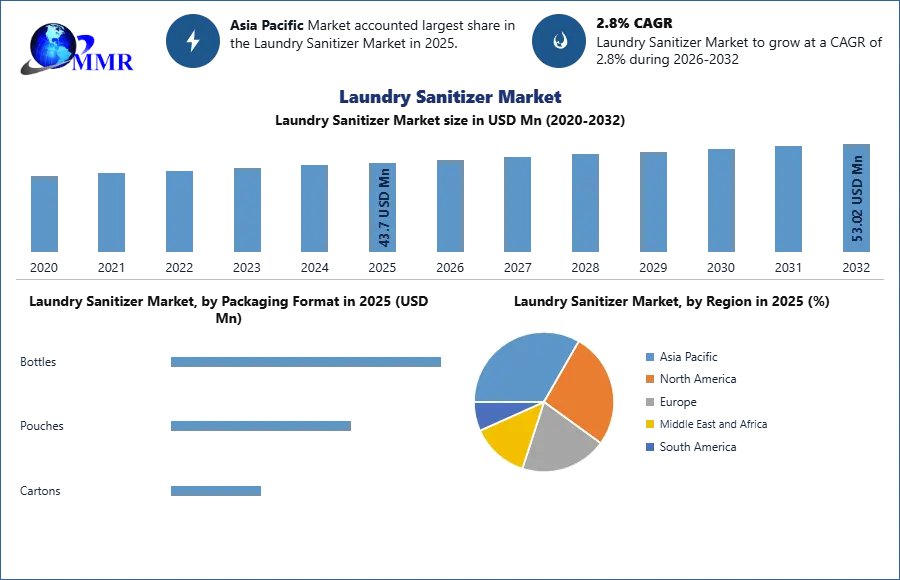
The Global Laundry Sanitizer Market size was valued at USD 43.7 Million in 2025 and the total Laundry Sanitizer Market revenue is expected to grow at a CAGR of 2.8% from 2026 to 2032, reaching nearly USD 53.02 Million.
Laundry sanitizer plays a pivotal role in the disinfection of clothing and textiles, all the while utilizing environmentally-friendly laundry detergents for their cleansing. Its function covers the elimination of bacteria, fungi, and specific viruses that potentially within materials, particularly those used in hospital environments or by healthcare practitioners. It used on most washable fabrics including Baby Clothes, Gym Clothes, Undergarments, Towels, Bedding, and Delicates. The Laundry Sanitizer Market is experiencing robust growth, driven by the increasing consumer focus on hygiene and sanitation. The ongoing COVID-19 pandemic has heightened awareness about the need for clean and germ-free clothes, fostering the demand for laundry sanitizers. Additionally, a growing concern for allergens and bacterial contaminants on fabrics further propels market expansion.
Key players in the market, such as Lysol, Clorox, and Procter & Gamb le, have introduced innovative products, including detergent additives and laundry disinfectant sprays, to cater to this surging demand. These market leaders have also been focusing on sustainable and eco-friendly formulations to meet changing consumer preferences. Moreover, partnerships and collaborations with laundromats and commercial laundry services are helping companies tap into new customer segments. The market is anticipated to witness significant growth in the coming years, with Asia-Pacific emerging as a promising market due to rising disposable incomes and changing lifestyle patterns. Overall, the Laundry Sanitizer Market is poised for continuous expansion as consumers increasingly prioritize cleanliness and sanitation in their daily lives.
To know about the Research Methodology :- Request Free Sample Report
Laundry Sanitizer Market Dynamics:
Hygiene Awareness is a Spurring Factor in the Laundry Sanitizer Market
The heightened awareness of hygiene and cleanliness, particularly during the COVID-19 pandemic, has led to an increased demand for laundry sanitizers. Consumers are looking for products that effectively eliminate bacteria and viruses from their clothing and textiles. For instance, companies like Lysol introduced laundry sanitizer products, riding the wave of pandemic-driven hygiene concerns. Additionally, the rising occurrence of allergies and skin sensitivities has amplified the demand for laundry sanitizers, especially among families with young children. Individuals with skin conditions or allergies seek products that ensure their clothes are free from allergens and irritants. Brands like Allersearch offer specialized laundry sanitizers designed to remove common allergens from fabrics, appealing to this specific consumer need.
The sustainability trend is influencing the laundry sanitizer market. Consumers are increasingly looking for eco-friendly and biodegradable options. Companies like Seventh Generation have capitalized on this trend by offering plant-based and environmentally friendly laundry sanitizers, catering to the eco-conscious consumer segment. The convenience and time-saving aspect of laundry sanitizers are also major growth drivers. As people's lives become busier, they seek efficient ways to ensure their laundry is not only clean but also sanitized. Products like Lysol Laundry Sanitizer, which added to the regular laundry cycle, exemplify the convenience aspect, as they eliminate the need for separate sanitizing routines. Another propelling aspect is the expansion of the hospitality industry. Hotels, restaurants, and other businesses in the hospitality sector are increasingly using laundry sanitizers to maintain high hygiene standards, especially for bedding and linens. This not only ensures guest safety but also contributes to the growth of the laundry sanitizer market. For instance, hotels like Marriott have adopted advanced laundry sanitizing protocols and solutions. All these aspects are estimated to drive the market growth and demand during the analysis period.
Emerging Markets and Niche Opportunities are Growth Prospects in the Laundry Sanitizer Market
In particular, as disposable income in developing countries increases, the demand for hygiene products rises. Untapped potential in emerging markets where consumer awareness of laundry sanitizers is growing. Companies like Clorox have expanded their presence in these markets by offering affordable laundry sanitizers, capitalizing on this growth potential. The aging population presents an opportunity as elderly individuals often prioritize health and cleanliness. The elderly demographic requires specialized laundry solutions, such as gentle yet effective sanitizers. Brands like Arm & Hammer have introduced laundry sanitizers that cater to the unique needs of the elderly, seizing this market opportunity. Moreover, the rise of subscription and on-demand services leveraged by laundry sanitizer companies. Subscriptions for laundry care products, similar to services like Stitch Fix for clothing, are gaining traction. These services include regular delivery of sanitizing agents to consumers' homes, creating a steady revenue stream. To illustrate like the Laundress, showcase how subscription models applied in the laundry care sector.
The laundry sanitizer market tap into the burgeoning pet care industry. As pet ownership increases, so does the demand for laundry sanitizers that effectively remove pet-related odors and allergens. Brands like Nature's Miracle offer enzyme-based laundry sanitizers designed for pet owners, capitalizing on this market opportunity. Furthermore, the sustainability trend provides room for growth by encouraging the development of eco-friendly laundry sanitizers. Consumers are seeking products that are both effective and environmentally responsible. Brands like Ecover have introduced laundry sanitizers with biodegradable and plant-based ingredients, catering to the eco-conscious market segment and harnessing the potential for eco-friendly growth. Additionally, the commercial sector, including gyms, schools, and healthcare facilities, presents a sizeable growth opportunity. These establishments have specific laundry needs, requiring commercial-grade sanitizers to maintain high levels of hygiene. Companies like Diversey offer professional laundry solutions designed for these sectors, capturing the growth potential in the commercial laundry sanitizer market. These aspects are anticipated to create better growth opportunities for the growth of the market.
Laundry Sanitizer Market Segment Analysis:
Based on type, the market has been divided into scented and plain laundry sanitizers. Among these, the scented sub-segment is projected to generate the maximum revenue. Scented laundry sanitizers, infused with various fragrances, offer a refreshing and aromatic dimension to the laundry experience. These are often favored for their ability to not only disinfect but also leave clothing smelling clean and pleasant. They are widely adopted by consumers who appreciate a lingering fresh scent in their laundry, which are especially appealing in the hospitality industry.
On the other hand, plain laundry sanitizers are devoid of added fragrances, focusing solely on their disinfecting and germ-killing properties. This subsegment appeals to those who prioritize sanitization without the introduction of additional scents, making them ideal for households with individuals who sensitivities or allergies to fragrances. They are commonly used in healthcare facilities, schools, and environments where a purely clean and sterile laundry outcome is essential. The choice between scented and plain laundry sanitizers depends on individual preferences, applications, and the need for either fragrance-enhanced freshness or unscented, robust disinfection. These subsegments provide consumers and businesses with tailored solutions for their laundry sanitation needs.
Laundry Sanitizer Market Regional Insights:
The Laundry Sanitizer Market displays significant regional variations based on key factors such as large producing regions, substantial consumer demand, and regional import-export dynamics. Notably, North America and Europe serve as substantial production hubs, with major companies like Clorox and Procter & Gamble operating in these regions. Their vast manufacturing capabilities have made them key contributors to the global supply chain. In contrast, Asia-Pacific, particularly China and India, stands out as a massive consumer market, with rapidly increasing awareness of hygiene and sanitation driving the demand for laundry sanitizers. Regional import-export data reveals that regions like North America and Europe primarily export laundry sanitizers to emerging markets in Asia-Pacific and Latin America, where the demand is on the upswing. Additionally, stringent regulations on laundry sanitation standards in North America and Europe influence the import and export of laundry sanitizer products, affecting global market dynamics.
Asia-Pacific, countries like China and India demonstrate unique import-export dynamics. While both are substantial consumer markets, China has also emerged as a significant producer of laundry sanitizers, fostering a dynamic export market. India, on the other hand, relies more heavily on imports, given its growing consumer demand for hygiene products and a burgeoning middle class. Additionally, Latin America presents a promising growth opportunity, with countries like Brazil and Mexico experiencing increasing demand for laundry sanitizers. These regional trends are further amplified by the impact of the COVID-19 pandemic, which has led to a surge in demand for laundry sanitizers worldwide, emphasizing the critical role of regional insights in understanding market dynamics and strategic decision-making for industry players.
Recent Industry Developments (2025–2026):
| Exact Date | Company | Development | Impact |
|---|---|---|---|
| 12 January 2026 | Samsung Electronics | Samsung launched its new Bespoke AI Laundry Combo featuring a dedicated Cold Sanitize cycle optimized for use with Lysol Laundry Sanitizer. | This cross-industry partnership drives consumer adoption of sanitizers by integrating specialized hardware settings for 99.9% bacteria removal in energy-efficient cold washes. |
| 15 March 2025 | Reckitt Benckiser Group PLC | Reckitt reported in its Annual Report 2024 that the Lysol Laundry Sanitizer platform grew into a £300 million net revenue business. | The massive scale achieved by Lysol solidifies its market leadership and signals a permanent shift in consumer behavior toward textile hygiene additives post-pandemic. |
| 22 May 2025 | Procter & Gamble | P&G expanded its Tide Purclean line with a new plant-based antimicrobial additive designed for high-efficiency machines. | The launch targets the eco-conscious segment, which now represents nearly 47% of laundry consumers seeking sustainable hygiene solutions. |
| 10 September 2025 | Unilever | Unilever introduced a concentrated laundry sanitizer under the Persil brand featuring biodegradable surfactants and 100% recyclable packaging. | This development addresses regulatory pressures in Europe regarding chemical footprints while meeting the demand for space-saving, concentrated formulas. |
| 14 November 2025 | Dettol (Reckitt) | Dettol signed a strategic collaboration with major hospitality chains in Asia Pacific to supply industrial-grade laundry sanitizers for high-turnover linens. | The partnership expands B2B revenue streams and sets new hygiene standards for the commercial laundry sector in emerging markets. |
| 05 February 2026 | Henkel AG & Co. KGaA | Henkel announced the R&D milestone of a new enzyme-based sanitizer that targets odor-causing bacteria without using harsh bleach or quaternary ammonium. | This technological innovation caters to the sensitive skin segment, expected to be the fastest-growing niche through 2030. |
Laundry Sanitizer Market Competitive Landscape:
Procter & Gamble (P&G) is a global giant, boasting a vast portfolio of consumer brands, from cleaning products to personal care items. Clorox, another household name, focuses on cleaning and disinfecting products and has gained considerable recognition during the COVID-19 pandemic. Both P&G and Clorox have maintained a strong market presence, primarily in North America. Unilever, a global player, distinguishes itself with a wide-ranging product portfolio that covers food, beverages, personal care, and cleaning products. Meanwhile, Dabur India Ltd. is known for its Ayurvedic and natural healthcare solutions, which cater to a specific niche in the health and wellness sector. Reckitt Benckiser Group PLC, which owns the brands Lysol and Dettol, is renowned for its disinfectant and hygiene products, particularly important during public health crises.
Several companies have unique position in the market like Spectrum Brands Inc. and Cosmo Films Ltd., focus on niche markets or specific product categories, such as pet care products or packaging and labeling films. Micro Balance Health Products specializes in indoor air quality and mold remediation solutions, carving out a unique position in the market. In contrast, ITC Ltd., based in India, has a diversified portfolio that extends beyond consumer goods into areas. Each company's competitive strengths lie in its ability to innovate, respond to market trends, and meet the evolving needs of consumers. They also vary in terms of geographic reach, with some companies dominating certain regions while others have a global presence. In this competitive landscape, adaptability, brand recognition, and a commitment to consumer well-being are pivotal factors in maintaining and expanding market share in the consumer goods and hygiene sector.
Laundry Sanitizer Market Scope: Inquiry Before Buying
| Laundry Sanitizer Market | |||
|---|---|---|---|
| Report Coverage | Details | ||
| Base Year: | 2025 | Forecast Period: | 2026-2032 |
| Historical Data: | 2020 to 2025 | Market Size in 2025: | 43.7 USD Mn |
| Forecast Period 2026-2032 CAGR: | 2.8% | Market Size in 2032: | 53.02 USD Mn |
| Segments Covered: | by Type | Scented Plain |
|
| by Packaging Format | Bottles Pouches Cartons |
||
| by Sales Channel | Grocery Stores Convenience Stores E-Commerce Other Channels |
||
| by Active Ingredient | Quaternary Ammonium Compounds Hydrogen Peroxide Chlorine-Based Compounds Alcohol-Based Formulations Others |
||
Laundry Sanitizer Market Regional Insights:
North America (United States, Canada and Mexico)
Europe (UK, France, Germany, Italy, Spain, Sweden, Austria and Rest of Europe)
Asia Pacific (China, South Korea, Japan, India, Australia, Indonesia, Malaysia, Vietnam, Taiwan, Bangladesh, Pakistan and Rest of APAC)
Middle East and Africa (South Africa, GCC, Egypt, Nigeria and Rest of ME&A)
South America (Brazil, Argentina Rest of South America)
Key Players / Competitors Profiles Covered in Brief in Global Laundry Sanitizer Market Report in Strategic Perspective:
- Reckitt Benckiser Group PLC
- The Procter & Gamble Company
- Unilever PLC
- The Clorox Company
- Church & Dwight Co., Inc.
- Henkel AG & Co. KGaA
- ITC Limited
- Dabur India Limited
- Dettol (United Kingdom)
- Micro Balance Health Products
- 3M Company
- Lysol (United States)
- Medline Industries, Inc.
- S.C. Johnson & Son, Inc.
- Kao Corporation
- Lion Corporation
- Amway Corporation
- Colgate-Palmolive Company
- Godrej Consumer Products Limited
- Seventh Generation Inc.
- Ecover
- Method Products, PBC
- Marico Limited
- Jyothy Labs Limited
- Spectrum Brands, Inc.