Japan Bioinformatics Market Size by Technology, by Application, By Service Type, By Deployment Mode, By End User by Region and Forecast 2034

16.6%
CAGR (2026-2034)
1.50 USD Bn.
Forecast Market Size
213
Report Pages
54
Market Tables

Overview

The Japan Bioinformatics Market was valued at USD 1.50 Billion in 2025 and is projected to reach USD 6.01 Billion by 2034, growing at a CAGR of 16.6% during the forecast period 2026–2034.

Japan Bioinformatics Market Overview

The Japan Bioinformatics Market covers advanced computational biology technologies, software platforms, and analytical services that process, interpret, and manage complex biological data. The market covers genomics, proteomics, transcriptomics, metabolomics, next-generation sequencing (NGS) data analysis, and molecular modeling. Bioinformatics plays a critical role in Japan's pharmaceutical, biotechnology, and healthcare industries by supporting drug discovery, genetic disease research, biomarker identification, and personalized medicine. Pharmaceutical companies and research institutions increasingly use bioinformatics software, genomic data analysis tools, and computational biology platforms to accelerate drug development, improve research accuracy, and understand complex molecular interactions.

Growing integration of artificial intelligence, machine learning, cloud-based bioinformatics platforms, and multi-omics data analysis transforms the Japanese bioinformatics industry. Pharmaceutical and biotechnology companies, academic research institutes, hospitals, diagnostic laboratories, and contract research organizations (CROs) represent major buyers of bioinformatics technologies and services. Expanding applications in AI-driven drug discovery, precision oncology, clinical genomics, and automated NGS data interpretation create opportunities for software developers, sequencing service providers, and computational biology specialists. Japan's advanced life sciences infrastructure and increasing demand for personalized healthcare further support the adoption of innovative bioinformatics solutions.

The Japan Bioinformatics Market maintains a strong position within the Asia Pacific bioinformatics industry, supported by Japan's advanced healthcare infrastructure, pharmaceutical research capabilities, and government-backed genomics initiatives. Major innovation centers include Tokyo, Osaka, Kyoto, and the Kansai region, which support biotechnology research, genomic medicine, and computational drug discovery. Leading Japan Bioinformatics Market key players, including Fujitsu, NEC Corporation, Hitachi, Illumina, QIAGEN, and Thermo Fisher Scientific, provide or support bioinformatics platforms, genomic sequencing technologies, and biological data analysis solutions. Maximize Market Research (MMR)'s Japan Bioinformatics Market analysis examines market size, market share, technology segmentation, growth drivers, regulatory frameworks, emerging trends, and competitive strategies. The research identifies Bioinformatics Platforms as a leading technology segment, holding more than 45% market share in its 2023 baseline, and highlights precision medicine, AI-powered genomics, and cloud-based bioinformatics as important growth opportunities. These developments shape the Japan Bioinformatics Market outlook through 2034.

Japan Bioinformatics Market Key Highlights

• Strong Market Growth: USD 1.50 Billion in 2025 to USD 6.01 Billion by 2034, at a CAGR of 16.6%.
• Leading Technology Segment: Bioinformatics Platforms hold over 45% market share in 2023, driven by genomic research and drug discovery applications.
• Regional Market Leadership: Kanto leads the Japan Bioinformatics Market, supported by biotechnology innovation and pharmaceutical R&D in Tokyo and surrounding areas.
• Major Growth Opportunities: AI-powered drug discovery, precision medicine, and NGS data analysis accelerate bioinformatics adoption.
• Emerging Technology Trends: Cloud-based bioinformatics, multi-omics integration, machine learning, and automated genomic analytics transform Japan's biotechnology industry.

Japan Bioinformatics Market Growth and Share Analysis
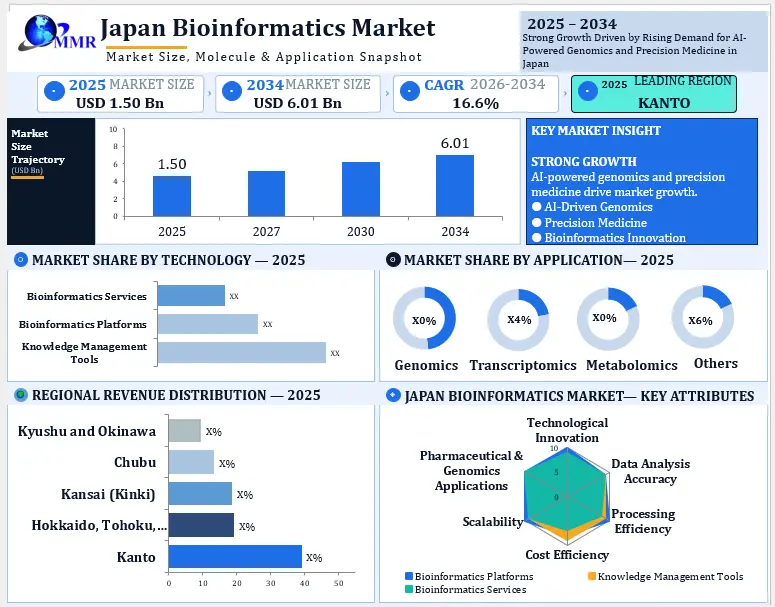
Japan Bioinformatics Market Growth

To know about the Research Methodology :- Request Free Sample Report

Japan Bioinformatics Market Dynamics:

Rising Genomic Research, Precision Medicine and Pharmaceutical R&D Investments Accelerating Market Growth

The Japan Bioinformatics Market experiences strong growth through increasing investments in genomic medicine, pharmaceutical research, next-generation sequencing (NGS), and personalized healthcare. Japan's advanced biotechnology infrastructure and aging population support growing demand for bioinformatics software, genomic data analysis, molecular diagnostics, and computational drug discovery platforms. Government-supported whole-genome research programs strengthen the integration of genetic information into cancer and rare disease research. Japan's genomic medicine initiatives include more than 19,000 rare disease cases analyzed through fiscal 2025, demonstrating substantial demand for genomic interpretation and biological data management. Pharmaceutical companies increasingly adopt AI-powered bioinformatics tools, molecular modeling, and biomarker discovery solutions to enhance research efficiency and therapeutic development.

High Software Licensing Costs, Expensive Computing Infrastructure and Limited Research Budgets Restrict Adoption

High implementation costs associated with advanced bioinformatics platforms, genomic analysis software, and high-performance computing systems represent significant restraints on the Japan Bioinformatics Market. Research institutions and biotechnology companies require specialized computing resources, secure genomic databases, and expensive software subscriptions to process biological information. For example, whole-genome sequencing at approximately 30× coverage can generate datasets requiring tens to hundreds of gigabytes of storage per sample, depending on data format and workflow. Additional expenditure on cloud computing, database maintenance, and technical support increases operating costs. Small biotechnology firms and academic laboratories face financial limitations when adopting premium bioinformatics knowledge management tools, NGS analysis platforms, and computational biology software, restricting broader technology accessibility.

AI-Driven Drug Discovery, Precision Oncology and Genomic Medicine Creating New Revenue Potential

Expanding applications of artificial intelligence, precision oncology, pharmacogenomics, and clinical genomic interpretation create significant Japan Bioinformatics Market opportunities. Pharmaceutical companies and biotechnology developers increasingly require specialized AI-based drug target identification, genomic variant interpretation, multi-omics analytics, and personalized medicine solutions. Japan's national genome research infrastructure supports the development of secure data-sharing systems and advanced clinical bioinformatics services. As of May 2026, Japan's genome medicine program reports approximately 37,359 stored case records across its research datasets, illustrating the scale of emerging data analysis requirements. Increasing demand for customized genomic software, specialized sequencing interpretation services, and computational drug discovery creates commercial opportunities for bioinformatics technology providers and research organizations through 2034.

Skilled Workforce Shortages, Genomic Data Security and Complex Multi-Omics Integration Affecting Industry Development

The Japan Bioinformatics Market faces technical and operational challenges related to shortages of specialized bioinformaticians, sensitive genomic information management, and integration of complex biological datasets. Developing reliable machine learning algorithms, NGS data analysis pipelines, and computational biology platforms requires expertise across molecular biology, statistics, programming, and advanced analytics. Japan's personal information protection requirements increase the importance of secure data handling, informed consent, and controlled genomic information sharing. Large-scale research projects involving thousands of whole-genome sequencing samples also require substantial storage capacity, scalable computing infrastructure, and standardized analytical workflows. Integrating genomics, proteomics, transcriptomics, and clinical records remains challenging because differences in data formats and research methodologies affect interoperability and analytical consistency.

Japan Bioinformatics Market Trends

AI-Powered Genomics, Cloud-Based Bioinformatics and Automated NGS Analysis Transforming Industry Innovation

The Japan Bioinformatics Market trends highlight increasing adoption of AI-powered genomic analytics, cloud-based bioinformatics platforms, high-throughput sequencing, and multi-omics data integration across pharmaceutical research and biotechnology applications. Japanese research organizations increasingly utilize machine learning, automated molecular analysis, and predictive algorithms to improve drug discovery and genomic interpretation. Cloud-based bioinformatics platforms offer scalable computing resources through subscription-based and pay-as-you-go models, supporting efficient processing of large sequencing datasets. Integration of genomics, transcriptomics, proteomics, and metabolomics strengthens biomarker discovery, while automated bioinformatics pipelines improve research reproducibility. Increasing demand for secure genomic data management, AI-driven molecular modeling, and computational precision medicine solutions shapes Japan Bioinformatics Market technology development through 2034.

Trends Real-Life Implementation Market Impact
Adoption of AI and Machine Learning Integration of AI algorithms in genomic analysis tools for variant calling and interpretation Increased accuracy in data analysis, faster insights, and reduced manual workload, leading to higher demand for AI-based solutions
Precision Medicine Tailoring cancer treatments based on genetic profiling using bioinformatics, resulting in targeted therapies Increased demand for bioinformatics tools supporting personalized medicine, driving market growth in tools for genetic analysis
Cloud-Based Solutions Cloud platforms for storing and analyzing large genomic datasets, enabling collaboration and accessibility Expansion of market reach, cost-effectiveness for smaller research entities, and improved scalability for handling large datasets

Japan Bioinformatics Market Segment Analysis:

Japan Bioinformatics Market, by Service Type

The Japan Bioinformatics Market by Service Type is segmented into Sequencing Data Analysis and Interpretation, Biological Database Management Services, Bioinformatics Consulting and Custom Development, Multi-Omics Data Integration Services, Structural and Functional Analysis Services, and Other Bioinformatics Services. Sequencing Data Analysis and Interpretation represents an important segment, supported by increasing adoption of next-generation sequencing (NGS), genomic research, and precision medicine applications. Biological Database Management Services enable secure storage, organization, and retrieval of complex genomic datasets, while Bioinformatics Consulting and Custom Development provide specialized computational biology solutions for pharmaceutical and biotechnology companies. Multi-Omics Data Integration Services combine genomics, proteomics, transcriptomics, and metabolomics to support biomarker discovery and personalized medicine. Structural and Functional Analysis Services contribute to protein structure prediction, molecular modeling, and AI-driven drug discovery. Growing demand for cloud-based bioinformatics platforms, automated NGS data interpretation, and outsourced genomic analysis services strengthens the Japan Bioinformatics Market growth outlook during 2026–2034.
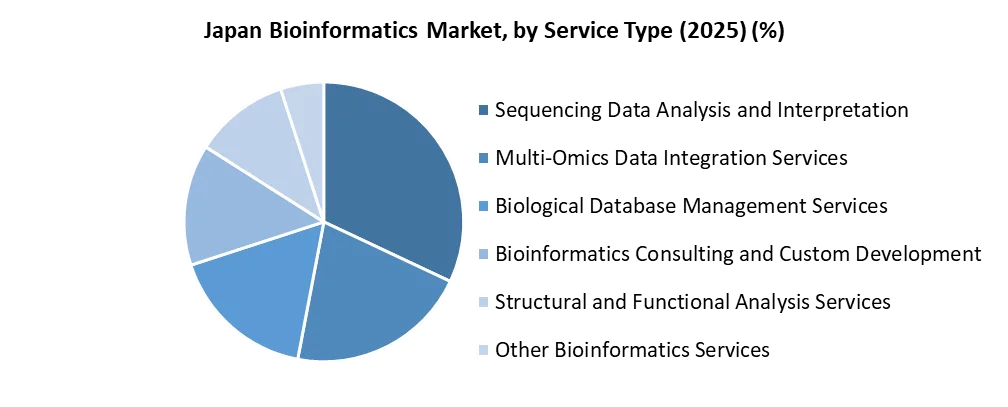
Japan Bioinformatics Market by service Type

Japan Bioinformatics Market, by Deployment Mode

The Japan Bioinformatics Market by Deployment Mode is segmented into On-Premises Bioinformatics Solutions, Cloud-Based Bioinformatics Solutions, and Hybrid Bioinformatics Solutions. Cloud-Based Bioinformatics Solutions are gaining significant demand due to scalable computing infrastructure, cost-efficient genomic data storage, and increasing adoption of AI-powered bioinformatics platforms. On-Premises Bioinformatics Solutions provide greater infrastructure control, data security, and customized computational capabilities for pharmaceutical companies, research institutes, and healthcare organizations. Hybrid Bioinformatics Solutions combine cloud computing flexibility with on-premises data management, supporting secure NGS data analysis, multi-omics integration, and precision medicine applications. Increasing investments in cloud-based genomic analytics, high-performance computing, automated bioinformatics workflows, and AI-driven drug discovery strengthen Japan Bioinformatics Market growth during 2026–2034.
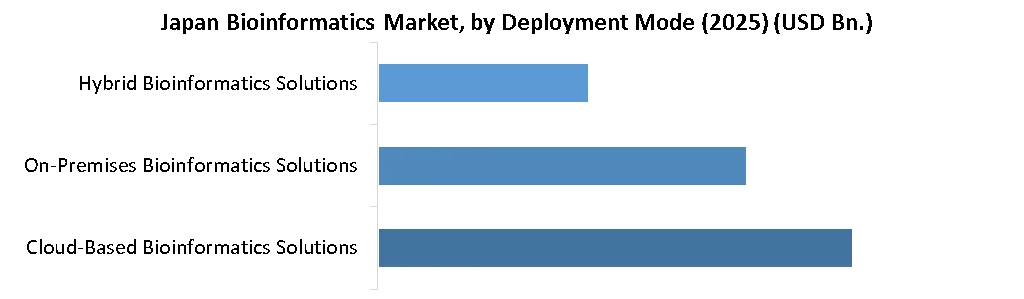
Japan Bioinformatics Market by Deployment Mode

Japan Bioinformatics Market Regional Analysis

Japan Bioinformatics Market Regional Analysis Kanto Region Dominates the Japan Bioinformatics Market with Strong Genomics Research and AI-Driven Drug Discovery

The Kanto region holds a leading position in the Japan Bioinformatics Market, supported by the concentration of biotechnology companies, pharmaceutical research institutions, genomic sequencing facilities, and advanced healthcare infrastructure across Tokyo, Yokohama, and Tsukuba. The presence of RIKEN, the University of Tokyo, and leading biomedical research centers support demand for bioinformatics software, next-generation sequencing (NGS) data analysis, computational biology, and AI-powered drug discovery platforms. Growing investment in precision medicine, genomic data management, and personalized healthcare strengthens the adoption of bioinformatics technologies. RIKEN's Yokohama campus supports genomic and integrative medical research, reinforcing the region's importance in Japan's bioinformatics ecosystem.

Kansai Region Expands Through Pharmaceutical Research and Computational Genomics

The Kansai region represents another major hub for Japan Bioinformatics Market growth, driven by biotechnology innovation and pharmaceutical research activities in Osaka, Kyoto, and Kobe. Kyoto University's Bioinformatics Center and Osaka University's Bioinformatics Initiative support genomic data analysis, biomedical informatics, systems biology, and computational drug discovery. Increasing integration of artificial intelligence, machine learning, and multi-omics technologies in pharmaceutical R&D creates opportunities for bioinformatics platforms and specialized data analysis services.

Emerging Regional Opportunities in Chubu, Tohoku, Kyushu, and Hokkaido

The Chubu, Tohoku, Kyushu, and Hokkaido regions contribute to the expansion of Japan's bioinformatics industry through university research, genomic medicine, biotechnology applications, and computational life sciences. Nagoya University strengthens AI-enabled biomedical data analysis and drug discovery research in Chubu, while Tohoku University's Medical Megabank supports large-scale genomic databases and personalized medicine. Kyushu University advances bioinformatics research in Fukuoka, and Hokkaido University supports genome informatics, infectious disease research, and computational biology. These developments create opportunities for bioinformatics tools, cloud-based genomic analysis, research services, and advanced biological data management solutions across Japan.

Japan Bioinformatics Market Recent Developments

Date Company Type Recent Developments
October 2026 NEC Corporation Strategic R&D Collaboration NEC, Taiho Pharmaceutical, the
Japanese Foundation for Cancer Research, AIST, and Waseda University
announced a joint project selected for Japan's NEDO demonstration program.
The initiative combines quantum computing, AI, and computational analysis to
develop a platform for designing and evaluating cancer immunotherapy targets
October 2026 Takara Bio Inc. Strategic
Collaboration Agreement
Takara Bio signed a basic collaboration agreement with
Epistra Inc. to advance AI-driven life sciences research, single-cell data
analysis, bioinformatics services, and multi-omics interpretation. The
partnership explores new computational biology services and research
automation opportunities.
October 2026 QIAGEN N.V. Product Launch, Technology Expansion QIAGEN introduced IPA
Investigator and QIAGEN Discovery Platform, expanding AI-powered biological
pathway analysis, genomic interpretation, and automated drug discovery
workflows. These solutions support pharmaceutical and biotechnology research,
including applications relevant to Japan's bioinformatics industry.
June 2026 Illumina Inc. Partnership,
Service Expansion
Illumina announced that its partnership with Sysmex
Corporation supports outsourced cancer genomic profiling through RIKEN
GENESIS using the TruSight Oncology Comprehensive panel system. The test
gained Japanese health insurance coverage effective June 1, expanding access
to precision oncology and genomic analysis services.
March 2026 Oxford Nanopore Technologies
plc
Strategic Collaboration Oxford Nanopore announced a
partnership with Japan's A.D.A.M. Innovations (Genesis Healthcare) to develop
advanced genomic sequencing and precision medicine applications. The
collaboration supports real-time nanopore sequencing, genomic data
interpretation, and new clinical testing workflows in Japan.

Japan Bioinformatics Market Competitive Landscape

Increasing technological innovation, pharmaceutical research investments, and demand for advanced genomic data analytics shape the Japan Bioinformatics Market Competitive Landscape. Leading Japan Bioinformatics Market key players, including Fujitsu Limited, NEC Corporation, Hitachi Ltd., Takara Bio Inc., Illumina Inc., QIAGEN N.V., Thermo Fisher Scientific, and Oxford Nanopore Technologies, strengthen their competitive positions through AI-powered bioinformatics platforms, next-generation sequencing (NGS), genomic data analysis, and computational biology solutions. Japanese technology companies focus on AI-driven healthcare analytics and computational drug discovery, while global life sciences companies provide advanced sequencing technologies, biological data interpretation tools, and precision medicine solutions.

Strategic collaborations, technology partnerships, product launches, and research investments intensify competition across the Japan Bioinformatics Industry. Companies increasingly integrate machine learning, cloud-based bioinformatics software, multi-omics data analysis, molecular modeling, and automated genomic sequencing platforms to enhance research efficiency and expand market presence. Growing demand for bioinformatics consulting services, personalized medicine, biomarker discovery, and pharmaceutical data analytics creates opportunities for established companies and emerging biotechnology specialists. Analytical accuracy, data security, technological innovation, and scalable computing infrastructure remain important competitive factors influencing Japan Bioinformatics Market growth, market share, and industry outlook during 2026–2034.

Japan Bioinformatics Market Scope: Inquire Before Buying

Japan Bioinformatics Market
Report Coverage Details
Base Year: 2025 Forecast Period: 2026-2034
Historical Data: 2020 to 2025 Market Size in 2025: 1.50 USD Billion
Forecast Period 2026-2034 CAGR: 16.6% Market Size in 2034: 6.01 USD Billion
Segments Covered: by Technology Knowledge Management Tools
Bioinformatics Platforms
Bioinformatics Services
by Application Metabolomics
Molecular phylogenetics
Transcriptomics
Chemoinformatic & drug design
Genomics
by Service Type Sequencing Data Analysis and Interpretation
Biological Database Management Services
Bioinformatics Consulting and Custom Development
Multi-Omics Data Integration Services
Structural and Functional Analysis Services
Other Bioinformatics Services
by Deployment Mode On-Premises Bioinformatics Solutions
Cloud-Based Bioinformatics Solutions
Hybrid Bioinformatics Solutions
by End User Medical Biotechnology
Academic and Scientific Research
Animal Biotechnology
Agricultural Biotechnology
Environmental Biotechnology
Forensic Biotechnology

Japan Bioinformatics Market Key Players:

1. QIAGEN N.V.
2. Thermo Fisher Scientific Inc.
3. Illumina Inc.
4. Agilent Technologies Inc.
5. Fujitsu Limited
6. NEC Corporation
7. Hitachi Ltd.
8. Takara Bio Inc.
9. F. Hoffmann-La Roche Ltd.
10. Danaher Corporation (Beckman Coulter and Genedata)
11. Oxford Nanopore Technologies plc
12. Pacific Biosciences of California Inc.
13. BGI Genomics Co., Ltd.
14. Bio-Rad Laboratories Inc.
15. Eurofins Scientific SE
16. Revvity Inc.
17. Waters Corporation
18. Bruker Corporation
19. Shimadzu Corporation
20. SOPHiA GENETICS SA
21. DNAnexus Inc.
22. 10x Genomics Inc.
23. Azenta Inc. (GENEWIZ)
24. Novogene Co., Ltd.
25. Macrogen Inc.
26. M3 Inc.
27. Rhelixa Inc.
28. RIKEN GENESIS Co., Ltd.
29. DNA Chip Research Inc.
30. GeneQuest Inc.
31. Human Metabolome Technologies Inc.
32. Sysmex Corporation
33. Dassault Systèmes SE (BIOVIA)
34. Certara Inc.
35. Schrödinger Inc.
36. Dotmatics
37. DNASTAR Inc.
38. Seqera Labs
39. Zymo Research Corporation
40. WuXi AppTec Co., Ltd.

Frequently Asked Questions:

1. What is the Japan Bioinformatics Market Size in 2025?
The Japan Bioinformatics Market is valued at USD 1.50 billion in 2025, driven by growing genomic research, pharmaceutical innovation, and computational biology applications.

2. What is the Expected Japan Bioinformatics Market Size by 2034?
The Japan Bioinformatics Market is projected to reach USD 6.01 billion by 2034, growing at a CAGR of 16.6% during 2026–2034.

3. What Are the Major Growth Drivers of the Japan Bioinformatics Market?
Increasing adoption of next-generation sequencing (NGS), AI-powered bioinformatics, precision medicine, and genomic data analysis drives Japan Bioinformatics Market growth.

4. Which Technology Dominates the Japan Bioinformatics Market?
Bioinformatics Platforms represent a leading technology segment, accounting for more than 45% market share in 2023, supported by genomic research and drug discovery applications.

5. Which Region Leads the Japan Bioinformatics Market?
The Kanto region leads the Japan Bioinformatics Market, supported by biotechnology research, pharmaceutical R&D, and advanced genomic sequencing facilities in Tokyo and surrounding areas.

6. What Are the Latest Japan Bioinformatics Market Trends in 2026?
Major trends include AI-driven genomic analysis, cloud-based bioinformatics platforms, automated NGS workflows, multi-omics integration, and precision oncology.

7. Who Are the Leading Companies in the Japan Bioinformatics Market?
Major Japan Bioinformatics Market key players include QIAGEN, Thermo Fisher Scientific, Illumina, Fujitsu, NEC Corporation, Takara Bio, and Oxford Nanopore Technologies.

Table of Contents

1. Japan Bioinformatics Market Introduction 1.1. Study Assumption and Market Definition 1.2. Scope of the Study 1.3. Executive Summary 2. Global Japan Bioinformatics Market: Competitive Landscape 2.1. MMR Competition Matrix 2.2. Competitive Landscape 2.3. Key Players Benchmarking 2.3.1. Company Name 2.3.2. Business Segment 2.3.3. End-user Segment 2.3.4. Revenue (2025) 2.3.5. Company Locations 2.4. Leading Japan Bioinformatics Market Companies, by market capitalization 2.5. Market Structure 2.5.1. Market Leaders 2.5.2. Market Followers 2.5.3. Emerging Players 2.6. Mergers and Acquisitions Details 3. Japan Bioinformatics Market: Dynamics 3.1. Japan Bioinformatics Market Trends by Region 3.1.1. North America Japan Bioinformatics Market Trends 3.1.2. Europe Japan Bioinformatics Market Trends 3.1.3. Asia Pacific Japan Bioinformatics Market Trends 3.1.4. Middle East and Africa Japan Bioinformatics Market Trends 3.1.5. South America Japan Bioinformatics Market Trends 3.2. Japan Bioinformatics Market Dynamics by Region 3.2.1. North America 3.2.1.1. North America Japan Bioinformatics Market Drivers 3.2.1.2. North America Japan Bioinformatics Market Restraints 3.2.1.3. North America Japan Bioinformatics Market Opportunities 3.2.1.4. North America Japan Bioinformatics Market Challenges 3.2.2. Europe 3.2.2.1. Europe Japan Bioinformatics Market Drivers 3.2.2.2. Europe Japan Bioinformatics Market Restraints 3.2.2.3. Europe Japan Bioinformatics Market Opportunities 3.2.2.4. Europe Japan Bioinformatics Market Challenges 3.2.3. Asia Pacific 3.2.3.1. Asia Pacific Japan Bioinformatics Market Drivers 3.2.3.2. Asia Pacific Japan Bioinformatics Market Restraints 3.2.3.3. Asia Pacific Japan Bioinformatics Market Opportunities 3.2.3.4. Asia Pacific Japan Bioinformatics Market Challenges 3.2.4. Middle East and Africa 3.2.4.1. Middle East and Africa Japan Bioinformatics Market Drivers 3.2.4.2. Middle East and Africa Japan Bioinformatics Market Restraints 3.2.4.3. Middle East and Africa Japan Bioinformatics Market Opportunities 3.2.4.4. Middle East and Africa Japan Bioinformatics Market Challenges 3.2.5. South America 3.2.5.1. South America Japan Bioinformatics Market Drivers 3.2.5.2. South America Japan Bioinformatics Market Restraints 3.2.5.3. South America Japan Bioinformatics Market Opportunities 3.2.5.4. South America Japan Bioinformatics Market Challenges 3.3. PORTER's Five Forces Analysis 3.4. PESTLE Analysis 3.5. Technology Roadmap 3.6. Regulatory Landscape by Region 3.6.1. North America 3.6.2. Europe 3.6.3. Asia Pacific 3.6.4. Middle East and Africa 3.6.5. South America 3.7. Key Opinion Leader Analysis For Japan Bioinformatics Industry 3.8. Analysis of Government Schemes and Initiatives For Japan Bioinformatics Industry 3.9. Japan Bioinformatics Market Trade Analysis 3.10. The Global Pandemic Impact on Japan Bioinformatics Market 4. Japan Bioinformatics Market: Global Market Size and Forecast by Segmentation (in USD Billion) 2025-2034 4.1. Japan Bioinformatics Market Size and Forecast, by Technology (2025-2034) 4.1.1. Knowledge Management Tools 4.1.2. Bioinformatics Platforms 4.1.3. Bioinformatics Services 4.2. Japan Bioinformatics Market Size and Forecast, by Application (2025-2034) 4.2.1. Metabolomics 4.2.2. Molecular phylogenetics 4.2.3. Transcriptomics 4.2.4. Chemoinformatic & drug design 4.2.5. Genomics 4.3. Japan Bioinformatics Market Size and Forecast, by Service Type (2025-2034) 4.3.1. Sequencing Data Analysis and Interpretation 4.3.2. Biological Database Management Services 4.3.3. Bioinformatics Consulting and Custom Development 4.3.4. Multi-Omics Data Integration Services 4.3.5. Structural and Functional Analysis Services 4.3.6. Other Bioinformatics Services 4.4. Japan Bioinformatics Market Size and Forecast, by Deployment Mode (2025-2034) 4.4.1. On-Premises Bioinformatics Solutions 4.4.2. Cloud-Based Bioinformatics Solutions 4.4.3. Hybrid Bioinformatics Solutions 4.5. Japan Bioinformatics Market Size and Forecast, by End User (2025-2034) 4.5.1. Medical Biotechnology 4.5.2. Academic and Scientific Research 4.5.3. Animal Biotechnology 4.5.4. Agricultural Biotechnology 4.5.5. Environmental Biotechnology 4.5.6. Forensic Biotechnology 4.6. Japan Bioinformatics Market Size and Forecast, by Region (2025-2034) 4.6.1. North America 4.6.2. Europe 4.6.3. Asia Pacific 4.6.4. Middle East and Africa 4.6.5. South America 5. North America Japan Bioinformatics Market Size and Forecast by Segmentation (in USD Billion) 2025-2034 5.1. North America Japan Bioinformatics Market Size and Forecast, by Technology (2025-2034) 5.1.1. Knowledge Management Tools 5.1.2. Bioinformatics Platforms 5.1.3. Bioinformatics Services 5.2. North America Japan Bioinformatics Market Size and Forecast, by Application (2025-2034) 5.2.1. Metabolomics 5.2.2. Molecular phylogenetics 5.2.3. Transcriptomics 5.2.4. Chemoinformatic & drug design 5.2.5. Genomics 5.3. North America Japan Bioinformatics Market Size and Forecast, by Service Type (2025-2034) 5.3.1. Sequencing Data Analysis and Interpretation 5.3.2. Biological Database Management Services 5.3.3. Bioinformatics Consulting and Custom Development 5.3.4. Multi-Omics Data Integration Services 5.3.5. Structural and Functional Analysis Services 5.3.6. Other Bioinformatics Services 5.4. North America Japan Bioinformatics Market Size and Forecast, by Deployment Mode (2025-2034) 5.4.1. On-Premises Bioinformatics Solutions 5.4.2. Cloud-Based Bioinformatics Solutions 5.4.3. Hybrid Bioinformatics Solutions 5.5. North America Japan Bioinformatics Market Size and Forecast, by End User (2025-2034) 5.5.1. Medical Biotechnology 5.5.2. Academic and Scientific Research 5.5.3. Animal Biotechnology 5.5.4. Agricultural Biotechnology 5.5.5. Environmental Biotechnology 5.5.6. Forensic Biotechnology 5.6. North America Japan Bioinformatics Market Size and Forecast, by Country (2025-2034) 5.6.1. United States 5.6.1.1. United States Japan Bioinformatics Market Size and Forecast, by Technology (2025-2034) 5.6.1.1.1. Knowledge Management Tools 5.6.1.1.2. Bioinformatics Platforms 5.6.1.1.3. Bioinformatics Services 5.6.1.2. United States Japan Bioinformatics Market Size and Forecast, by Application (2025-2034) 5.6.1.2.1. Metabolomics 5.6.1.2.2. Molecular phylogenetics 5.6.1.2.3. Transcriptomics 5.6.1.2.4. Chemoinformatic & drug design 5.6.1.2.5. Genomics 5.6.1.3. United States Japan Bioinformatics Market Size and Forecast, by Service Type (2025-2034) 5.6.1.3.1. Sequencing Data Analysis and Interpretation 5.6.1.3.2. Biological Database Management Services 5.6.1.3.3. Bioinformatics Consulting and Custom Development 5.6.1.3.4. Multi-Omics Data Integration Services 5.6.1.3.5. Structural and Functional Analysis Services 5.6.1.3.6. Other Bioinformatics Services 5.6.1.4. United States Japan Bioinformatics Market Size and Forecast, by Deployment Mode (2025-2034) 5.6.1.4.1. On-Premises Bioinformatics Solutions 5.6.1.4.2. Cloud-Based Bioinformatics Solutions 5.6.1.4.3. Hybrid Bioinformatics Solutions 5.6.1.5. United States Japan Bioinformatics Market Size and Forecast, by End User (2025-2034) 5.6.1.5.1. Medical Biotechnology 5.6.1.5.2. Academic and Scientific Research 5.6.1.5.3. Animal Biotechnology 5.6.1.5.4. Agricultural Biotechnology 5.6.1.5.5. Environmental Biotechnology 5.6.1.5.6. Forensic Biotechnology 5.6.2. Canada 5.6.2.1. Canada Japan Bioinformatics Market Size and Forecast, by Technology (2025-2034) 5.6.2.1.1. Knowledge Management Tools 5.6.2.1.2. Bioinformatics Platforms 5.6.2.1.3. Bioinformatics Services 5.6.2.2. Canada Japan Bioinformatics Market Size and Forecast, by Application (2025-2034) 5.6.2.2.1. Metabolomics 5.6.2.2.2. Molecular phylogenetics 5.6.2.2.3. Transcriptomics 5.6.2.2.4. Chemoinformatic & drug design 5.6.2.2.5. Genomics 5.6.2.3. Canada Japan Bioinformatics Market Size and Forecast, by Service Type (2025-2034) 5.6.2.3.1. Sequencing Data Analysis and Interpretation 5.6.2.3.2. Biological Database Management Services 5.6.2.3.3. Bioinformatics Consulting and Custom Development 5.6.2.3.4. Multi-Omics Data Integration Services 5.6.2.3.5. Structural and Functional Analysis Services 5.6.2.3.6. Other Bioinformatics Services 5.6.2.4. Canada Japan Bioinformatics Market Size and Forecast, by Deployment Mode (2025-2034) 5.6.2.4.1. On-Premises Bioinformatics Solutions 5.6.2.4.2. Cloud-Based Bioinformatics Solutions 5.6.2.4.3. Hybrid Bioinformatics Solutions 5.6.2.5. Canada Japan Bioinformatics Market Size and Forecast, by End User (2025-2034) 5.6.2.5.1. Medical Biotechnology 5.6.2.5.2. Academic and Scientific Research 5.6.2.5.3. Animal Biotechnology 5.6.2.5.4. Agricultural Biotechnology 5.6.2.5.5. Environmental Biotechnology 5.6.2.5.6. Forensic Biotechnology 5.6.3. Mexico 5.6.3.1. Mexico Japan Bioinformatics Market Size and Forecast, by Technology (2025-2034) 5.6.3.1.1. Knowledge Management Tools 5.6.3.1.2. Bioinformatics Platforms 5.6.3.1.3. Bioinformatics Services 5.6.3.2. Mexico Japan Bioinformatics Market Size and Forecast, by Application (2025-2034) 5.6.3.2.1. Metabolomics 5.6.3.2.2. Molecular phylogenetics 5.6.3.2.3. Transcriptomics 5.6.3.2.4. Chemoinformatic & drug design 5.6.3.2.5. Genomics 5.6.3.3. Mexico Japan Bioinformatics Market Size and Forecast, by Service Type (2025-2034) 5.6.3.3.1. Sequencing Data Analysis and Interpretation 5.6.3.3.2. Biological Database Management Services 5.6.3.3.3. Bioinformatics Consulting and Custom Development 5.6.3.3.4. Multi-Omics Data Integration Services 5.6.3.3.5. Structural and Functional Analysis Services 5.6.3.3.6. Other Bioinformatics Services 5.6.3.4. Mexico Japan Bioinformatics Market Size and Forecast, by Deployment Mode (2025-2034) 5.6.3.4.1. On-Premises Bioinformatics Solutions 5.6.3.4.2. Cloud-Based Bioinformatics Solutions 5.6.3.4.3. Hybrid Bioinformatics Solutions 5.6.3.5. Mexico Japan Bioinformatics Market Size and Forecast, by End User (2025-2034) 5.6.3.5.1. Medical Biotechnology 5.6.3.5.2. Academic and Scientific Research 5.6.3.5.3. Animal Biotechnology 5.6.3.5.4. Agricultural Biotechnology 5.6.3.5.5. Environmental Biotechnology 5.6.3.5.6. Forensic Biotechnology 6. Europe Japan Bioinformatics Market Size and Forecast by Segmentation (in USD Billion) 2025-2034 6.1. Europe Japan Bioinformatics Market Size and Forecast, by Technology (2025-2034) 6.2. Europe Japan Bioinformatics Market Size and Forecast, by Application (2025-2034) 6.3. Europe Japan Bioinformatics Market Size and Forecast, by Service Type (2025-2034) 6.4. Europe Japan Bioinformatics Market Size and Forecast, by Deployment Mode (2025-2034) 6.5. Europe Japan Bioinformatics Market Size and Forecast, by End User (2025-2034) 6.6. Europe Japan Bioinformatics Market Size and Forecast, by Country (2025-2034) 6.6.1. United Kingdom 6.6.1.1. United Kingdom Japan Bioinformatics Market Size and Forecast, by Technology (2025-2034) 6.6.1.2. United Kingdom Japan Bioinformatics Market Size and Forecast, by Application (2025-2034) 6.6.1.3. United Kingdom Japan Bioinformatics Market Size and Forecast, by Service Type (2025-2034) 6.6.1.4. United Kingdom Japan Bioinformatics Market Size and Forecast, by Deployment Mode (2025-2034) 6.6.1.5. United Kingdom Japan Bioinformatics Market Size and Forecast, by End User (2025-2034) 6.6.2. France 6.6.2.1. France Japan Bioinformatics Market Size and Forecast, by Technology (2025-2034) 6.6.2.2. France Japan Bioinformatics Market Size and Forecast, by Application (2025-2034) 6.6.2.3. France Japan Bioinformatics Market Size and Forecast, by Service Type (2025-2034) 6.6.2.4. France Japan Bioinformatics Market Size and Forecast, by Deployment Mode (2025-2034) 6.6.2.5. France Japan Bioinformatics Market Size and Forecast, by End User (2025-2034) 6.6.3. Germany 6.6.3.1. Germany Japan Bioinformatics Market Size and Forecast, by Technology (2025-2034) 6.6.3.2. Germany Japan Bioinformatics Market Size and Forecast, by Application (2025-2034) 6.6.3.3. Germany Japan Bioinformatics Market Size and Forecast, by Service Type (2025-2034) 6.6.3.4. Germany Japan Bioinformatics Market Size and Forecast, by Deployment Mode (2025-2034) 6.6.3.5. Germany Japan Bioinformatics Market Size and Forecast, by End User (2025-2034) 6.6.4. Italy 6.6.4.1. Italy Japan Bioinformatics Market Size and Forecast, by Technology (2025-2034) 6.6.4.2. Italy Japan Bioinformatics Market Size and Forecast, by Application (2025-2034) 6.6.4.3. Italy Japan Bioinformatics Market Size and Forecast, by Service Type (2025-2034) 6.6.4.4. Italy Japan Bioinformatics Market Size and Forecast, by Deployment Mode (2025-2034) 6.6.4.5. Italy Japan Bioinformatics Market Size and Forecast, by End User (2025-2034) 6.6.5. Spain 6.6.5.1. Spain Japan Bioinformatics Market Size and Forecast, by Technology (2025-2034) 6.6.5.2. Spain Japan Bioinformatics Market Size and Forecast, by Application (2025-2034) 6.6.5.3. Spain Japan Bioinformatics Market Size and Forecast, by Service Type (2025-2034) 6.6.5.4. Spain Japan Bioinformatics Market Size and Forecast, by Deployment Mode (2025-2034) 6.6.5.5. Spain Japan Bioinformatics Market Size and Forecast, by End User (2025-2034) 6.6.6. Sweden 6.6.6.1. Sweden Japan Bioinformatics Market Size and Forecast, by Technology (2025-2034) 6.6.6.2. Sweden Japan Bioinformatics Market Size and Forecast, by Application (2025-2034) 6.6.6.3. Sweden Japan Bioinformatics Market Size and Forecast, by Service Type (2025-2034) 6.6.6.4. Sweden Japan Bioinformatics Market Size and Forecast, by Deployment Mode (2025-2034) 6.6.6.5. Sweden Japan Bioinformatics Market Size and Forecast, by End User (2025-2034) 6.6.7. Austria 6.6.7.1. Austria Japan Bioinformatics Market Size and Forecast, by Technology (2025-2034) 6.6.7.2. Austria Japan Bioinformatics Market Size and Forecast, by Application (2025-2034) 6.6.7.3. Austria Japan Bioinformatics Market Size and Forecast, by Service Type (2025-2034) 6.6.7.4. Austria Japan Bioinformatics Market Size and Forecast, by Deployment Mode (2025-2034) 6.6.7.5. Austria Japan Bioinformatics Market Size and Forecast, by End User (2025-2034) 6.6.8. Rest of Europe 6.6.8.1. Rest of Europe Japan Bioinformatics Market Size and Forecast, by Technology (2025-2034) 6.6.8.2. Rest of Europe Japan Bioinformatics Market Size and Forecast, by Application (2025-2034) 6.6.8.3. Rest of Europe Japan Bioinformatics Market Size and Forecast, by Service Type (2025-2034) 6.6.8.4. Rest of Europe Japan Bioinformatics Market Size and Forecast, by Deployment Mode (2025-2034) 6.6.8.5. Rest of Europe Japan Bioinformatics Market Size and Forecast, by End User (2025-2034) 7. Asia Pacific Japan Bioinformatics Market Size and Forecast by Segmentation (in USD Billion) 2025-2034 7.1. Asia Pacific Japan Bioinformatics Market Size and Forecast, by Technology (2025-2034) 7.2. Asia Pacific Japan Bioinformatics Market Size and Forecast, by Application (2025-2034) 7.3. Asia Pacific Japan Bioinformatics Market Size and Forecast, by Service Type (2025-2034) 7.4. Asia Pacific Japan Bioinformatics Market Size and Forecast, by Deployment Mode (2025-2034) 7.5. Asia Pacific Japan Bioinformatics Market Size and Forecast, by End User (2025-2034) 7.6. Asia Pacific Japan Bioinformatics Market Size and Forecast, by Country (2025-2034) 7.6.1. China 7.6.1.1. China Japan Bioinformatics Market Size and Forecast, by Technology (2025-2034) 7.6.1.2. China Japan Bioinformatics Market Size and Forecast, by Application (2025-2034) 7.6.1.3. China Japan Bioinformatics Market Size and Forecast, by Service Type (2025-2034) 7.6.1.4. China Japan Bioinformatics Market Size and Forecast, by Deployment Mode (2025-2034) 7.6.1.5. China Japan Bioinformatics Market Size and Forecast, by End User (2025-2034) 7.6.2. S Korea 7.6.2.1. S Korea Japan Bioinformatics Market Size and Forecast, by Technology (2025-2034) 7.6.2.2. S Korea Japan Bioinformatics Market Size and Forecast, by Application (2025-2034) 7.6.2.3. S Korea Japan Bioinformatics Market Size and Forecast, by Service Type (2025-2034) 7.6.2.4. S Korea Japan Bioinformatics Market Size and Forecast, by Deployment Mode (2025-2034) 7.6.2.5. S Korea Japan Bioinformatics Market Size and Forecast, by End User (2025-2034) 7.6.3. Japan 7.6.3.1. Japan Japan Bioinformatics Market Size and Forecast, by Technology (2025-2034) 7.6.3.2. Japan Japan Bioinformatics Market Size and Forecast, by Application (2025-2034) 7.6.3.3. Japan Japan Bioinformatics Market Size and Forecast, by Service Type (2025-2034) 7.6.3.4. Japan Japan Bioinformatics Market Size and Forecast, by Deployment Mode (2025-2034) 7.6.3.5. Japan Japan Bioinformatics Market Size and Forecast, by End User (2025-2034) 7.6.4. India 7.6.4.1. India Japan Bioinformatics Market Size and Forecast, by Technology (2025-2034) 7.6.4.2. India Japan Bioinformatics Market Size and Forecast, by Application (2025-2034) 7.6.4.3. India Japan Bioinformatics Market Size and Forecast, by Service Type (2025-2034) 7.6.4.4. India Japan Bioinformatics Market Size and Forecast, by Deployment Mode (2025-2034) 7.6.4.5. India Japan Bioinformatics Market Size and Forecast, by End User (2025-2034) 7.6.5. Australia 7.6.5.1. Australia Japan Bioinformatics Market Size and Forecast, by Technology (2025-2034) 7.6.5.2. Australia Japan Bioinformatics Market Size and Forecast, by Application (2025-2034) 7.6.5.3. Australia Japan Bioinformatics Market Size and Forecast, by Service Type (2025-2034) 7.6.5.4. Australia Japan Bioinformatics Market Size and Forecast, by Deployment Mode (2025-2034) 7.6.5.5. Australia Japan Bioinformatics Market Size and Forecast, by End User (2025-2034) 7.6.6. Indonesia 7.6.6.1. Indonesia Japan Bioinformatics Market Size and Forecast, by Technology (2025-2034) 7.6.6.2. Indonesia Japan Bioinformatics Market Size and Forecast, by Application (2025-2034) 7.6.6.3. Indonesia Japan Bioinformatics Market Size and Forecast, by Service Type (2025-2034) 7.6.6.4. Indonesia Japan Bioinformatics Market Size and Forecast, by Deployment Mode (2025-2034) 7.6.6.5. Indonesia Japan Bioinformatics Market Size and Forecast, by End User (2025-2034) 7.6.7. Malaysia 7.6.7.1. Malaysia Japan Bioinformatics Market Size and Forecast, by Technology (2025-2034) 7.6.7.2. Malaysia Japan Bioinformatics Market Size and Forecast, by Application (2025-2034) 7.6.7.3. Malaysia Japan Bioinformatics Market Size and Forecast, by Service Type (2025-2034) 7.6.7.4. Malaysia Japan Bioinformatics Market Size and Forecast, by Deployment Mode (2025-2034) 7.6.7.5. Malaysia Japan Bioinformatics Market Size and Forecast, by End User (2025-2034) 7.6.8. Vietnam 7.6.8.1. Vietnam Japan Bioinformatics Market Size and Forecast, by Technology (2025-2034) 7.6.8.2. Vietnam Japan Bioinformatics Market Size and Forecast, by Application (2025-2034) 7.6.8.3. Vietnam Japan Bioinformatics Market Size and Forecast, by Service Type (2025-2034) 7.6.8.4. Vietnam Japan Bioinformatics Market Size and Forecast, by Deployment Mode (2025-2034) 7.6.8.5. Vietnam Japan Bioinformatics Market Size and Forecast, by End User (2025-2034) 7.6.9. Taiwan 7.6.9.1. Taiwan Japan Bioinformatics Market Size and Forecast, by Technology (2025-2034) 7.6.9.2. Taiwan Japan Bioinformatics Market Size and Forecast, by Application (2025-2034) 7.6.9.3. Taiwan Japan Bioinformatics Market Size and Forecast, by Service Type (2025-2034) 7.6.9.4. Taiwan Japan Bioinformatics Market Size and Forecast, by Deployment Mode (2025-2034) 7.6.9.5. Taiwan Japan Bioinformatics Market Size and Forecast, by End User (2025-2034) 7.6.10. Rest of Asia Pacific 7.6.10.1. Rest of Asia Pacific Japan Bioinformatics Market Size and Forecast, by Technology (2025-2034) 7.6.10.2. Rest of Asia Pacific Japan Bioinformatics Market Size and Forecast, by Application (2025-2034) 7.6.10.3. Rest of Asia Pacific Japan Bioinformatics Market Size and Forecast, by Service Type (2025-2034) 7.6.10.4. Rest of Asia Pacific Japan Bioinformatics Market Size and Forecast, by Deployment Mode (2025-2034) 7.6.10.5. Rest of Asia Pacific Japan Bioinformatics Market Size and Forecast, by End User (2025-2034) 8. Middle East and Africa Japan Bioinformatics Market Size and Forecast by Segmentation (in USD Billion) 2025-2034 8.1. Middle East and Africa Japan Bioinformatics Market Size and Forecast, by Technology (2025-2034) 8.2. Middle East and Africa Japan Bioinformatics Market Size and Forecast, by Application (2025-2034) 8.3. Middle East and Africa Japan Bioinformatics Market Size and Forecast, by Service Type (2025-2034) 8.4. Middle East and Africa Japan Bioinformatics Market Size and Forecast, by Deployment Mode (2025-2034) 8.5. Middle East and Africa Japan Bioinformatics Market Size and Forecast, by End User (2025-2034) 8.6. Middle East and Africa Japan Bioinformatics Market Size and Forecast, by Country (2025-2034) 8.6.1. South Africa 8.6.1.1. South Africa Japan Bioinformatics Market Size and Forecast, by Technology (2025-2034) 8.6.1.2. South Africa Japan Bioinformatics Market Size and Forecast, by Application (2025-2034) 8.6.1.3. South Africa Japan Bioinformatics Market Size and Forecast, by Service Type (2025-2034) 8.6.1.4. South Africa Japan Bioinformatics Market Size and Forecast, by Deployment Mode (2025-2034) 8.6.1.5. South Africa Japan Bioinformatics Market Size and Forecast, by End User (2025-2034) 8.6.2. GCC 8.6.2.1. GCC Japan Bioinformatics Market Size and Forecast, by Technology (2025-2034) 8.6.2.2. GCC Japan Bioinformatics Market Size and Forecast, by Application (2025-2034) 8.6.2.3. GCC Japan Bioinformatics Market Size and Forecast, by Service Type (2025-2034) 8.6.2.4. GCC Japan Bioinformatics Market Size and Forecast, by Deployment Mode (2025-2034) 8.6.2.5. GCC Japan Bioinformatics Market Size and Forecast, by End User (2025-2034) 8.6.3. Nigeria 8.6.3.1. Nigeria Japan Bioinformatics Market Size and Forecast, by Technology (2025-2034) 8.6.3.2. Nigeria Japan Bioinformatics Market Size and Forecast, by Application (2025-2034) 8.6.3.3. Nigeria Japan Bioinformatics Market Size and Forecast, by Service Type (2025-2034) 8.6.3.4. Nigeria Japan Bioinformatics Market Size and Forecast, by Deployment Mode (2025-2034) 8.6.3.5. Nigeria Japan Bioinformatics Market Size and Forecast, by End User (2025-2034) 8.6.4. Rest of ME&A 8.6.4.1. Rest of ME&A Japan Bioinformatics Market Size and Forecast, by Technology (2025-2034) 8.6.4.2. Rest of ME&A Japan Bioinformatics Market Size and Forecast, by Application (2025-2034) 8.6.4.3. Rest of ME&A Japan Bioinformatics Market Size and Forecast, by Service Type (2025-2034) 8.6.4.4. Rest of ME&A Japan Bioinformatics Market Size and Forecast, by Deployment Mode (2025-2034) 8.6.4.5. Rest of ME&A Japan Bioinformatics Market Size and Forecast, by End User (2025-2034) 9. South America Japan Bioinformatics Market Size and Forecast by Segmentation (in USD Billion) 2025-2034 9.1. South America Japan Bioinformatics Market Size and Forecast, by Technology (2025-2034) 9.2. South America Japan Bioinformatics Market Size and Forecast, by Application (2025-2034) 9.3. South America Japan Bioinformatics Market Size and Forecast, by Service Type (2025-2034) 9.4. South America Japan Bioinformatics Market Size and Forecast, by Deployment Mode (2025-2034) 9.5. South America Japan Bioinformatics Market Size and Forecast, by End User (2025-2034) 9.6. South America Japan Bioinformatics Market Size and Forecast, by Country (2025-2034) 9.6.1. Brazil 9.6.1.1. Brazil Japan Bioinformatics Market Size and Forecast, by Technology (2025-2034) 9.6.1.2. Brazil Japan Bioinformatics Market Size and Forecast, by Application (2025-2034) 9.6.1.3. Brazil Japan Bioinformatics Market Size and Forecast, by Service Type (2025-2034) 9.6.1.4. Brazil Japan Bioinformatics Market Size and Forecast, by Deployment Mode (2025-2034) 9.6.1.5. Brazil Japan Bioinformatics Market Size and Forecast, by End User (2025-2034) 9.6.2. Argentina 9.6.2.1. Argentina Japan Bioinformatics Market Size and Forecast, by Technology (2025-2034) 9.6.2.2. Argentina Japan Bioinformatics Market Size and Forecast, by Application (2025-2034) 9.6.2.3. Argentina Japan Bioinformatics Market Size and Forecast, by Service Type (2025-2034) 9.6.2.4. Argentina Japan Bioinformatics Market Size and Forecast, by Deployment Mode (2025-2034) 9.6.2.5. Argentina Japan Bioinformatics Market Size and Forecast, by End User (2025-2034) 9.6.3. Rest Of South America 9.6.3.1. Rest Of South America Japan Bioinformatics Market Size and Forecast, by Technology (2025-2034) 9.6.3.2. Rest Of South America Japan Bioinformatics Market Size and Forecast, by Application (2025-2034) 9.6.3.3. Rest Of South America Japan Bioinformatics Market Size and Forecast, by Service Type (2025-2034) 9.6.3.4. Rest Of South America Japan Bioinformatics Market Size and Forecast, by Deployment Mode (2025-2034) 9.6.3.5. Rest Of South America Japan Bioinformatics Market Size and Forecast, by End User (2025-2034) 10. Company Profile: Key Players 10.1. QIAGEN N.V. 10.1.1. Company Overview 10.1.2. Business Portfolio 10.1.3. Financial Overview 10.1.4. SWOT Analysis 10.1.5. Strategic Analysis 10.1.6. Scale of Operation (small, medium, and large) 10.1.7. Details on Partnership 10.1.8. Regulatory Accreditations and Certifications Received by Them 10.1.9. Awards Received by the Firm 10.1.10. Recent Developments 10.2. Thermo Fisher Scientific Inc. 10.3. Illumina Inc. 10.4. Agilent Technologies Inc. 10.5. Fujitsu Limited 10.6. NEC Corporation 10.7. Hitachi Ltd. 10.8. Takara Bio Inc. 10.9. F. Hoffmann-La Roche Ltd. 10.10. Danaher Corporation (Beckman Coulter and Genedata) 10.11. Oxford Nanopore Technologies plc 10.12. Pacific Biosciences of California Inc. 10.13. BGI Genomics Co., Ltd. 10.14. Bio-Rad Laboratories Inc. 10.15. Eurofins Scientific SE 10.16. Revvity Inc. 10.17. Waters Corporation 10.18. Bruker Corporation 10.19. Shimadzu Corporation 10.20. SOPHiA GENETICS SA 10.21. DNAnexus Inc. 10.22. 10x Genomics Inc. 10.23. Azenta Inc. (GENEWIZ) 10.24. Novogene Co., Ltd. 10.25. Macrogen Inc. 10.26. M3 Inc. 10.27. Rhelixa Inc. 10.28. RIKEN GENESIS Co., Ltd. 10.29. DNA Chip Research Inc. 10.30. GeneQuest Inc. 10.31. Human Metabolome Technologies Inc. 10.32. Sysmex Corporation 10.33. Dassault Systèmes SE (BIOVIA) 10.34. Certara Inc. 10.35. Schrödinger Inc. 10.36. Dotmatics 10.37. DNASTAR Inc. 10.38. Seqera Labs 10.39. Zymo Research Corporation 10.40. WuXi AppTec Co., Ltd. 11. Key Findings 12. Industry Recommendations 13. Japan Bioinformatics Market: Research Methodology 14. Terms and Glossary

Custom Market Research Services

We Will Customise The Research For You, In Case The Report Listed Above Does Not Meet With Your Requirements