
India Beta-Glucan Market Industry Analysis, Demand Drivers, Segment Performance
Overview
India Beta-Glucan Market valued at USD 86.4 Mn in 2025, forecast to reach USD 218.7 Mn by 2032 at 14.22% CAGR. Explore key growth drivers, segments, and investment opportunities.
India Beta-Glucan Market Definition
The India beta-glucan market was valued at USD 86.4 Million in 2025 and is projected to reach USD 218.7 Million by 2032, growing at a CAGR of 14.22% during the forecast period (2026–2032).
The India Beta-Glucan Market refers to the production, distribution, and consumption of beta-glucan products, including oat and barley beta-glucan, yeast beta-glucan, mushroom beta-glucan, and other beta-glucan-based powders, extracts, and concentrates. These products are widely used in functional foods and beverages, dietary supplements, nutraceuticals, pharmaceuticals, cosmetics, and animal feed due to their functional and health-related properties.
| Parameter | Value |
| Market Size (Base Year) | USD 86.4 Million |
| Forecast Market Size (2032) | USD 218.7 Million |
| CAGR (2026–2032) | 14.22% |
| Base Year | 2025 |
| Forecast Period | 2026–2032 |
| Historical Period | 2020–2025 |
| Key Growth Opportunity | organic stores, health chain stores |
| Leading Segment (Form) | Powder, Liquid, Capsules, Tablets, Granules |
| Leading Segment (Application) | Food & Beverage, Dietary Supplements, Pharmaceuticals, Animal Feed, Cosmetics & Personal Care and Others |
India Beta-Glucan Market Overview
The India beta-glucan market encompasses the production, distribution, and consumption of beta-glucan ingredients and finished products across functional food, dietary supplement, pharmaceutical, animal feed, and cosmetics applications. Beta-glucan is a polysaccharide found in the cell walls of oats, barley, yeasts, and fungi, recognized for its cholesterol-lowering properties, immune-modulating activity, and prebiotic benefits for gut health. In India, market demand is shaped by the intersection of health megatrends, regulatory frameworks, cultural attitudes toward functional nutrition, and the country's specific agricultural and industrial capabilities.
Consumer awareness of beta-glucan's scientifically validated health benefits is rising in India, supported by regulatory health claim approvals, clinical research publications, and growing media coverage of functional nutrition. The nutraceutical and functional food industries are primary demand engines, with pharmaceutical and cosmetic applications representing premium growth segments. Healthcare cost containment policies in India are increasingly supportive of preventive nutrition approaches, creating favourable conditions for beta-glucan market expansion throughout the 2026–2032 forecast period
India Beta-Glucan Market Growth Outlook
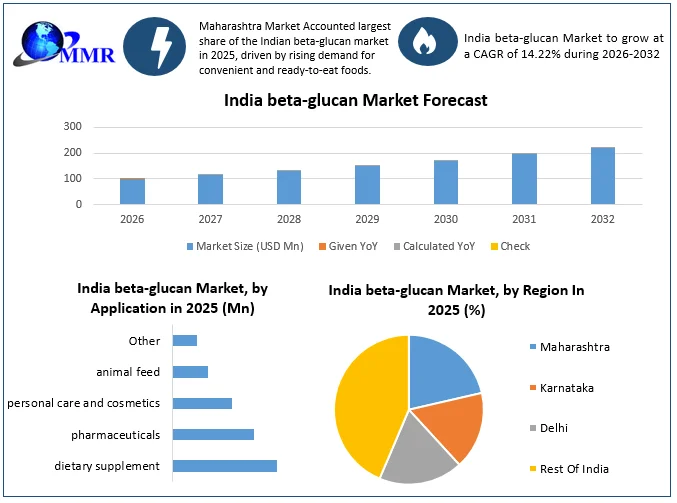
To know about the Research Methodology :- Request Free Sample Report
India Beta-Glucan Market Historical Size (2020–2025)
| Year | Market Size | Growth Rate (YoY) |
| 2020 | USD 43.2 Mn | 11.4% |
| 2021 | USD 51.4 Mn | 19.0% |
| 2022 | USD 59.8 Mn | 16.3% |
| 2023 | USD 68.7 Mn | 14.9% |
| 2024 | USD 78.1 Mn | 13.7% |
| 2025 | USD 86.4 Mn | 10.6% |
India Beta-Glucan Market Key Highlights
• Market Size (2025): India Beta-Glucan Market is valued at USD 86.4 million.
• Projected Market Size (2032): The market is expected to reach USD 218.7 million.
• Forecast CAGR (2026–2032): The market is projected to grow at a 14.22% CAGR.
• Dominant Type: Yeast Beta-Glucan leads with a 34.2% market share.
• Fastest-Growing Type: Mushroom Beta-Glucan is expected to witness the fastest growth.
• Dominant Application: Dietary Supplements account for the largest share at 38.4%.
• Leading Distribution Channel: Online distribution dominates with a 52.6% share.
India Beta-Glucan Market Consumer Insights & Demand Analysis
Indian consumers are increasingly moving toward preventive healthcare, functional foods, and dietary supplements, creating stronger demand for beta-glucan as a health-oriented ingredient. Interest is particularly linked to products positioned around immunity, heart health, digestive wellness, and overall nutrition. Consumers increasingly examine ingredient lists and health claims, with scientific evidence playing an important role in purchasing decisions.
Demand is strongest among urban and health-conscious consumers, particularly younger and working-age groups who prefer convenient formats such as fortified foods, nutritional beverages, capsules, powders, cereals, and snack products. E-commerce and organized retail are also improving access to functional foods and supplements beyond major metropolitan areas
| Consumer Dimension | Key Insights | Market Implication |
| Health Awareness | Growing recognition of beta-glucan benefits for cholesterol, immunity, and gut health in India | Supports premium product positioning |
| Price Sensitivity | Segment bifurcation between premium health-conscious consumers and price-driven buyers | Dual-tier product strategy required |
| Demand Patterns | Rising consumption frequency among health-oriented urban demographics | Subscription and repeat purchase models viable |
| Sustainability | Increasing preference for sustainably sourced, plant-derived functional ingredients | Organic and eco-certified variants gaining share |
| Digital Behavior | Growing use of online health platforms and e-commerce for supplement discovery and purchase | Digital marketing and DTC strategy essential |
India Beta Glucan Market Dynamics
India Beta Glucan Market Drivers
• India's massive and rapidly growing middle class with rising health consciousness and spending on preventive nutrition
• Surging prevalence of diabetes (world's largest diabetic population) and cardiovascular disease driving demand for functional health ingredients
• Government AYUSH and Ayurveda promotion policies creating synergy with mushroom and plant-based functional ingredients
• Rapidly expanding domestic nutraceutical industry supported by favourable FDI policies and manufacturing incentives
India Beta Glucan Market Restraints
• FSSAI regulatory uncertainty around novel functional food ingredients creating market hesitancy for some applications
• Low consumer awareness of beta-glucan specifically, despite high interest in general health supplementation
• Price sensitivity of a significant portion of the Indian consumer base limiting premium product penetration
• Fragmented retail landscape with limited cold chain infrastructure in tier-2 and tier-3 cities
India Beta Glucan Market Opportunities
• India's rapidly growing pharmaceutical and nutraceutical export market creating demand for high-quality functional ingredients including beta-glucan
• Alignment of beta-glucan immune benefits with Ayurveda-adjacent wellness narrative resonating with Indian consumers
• Growing tier-1 and metro city health food retail infrastructure (organic stores, health chain stores) enabling premium distribution
• Government Production Linked Incentive (PLI) schemes for food processing supporting domestic beta-glucan ingredient manufacturing
India Beta Glucan Market Challenges
• Complex FSSAI licensing and approval process for novel health food ingredients
• Competition from established Ayurvedic and traditional herbal immunity products (ashwagandha, giloy, tulsi) for consumer mindshare
• Limited domestic oat cultivation requiring import dependence for oat-derived beta-glucan
• Managing consumer education in a diverse, multi-language market with varying health literacy levels
India Beta Glucan Market Segment Analysis
India Beta Glucan Market by Distribution Channel
The India beta-glucan market is distributed through supermarkets/hypermarkets, pharmacies and drug stores, online retail, specialty stores, and direct sales, with each channel serving distinct consumer needs. Pharmacies and drug stores remain important for beta-glucan supplements because consumers associate these outlets with health expertise and trusted wellness products. Supermarkets and hypermarkets support broader market penetration by providing convenient access to functional foods, fortified products, and dietary supplements, particularly in urban and Tier-1 and Tier-2 markets. Online retail is emerging as a fast-growing channel, supported by expanding e-commerce adoption, product variety, home delivery, digital promotions, and increasing consumer interest in preventive nutrition. Specialty stores attract health-conscious consumers seeking premium nutritional and functional products, while direct sales are gaining relevance for wellness and supplement brands through direct-to-consumer models, personalized recommendations, and recurring purchases.

India Beta Glucan Market by Application
The India beta-glucan market is categorized by application into food & beverages, dietary supplement, pharmaceuticals, personal care and cosmetics, animal feed, and others. The food & beverage sector is the largest application segment in the Indian beta-glucan market. This is because the functionality and nutritional benefits provided by beta-glucan are being utilized in various food items like functional foods, cereals, bakery products, snacks, and beverages. It is also being used in dietary supplements as people are becoming more conscious about their health and are willing to spend on products that promote immunity and overall well-being. Pharmaceuticals is another important application segment for beta-glucan in India. This polymer is being used for its immunomodulatory and hypocholesterolaemia activities. Beta-glucan is also used in personal care and cosmetics products for its emollient properties. Animal feed is also an important application for beta-glucan in India. The growth of this segment is mainly driven by the demand for immunomodulatory products in animals like poultry and fish
India Beta Glucan Market Regional Analysis
| Region | Market Share | Key Demand Drivers & Trends |
| Maharashtra (Mumbai) | 21.4% | Largest health market, financial capital, premium spending |
| Karnataka (Bengaluru) | 16.8% | Tech-savvy, young health-conscious consumers |
| Delhi-NCR | 18.2% | High-income market, international brand preference |
| Rest of India (Tier-2, 3 cities) | 43.6% | Fastest growing – Rising health awareness in smaller cities |
India Beta Glucan Market Competitive Landscape
The India Beta-Glucan Market is characterized by a competitive and increasingly diversified landscape, with international ingredient manufacturers, specialized nutraceutical suppliers, and domestic players competing across food, dietary supplements, functional beverages, pharmaceuticals, and animal nutrition. Competition is primarily driven by ingredient quality, purity, source differentiation, formulation capabilities, clinical validation, pricing, and supply reliability. Yeast beta-glucan remains an important product category, while mushroom and cereal-based beta-glucans are gaining attention due to increasing demand for natural and functional ingredients. Companies are also strengthening their presence through product innovation, customized formulations, strategic distribution partnerships, and expansion of online sales channels. International suppliers generally compete through advanced production technologies, branded ingredients, and scientific research, while Indian companies benefit from localized supply, cost competitiveness, flexible volumes, and growing domestic distribution networks.
India Beta Glucan Market Key Players & Benchmarking
| Company | Headquarters | Beta-Glucan Type | Market Position | Revenue (Est.) |
| Vinayak Ingredients India | Mumbai | Oat, Yeast | Market Leader | Private |
| Ambe Phytoextracts | Surat | Mushroom, Oat | Major Player | Private |
| Himalaya Drug Company | Bengaluru | Mushroom BG (Herbal) | Major Player | ~USD 420 Mn |
| Piramal Healthcare | Mumbai | Pharmaceutical BG | Major Player | ~USD 1.9 Bn (healthcare div.) |
| Nutri World India | Delhi | Yeast, Oat | Growing Player | Private |
| Bio sharp Life Sciences | Pune | Yeast Beta-Glucan | Specialist | Private |
| AVT Natural Products | Bengaluru | Mushroom, Plant extracts | Specialist | ~USD 85 Mn |
| Hindustan Unilever (Health) | Mumbai | Functional Foods | Emerging | ~USD 6.2 Bn |
India Beta Glucan Market Technology & Innovation Trends
India's beta-glucan technology ecosystem is at an early but rapidly developing stage. Government-funded research at institutions including CSIR (Council of Scientific and Industrial Research), IIT campuses, and ICAR (Indian Council of Agricultural Research) is investigating domestic oat and barley beta-glucan extraction, mushroom cultivation optimization, and bioavailability enhancement. Private sector investment in fermentation capacity for yeast beta-glucan production is beginning to emerge. Start-ups in the functional nutrition space are developing India-specific delivery formats including effervescent tablets, Ayurvedic blend powders, and fiber-enriched snack foods incorporating beta-glucan.
| Innovation Area | Current Trend | Market Impact |
| Extraction Technology | Enzymatic, ultrasonic, and supercritical CO2 extraction improving purity and yield | Reduced production costs, higher quality ingredients |
| Delivery Systems | Microencapsulation, nanoparticle, and liposomal systems for improved bioavailability | Enables beverage and clear-liquid formulations |
| Sustainable Formulations | Upcycling cereal industry by-products for beta-glucan extraction | Lower carbon footprint, cost efficiency |
| Packaging Innovation | Sustainable and biodegradable packaging for supplement products | Aligns with ESG consumer preferences |
| Digital Technology | AI-driven formulation optimization and quality testing automation | Faster product development cycles |
India Beta Glucan Market Regulatory Framework
In India, beta-glucan ingredients are regulated under the Food Safety and Standards (Health Supplements, Nutraceuticals, Food for Special Dietary Use, Food for Special Medical Purpose, Functional Food and Novel Food) Regulations, 2022, administered by the Food Safety and Standards Authority of India (FSSAI). Products making health or structure/function claims require scientific substantiation and FSSAI notification. Dietary supplement products must comply with labelling requirements under FSS Labelling and Display Regulations. Pharmaceutical applications are regulated by the Central Drugs Standard Control Organisation (CDSCO). The AYUSH Ministry's regulatory framework governs Ayurvedic products that may incorporate mushroom-derived beta-glucan. The Production Linked Incentive (PLI) scheme for food processing supports domestic nutraceutical manufacturing infrastructure.
India Beta Glucan Market Strategic Insights
Why does this market deserve investor attention?
The India beta-glucan market sits at the intersection of several powerful secular trends rising chronic disease prevalence, aging populations, and consumer shift toward preventive health and functional nutrition. Regulatory health claim frameworks provide competitive moats, and the market is still in a relatively early growth phase with significant upside potential through 2032.
What are the key growth drivers and momentum?
Growth is driven by expanding functional food and dietary supplement sectors, growing health literacy among consumers, regulatory clarity for health claims, and increasing investment by food technology companies in beta-glucan-enriched product development. The post-pandemic immune health awareness trend has provided additional momentum across supplement channels.
What regional factors shape demand?
Within India, demand is highest in urbanized, high-income regions with established health food retail infrastructure. Rural and lower-income regions represent longer-term opportunities as health awareness and retail access improve. Cultural factors, dietary traditions, and regional healthcare expenditure patterns also influence demand distribution.
How strong is innovation and competition?
Innovation intensity is high, with leading companies investing in extraction technology, delivery system innovation, and novel applications. Competition is increasing but remains concentrated among established ingredient companies and domestic specialists, creating opportunities for differentiated players with superior technology or market positioning.
Where are the biggest future opportunities?
The largest future opportunities lie in dietary supplements (highest margin), pharmaceutical-grade applications, and cosmetics. Untapped consumer segments including sports nutrition, cognitive health, and pet nutrition represent emerging growth frontiers. Export opportunities to neighbouring markets offer additional upside for India-based producers.
India Beta Glucan Market Investor Takeaway
India represents the highest-growth beta-glucan investment opportunity among major global markets, with a 14.22% CAGR through 2032 underpinned by structural demand drivers including the world's largest diabetic population, a rapidly expanding nutraceutical industry, and a young, health-aware urban consumer base. The market is at an early stage of development, creating significant first-mover advantages for companies establishing brand recognition, FSSAI regulatory clarity, and distribution partnerships ahead of mainstream market maturation.
India Beta Glucan Market Scope: Inquire before buying
| India Beta Glucan Market | |
| Base Year | 2025 |
| Forecast Period | 2026–2032 |
| Historical Period | 2020–2025 |
| Market Size (Base Year) | USD 86.4 Million |
| Forecast Market Size (2032) | USD 218.7 Million |
| CAGR | 14.22% |
| Segment: By Source | Yeast-based Beta Glucan | Oat-based Beta Glucan | Barley-based Beta Glucan | Mushroom-based Beta Glucan | Seaweed-based Beta Glucan | Others |
| Segment: By Application | Food & Beverages | Dietary Supplements | Pharmaceuticals | Animal Feed | Cosmetics & Personal Care | Others |
| Segment: By Purity Level | High Purity (>80%) | Medium Purity (50%–80%) | Low Purity (<50%) |
| Segment: By Form | Powder | Liquid | Capsules | Tablets | Granules |
| Segment: By Functionality | Immune Support | Cholesterol Reduction | Digestive Health | Blood Sugar Management | Cardiovascular Health Support | Others |
| Regional Analysis | Maharashtra (Mumbai) | Karnataka (Bengaluru) | Delhi-NCR | Rest of India (Tier-2, 3 cities) |
| Key Companies | Vinayak Ingredients India | Ambe Phytoextracts | Himalaya Drug Company | Piramal Healthcare | Nutri World India | Others |
Frequently Asked Questions:
1. What is the size of India's beta-glucan market?
The India beta-glucan market was valued at USD 86.4 million in 2025 and is projected to reach USD 218.7 million by 2032, growing at the highest CAGR of 14.22% among major global markets.
2. Why is India's beta-glucan market growing so fast?
Key growth drivers include surging chronic disease prevalence (diabetes, cardiovascular disease), post-COVID immune health awareness, a rapidly expanding middle class, growing e-commerce supplement retail, and government support for nutraceutical manufacturing through PLI schemes.
3. How is beta-glucan regulated in India?
Beta-glucan ingredients in India are regulated by the Food Safety and Standards Authority of India (FSSAI) under the Food Safety and Standards Act 2006. Functional food claims require FSSAI notification or approval, and health supplement products are governed by the Health Supplements, Nutraceuticals, Foods for Special Dietary Use, and Special Medical Purpose Foods regulations.
4. Which type of beta-glucan is most popular in India?
Yeast beta-glucan leads at 34.2% share due to its cost competitiveness and applicability in both dietary supplements and animal nutrition. Mushroom beta-glucan holds strong appeal due to cultural alignment with Ayurvedic wellness traditions.
5. What role does animal feed play in India's beta-glucan market?
Animal feed represents 18.6% of India's beta-glucan applications significantly higher than global averages driven by India's large poultry and aquaculture industries adopting yeast beta-glucan for immune health and as an antibiotic alternative.