
Ice Hockey Sticks Market - Industry Structure Evaluation, Demand Drivers Analysis, Regional Growth Analysis and Identification, Competitive Positioning Review & Global Market Size Forecast to 2032
Overview
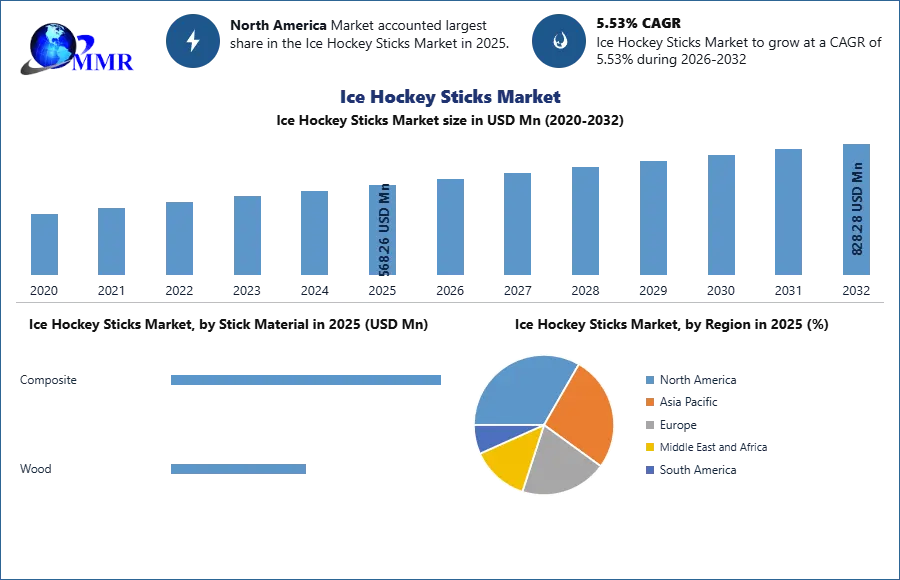
Global Ice Hockey Sticks Market size was valued at USD 568.26 Mn in 2025 and is expected to reach USD 828.28 Mn by 2032, at a CAGR of 5.53 % from forecast 2026 to 2032.
The widespread popularity and participation in ice hockey across various regions has primarily driven the market. Ice hockey sticks serve as essential tools for players to control the puck, shoot, and pass during gameplay. Ice hockey sticks are essential for players to control the puck, shoot, and pass during gameplay. The increasing popularity of ice hockey as a sport, particularly in North America, Europe, and other regions has increased the demand for high-quality sticks. To enhance their ice performance, new-age and professional players seek top-notch equipment.
Global trend of urbanization and population growth has benefitted the market. As exposure to the sport and its excitement has increased, the demand for ice hockey sticks has increased. Ice hockey is gaining popularity and attracting a new generation of players in the emerging markets
The companies in the ice hockey market invest heavily in R&D to continuously improve stick technologies, focusing on factors such as flexibility, durability, weight and overall performance. This competitive landscape has driven the introduction of innovative materials and designs, offering players a wide range of options to suit their playing style and preferences.
The market is influenced by the emphasis on performance, player safety, and technological advancements. Manufacturers focus to create sticks that provide best performance while promising durability and minimizing the risk of injuries. With advancements in materials and manufacturing techniques, ice hockey sticks have become lighter, more responsive, and better suited to the demands of the game.
The expanding popularity of ice hockey in regions like Asia-Pacific presents significant growth opportunities for the market. The demand for sticks is fueled by the increasing participation of women and younger generations. The growth of the market has witnessed an exciting development with Bauer's recent announcement of the highly anticipated release of their latest innovation, the Vapor Hyperlight stick. This new addition to Bauer's lineup is generating significant buzz due to its groundbreaking features and potential to reshape the industry.
 To know about the Research Methodology :- Request Free Sample Report
Ice Hockey Sticks Market Dynamics
The market dynamics of the Ice Hockey Sticks Market are influenced by several key factors, including evolving player preferences, technological advancements, competitive landscape, and market trends.
Evolving player preferences play a significant role in shaping the Ice Hockey Sticks Market. As players strive to enhance their performance on the ice, their preferences for stick characteristics such as flex, blade curve, and grip evolve. Manufacturers closely monitor these preferences and continuously innovate to meet the changing demands of players. Customization options, such as different flex profiles and blade patterns, are increasingly offered to cater to individual player preferences.
Technological advancements have a profound impact on the Ice Hockey Sticks Market. Manufacturers invest in research and development to introduce new materials, construction techniques, and design innovations. Advanced materials such as carbon fiber composites are utilized to create sticks that are lightweight, durable, and responsive. Technological advancements also focus on improving features like blade construction, shaft flexibility, and vibration dampening to enhance player performance and comfort
Ice Hockey Sticks Market Challenges
The Ice Hockey Sticks Market encounters obstacles including intense competition, high manufacturing costs, counterfeit products, evolving player preferences, the need to stay technologically advanced, global economic factors, sustainability concerns, and regulatory compliance. However, manufacturers in the market remain resilient by prioritizing innovation, strategic planning, and meeting the evolving needs of players while upholding product quality and safety standards
Ice Hockey Sticks Market Restraints
The Ice Hockey Sticks Market faces three prevalent restraints: price sensitivity, limited durability and lifespan, and customization challenges. Price sensitivity hinders market growth as the cost of high-quality sticks can be prohibitive for some consumers, impacting accessibility. The limited durability and lifespan of sticks pose a challenge, requiring frequent replacements and adding to the overall cost of participation. Additionally, customization demands, including flex profiles and blade curves, can increase production complexity and costs for manufacturers. These restraints shape the competitive landscape and impact the growth potential of the Ice Hockey Sticks Market.
Emerging Trends in the Ice Hockey Sticks Market
The Ice Hockey Sticks Market is experiencing a wave of emerging trends that are reshaping the industry and opening up new opportunities. One significant trend is the increasing emphasis on sustainable and eco-friendly practices. Manufacturers are adopting environmentally friendly approaches by utilizing recycled or sustainable materials and implementing measures to reduce their carbon footprint in production processes. Furthermore, arenas and organizations are incorporating energy-efficient technologies and exploring renewable energy sources to minimize their environmental impact.
Another key trend in the Ice Hockey Sticks Market is the integration of fan engagement and digital innovation. The ice hockey industry is embracing digital platforms and technologies to enhance fan experiences and create more immersive interactions. Through streaming services, social media platforms, and interactive apps, fans now have access to live games, highlights, and behind-the-scenes content, fostering a deeper connection with the sport. The exploration of virtual reality and augmented reality technologies also offers exciting possibilities to bring fans even closer to the action on and off the ice.
Additionally, women's ice hockey is on the rise, gaining significant traction and recognition. With increased media coverage and growing support from governing bodies, women's hockey has witnessed a surge in participation and interest. The success of women's national teams and professional leagues has fueled market growth for women's-specific equipment and merchandise, providing greater opportunities and investment in the development of the sport.
Ice Hockey Sticks Market Segment Analysis
by Player Level: The ice hockey sticks market is segmented based on player levels, catering to the distinct needs of professional players, amateur or recreational players, and youth or junior players. Professional players form a significant segment, demanding high-performance sticks with advanced materials and specific features to enhance their game.
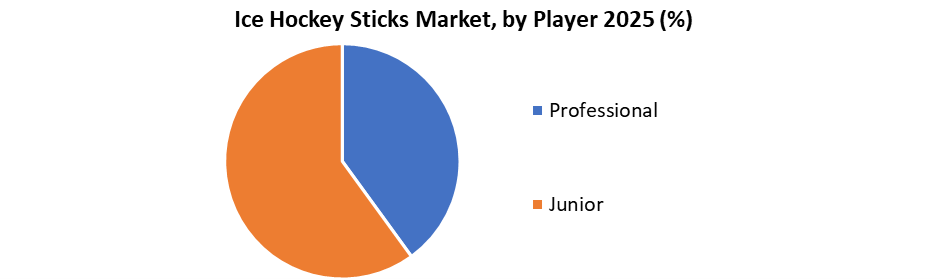
These sticks are designed to provide optimal power, control, and precision. The market for professional-level sticks is driven by the high-performance demands of professional leagues worldwide, with the NHL being a prominent contributor. Amateur or recreational players represent a large segment of the market, seeking sticks that offer durability and decent performance at a more affordable price point.
These sticks are designed to provide a balance between performance and value. The youth or junior segment is experiencing growth due to the increasing popularity of youth ice hockey leagues and development programs. Sticks for this segment are tailored to suit the age, size, and skill level of young players, providing them with the necessary tools to develop their skills and enjoy the game.
by Stick Material: The ice hockey sticks market is segmented based on the materials used in stick construction, primarily composite sticks and wooden sticks. Due to their lightweight construction, improved performance, and durability the composite sticks have gained popularity. A combination of carbon fiber, fiberglass, and other composite materials are used in the sticks. This enhances power, responsiveness, and accuracy. The adoption of these sticks by both professional and amateur players has driven the growth of the market. Wooden sticks are less popular than composite sticks but still have a dedicated market segment. Wooden sticks offer a unique feel and characteristics that some players prefer. They are often more affordable than composite sticks, making them a popular choice among recreational players and those on a budget.
by Flex Profile: The flex profile of an ice hockey stick refers to its stiffness or flexibility. The ice hockey sticks market is segmented based on the flex ratings of sticks, including low flex, mid flex, and high flex sticks. Low flex sticks have a lower flex rating and are favored by players seeking powerful and accurate shots. These sticks provide a quick release and allow players to generate maximum power and velocity in their shots. Many professional players use sticks with low flex ratings to achieve high-performance shooting. To offer a balance between power and control mid flex sticks are used amateurs and recreational players. They provide a mix of power and accuracy, making them versatile for various playing styles. Players who prioritize puck handling, quick release, and stickhandling skills use high flex sticks. These sticks offer enhanced control, maneuverability, and a quick whip-like release for precise passes and shots.
Ice Hockey Sticks Market Regional Insights
North America: By 2032, ice hockey sticks market in North America is projected to reach a market size of approximately $x million growing at a compound annual growth rate (CAGR) of x%. The region is the largest market for ice hockey sticks market. High participation rate in ice hockey and the presence of professional leagues drives the ice hockey sticks market. The demand for high-performance sticks and technological advancements in stick construction contribute to market growth.
Europe: The European ice hockey sticks market is anticipated to reach around $x billion by 2032, with a CAGR of x%. The region has a strong ice hockey culture and boasts many professional players. Sport's popularity and the increasing focus on performance and craftsmanship in Europe increases the demand for the ice hockey sticks. A wide range of brands and models cater to the diverse preferences of players in the Europe market.
Asia-Pacific: The Asia-Pacific ice hockey sticks market is expected to experience rapid growth, with a projected market size of approximately $x million by 2032, growing at a CAGR of x%. China, Japan, and South Korea witness a increase in popularity in the region. The demand for ice hockey sticks is driven by the increasing investment in infrastructure and Development programs for youth. The market is characterised by the presence of international brands and the emergence of local manufacturers catering to the specific needs of the Asian market.
Latin America: The Latin American ice hockey sticks market has a significant market size. The projected market size of the market is $x million by 2032, growing at a CAGR of x%. Ice hockey is a niche sport in this region. Still, the market is witnessing a gradual increase in demand, primarily driven by a small but dedicated community of ice hockey enthusiasts. The availability of imported ice hockey sticks from established brands meets the need of players participating in local leagues and recreational players.
Middle East & Africa: The Middle East & Africa, ice hockey sticks market, is expected to witness steady growth, with a projected market size of approximately $x million by 2032, growing at a CAGR of x%. The region is seeing a growing interest in winter sports, including ice hockey, leading to establishment of ice hockey facilities. The market is characterised by imported ice hockey sticks from international brands, catering to the demand of expatriate communities and local players. The availability of a range of stick models and sizes is gaining importance in this developing market.
Ice Hockey Sticks Market Competitive Landscape
The competitive landscape section of the ice hockey sticks market report provides a comprehensive analysis of the key market participants. The report examines the company profiles, product portfolios, financial performance, SWOT analysis, and most recent developments of the market's leading competitors.
Some of the prominent players in the market include Bauer Hockey, CCM Hockey, Warrior Sports, Sherwood Hockey, and True Hockey, among others.
Bauer Hockey, a leading player in the market, is known for its high-performance ice hockey sticks and has a strong presence worldwide. The company focuses on continuous product innovation and leverages advanced technologies to enhance stick performance and durability. It collaborates with professional ice hockey players to develop and refine their stick designs, catering to the specific needs and preferences of players.
Sherwood Hockey, with a long-standing history in the industry, offers a range of ice hockey sticks known for their traditional wooden construction. The company has adapted to changing market trends by incorporating modern materials while preserving the feel and characteristics of wooden sticks. Sherwood Hockey targets players who prefer the classic feel and performance of wooden sticks, maintaining its niche in the market.
True Hockey is a relatively newer entrant but has quickly gained recognition for its high-quality carbon fibre Market. The company emphasizes precision engineering and manufacturing processes to deliver sticks with excellent balance, responsiveness, and durability. True Hockey has built a reputation for catering to the needs of professional players and has garnered endorsements from top-level athletes.
Overall, the competitive landscape of the ice hockey sticks market dynamic, with players continuously striving to offer innovative products and meet the evolving demands of players. The focus on performance, technology, and customization remains at the forefront of competition, with companies aiming to differentiate themselves and gain market share in this highly competitive industry.
Recent Industry Developments
| Exact Date | Company | Development | Impact |
|---|---|---|---|
| 12 January 2026 | Bauer Hockey | Unveiled the Vapor Hyperlite 3 composite stick featuring a new Advanced Carbon Layering (ACL) 2.0 technology for improved durability. | Reinforces Bauer’s dominant market share in the premium professional stick segment by addressing the common issue of composite blade fatigue. |
| 22 January 2026 | Professional Women's Hockey League (PWHL) | Announced an expansion into Vancouver for the 2025–2026 season, securing exclusive equipment partnerships with CCM and Bauer. | Expected to drive a 5.7% growth in the female-specific hockey stick segment through localized retail demand and high-visibility professional usage. |
| 14 March 2025 | Warrior Sports | Launched the Covert Deluxe and Alpha Deluxe stick series, specifically engineered for ultra-quick release and youth-specific flex profiles. | Strengthens Warrior’s competitive position in the fast-growing youth demographic, which is projected to expand at a 6.45% CAGR. |
| 15 April 2025 | Pure Hockey | Completed the acquisition of The Hockey Headquarters, a major regional equipment retailer and apparel distributor in the United States. | Consolidates offline retail distribution, giving major stick brands more direct access to localized amateur and youth hockey markets. |
| 02 June 2025 | Adidas | Introduced the 2025/26 Hockey Stick Range with optimized shaft flex options and updated graphics across its ice and field hockey lineups. | Enhances Adidas' brand presence in the mid-range amateur segment, competing directly with established niche brands through superior retail logistics. |
Ice Hockey Sticks Market Scope: Inquire before buying
| Ice Hockey Sticks Market | |||
|---|---|---|---|
| Report Coverage | Details | ||
| Base Year: | 2025 | Forecast Period: | 2026-2032 |
| Historical Data: | 2020 to 2025 | Market Size in 2025: | 568.26 USD Mn |
| Forecast Period 2026-2032 CAGR: | 5.53% | Market Size in 2032: | 828.28 USD Mn |
| Segments Covered: | by Player | Professional Junior Amateur |
|
| by Stick Material | Composite Wood |
||
| by Flex Profile | Low Mid High |
||
| by Distribution Channel | Online Offline |
||
Ice Hockey Sticks Market, by Region
North America (United States, Canada and Mexico)
Europe (UK, France, Germany, Italy, Spain, Sweden, Austria and Rest of Europe)
Asia Pacific (China, South Korea, Japan, India, Australia, Indonesia, Malaysia, Vietnam, Taiwan, Bangladesh, Pakistan and Rest of APAC)
Middle East and Africa (South Africa, GCC, Egypt, Nigeria and Rest of ME&A)
South America (Brazil, Argentina Rest of South America)
Key Players / Competitors Profiles Covered in Brief in Global Ice Hockey Sticks Market Report in Strategic Perspective:
- BAUER HOCKEY
- CCM Hockey
- Warrior Sports
- Sherwood Hockey
- True Hockey
- Easton Hockey
- STX
- Reebok-CCM
- Fischer Sports
- Graf Hockey
- Vaughn Hockey
- Winnwell
- Mylec Inc.
- Eagle Hockey
- Franklin Sports Inc.
- Tour Hockey
- Alkali Hockey
- TPS Hockey
- Christian Hockey
- Torspo Hockey
- Verbero Hockey
- Blackwood Hockey
- Colt Hockey
- Monarch Hockey
- Hespeler Hockey