
Ice cream Machine Market– Industry Structure Evaluation, Demand Drivers Analysis, Regional Growth Analysis and Identification, Competitive Positioning Review & Global Market Size Forecast to 2032
Overview
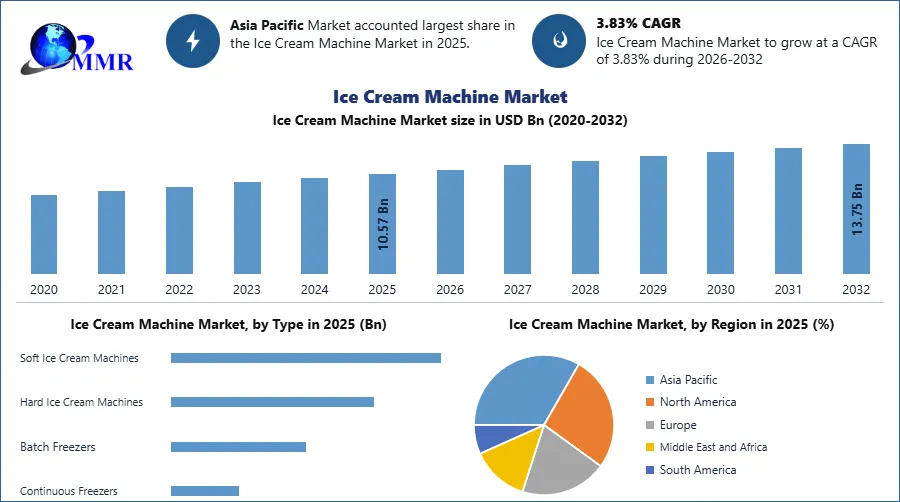
The Global Ice Cream Machine Market was valued at USD 10.57 Billion in 2025 and is estimated to grow at a CAGR of 3.83% over the forecast period, reaching USD 13.75 Billion by 2032.
Ice Cream Machine Market Overview:
Ice cream machines are specialized foodservice and processing systems used to free10.57 ze, churn, aerate, and dispense hard ice cream, soft serve, gelato, frozen yogurt, custard, and related frozen desserts. The market covers both commercial and limited household demand, though revenue is primarily concentrated in commercial installations. Growth has been supported by expansion in organized foodservice, rising global ice cream consumption, increasing operator focus on hygiene and process consistency, and the need for faster service with less manual intervention. Technological development has centered on automated controls, viscosity and temperature management, energy-efficient refrigeration, compact footprints, and multi-format production capabilities. Manufacturers are also emphasizing menu flexibility, easier maintenance, and improved reliability for high-throughput environments. Demand outlook remained positive because restaurants, dessert chains, convenience-led operators, and specialty frozen dessert brands continued investing in equipment that improves output consistency, reduces labor strain, and supports premium frozen dessert offerings.
This report analyzes the Ice Cream Machine Market as the 2026 Middle East crisis triggers a historic cost shock to commercial refrigeration and dairy processing. With crude prices surging to $120/bbl and regional LPG shortages spiking utility costs by 30%, the industry is facing a critical pivot toward high-efficiency compressors and natural CO₂ refrigerants. We explore how market leaders are leveraging AI-driven "Smart-Churn" technology and automated cleaning systems to bypass rising labor costs and energy-intensive manual maintenance. By evaluating the surge in compact countertop models for micro-cafés and artisanal soft-serve innovation, this study provides stakeholders with strategic frameworks to maintain margins in a high-inflation landscape where energy autonomy and space-saving designs are the new market imperatives.
Ice Cream Machine Market Scope
 To know about the Research Methodology:-Request Free Sample Report
Ice Cream Machine Market Dynamics:
Growth Driver: Foodservice Expansion And Menu Premiumization
Demand for ice cream machines has been supported by the expansion of quick-service restaurants, dessert chains, cafés, entertainment venues, and specialty frozen dessert shops. Commercial operators increasingly prefer equipment that can deliver fast dispensing, uniform texture, multi-flavor capability, and operational consistency during peak service hours. Product positioning across major manufacturers also shows strong emphasis on high-capacity and space-saving systems for QSRs, kiosks, and high-volume restaurant environments.
Technology Shift: Automation, Consistency Control, And Energy Efficiency
The market has increasingly moved toward automated and digitally controlled machines that improve texture consistency, reduce labor dependence, and simplify cleaning and maintenance. Taylor highlights microprocessor-based viscosity control in commercial soft serve systems, while Electro Freeze promotes temperature-monitoring quality systems and standby modes to maintain product quality and reduce operating inefficiencies. Public market coverage also links future competitiveness to IoT-enabled, energy-efficient, and higher-capacity platforms.
Opportunity: Plant-Based, Multi-Format, And Flexible Production
A major opportunity is the growing need for machines that can handle premium soft serve, frozen yogurt, custard, sorbet, gelato, and plant-based recipes within the same operating environment. Public market commentary points to rising interest in plant-based and customized frozen desserts, while manufacturers are marketing machines for multiple frozen formats and broader menu flexibility. This improves equipment utilization and supports premium pricing strategies for operators
The ice cream machine market is undergoing a significant transformation in 2025, driven by the integration of artificial intelligence (AI), machine learning, and the Internet of Things (IoT). These technological advancements are revolutionizing the production, customization, and distribution of frozen desserts. AI-powered machines enhance automation in ice cream production. Self-serve kiosks equipped with touchless interfaces improve hygiene and efficiency, while AI-controlled portioning minimizes waste. For instance, NISSEI’s AI-driven machines self-adjust temperature and portion sizes based on user preferences. Additionally, machine learning algorithms analyze customer preferences to suggest unique flavors, allowing customers to create customized ice cream flavors via digital interfaces. Companies like Ice Cream Inc. utilize AI-powered kiosks to let customers create and mix their flavors in real time.
Inventory management and cost efficiency are also optimized using AI. Real-time inventory monitoring prevents stock shortages, and AI forecasts demand based on weather, sales data, and customer behavior. Taylor Company’s AI-integrated machines analyze ingredient usage and suggest restocking schedules, reducing costs and food waste. Furthermore, AI enhances quality control by continuously monitoring and adjusting temperature, texture, and consistency to ensure premium quality ice cream. Electro Freeze’s smart ice cream dispensers use AI to control viscosity and ensure consistent servings.
The integration of AI into ice cream machines elevates product quality by providing unmatched accuracy in ingredient mixing, freezing, and texture control. Real-time data from sensors tracking temperature, viscosity, and ingredient uniformity allows AI-powered machines to automatically adjust to guarantee ideal outcomes with every batch. This technology not only produces a more consistent and premium product but also significantly reduces human error. Whether in large factories or small artisan ice cream stores, AI helps produce creamier, more consistent ice cream.
Smart connectivity through IoT enables remote monitoring and control of ice cream machines. Many models now include Wi-Fi and Bluetooth connectivity, allowing operators to monitor and operate machines via smartphone apps or cloud-based systems. This interconnectedness provides convenience, especially for businesses operating multiple sites or large-scale manufacturing plants. For example, Unilever has incorporated image capture and AI technology within 50,000 of its freezers, helping them manage stock levels and submit orders seamlessly.
Sustainability is a priority in the ice cream industry, with the development of more environmentally friendly, energy-efficient ice cream equipment.
Ice Cream Machine Market Segment Analysis:
Ice Cream Machine Market Segmentation, by Type
Based on type, the market has been divided into Soft Ice Cream Machines, Hard Ice Cream Machines, Batch Freezers, and Continuous Freezers. Among these, the Soft Ice Cream Machines sub-segment was projected to generate the maximum revenue. The Soft Ice Cream Machines sub-segment witnessed the highest market share in the global ice cream machine market in 2025. This segment dominated because soft serve systems were more widely deployed across quick-service restaurants, frozen yogurt chains, kiosks, amusement venues, convenience-led foodservice, and dessert counters where speed, repeatability, and continuous dispensing were commercially critical. Public competitive sources consistently identified soft machines as the leading type, with one study describing soft ice cream machines as the main type and another placing them at over half of total usage. Their dominance was reinforced by easier menu expansion into frozen yogurt, sorbet, and custard formats, as well as stronger suitability for high-volume outlets that required fast serving and lower batch-preparation complexity.
Ice Cream Machine Market Segmentation, by Application
Based on application, the market has been divided into Restaurants, Cafés And Coffee Shops, Ice Cream Parlors, Catering Industry, Entertainment Venues, Cold Drink Shops, Hotels, Institutional Kitchens, and Household. Among these, the Catering Industry sub-segment generated the maximum revenue in 2025. This segment dominated because catering and commercial foodservice environments required dependable, higher-capacity machines capable of producing large volumes with consistent product texture and fast turnaround. Competitive public sources repeatedly identified catering or foodservice-led use cases as the leading application area. This position was supported by the expansion of organized dessert services at events, restaurants, QSRs, and large gatherings where operators valued output reliability, reduced manual labor, and the ability to serve multiple frozen formats from compact commercial systems. In 2025, the application remained dominant because foodservice operators continued prioritizing productivity, speed of service, hygiene compliance, and equipment versatility more than household buyers.
Ice Cream Machine Market Regional Analysis
Asia Pacific dominated the market in the year 2025, and was expected to continue its dominance during the forecast period. The region led because it combined a large manufacturing base, strong foodservice expansion, dense population centers, rising dessert consumption, and broad commercial deployment across China, Japan, South Korea, India, and Southeast Asia. Public market coverage identified Asia-Pacific and North America as the main markets together accounting for about 60% of global demand, while one market study specifically described Asia-Pacific as the leading market for the category. Regional strength was also supported by the presence of major machine manufacturers and suppliers, expanding restaurant and café networks, and growing adoption of automated dessert equipment in both developed and emerging urban centers. In 2025, these factors kept Asia Pacific ahead on volume demand, installed base growth, and regional manufacturing depth, while North America remained highly important in premium and technologically advanced commercial deployments
The objective of the report is to present a comprehensive analysis of the global Market to the stakeholders in the industry. The past and current status of the industry with the forecasted market size and trends are presented in the report with the analysis of complicated data in simple language. The report covers all the aspects of the industry with a dedicated study of key players that include market leaders, followers, and new entrants.
PORTER, PESTEL analysis with the potential impact of micro-economic factors of the market have been presented in the report. External as well as internal factors that are supposed to affect the business positively or negatively have been analyzed, which will give a clear futuristic view of the industry to the decision-makers.
The report also helps in understanding the global Market dynamics, structure by analyzing the market segments and project the global Market size. Clear representation of competitive analysis of key players by product, price, financial position, product portfolio, growth strategies, and regional presence in the global Market make the report investor’s guide.
Recent Developments
May 2025: Carpigiani showcased its latest machine lineup at the National Restaurant Association Show 2025, highlighting systems such as Dream by V-Air, Nuvia, 161K, Readychef, Pastochef, 193, and K3. The showcase underscored continued investment in automation, premium soft serve capability, and broader foodservice versatility across the global ice cream machine category.
February 2025: Stoelting introduced its Mix-In Blender for soft serve, frozen yogurt, custard, and milkshake applications. The launch was strategically relevant because it expanded equipment-side customization capability for operators seeking higher-value frozen dessert menus, quicker add-in integration, and more flexible premium product preparation in commercial service environments.
Ice Cream Machine Market Scope: Inquire before buying
| Ice Cream Machine Market | |||
|---|---|---|---|
| Report Coverage | Details | ||
| Base Year: | 2025 | Forecast Period: | 2026-2032 |
| Historical Data: | 2020 to 2025 | Market Size in 2025: | USD 10.57 Billion |
| Forecast Period 2026-2032 CAGR: | 3.83% | Market Size in 2032: | USD 13.75 Billion |
|
Segments Covered Ice Cream Machine Market : |
by Type | Soft Ice Cream Machines Hard Ice Cream Machines Batch Freezers Continuous Freezers |
|
| by Operation Type | Automatic Machines Semi Automatic Machines Manual Machines |
||
| by Configuration | Single Cylinder Machines Multi Cylinder Machines Countertop Machines Floor Standing Machines |
||
| by Power Source | Electric Machines Gas Powered Machines |
||
| by Application | Restaurants Cafés And Coffee Shops Ice Cream Parlors Catering Industry Entertainment Venues Cold Drink Shops Hotels Institutional Kitchens Household |
||
Ice Cream Machine Market, by Region
North America (United States, Canada and Mexico)
Europe (UK, France, Germany, Italy, Spain, Sweden, Austria and Rest of Europe)
Asia Pacific (China, South Korea, Japan, India, Australia, Indonesia, Malaysia, Vietnam, Taiwan, Bangladesh, Pakistan and Rest of APAC)
Middle East and Africa (South Africa, GCC, Egypt, Nigeria and Rest of ME&A)
South America (Brazil, Argentina Rest of South America)
Ice Cream Machine Market, Key Players:
- Taylor Company
- Carpigiani
- Nissei
- Electro Freeze
- Stoelting
- ICETRO
- Spaceman
- Gel Matic
- DONPER
- Guangshen
- Shanghai Lisong
- Oceanpower
- Tetra Pak
- Gram Equipment
- Tekno-Ice
- Technogel
- Big Drum Engineering GmbH
- Ice Group
- Bravo
- Catta 27
- Vojta
- Frigomat
- Ali Group
- Middleby Corporation
- Vollrath Company LLC
Frequently Asked Questions
1. What is the projected size and growth rate of the global ice cream machine market?
Ans. The ice cream machine market valuation was USD 10.57 billion in 2025, reaching USD 13.75 billion by 2032 via a 3.83% CAGR and steady demand.
2. Which region currently leads the global ice cream machine market share?
Ans. Asia Pacific dominates ice cream machine market share due to rapid foodservice expansion, high manufacturing output, and rising dessert consumption across China, India, and Japan.
3. How is artificial intelligence impacting ice cream machine trends 2026?
Ans. AI-driven ice cream machine trends 2026 focus on automated viscosity control, self-adjusting temperatures, and personalized flavor suggestions to optimize production efficiency and premium product quality.
4. Which product type holds the largest ice cream machine market share?
Ans. Soft ice cream machines lead the market, favored by QSRs and kiosks for high-speed dispensing, operational consistency, and versatility in serving yogurt or custard.
5. What role does IoT play in modern ice cream machine industry growth drivers?
Ans. IoT connectivity serves as industry growth drivers by enabling remote monitoring, predictive maintenance, and real-time inventory tracking via cloud-based systems for multi-site commercial operators.
6. How are sustainability initiatives influencing ice cream machine manufacturing?
Ans. Manufacturers prioritize sustainability by developing energy-efficient refrigeration systems and eco-friendly components to reduce operational costs and meet global environmental standards for foodservice equipment.
7. What are the primary ice cream machine market opportunities for commercial operators?
Ans. Expanding into plant-based recipes and multi-format production offers significant growth, allowing businesses to utilize flexible equipment for diverse, premium, and customized frozen dessert menus.