
Electric Vehicle Range Extender Market – Global Market Size, Strategic Growth Drivers, Risk Assessment Framework, Regulatory Landscape Review, Competitive Intensity Mapping & Long-Term Industry Outlook to 2032
Overview
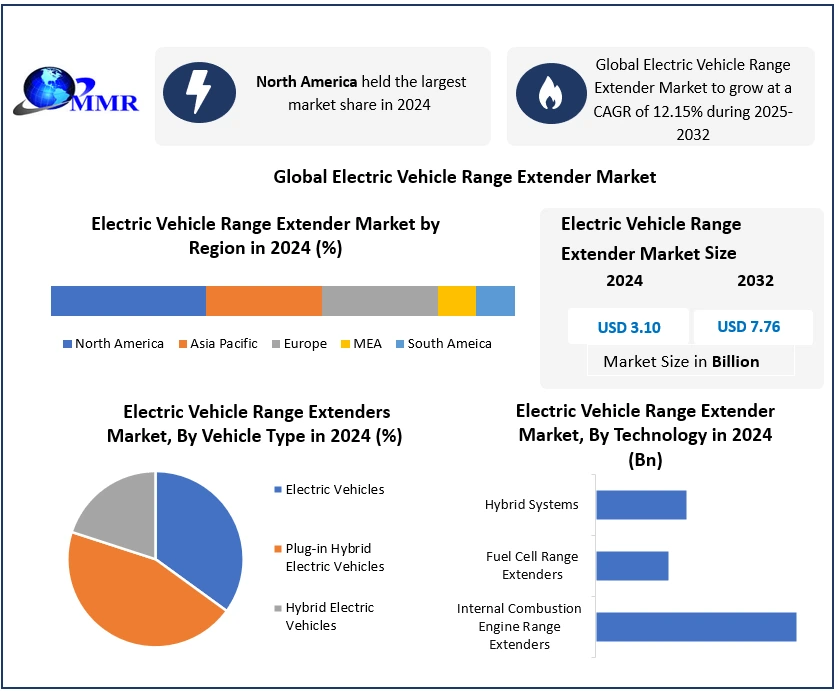
Electric Vehicle Range Extender Market was valued at USD 3.10 Billion in 2024, and total Global Electric Vehicle Range Extender Market revenue is expected to grow at a CAGR of 12.15% and reach nearly USD 7.76 Billion from 2025 to 2032.
Global Electric Vehicle Range Extender Market Overview:
Electric Vehicle (EV) Range Extender Market, an important segment of the global Electric and Hybrid Vehicle industry, is witnessing rapid growth driven by increasing EV adoption, range anxiety concerns, and advancements in hybrid propulsion technologies. Once considered niche components for plug-in hybrid electric vehicles (PHEVs) and battery electric vehicles (BEVs), range extenders are now engineered with compact internal combustion engines (ICE), fuel cells, and advanced battery management systems to enhance driving range, improve energy efficiency, and support sustainable mobility.
 To know about the Research Methodology:-Request Free Sample Report
North America currently leads the EV range extender market due to strong government incentives, infrastructure development, and adoption of hybrid and plug-in electric vehicles, while Asia-Pacific, particularly China and India, is driving volume growth through rising EV production and increasing consumer preference for low-emission vehicles. Policy frameworks, such as subsidies for EV adoption and emissions regulations, are also shaping Electric Vehicle Range Extender market dynamics. For instance, U.S. federal tax credits have encouraged automakers to integrate range extenders into PHEVs, while China’s New Energy Vehicle (NEV) policy has accelerated local manufacturing and adoption.
The competitive landscape of electric vehicle range extender industry features major global players including BMW, Nissan Motor Corporation, MAHLE, Magna International, Ballard Power Systems, and AVL, who are investing heavily in R&D for fuel cell range extenders, ICE hybrid systems, and battery optimization technologies. As the EV ecosystem evolves with electrification, smart charging infrastructure, and connected mobility solutions, range extenders are emerging as key enablers of extended driving range, vehicle efficiency, and consumer confidence.
Electric Vehicle Range Extender Market Dynamics
Rising Range Anxiety and Demand for Extended Driving Range to Boost the Electric Vehicle Range Extender Market
As battery electric vehicles (BEVs) and plug-in hybrid electric vehicles (PHEVs) gain popularity, consumers demand solutions that ensure uninterrupted mobility and greater convenience. The Electric Vehicle (EV) Range Extender Market is driven by EV range extenders, including internal combustion engine (ICE) modules and fuel cell systems, which provide supplemental energy when the main battery is low, enhancing vehicle efficiency and reliability. Rapid adoption of hybrid electric vehicles, coupled with government incentives, emission regulations, and advancements in battery management systems and charging infrastructure, further drive market growth, making range extenders essential for sustainable and practical EV mobility. Additionally, innovations in lightweight materials and smart energy optimization technologies are improving performance and cost-effectiveness, attracting both OEMs and investors to the expanding market. Growing awareness of sustainable mobility solutions is also encouraging integration of range extenders across global EV fleets, further boosting the EV Range Extender Market.
Government Incentives and Hybrid Vehicle Adoption to Unlock Opportunities in the EV Range Extender Market
A key opportunity in the Electric Vehicle (EV) Range Extender Market lies in the rapid growth of electric mobility infrastructure and the increasing demand for long-range, low-emission vehicles. As governments worldwide implement stricter emission regulations and offer incentives for battery electric vehicles (BEVs) and plug in hybrid electric vehicles (PHEVs), automakers are motivated to integrate advanced range extenders, including fuel cell systems and internal combustion engine (ICE) modules, into their vehicle portfolios. Additionally, expansion in EV charging networks, adoption of hybrid electric vehicles (HEVs), and innovations in lightweight materials and energy efficient technologies create significant market opportunities. These factors enable OEMs and investors to capitalize on the increasing need for sustainable mobility solutions and extended EV driving range.
Electric Vehicle Range Extender Market Segment Analysis
Based on vehicle type, the Electric Vehicle (EV) Range Extender Market is segmented into Battery Electric Vehicles (BEVs), Plug-in Hybrid Electric Vehicles (PHEVs), and Hybrid Electric Vehicles (HEVs). The plug in hybrid electric vehicles segment dominated the market, holding the largest share, due to its important role in combining electric driving with a backup range extender system. PHEVs use internal combustion engine (ICE) or fuel cell range extenders to provide supplemental energy when the main battery is low, effectively addressing range anxiety. Their ability to operate in electric mode for daily commutes while relying on the range extender for longer trips makes them highly practical. Strong adoption in North America, Europe, and Asia Pacific, supported by government incentives and emission regulations, drives this segment’s market leadership.
Based on technology, the Electric Vehicle (EV) Range Extender Market is segmented into Internal Combustion Engine (ICE) Range Extenders, Fuel Cell Range Extenders, and Hybrid Systems. The Internal Combustion Engine Range Extenders segment dominated the market, holding the largest share, due to its established technology, cost-effectiveness, and widespread integration in plug-in hybrid electric vehicles (PHEVs). ICE range extenders provide supplemental power when the main battery is low, ensuring extended driving range and reducing range anxiety for consumers. High adoption in North America, Europe, and Asia-Pacific, coupled with mature supply chains, strong OEM partnerships, and regulatory support, has solidified ICE-based range extenders as the preferred technology, while fuel cell and hybrid systems are emerging as fast growing alternatives.
Electric Vehicle Range Extender Market Regional Analysis
North America region dominated the Electric vehicle Range Extender Market, driven by the increasing adoption of electric and plug-in hybrid vehicles, government incentives for EV adoption, and advancements in battery and hybrid technologies. Leading automotive manufacturers in the U.S. and Canada are investing heavily in range extender integration, battery management systems, and lightweight hybrid components, enabling enhanced driving range, reduced emissions, and improved energy efficiency. The presence of major EV range extender market players such as Magna International, Robert Bosch, and Continental AG further strengthens the region’s leadership. More than 45% of new electric vehicle sales in North America in 2024 feature range extender technologies, highlighting strong adoption trends. Additionally, ongoing investments in EV infrastructure, charging stations, and R&D for high-efficiency hybrid systems are driving continuous innovation in the region.
Electric Vehicle Range Extender Market Competitive Landscape
Electric Vehicle Range Extender Market is highly competitive, led by global players such as Magna International, Robert Bosch, MAHLE Group, Continental AG, BMW Group, and General Motors, alongside regional and emerging vendors offering cost-effective, scalable, and technologically advanced hybrid and extended-range solutions. These companies focus on internal combustion engine (ICE) range extenders, fuel cell range extenders, hybrid powertrains, battery management systems, and lightweight hybrid components to meet the growing demand from electric and plug-in hybrid vehicle manufacturers, fleet operators, and commercial mobility providers. Strategic initiatives such as R&D in high efficiency range extenders, hybrid vehicle integration, battery optimization, and fuel cell development are shaping the competitive landscape. Companies are also investing in long-range capabilities, energy-efficient thermal management systems, compact powertrain solutions, and modular hybrid platforms to enhance vehicle performance and consumer adoption.
Electric Vehicle Range Extender Market Key Trends
• Shift Toward Hybrid and Extended Range Electrification
Automakers are increasingly adopting extended range electric vehicles and plug in hybrid electric vehicles to address range anxiety and enhance consumer confidence in EVs. Integration of ICE and fuel cell range extenders allows longer driving distances while maintaining low emissions, driving market expansion globally.
• Next-Generation Powertrain Innovation
Focus on high efficiency hybrid powertrains, lightweight thermal management systems, and advanced battery management (BMS) technologies is transforming EV performance. Compact fuel cell-based and internal combustion range extenders are enabling cost-effective, scalable, and eco-friendly solutions for passenger cars, commercial fleets, and urban mobility.
• Smart Energy Management & Connected Vehicle Integration
Integration of AI-driven energy optimization, IoT-based telematics, and real-time battery monitoring is enhancing efficiency and vehicle uptime. These technologies optimize energy consumption, enable predictive maintenance, and improve the overall connected EV experience.
Electric Vehicle Range Extender Market Recent Development
• On July 24, 2025, MAHLE premiered its high-efficiency 85 kW range extender system at IAA, boasting over 97% peak efficiency for the electric part and up to 1,350 km total WLTP range in some configurations.
• On July 18, 2025, General Motors announced that from 2027, its joint venture Ultium Cells will begin producing lithium iron phosphate (LFP) batteries in Tennessee, signaling a strategic move to diversify EV battery chemistry to balance range, cost, and performance.
• On March 19, 2025, Continental AG expanded its electrified powertrain division by introducing an integrated eAxle system compatible with range extender architectures. This innovation supports improved energy recovery, reduced emissions, and enhanced range optimization for hybrid and EREV platforms.
The scope of the Report Global Electric Vehicle Range Extender Market: Inquire before buying
| Global Electric Vehicle Range Extender Market | |||
|---|---|---|---|
| Report Coverage | Details | ||
| Base Year: | 2024 | Forecast Period: | 2025-2032 |
| Historical Data: | 2019 to 2024 | Market Size in 2024: | USD 3.10 Bn. |
| Forecast Period 2025 to 2032 CAGR: | 12.15% | Market Size in 2032: | USD 7.76 Bn. |
| Segments Covered: | by Vehicle Type | Electric Vehicles Plug-in Hybrid Electric Vehicles Hybrid Electric Vehicles |
|
| byTechnology | Internal Combustion Engine (ICE) Range Extenders Fuel Cell Range Extenders Hybrid Systems |
||
| by Component | Range Extender Engine Module Battery Management System Energy Control Unit |
||
| by Application | Passenger Vehicles Commercial Vehicles Light Electric Vehicles |
||
Electric Vehicle Range Extender Market, by Region
North America (United States, Canada, and Mexico)
Europe (UK, France, Germany, Italy, Spain, Sweden, Austria, and the Rest of Europe)
Asia Pacific (China, South Korea, Japan, India, Australia, ASEAN, Indonesia, Philippines, Malaysia, Vietnam, Thailand, ASEAN, Rest of Asia Pacific)
Middle East & Africa (South Africa, GCC, Nigeria, Rest of ME&A)
South America (Brazil, Argentina, Rest of South America)
Electric Vehicle Range Extender Market, Key Players
North America
1. General Motors (USA)
2. Plug Power Inc. (USA)
3. Wrightspeed Inc. (USA)
4. Ashwoods Electric Motors (USA)
5. Ballard Power Systems (Canada)
6. Magna International Inc. (Canada)
Europe
7. BMW Group (Germany)
8. MAHLE GmbH (Germany)
9. Rheinmetall AG (Germany)
10. FEV Group GmbH (Germany)
11. AVL List GmbH (Austria)
12. Fagor Ederlan Group (Spain)
13. Ceres Power Holdings plc (UK)
14. AB Volvo (Sweden)
15. EP Tender (France)
Asia Pacific
16. Nissan Motor Corporation (Japan)
17. Horizon Fuel Cell Technologies (Singapore)
18. Mahindra Electric (India)
19. BYD Auto Co., Ltd. (China)
20. Geely Automobile Holdings Ltd. (China)
21. SAIC Motor Corporation Limited (China)
22. Toyota Motor Corporation (Japan)
Frequently Asked Questions:
1. What is driving the Market growth?
Ans: The market is driven by increasing EV adoption, demand for extended driving range, advancements in battery technology, and supportive government incentives promoting hybrid and range extended EVs.
2. Which region dominated the Market in 2024?
Ans: North America dominated the Market in 2024.
3. Who are the major players in the Electric Vehicle Range Extender Market?
Ans: Leading companies include Magna International, MAHLE, BMW Group, General Motors.
4. How are government policies impacting the EV Range Extender Market?
Ans: Supportive policies such as emission reduction targets, EV subsidies, and hybrid vehicle incentives in the EU, U.S., China, and India are accelerating adoption.
5. What are the expected returns for investors in this sector?
Ans: With rising EV demand and new hybrid models launching, investors can expect steady growth and medium-term ROI driven by technology licensing and OEM partnerships.