
Hydroponic Irrigation Systems Market By Offering, By Nutrient Delivery Technology, By Component, By Automation Level, By Farming Facility / Application , By Deployment Type and Regional Insights 2034
Overview
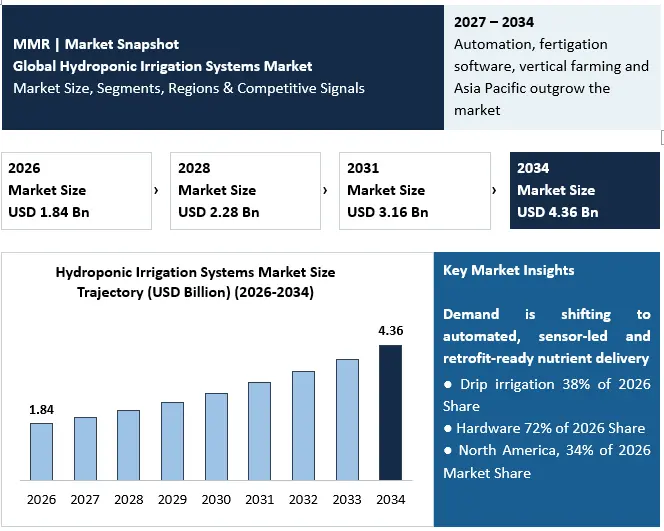
The Global Hydroponic Irrigation Systems Market was valued at USD 1.84 Bn in 2026 and is expected to reach USD 4.36 Bn by 2034, growing at a CAGR of 11.4% during 2027–2034.
Hydroponic irrigation systems are the water and nutrient delivery infrastructure of soilless farming: pumps, reservoirs, pipes, drippers, nozzles, dosing units, filtration, sensors and controllers that deliver a precisely mixed nutrient solution to plant roots, schedule every irrigation cycle and recirculate unused solution. The market spans drip irrigation, nutrient film technique (NFT), flood-and-drain (ebb and flow), deep water culture (DWC) and aeroponic spray and misting systems, delivered as hardware, software and services for commercial greenhouses, indoor vertical farms, nurseries and residential installations. The global Hydroponic Irrigation Systems Market, therefore, encompasses automated and smart hydroponic irrigation systems, hydroponic nutrient delivery systems, hydroponic fertigation systems and precision irrigation technology for controlled environment agriculture.
The Hydroponic Irrigation Systems Market analysis provides strategic insights for greenhouse operators, vertical farming companies, commercial nurseries, equipment manufacturers, component suppliers, system integrators, distributors and investors. The report examines hydroponic irrigation equipment pricing, installation costs, lifecycle economics, procurement patterns, retrofit opportunities, water and nutrient use efficiency, and technological advancements. It also assesses market demand, competitive positioning, investment potential and growth opportunities across nutrient delivery technologies, automation levels, farming applications and key regional markets, supporting informed business decisions and strategic planning through 2034.
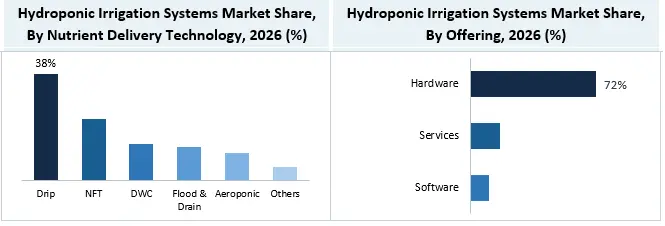
Hardware and drip irrigation accounted for the largest shares of Hydroponic Irrigation Systems Market sales in 2026, at about 72% and XX% of value, respectively, while North America led the regional split with about 34%. Hydroponic Irrigation Systems Market growth is shifting toward fully automated systems, software, IoT-based monitoring, indoor vertical farming, aeroponic nutrient delivery, and retrofit and modernization programs. Increasing water scarcity, food security concerns, and demand for water-efficient hydroponic farming are accelerating market growth across emerging Asia Pacific and Middle Eastern economies.
Maximize Market Research delivers a comprehensive Hydroponic Irrigation Systems Market Research Report covering global value (USD Bn) and volume (000’Units) by offering, nutrient delivery technology, component, automation level, farming facility, deployment type and region, across 5 regions and 45 countries, together with a competitive landscape, strategic scenarios and growth opportunities. The report also examines manufacturing costs, supply chain dynamics, equipment pricing, technological innovations, regulatory frameworks, investment trends, competitive benchmarking, customer procurement patterns, and strategic recommendations for Hydroponic Irrigation Systems Market entry and growth.
Hydroponic Irrigation Systems Market Size and Growth: Industry Outlook to 2034
The Hydroponic Irrigation Systems Market is sized at the irrigation-system level: pumps and fluid handling equipment, pipes, tubing and channels, nutrient dosing and mixing equipment, filtration and water treatment, sensors, controllers and automation hardware, and the software and services attached to them, supplied for new installations, retrofit and replacement projects. Hydroponic Irrigation Systems Market size is measured as supplier revenue and excludes crop sales, grow media, lighting, HVAC and building structures. The forecast rests on a visible investment pipeline in controlled environment agriculture, water-saving farming programs and AI-enabled fertigation launches, supporting the Hydroponic Irrigation Systems Market growth outlook across North America, Europe and Asia Pacific.
Hydroponic Irrigation Systems Market Growth and Share Analysis
To know about the Research Methodology :- Request Free Sample Report
Key Findings: Insights Shaping the Global Hydroponic Irrigation Systems Market
Company filings, industry association data, grower procurement behaviour, and 2026 product-launch activity point to the following key market research findings, highlighting Hydroponic Irrigation Systems Market demand, deployment, supply, revenue generated and Hydroponic Irrigation Systems industry value creation through 2034.
1. Hardware leads; software and services lead growth. Hardware held about 72% of 2026 value and grows at XX%, while software grows at XX% and services at XX%. Value is moving from pumps and pipes toward controllers, dosing logic, analytics and lifecycle service contracts.
2. Drip leads technologies; aeroponic and DWC systems grow fastest. Drip irrigation held about 38% of 2026 value and grows at XX%, NFT held XX% and grows at 11.2%, deep water culture held XX% and grows at XX%, flood-and-drain held 12% and grows at XX%, and aeroponic spray and misting held XX% and grows at 16.5%. Higher yields per square metre and lower water use support the faster-growing technologies.
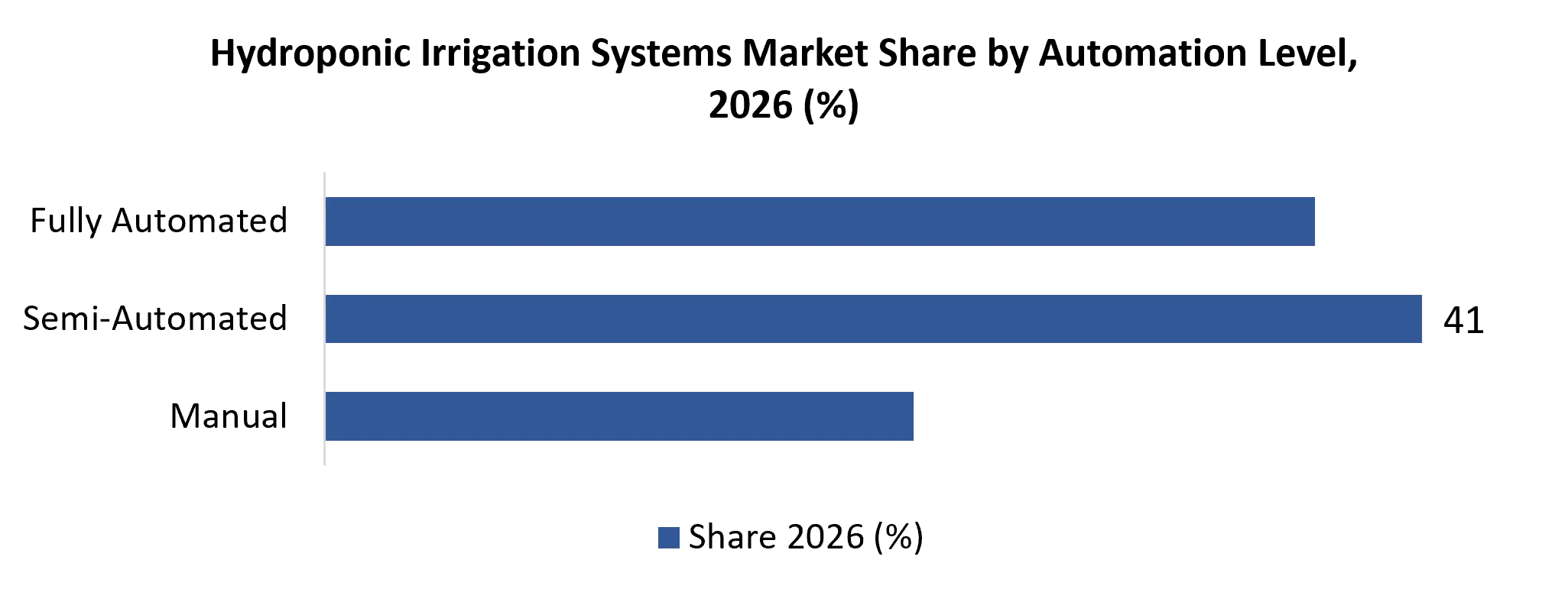
3. Automation is the main upgrade path. Fully automated systems held about 37% of 2026 value and grow at XX%, against XX% for semi-automated systems and 3.5% for manual systems, as growers pursue dosing accuracy, labor savings and water reuse.
4. Greenhouses led; indoor vertical farms grow fastest. Commercial greenhouses held about 52% of 2026 value and grow at XX%, while indoor vertical farms held XX% and grow at XX%. Residential, educational and small-scale installations, at about 7% of value, grow at XX% as compact smart kits reach home growers.
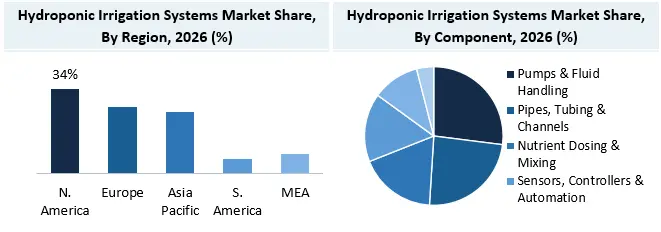
5. Sensors, controllers and dosing equipment outgrow mechanical components. Pumps and fluid handling equipment is the largest component at about 27% of 2026 value, but sensors, controllers and automation hardware grow at XX% and nutrient dosing and mixing equipment at XX%, ahead of pipes, tubing and channels at 9.2%.
6. Retrofit and modernization is the faster deployment route. Retrofit and modernization held about 28% of 2026 value and grows at XX%, against 11.3% for new installations and XX% for replacement installations, as existing greenhouses add automated fertigation and recirculation.
7. Asia Pacific is the fastest-growing region; North America is the largest. North America held about 34% of 2026 value and grows at XX%, Europe held XX% and grows at XX% on its greenhouse base, and Asia Pacific held XX% and grows at 13.4%, lifting its share to about XX% by 2034. The Middle East and Africa grow at XX% on water scarcity and food security investments.
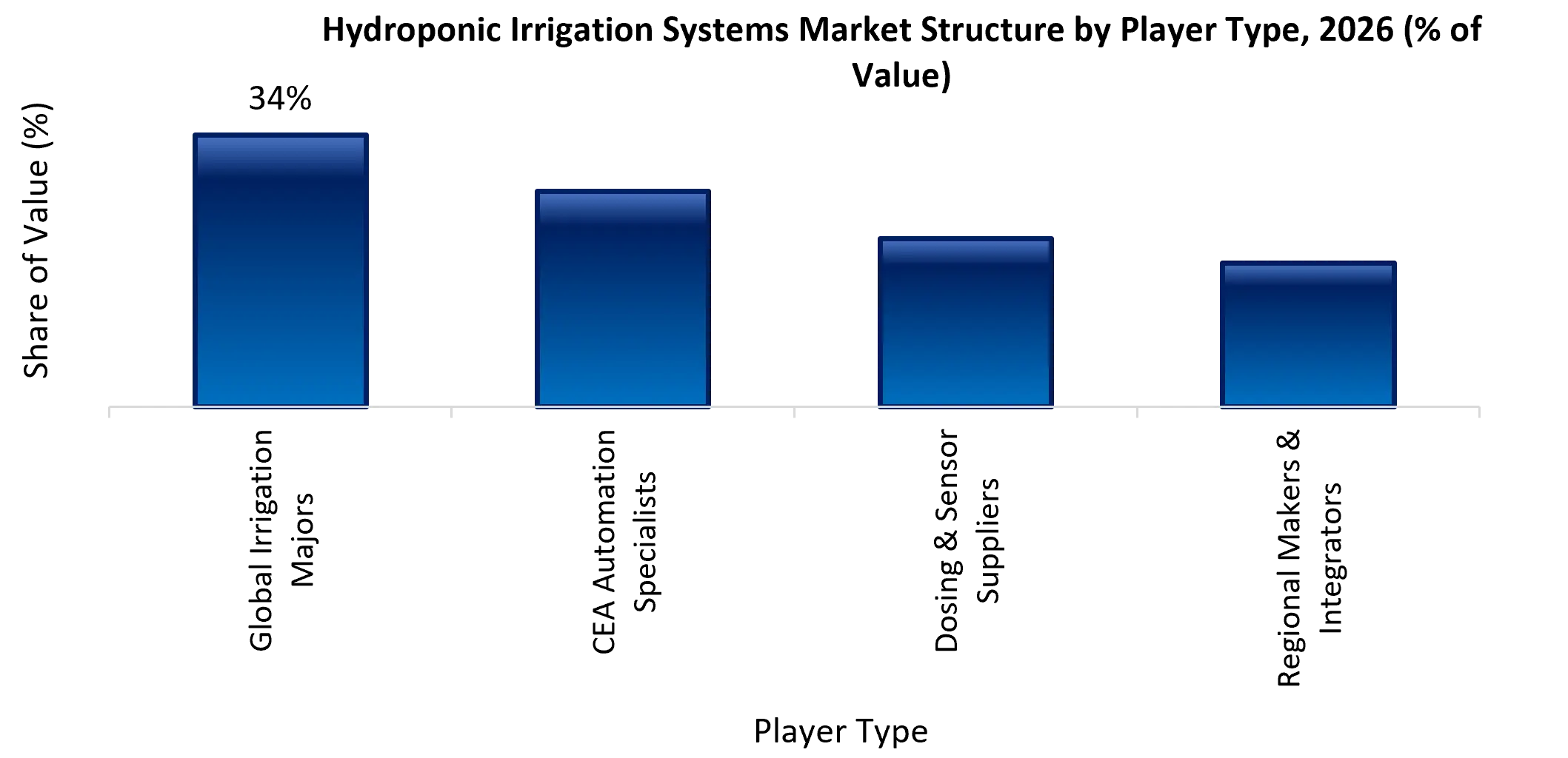
8. The competitive landscape is layered. Global precision irrigation majors, controlled environment agriculture automation specialists, nutrient dosing and sensor manufacturers, regional irrigation companies and greenhouse system integrators compete on water efficiency, dosing accuracy, automation, reliability and service coverage.
Hydroponic Irrigation Systems Market Overview: Industry Landscape, Market Insights and Growth Prospects
This Hydroponic Irrigation Systems Market overview and market synopsis summarises the industry landscape, market insights and market research findings: Hydroponic Irrigation Systems market size reached USD 1.84 Bn in 2026, and market analysis shows industry trends toward automated, sensor-led and water-efficient solutions. Hydroponic Irrigation Systems Market dynamics, market segmentation, key players and the competitive landscape are covered in detail, along with growth prospects, Hydroponic Irrigation Systems Market opportunities, challenges, emerging markets and the market outlook to 2034.
Hydroponic Irrigation Systems Market Trends
1. Rising Adoption of Water-Efficient and Closed-Loop Hydroponic Irrigation: Water scarcity and nutrient-discharge rules are pushing growers to recirculating systems that capture, filter and reuse drainage. These closed-loop designs support Hydroponic Irrigation Systems Market demand, installations and revenue growth in water-efficient hydroponic farming.
2. Shift to Automated Fertigation and AI-Assisted Nutrient Dosing: Growers are replacing manual mixing with automated hydroponic fertigation systems that control pH and electrical conductivity in real time. Orbia Netafim launched its AI-enabled Dosing 5G range in February 2026 and introduced it in India in March 2026, showing how self-learning dosing is moving into mainstream product lines.
3. IoT-Based Hydroponic Irrigation and Smart Controllers: Cloud-connected controllers, wireless sensors and remote dashboards turn irrigation into a data service. Netafim’s GrowSphere FLEX controller, launched in August 2026 for smallholder and mid-sized farms, shows smart hydroponic irrigation systems moving beyond large greenhouses.
4. Commercial Greenhouse and Vertical Farming Expansion: New greenhouse and vertical farm projects need integrated irrigation, climate and lighting control. Multi-layer vertical farming irrigation systems favor compact aeroponic, NFT and DWC designs, which lifts demand for pumps, manifolds, dosing units and monitoring software per facility.
5. Modular, Scalable and Retrofit-Ready Equipment: Suppliers are standardizing modular irrigation skids and plug-and-play dosing units so that growers can expand in stages or upgrade existing sites without rebuilding. Retrofit-ready designs convert one-time equipment sales into upgrade, software and service revenue.
Hydroponic Irrigation Systems Market Drivers: Water Scarcity, Food Security, Controlled Environment Agriculture and Precision Fertigation
Water scarcity and water-efficient farming are the primary demand drivers. Agriculture accounted for 72% of global freshwater withdrawals in 2026, increasing the need for efficient nutrient delivery and water recirculation. Hydroponic systems can reduce water consumption by up to 90% compared with conventional soil cultivation under suitable conditions. Government-supported water conservation and food security initiatives encourage greenhouse and soilless farming investments across the Middle East, Asia Pacific and southern Europe.
Controlled environment agriculture investment converts into equipment orders. Commercial greenhouse expansion, vertical farming and propagation facilities increase demand for engineered irrigation infrastructure. FAO estimates that 1.2 billion people live in agricultural areas facing severe water constraints, strengthening the need for efficient cultivation technologies. The hydroponic systems may use 80–99% less irrigation water than conventional soil-based cultivation, depending on system design and operating conditions. These advantages encourage investment in precision irrigation, nutrient recirculation and greenhouse automation.
Automation, sensors and AI add a commercial case beyond water savings. Automated nutrient dosing, pH sensors, electrical conductivity monitoring and predictive irrigation controls improve nutrient management and operational efficiency. Government agricultural guidance identifies an optimal hydroponic nutrient solution pH range of 5.8–6.5 and an indicative EC range of 1.5–2.5 dS/m, although requirements vary by crop. Virginia Cooperative Extension recommends checking EC and pH 2–3 times weekly in DWC systems, highlighting opportunities for automated monitoring and remote diagnostics.
Hydroponic Irrigation Systems Market Restraints and Challenges: High Initial Investment, Energy Costs, Technical Skills and Maintenance
High initial investment and long payback are the most persistent restraint. Pumps, reservoirs, dosing units, filtration, sensors and controllers, funded together with greenhouse or vertical farm structures, and energy and electricity costs weigh on vertical farm economics. Smaller growers often delay automation, and installation, engineering and commissioning costs raise the total cost of ownership.
Technical skills, clogging and maintenance slow adoption. Recirculating systems must manage emitter clogging, biofilm, pathogen spread and nutrient imbalance, which needs trained operators, filtration and disinfection. Sensor calibration drift, pump wear and electrical faults create downtime risk because a failed cycle can damage a whole crop within hours.
Supply chain, regulation and competition add to Hydroponic Irrigation Systems Market constraints. Plastic resin prices, electronic component supply, import duties and currency movements affect equipment costs, while nutrient-rich wastewater discharge rules and food safety requirements raise compliance costs. Low-cost suppliers and alternative irrigation or substrate-based approaches also pressure pricing, and a lack of common data standards limits interoperability between controllers, sensors and software platforms.
Hydroponic Irrigation Systems Market Dynamics Analysis:
1. Hydroponic Irrigation Systems Market Demand and Supply Gap Analysis: Global agriculture accounts for 72% of freshwater withdrawals, supporting demand for water-efficient hydroponic irrigation systems. Supply constraints include specialized dosing equipment, electronic controllers, sensors and skilled installation capacity, particularly for large commercial greenhouse and vertical farming projects.
2. Consumer Behavior Trends and Preference Evolution: Commercial growers increasingly prioritize automated irrigation, nutrient dosing accuracy and lifecycle costs. Hydroponic systems can reduce water consumption compared with conventional soil-based cultivation under suitable operating conditions, encouraging investment in recirculating systems, while residential buyers prefer compact, app-controlled solutions.
3. Technological Advancements and Innovation Impact: Hydroponic systems can achieve 80–95% lower water consumption than irrigated field-grown crops under suitable conditions. AI-assisted dosing, IoT controllers, digital twins and variable-speed pumps further support nutrient efficiency, crop uniformity and irrigation automation.
4. Regulatory Influences and Regulatory Changes: Agriculture accounts for 72% of global freshwater withdrawals. Water conservation policies, nutrient-rich wastewater discharge limits, food safety requirements and electrical equipment certifications are influencing hydroponic irrigation system design and compliance investments.
5. Competitive Forces and Market Forces: Hydroponic irrigation suppliers compete on equipment pricing, dosing precision, water efficiency and technical support. With hydroponic cultivation capable of reducing water consumption by 80–95% under suitable conditions, manufacturers increasingly differentiate products through recirculation technology, automated monitoring and lifecycle cost optimization.
6. Environmental Factors and Socioeconomic Influences: FAO reports that renewable freshwater availability per person declined 7% over the past decade, while UN projections indicate 67% of the global population will live in urban areas by 2050. These pressures support water-efficient hydroponic farming, urban agriculture and compact irrigation system adoption.
7. Competitive Landscape Shifts, Market Fluctuation Analysis and External Market Influences: Ownership changes among irrigation majors, partnerships with hydroponic retailers and new smart controller launches are shifting the competitive landscape, while energy prices, interest rates and farm funding cycles drive market fluctuation.
8. Consumer Preferences Evolution and Regulatory Changes: Growers now ask for water-use and nutrient-use data, remote monitoring and verified performance, which aligns product development with tightening agricultural water and wastewater regulation.
Hydroponic Irrigation Systems Consumer Scenario: Grower Behaviour, Procurement Patterns and Food Retail Expectations
The consumer of a hydroponic irrigation system is the grower, not the shopper: commercial greenhouse operators, vertical farming companies, nurseries, institutions and home growers buy, install and maintain it, while retailers, food service buyers and consumers shape demand through expectations of local, fresh, pesticide-light produce. Understanding this consumer scenario, customer profiling and purchasing behaviour is essential for market entry and market strategies.
1. Commercial Greenhouse Operators Dominate Buying: Commercial greenhouses accounted for 52% of 2026 market value, driven by demand for automated fertigation, filtration and recirculating irrigation systems.
2. Performance-Based Procurement: Growers prioritize dosing accuracy, irrigation uniformity, equipment reliability and technical support.
3. Vertical Farming Prioritizes Automation: Indoor vertical farms accounted for XX% of 2026 market value, with a projected 15.1% CAGR, supporting demand for NFT, DWC and aeroponic systems.
4. Nurseries Focus on Irrigation Uniformity: Commercial nurseries prioritize consistent nutrient delivery, water quality and disease prevention. Maintaining nutrient solution pH between 5.5 and 6.5 supports effective nutrient availability for many hydroponic crops.
5. Residential Buyers Prefer Convenience: Home growers favor compact hydroponic kits with automated timers and nutrient monitoring. Small-scale systems commonly require nutrient solution replacement every 1–2 weeks, depending on crop and system conditions.
6. Retail Demand Influences Equipment Investment: Year-round demand for fresh produce encourages greenhouse modernization. According to FAO, agriculture accounts for 72% of global freshwater withdrawals, strengthening interest in water-efficient hydroponic irrigation.
7. Retrofit Economics Shape Purchasing Decisions: Growers increasingly upgrade pumps, sensors and dosing controllers instead of replacing complete systems. Automated irrigation supports continuous 24-hour monitoring of nutrient delivery, pH and electrical conductivity, improving operational control and maintenance planning.
Hydroponic Irrigation Systems Market Innovations:
AI-assisted nutrient dosing, IoT-based hydroponic irrigation, real-time pH and electrical conductivity sensing, closed-loop water recycling and digital twin-based farm optimization are redefining product roadmaps. Orbia Netafim’s Dosing 5G range, launched in February 2026, uses self-learning algorithms to automate nutrient delivery, and its GrowSphere FLEX controller, launched in August 2026, brings cloud-based insights and crop-stage recommendations to smaller farms.
Hydroponic irrigation equipment is governed by agricultural irrigation equipment standards, material safety and chemical compatibility rules, electrical safety certification for pumps and controllers, agricultural water management and food safety requirements, and environmental limits on nutrient-rich wastewater discharge.
Hydroponic Nutrient Delivery Technology Landscape:
Technology defines how nutrients reach the root zone. Hydroponic drip irrigation systems deliver measured doses through emitters to substrate-grown crops and can run as open-drain or recirculating systems. Nutrient film technique passes a thin film of solution through sloped channels for leafy greens and herbs. Flood-and-drain systems periodically flood a tray and drain it back to a reservoir, deep water culture suspends roots in an aerated nutrient reservoir, and aeroponic systems spray or mist roots in air for propagation and vertical farming.
Drip and NFT Systems: Emitters, Nutrient Films, Recirculation and Maintenance
Drip irrigation held the largest share of the 2026 market because it suits substrate-based fruiting crops such as tomatoes, cucumbers, peppers and berries in commercial greenhouses. Pressure-compensated emitters, filtration and flushing routines protect uniformity and limit clogging, and recirculating drip designs collect and treat drainage for reuse. NFT remains important for leafy greens and herbs because of its low water use, simple channels and low substrate cost, but it depends on continuous pump operation and reliable power backup.
Fully automated drip and NFT lines combine dosing pumps, injectors, EC and pH sensors and controllers that adjust recipes by crop stage. Integration with greenhouse climate control lets growers align irrigation with light and temperature, and this combination of automation and recirculation is a major upgrade pipeline for existing greenhouses through 2034.
Flood-and-Drain, Deep Water Culture and Aeroponic Systems: Root-Zone Oxygenation, Spray Cycles and Vertical Farm Fit
Flood-and-drain systems support nurseries, propagation and commercial horticulture through automated nutrient circulation. According to the USDA's Hydroponic Task Force, substrate-based hydroponic systems may require 10–30% excess irrigation for salt management. Deep Water Culture (DWC) systems require continuous aeration and nutrient monitoring, with the University of Florida recommending a pH range of 5.5–6.5 and nutrient solution replacement every 1–2 weeks for small-scale systems. Aeroponic nutrient delivery uses controlled misting to improve root oxygen exposure and water efficiency, supporting adoption in multi-layer vertical farming. However, filtration, nozzle maintenance and reliable pumping remain essential for operational performance.
Global Hydroponic Irrigation Systems Market Segment Analysis
By offering, hardware led with about 72% of 2026 value, followed by services at XX% and software at XX%. Software is the fastest-growing offering at 16.8% CAGR, ahead of services at XX% and hardware at XX%, as growers add analytics, remote monitoring and maintenance contracts to installed equipment.
By nutrient delivery technology, drip irrigation systems led the Hydroponic Irrigation Systems Market with about 38% of 2026 value, supported by their widespread use in commercial greenhouses and substrate-based cultivation. Nutrient Film Technique (NFT) systems use a shallow, continuously circulating nutrient solution, while Deep Water Culture (DWC) systems require continuous root aeration and nutrient monitoring. Flood-and-drain systems operate through timed irrigation cycles, whereas aeroponic systems use low-pressure and high-pressure misting technologies. Hydroponic nutrient solutions typically operate within a pH range of 5.5–6.5, while dissolved oxygen levels of 5–8 mg/L support root health in water-based cultivation systems.
By automation level, semi-automated systems led with about 41% of 2026 value, followed by fully automated systems at XX% and manual and non-automated systems at XX%. Fully automated systems grow fastest at 15.2% CAGR, against XX% for semi-automated systems, while manual systems grow at only XX% as growers migrate to automated control.
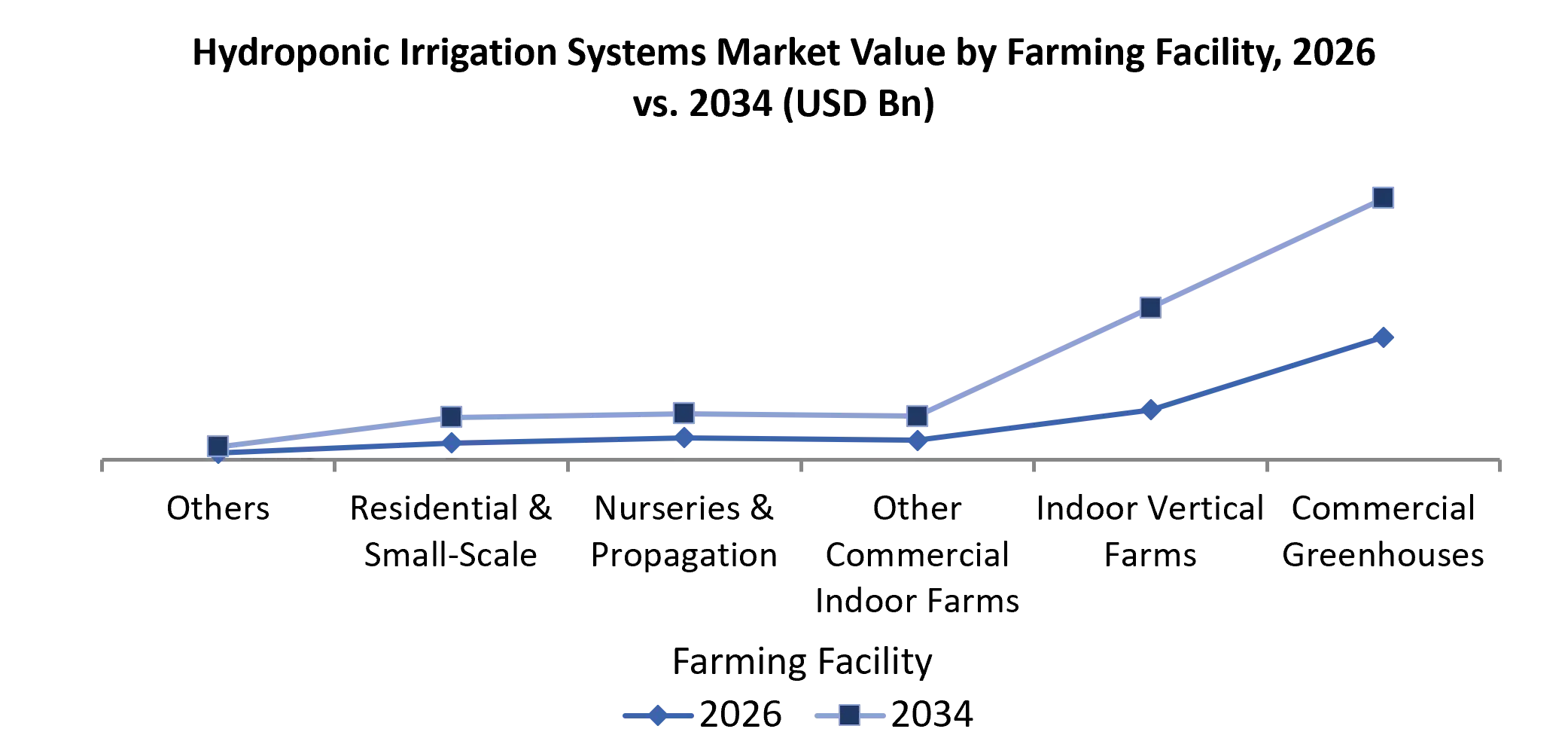
By farming facility and application, commercial greenhouses led with about 52% of 2026 value, followed by indoor vertical farms at XX%, commercial nurseries and propagation facilities at 9%, other commercial indoor hydroponic farms at 8%, residential, educational and small-scale non-commercial installations at XX% and others at XX%. Indoor vertical farms are expected to register the fastest growth at 15.1% CAGR, followed by residential and small-scale installations at XX%, other commercial indoor farms at 11.0%, commercial greenhouses at 10.4% and nurseries at XX%.
Hydroponic Irrigation Systems Market Regional Outlook:
The North America Hydroponic Irrigation Systems Market held the largest share, about 34% of global value in 2026, and grows at about XX% CAGR through 2034. Commercial greenhouse production, indoor vertical farming, a mature hydroponic retail and distribution network and retrofit demand support regional growth, and the United States, Canada and Mexico each contribute greenhouse capacity. The Asia Pacific Hydroponic Irrigation Systems Market held about 25% of 2026 value and is expected to be the fastest-growing region at a 13.4% CAGR, rising to about XX% of value by 2034. China, Japan, India, South Korea, Australia and Singapore are expanding controlled environment agriculture, and in March 2026 Netafim introduced its fifth-generation AI-enabled dosing systems in India, a sign of rising precision fertigation demand.
Europe held about 27% of 2026 value and is expected to grow at about 10.0% CAGR. The Netherlands, Germany, the United Kingdom, France, Spain and Italy lead demand through greenhouse horticulture, water efficiency rules and precision irrigation adoption, and Dutch automation and engineering firms export systems worldwide. The Middle East and Africa held about 8% of 2026 value and grow at 12.8% on water scarcity, food security and large greenhouse projects in the United Arab Emirates, Saudi Arabia, Israel and Egypt, while South America held about 6% and grows at about 11.0% on greenhouse horticulture in Brazil, Chile, Colombia and Argentina. Regional market development, local consumer behavior and regional competitive landscape differ by water cost, energy price and grower skill.
| Region | 2026 share | 2026 (USD Bn) | 2034 (USD Bn) | CAGR | Notes |
| North America | 34.0% | XX | XX | 10.4% | US, Canada and Mexico greenhouse and vertical farming; mature retail channels, retrofit and software-led upgrades |
| Europe | XX% | XX | XX | XX% | Netherlands, Germany, UK, France, Spain and Italy; greenhouse horticulture, water efficiency and precision irrigation |
| Asia Pacific | XX% | XX | XX | XX% | China, Japan, India, South Korea, Australia and Singapore; largest growth, new controlled environment agriculture projects |
| Middle East & Africa | XX% | XX | XX | XX% | UAE, Saudi Arabia, Israel, Turkey, Egypt and South Africa; water scarcity, food security and greenhouse investments |
| South America | XX% | XX | XX | 11.0% | Brazil leads; greenhouse horticulture, Argentina, Chile and Colombia adoption of fertigation and drip systems |
Leading Hydroponic Irrigation Systems Manufacturers:
The Hydroponic Irrigation Systems Market competitive landscape includes precision irrigation manufacturers, automation specialists, nutrient dosing providers and distributors. Netafim, Rivulis and Jain Irrigation supply drip irrigation and fertigation equipment. Priva, Ridder, Autogrow and Growlink specialize in automated irrigation controls and monitoring software. Dosatron and Bluelab provide nutrient dosing and water quality solutions. Hydrofarm, Hort Americas and Royal Brinkman strengthen distribution, while regional manufacturers support turnkey installations and technical services.
Global Hydroponic Irrigation Systems Market Recent Developments
| Date | Company | Key Development | Impact on Hydroponic Irrigation Systems Market |
| Feb 26 | Orbia Netafim | Launched the Dosing 5G fertigation range, which uses self-learning AI to automate nutrient delivery, and integrated it with the GrowSphere digital farming platform. | Moves AI-assisted nutrient dosing into mainstream products and raises automation expectations for hydroponic fertigation systems. |
| Feb 26 | GrowGeneration / Netafim | Announced a co-marketing and sales collaboration at Indoor Ag-Con covering integrated fertigation, substrate and nutrient programs, grower workshops and irrigation design consultations. | Shows how retail and equipment partnerships shape access to commercial hydroponic irrigation systems. |
| Mar 26 | Netafim India | Unveiled fifth-generation AI-enabled automated dosing systems in New Delhi to improve input efficiency and crop productivity. | Extends precision fertigation to Asia Pacific growers and supports the region’s faster growth. |
| Aug 26 | Orbia Netafim | Launched GrowSphere FLEX, a smart irrigation and fertigation controller for smallholder and mid-sized farms with cloud insights and crop-stage recommendations. | Widens the addressable base for smart and IoT-based irrigation beyond large greenhouses. |
Hydroponic Irrigation Systems Competitive Landscape Analysis:
1. Competitor Analysis, Company Revenue and Hydroponic Irrigation Systems Market Share: The report evaluates leading manufacturers based on hydroponic irrigation revenue, net sales, market share, profitability, R&D investments, financial performance and competitive positioning using company filings and industry data.
2. Competitor Profiling, Industry Rivals Examination and Competitive Positioning: Competitive analysis examines global irrigation majors, controlled environment automation specialists, dosing and sensor suppliers and regional manufacturers, focusing on nutrient delivery technology, automation, certification, product innovation, pricing strategy and competitive advantage.
3. Rivalry Intensity, Market Rivalry Intensity and Industry Player Dynamics: Competition is shaped by water efficiency claims, dosing accuracy, software capability, service networks, regional manufacturing and distribution reach, while low-cost suppliers and new smart controller launches increase rivalry among suppliers.
4. Market Player Strategies, Competitive Benchmark Analysis and Rival Market Share: Leading companies strengthen positions through smart irrigation launches, partnerships with greenhouse operators and retailers, localized manufacturing, acquisitions and portfolio expansion, while benchmarking compares market share, capabilities, differentiation and revenue growth.
 5. Strategic Analysis and Competitive Ecosystem: The competitive ecosystem includes multinational irrigation groups, specialized hydroponic technology providers, component suppliers, system integrators and distributors competing through pricing, technology licensing, strategic alliances, product innovation and expansion into emerging controlled environment agriculture markets.
Global Hydroponic Irrigation Systems Market Scope:Inquire before buying
| Global Hydroponic Irrigation Systems Market | |||
|---|---|---|---|
| Report Coverage | Details | ||
| Base Year: | 2026 | Forecast Period: | 2027-2034 |
| Historical Data: | 2021 to 2026 | Market Size in 2026: | USD 1.84 Billion |
| Forecast Period 2027 to 2034 CAGR: | 11.4% | Market Size in 2034: | USD 4.36 Billion |
| Hydroponic Irrigation Systems Market Segments Covered: | By Offering | Hardware Software Services |
|
| By Nutrient Delivery Technology | Drip Irrigation Systems Nutrient Film Technique (NFT) Systems Flood-and-Drain (Ebb and Flow) Systems Deep Water Culture (DWC) Systems Aeroponic Spray and Misting Systems Others |
||
| By Component | Pumps and Fluid Handling Equipment Pipes, Tubing, Channels and Distribution Equipment Nutrient Dosing and Mixing Equipment Filtration, Disinfection and Water Treatment Equipment Sensors, Controllers and Automation Hardware Others |
||
| By Automation Level | Manual and Non-Automated Systems Semi-Automated Systems Fully Automated Systems |
||
| By Farming Facility / Application | Commercial Greenhouses Indoor Vertical Farms Other Commercial Indoor Hydroponic Farms Commercial Nurseries and Propagation Facilities Residential, Educational and Small-Scale Non-Commercial Installations Others |
||
| By Deployment Type | New Installations Retrofit and Modernization Replacement Installations |
||
Global Hydroponic Irrigation Systems Market, By Region
North America (United States, Canada, Mexico)
Europe (Germany, United Kingdom, France, Italy, Spain, Netherlands, Switzerland, Sweden, Denmark, Belgium, Austria, Poland, Rest of Europe)
Asia Pacific (China, Japan, India, South Korea, Australia, New Zealand, Singapore, Taiwan, Thailand, Malaysia, Indonesia, Vietnam, Philippines, Rest of Asia Pacific)
Middle East and Africa (United Arab Emirates, Saudi Arabia, Israel, Turkey, South Africa, United Arab Emirates, Saudi Arabia, Israel, Turkey, Egypt, Nigeria, Algeria, Morocco, Angola, Kenya, Ghana, Rest of Middle East and Africa)
South America (Brazil, Argentina, Chile, Colombia, Rest of South America)
Key players/Competitors profiles covered in the Hydroponic Irrigation Systems Market report from a strategic perspective
North America
1. Hawthorne Gardening Company (United States)
2. Hydrofarm Holdings Group, Inc. (United States)
3. American Hydroponics (United States)
4. CropKing Incorporated (United States)
5. AmHydro (United States)
6. Netafim USA (United States)
7. Dosatron International (United States Operations)
8. Dramm Corporation (United States)
9. Argus Control Systems Ltd. (Canada)
10. Hort Americas (United States)
Europe
11. Priva (Netherlands)
12. Ridder (Netherlands)
13. Van der Ende Group (Netherlands)
14. Royal Brinkman (Netherlands)
15. Hortimax (Netherlands)
16. Autogrow (European Market Presence)
17. Growlink (European Market Presence)
18. Dosatron International (France)
19. Irritec S.p.A. (Italy)
20. Lainco S.A. (Spain)
Asia Pacific
21. Jain Irrigation Systems Limited (India)
22. Mahindra EPC Irrigation Limited (India)
23. Automat Industries (India)
24. Future Farms (India)
25. UrbanKisaan (India)
26. NetaFim India (India)
27. Chinadrip Irrigation Equipment Co., Ltd. (China)
28. Senmatic (Asia Pacific Market Presence)
29. Galcon (Asia Pacific Market Presence)
30. Bluelab Corporation (New Zealand)
31. Autogrow (New Zealand)
32. Nutrifield (Australia)
33. Holman Industries (Australia)
34. NaanDanJain Irrigation (Asia Pacific Market Presence)
Middle East & Africa
35. Netafim (Israel)
36. Rivulis (Israel)
37. Metzer (Israel)
38. Talgil Computing & Control Ltd. (Israel)
39. Pure Harvest Smart Farms (United Arab Emirates)
40. Red Sea Farms (Saudi Arabia)
South America
41. Netafim Brazil (Brazil)
42. Rivulis Brazil (Brazil)
43. Irritec Brazil (Brazil)
44. Jain Irrigation South America Operations (South America)
Others
Global Hydroponic Irrigation Systems Market FAQs: Frequently Asked Questions
1. What is the Hydroponic Irrigation Systems Market Size?
Ans. MMR values the global Hydroponic Irrigation Systems Market at USD 1.84 Bn in 2026, with USD 4.36 Bn expected by 2034, at a CAGR of 11.4% during 2027–2034.
2. What Drives Hydroponic Irrigation Systems Market Growth?
Ans. Growth comes from water scarcity, food security programs, commercial greenhouse and vertical farm expansion, automated fertigation and nutrient dosing, IoT-based monitoring, retrofit programs and rising software and service content.
3. Which region and country is the largest Hydroponic Irrigation Systems Market?
Ans. North America held the largest share in 2026, about 34% of value, while Asia Pacific is the fastest-growing region at a XX% CAGR. The United States leads North America, and China, India and Japan lead Asia Pacific demand.
4. Which Hydroponic Irrigation Systems segments are growing fastest?
Ans. Hardware is the largest offering at about 72% of 2026 value, but software grows fastest at XX% CAGR. Drip irrigation leads technologies at XX%, aeroponic systems grow fastest at XX%, fully automated systems grow at 15.2%, and indoor vertical farms lead application growth at XX%.
5. Who are the leading Hydroponic Irrigation Systems manufacturers?
Ans. Leading names include Netafim, Rivulis, Jain Irrigation Systems, Priva, Ridder, Hortimax, Autogrow, Bluelab, Dosatron International, Hydrofarm, Argus Control Systems and Talgil Computing & Control, among others profiled in the report.
6. What is hydroponic fertigation and how does it differ from conventional irrigation?
Ans. Hydroponic fertigation delivers a precisely mixed nutrient solution directly to roots and controls pH and electrical conductivity, usually with recirculation of unused solution. Conventional irrigation waters soil, which buffers nutrients, so hydroponic systems need much tighter dosing and monitoring.
7. What is the Hydroponic Irrigation Systems Market outlook to 2034?
Ans. The market outlook to 2034 is positive, with growth led by Asia Pacific, software, automation, indoor vertical farms and retrofit, and with a large remaining installation pipeline across greenhouses in North America, Europe, the Middle East and emerging economies.